Indietool
Programmatic SEO Strategy: A Complete Guide for 2026
94.74% of keywords receive 10 or fewer monthly searches. A programmatic SEO strategy succeeds by capturing these long-tail combinations at scale, not by chasing only high-volume head terms.
That opportunity comes with a hard constraint: more pages don't automatically produce more search visibility. A compiled analysis of large-scale keyword research reports that 94.74% of keywords in Ahrefs' database receive 10 or fewer monthly searches, while another estimate places long-tail queries at 91.8% of Google searches (Layer3 Labs' analysis of programmatic SEO data). The distribution creates room for directories, marketplaces, comparison tools, and other businesses with enough structured data to serve many distinct intents.
The practical question isn't whether a team can generate thousands of URLs. It's whether every URL deserves to exist. Google's scaled content abuse policy, the rise of AI Overviews, and the widening gap between visibility and clicks have made that distinction central to sustainable execution.
Table of Contents
- What Is Programmatic SEO and Why It Matters Now
- The Google Scaled Content Abuse Policy Shift
- Building the Programmatic SEO Architecture
- Implementing Quality Controls and The Swap Test
- Engineering Crawl Efficiency for Large Datasets
- Rethinking Success Metrics in the AI Overview Era
- Actionable Implementation Checklist for Founders
What Is Programmatic SEO and Why It Matters Now
96.55% of web pages receive zero organic Google traffic. Only 5.7% of newly published pages reach Google's top 10 within a year, according to Layer3 Labs' analysis. Those figures expose the trade-off behind programmatic SEO: publishing more URLs creates more opportunities, but it does not create visibility by itself.
A directory for software tools shows how the model works. One product record can include its category, target audience, platform, pricing model, integrations, launch date, founder description, and alternatives. A publishing system can combine those fields with distinct search intents to produce product pages, category pages, comparison pages, audience pages, and use-case pages.
Programmatic SEO is a scalable publishing system built from structured data, reusable templates, and distinct search intents. The template provides consistency. The underlying data and intent determine whether each page answers a different question or just repeats its neighbors.
The long tail gives this structure commercial value. “Project management software for remote teams” expresses a different need from “open-source project management software for developers,” even when both pages draw from the same catalog. A useful directory maps those differences to real attributes, evidence, and selection criteria. It does not add a location, audience, or feature modifier to the same paragraph and call the result a new page.
Why directories have a structural advantage
Directories start with raw material that many programmatic projects have to create first. Each listing represents an entity, each entity has attributes, and relationships between entities can support navigation, comparisons, and discovery.
Useful page types include:
- Entity pages: A detailed profile covering verified attributes, use cases, integrations, and relevant alternatives.
- Category pages: A curated grouping that explains meaningful distinctions between products instead of displaying names in a list.
- Comparison pages: A structured evaluation of two or more products based on actual differences.
- Audience pages: A collection organized around a target user when the directory has evidence that the products serve that audience.
- Alternative pages: An explanation of how substitutes differ in capabilities, pricing models, or intended use.
Each page should answer a recognizable question and help the visitor complete a task. If changing the product name leaves the copy almost unchanged, the system has produced a keyword shell.
Indexation belongs in the planning stage. A page may be technically published without being selected for Google's index, so teams should understand how indexation works before launching a large URL set.
The scale argument is therefore conditional. Publishing 1,000 useful pages can create meaningful aggregate discovery if those pages serve distinct needs, remain accessible, and receive ongoing maintenance. Page volume alone cannot compensate for thin data, weak differentiation, poor internal links, or outdated listings. Since Google's March 2024 shift toward scaled content abuse enforcement, and with AI Overviews changing how users encounter results, programmatic sites also need to assess visibility, qualified visits, assisted discovery, and completed tasks, not clicks alone.
The Google Scaled Content Abuse Policy Shift
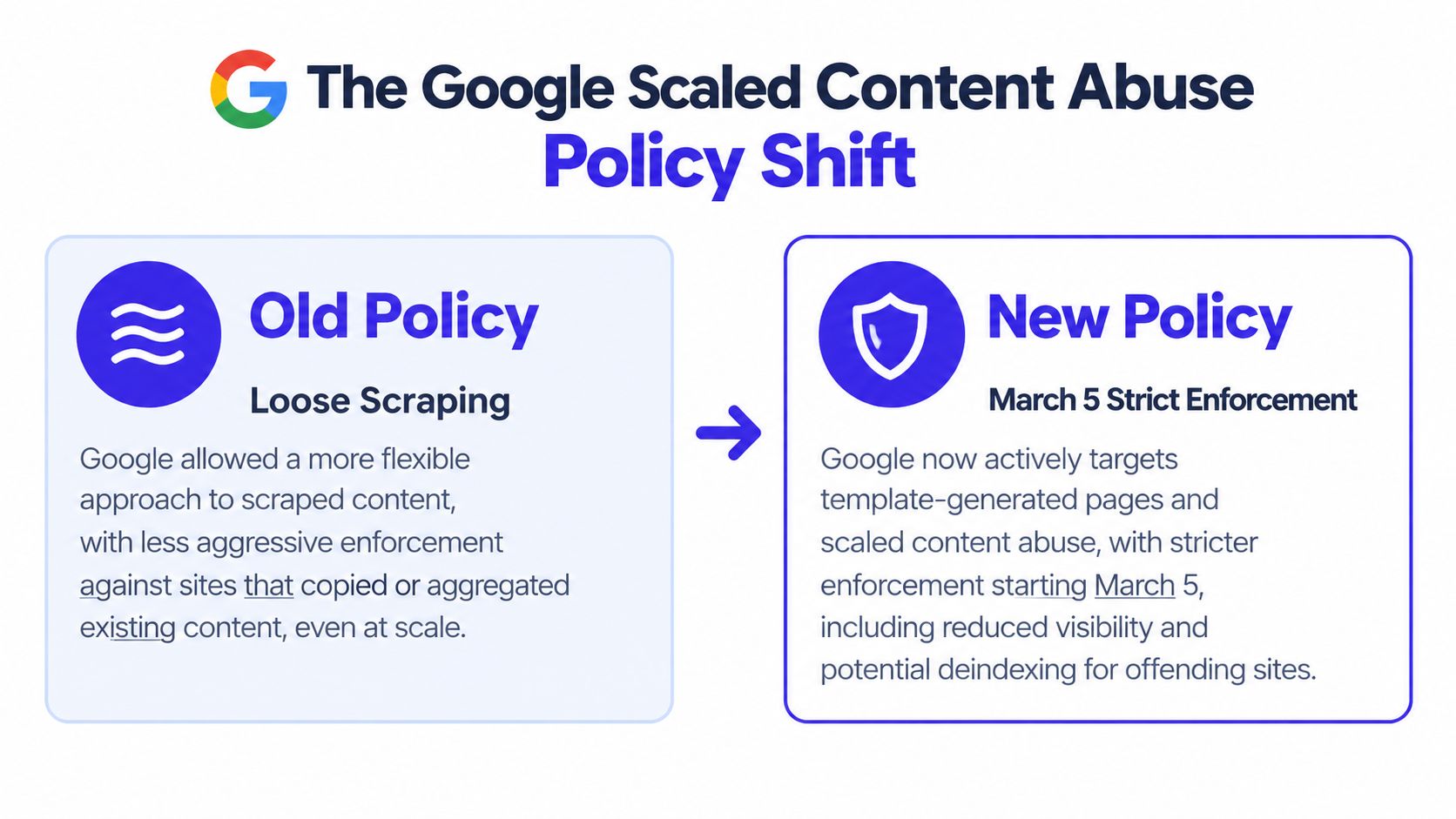
On March 5, 2024, Google introduced its scaled content abuse policy. The important change wasn't a simple ban on machine-written text. Google defined abuse around the purpose of producing many pages, specifically whether the pages primarily manipulate rankings instead of helping users. The policy applies whether content is created by automation, humans, or a combination of both (Google's March 2024 spam policy announcement).
That shifted the operating question from “Was AI involved?” to “What value does this page add?” A human can produce scaled abuse. An automated system can publish valuable pages. The production method is relevant, but it isn't the decisive test.
What Google treats as low value
Google's examples include mass-produced pages with little original information, scraped or lightly transformed material, keyword-focused pages that make little sense, and combinations of existing webpages that add no user value. A template that swaps a city, product, or audience label while leaving the underlying answer unchanged sits close to this risk boundary.
The distinction matters for directory operators. Aggregating listings can be useful if the directory verifies information, adds meaningful filters, explains category differences, provides comparisons, and gives visitors a credible way to evaluate the entries. Reproducing a source feed inside a decorative template adds much less value.
Practical rule: Every generated URL needs a defensible search purpose, differentiated data, useful navigation, and a user experience that makes sense without the search keyword.
This policy raised the quality threshold for programmatic SEO. The difficult work is no longer creating a rendering pipeline. It's designing a data model that produces distinct answers, rejecting page types that rely on superficial variation, and maintaining information after publication.
Google's spam policies documentation makes the broader principle clear: scaled production isn't the violation by itself. The risk appears when scale becomes the primary mechanism and user benefit becomes an afterthought. Teams should therefore treat quality as a publishing gate, not a copy-editing step applied after thousands of pages are live.
Building the Programmatic SEO Architecture
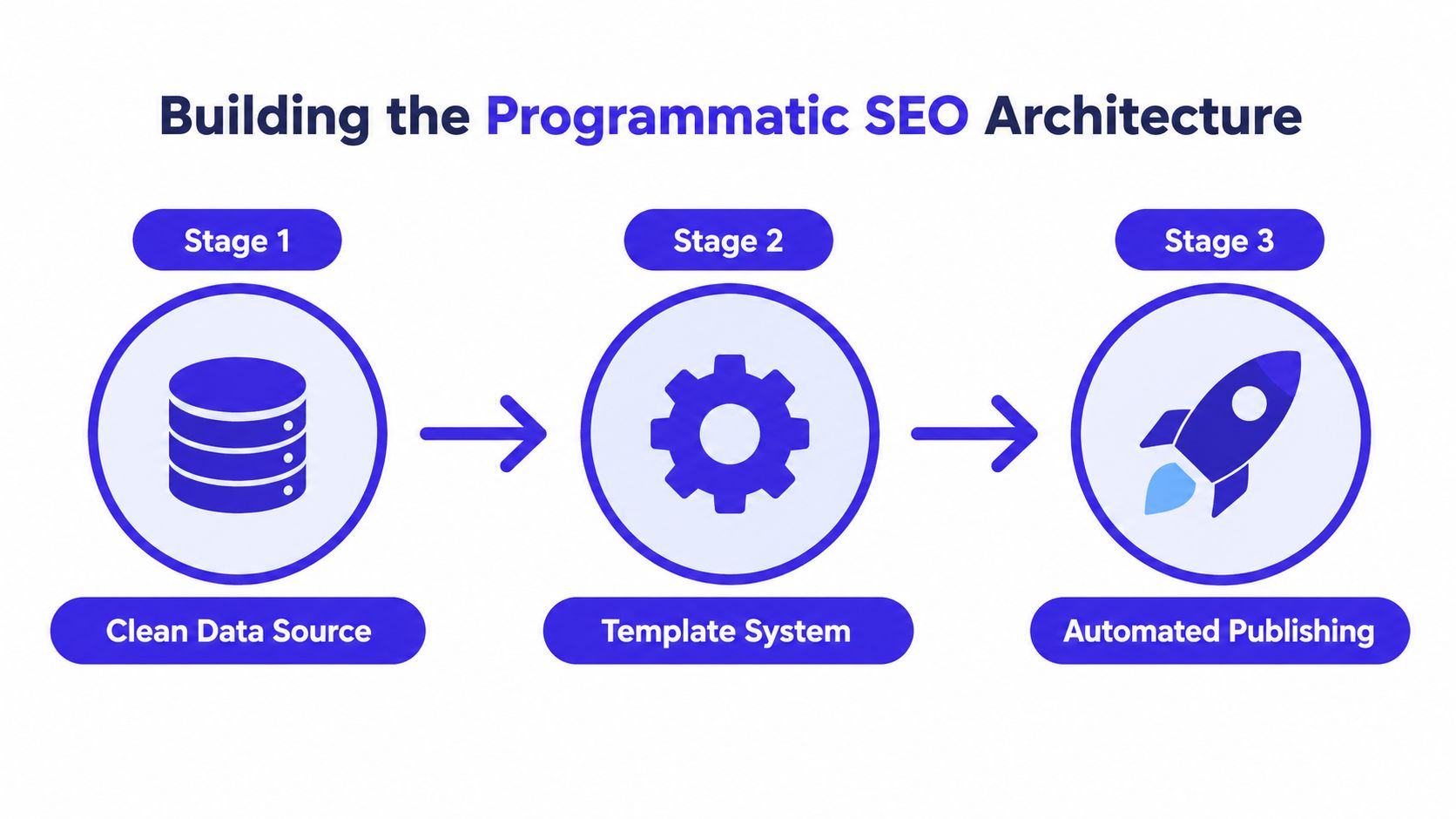
A durable system has three layers: a clean data source, a template system, and a controlled publishing process. If any layer is weak, the output becomes difficult to trust. A polished template can't compensate for incomplete product attributes, and accurate data can't help users if pages are buried behind chaotic URLs.
Start with an entity schema
For a directory, define the fields that make one listing meaningfully different from another. Useful fields can include:
- Identity: Product name, official URL, founder-provided description, and primary category.
- Commercial context: Pricing model, free or paid availability, and the type of buyer it serves.
- Product attributes: Platform, integrations, core features, and supported workflows.
- Audience signals: Role, company type, skill level, or use case.
- Freshness fields: Launch date, update history, and a clear indication of when information was last checked.
The schema should influence what pages you permit. If an alternatives page has no reliable way to compare products, don't publish it merely because the URL pattern is easy to generate.
Make the template expose differences
A strong template doesn't hide the data behind interchangeable prose. It turns meaningful fields into visible comparisons, summaries, filters, and navigation. Product pages can show supported platforms and integrations. Category pages can group entries by relevant attributes. Comparison pages can explain where two products overlap and where they diverge.
Use the swap test before publishing. Replace one listing with another and read both pages without looking at the URL. If the primary content remains substantively identical, the template needs a stronger data layer or the page type should be removed.
Keep URLs and links understandable
Use clean, static patterns that describe the entity or intent. Build a hierarchy in which category hubs link to relevant listings, listings link to related categories and alternatives, and comparison pages connect back to the entities they evaluate. This structure helps visitors browse and gives crawlers a predictable path through the catalog.
Teams building these systems can also consult the FindClout programmatic SEO guide for another practical perspective on connecting data, generation, and publishing workflows. The resource is most useful when treated as implementation context, not as a substitute for deciding whether a page has enough unique value.
Implementing Quality Controls and The Swap Test
The swap test is deliberately simple. Take a published page, replace its subject with another entity from the same collection, and ask whether the result still makes sense. If only the name, title, and a few keywords change, the page probably depends on variable substitution rather than genuine differentiation.
Compare two approaches:
| Thin template generation | Quality-controlled publishing |
|---|---|
| Changes a keyword or entity name | Changes the underlying facts and user task |
| Reuses the same description across pages | Uses verified attributes specific to each entity |
| Publishes every possible combination | Rejects combinations without a defensible intent |
| Measures success by URL count | Measures indexation, impressions, clicks, and conversions by cohort |
| Leaves weak pages live indefinitely | Improves, consolidates, or excludes weak pages |
The second approach requires more preparation and produces fewer eligible URLs. That trade-off is healthy. A smaller set of pages with real data can support stronger navigation and a clearer reputation than a much larger set of near-duplicates.
Build a publishing gate
Before a page enters the CMS, validate several conditions:
- Data completeness: Required fields exist and come from a source the team can verify.
- Intent clarity: The page answers a specific query or supports a recognizable decision.
- Differentiation: The content changes materially when the entity changes.
- Navigation value: The page links to relevant hubs, related entities, and useful alternatives.
- Indexation decision: The team has a reason to index the URL rather than treating indexation as automatic.
Monitoring should continue after publication. Track the indexed-to-published ratio, impressions per URL cohort, organic clicks per page cohort, and the share of pages receiving impressions within 30 to 60 days. These metrics are operational signals, not proof that a page is good, but they help reveal patterns across templates.
A cohort with no impressions, weak internal links, or duplicated primary content needs a decision. Improve the data, consolidate the page, or exclude it from indexing. Keeping every weak URL live because it might eventually rank turns the publishing system into a storage system for unresolved quality problems.
Engineering Crawl Efficiency for Large Datasets
Large directories can lose visibility before content quality becomes the immediate issue. Google's crawling activity reflects both crawl capacity, the rate a server can sustain, and crawl demand, which is influenced by page importance, popularity, freshness, and perceived value. A site that makes low-value URLs easier to discover than important listings creates its own bottleneck.
A directory distributing listings across more than 1,210 index, category, and alternatives pages needs a deliberate discovery model (Bugviso's explanation of crawl budget). The goal isn't to make every URL equally prominent. It's to make priority pages easy to find and duplicate variants difficult to mistake for primary destinations.
Reduce URL entropy
Use static URL patterns for core page types. Keep filters, sorting states, tracking parameters, and duplicate category combinations from creating uncontrolled crawl paths. If a filter produces a useful, distinct search landing page, give it a clear canonical strategy and a reason to exist. If it only changes presentation order, don't let it become an indexable URL by default.
Your XML sitemap should contain only canonical, indexable URLs. Accurate lastmod values should reflect meaningful content changes rather than routine deployments. Hub pages should link directly to important detail pages, while related links should be curated around actual relevance instead of generated indiscriminately.
Inspect what bots actually request
Use Google Search Console's Crawl Stats report and server logs to examine requests, response times, status codes, and the proportion of crawls reaching priority listing pages. Look for a mismatch between crawler activity and business value. Repeated requests for parameter variations, redirects, or thin category combinations indicate that the system is spending attention in the wrong places.
The response isn't always more server capacity. Canonicalization, selective noindexing, appropriate robots controls, and stronger internal links can reduce waste. Fast responses still matter, but speed won't make a duplicate page valuable.
For a broader explanation of discovery and crawl behavior, see Google crawling and how it works. The operational principle is straightforward: publication can make a URL available, but efficient crawl paths and unique value give it a better chance of being discovered and evaluated.
Rethinking Success Metrics in the AI Overview Era
A top organic position no longer guarantees a visit. In its December 2025 analysis, Ahrefs reported that keywords with AI Overviews had a 58% lower average click-through rate for the top-ranking page than comparable results without that feature (Ahrefs' analysis of AI Overviews and clicks). That finding changes the commercial evaluation of programmatic pages, especially those built around questions that Google can answer directly in the results.

A page can still matter when it doesn't receive the click you expected. It may provide facts that an AI system cites, introduce a brand to a researcher, support a branded search later, or help a visitor who visits the site directly after recognizing the entity elsewhere. The right investment depends on the intent behind the page, not just its position.
Optimize for more than sessions
For a directory, durable page value can come from several outcomes:
- Citation-worthy information: Verified product attributes, clear entity descriptions, and structured comparisons give systems something specific to reference.
- Branded discovery: A user may remember a product or directory after seeing it in search, even without an immediate visit.
- Direct navigation: Entity pages can become destinations for people comparing options or returning to a known listing.
- Referral quality: A smaller number of visits can be commercially useful when visitors have strong product or category intent.
- Assisted conversion: A page may influence a signup, submission, or purchase that occurs through another channel.
Track impressions, AI-related visibility where available, branded searches, referral clicks, signups, and assisted conversions separately. Don't compress all of those outcomes into sessions. A high-volume informational page may be less valuable than a lower-volume comparison page if the latter sends visitors who are ready to evaluate products.
A page designed for generative search should still satisfy a human. Generative engine optimization guidance can help teams think about entity clarity and citation context, but it shouldn't lead to vague copy written only for machine extraction. The strongest foundation remains specific, maintained information that answers a real user need.
This short video can provide additional context for teams adapting search measurement to AI-mediated results:
The practical shift is from “How many pages rank?” to “What useful outcome does each page create?” Some pages should earn referral traffic. Others should strengthen entity discovery, support comparisons, or supply facts that travel beyond the traditional results page.
Actionable Implementation Checklist for Founders
Founders don't need to launch a massive page set to test a programmatic SEO strategy. They need a reliable data model, a narrow page type, and enough feedback to identify whether the system produces different answers.
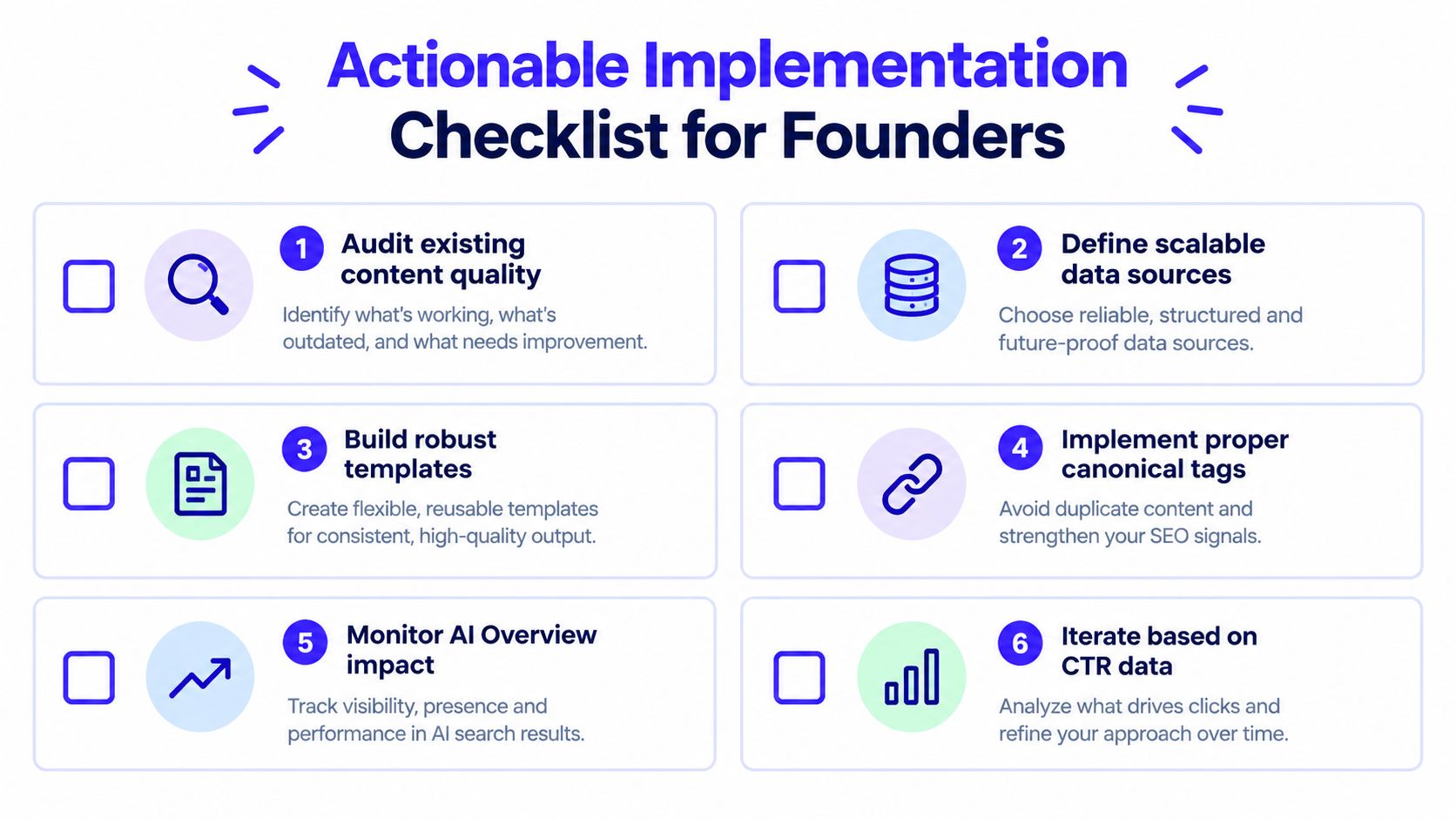
1. Audit the content you already have
Export your existing page types and inspect representative examples from each group. Look for repeated introductions, interchangeable descriptions, empty attribute fields, weak internal links, and URLs that exist only because a keyword combination was available.
Don't start by rewriting every page. First identify which templates have a viable data layer and which ones can't become useful without a different product or research process.
2. Define scalable data sources
List every field required to make a page distinct. Mark each field as verified, founder-provided, user-submitted, derived from a reliable source, or missing. A page type that depends on fields you can't consistently populate shouldn't enter automated publishing.
For a directory, that might mean collecting platform support, integrations, pricing context, target users, use cases, founder descriptions, and alternatives. The important question is whether those fields change the visitor's decision.
3. Build and challenge the template
Write the page structure around the decision the user needs to make. Then run the swap test with several entities. Ask a reviewer who didn't build the template to explain how the pages differ. If the answer is “mostly the name and category,” redesign the data presentation before publishing.
4. Set canonical and indexing rules
Define which page types can be indexed, which variants should canonicalize to a primary URL, and which filters should remain out of search. Generate sitemaps from those rules rather than submitting every stored record.
5. Monitor AI Overview impact
Separate impressions from clicks and examine which page types appear to support branded discovery, citations, referrals, or conversions. A decline in clicks doesn't automatically mean the content failed, but it does require a closer look at query intent and business value.
6. Iterate from cohort data
Review indexed-to-published ratios, impressions per URL cohort, clicks by page type, and pages that remain invisible after publication. Improve pages with a realistic path to differentiation. Consolidate or exclude pages that can't earn inclusion.
Build the smallest page system that proves the data is useful, then expand only the page types that pass the quality and measurement checks.
For founders launching a directory or product catalog, this approach also keeps engineering focused. The team can prioritize structured submissions, clear entity pages, canonical URLs, and meaningful relationships before investing in elaborate generation logic. Automation should reduce repetitive work, not remove editorial judgment.
The most resilient programmatic sites behave like products. Each page has a user task, a data layer that makes it distinct, and a measurement plan that shows whether it helped. That standard is more demanding than publishing keyword variants, but it creates an asset the team can maintain as search interfaces continue to change.
IndieTool helps indie founders distribute app and startup listings through automated product showcase pages, directory categories, alternatives pages, and founder-facing analytics. If you're building a programmatic SEO strategy around a real product catalog, visit IndieTool to review its listing and launch options.