Indietool
What Is Generative Engine Optimization and Why It Matters
Maya launched a clean CRM for solo consultants. Her landing page ranks on page one for “simple CRM for freelancers,” organic traffic is climbing, and the product finally feels discoverable. Then she asks ChatGPT the same question her prospects ask. The answer recommends several tools, but Maya's CRM isn't mentioned. She tries Perplexity, and gets a similar result.
Nothing is necessarily broken on her website. A strong Google ranking and a strong position inside an AI-generated answer are different visibility outcomes. Google presents a list of pages for the searcher to evaluate. An answer engine gathers information, selects sources, and writes a response that may mention only a small part of what it found.
That gap is the reason founders are asking what is generative engine optimization, and whether it requires abandoning SEO. It doesn't. GEO adds a distribution and measurement layer for a search environment where buyers increasingly ask AI tools for shortlists, comparisons, and recommendations.
Table of Contents
- The Moment You Realize SEO Alone Is Not Enough
- What Generative Engine Optimization Means
- Generative Engine Optimization vs Traditional SEO
- Core Tactics That Move AI Citations
- Why AI Search Behavior Changes the Stakes
- Measuring GEO Without Losing Your Mind
- A 30 60 90 Day GEO Plan for Indie Founders
- The Mindset Shift From Ranking to Being Cited
The Moment You Realize SEO Alone Is Not Enough
Maya's first instinct is to check her rankings again. They're still there. Search Console shows impressions, clicks, and a page-one position. From a traditional SEO perspective, the page is doing its job.
Her prospect's behavior has changed, though. Instead of opening several results, the prospect asks an AI assistant to identify a simple CRM for freelancers, explain the trade-offs, and suggest a practical choice. The assistant doesn't need to show every relevant page. It synthesizes an answer from the material it can retrieve and trust.
That creates two separate paths to visibility:
- The blue-link path: A searcher sees a ranked result, clicks through, and evaluates the website.
- The synthesized-answer path: An AI system combines information from multiple sources and may cite, summarize, or omit a company entirely.
The uncomfortable question: If your ideal customer asks an AI assistant for a recommendation, does your brand appear in the answer, or only in the search results behind it?
A page can satisfy classic ranking requirements and still lack the signals an answer engine uses to describe a product. The model may find clearer explanations elsewhere, encounter more third-party references to a competitor, or fail to understand what the product does.
The practical response isn't to stuff pages with awkward phrases or write for machines at the expense of customers. It's to treat AI visibility as a separate outcome worth observing. You need content that answers questions cleanly, references that reinforce your claims, and a repeatable way to see whether answer engines represent your product accurately.
What Generative Engine Optimization Means
A page can rank well on Google and still disappear from an AI-generated recommendation. Generative Engine Optimization, or GEO, is the practice of improving how often and how accurately your content, product, or brand appears in answers produced by AI-powered search systems. These systems include ChatGPT, Perplexity, Gemini, Google AI Overviews, and other interfaces that synthesize information rather than display only ranked pages.
The academic foundation is unusually clear. In late 2023, researchers from Princeton, Georgia Tech, IIT Delhi, and Niloy Ganguly published GEO: Generative Engine Optimization, presenting GEO as a distinct discipline for generative answer engines. Their controlled experiments found that adding citations, quotations, and statistics could improve source visibility by 30% to 40% on a position-adjusted word-count metric and by 15% to 30% on a subjective impression metric.
Those results do not mean that inserting statistics will produce the same outcome for every page. They show that how information is presented can affect whether a generative system includes it, alongside whether a conventional search engine can index it.
Why the black-box idea matters
The Princeton publication record for the GEO research describes GEO as a black-box optimization problem. You cannot inspect an AI engine's internal selection process or view a public ranking position for every prompt. For an indie founder, that changes the workflow: treat visibility as an outcome to test, not a position to assume.
You can influence the inputs and measure the outputs:
- Publish information that answers a real buyer question.
- Make the page accessible, understandable, and easy to extract.
- Support important claims with named sources.
- Earn relevant references beyond your own website.
- Test whether an AI system cites or describes you correctly.
Terms such as Answer Engine Optimization, AI Optimization, and Large Language Model Optimization may also appear. The labels overlap, but GEO works as a useful umbrella for the content, technical, authority, and distribution work required to become part of a generated answer.
SEO helps a person find your page. GEO helps an answer engine select your information, represent it accurately, and include it in the answer given to that person. That distinction turns the work from a formatting exercise into a measurement and distribution problem.
Generative Engine Optimization vs Traditional SEO
SEO and GEO share a foundation. Both depend on useful content, technical accessibility, clear topical relevance, and credible authority. A slow, confusing website won't become a trusted source just because it adds FAQ schema.
The difference appears in the desired endpoint. Traditional SEO aims to earn visibility in a results page and encourage a click. GEO aims to earn selection, citation, synthesis, or an accurate mention inside an answer that might satisfy the user without a visit.
| Dimension | Traditional SEO | Generative Engine Optimization |
|---|---|---|
| Primary goal | Earn a visible position in organic results | Appear as a cited, selected, or accurately summarized source |
| User experience | The searcher chooses which result to open | The AI system narrows, combines, and presents information |
| Important signals | Relevance, crawlability, links, content quality, authority | Source clarity, extractable answers, entity understanding, corroborating mentions, authority |
| Core metrics | Rankings, impressions, clicks, conversions | Citation rate, mention accuracy, share of voice, AI referrals, conversions |
| Main failure mode | The page is difficult to find | The page ranks but isn't selected or is described incorrectly |
Backlinks still matter. A resource such as PPC for wealth managers demonstrates how a specialized site can build visibility around a defined audience and topic. In GEO, the broader lesson is that contextual authority helps machines connect a brand with the problem it solves, whether the reference is a direct link or a meaningful third-party mention.
Structured data, clear organization, and strong editorial standards also support both disciplines. Don't remove title tags, internal links, crawlable copy, or useful landing pages from a working SEO program just because AI answers are growing.
GEO is additive. Keep earning the click from conventional search, while building the evidence and distribution that help answer engines include your company in their shortlists.
Core Tactics That Move AI Citations
A page can rank in Google and still remain absent from an AI answer. AI systems need material they can identify, check, and reuse, so an indie founder must make the product clear and place supporting evidence where retrieval systems can find it.
Start with quotable evidence
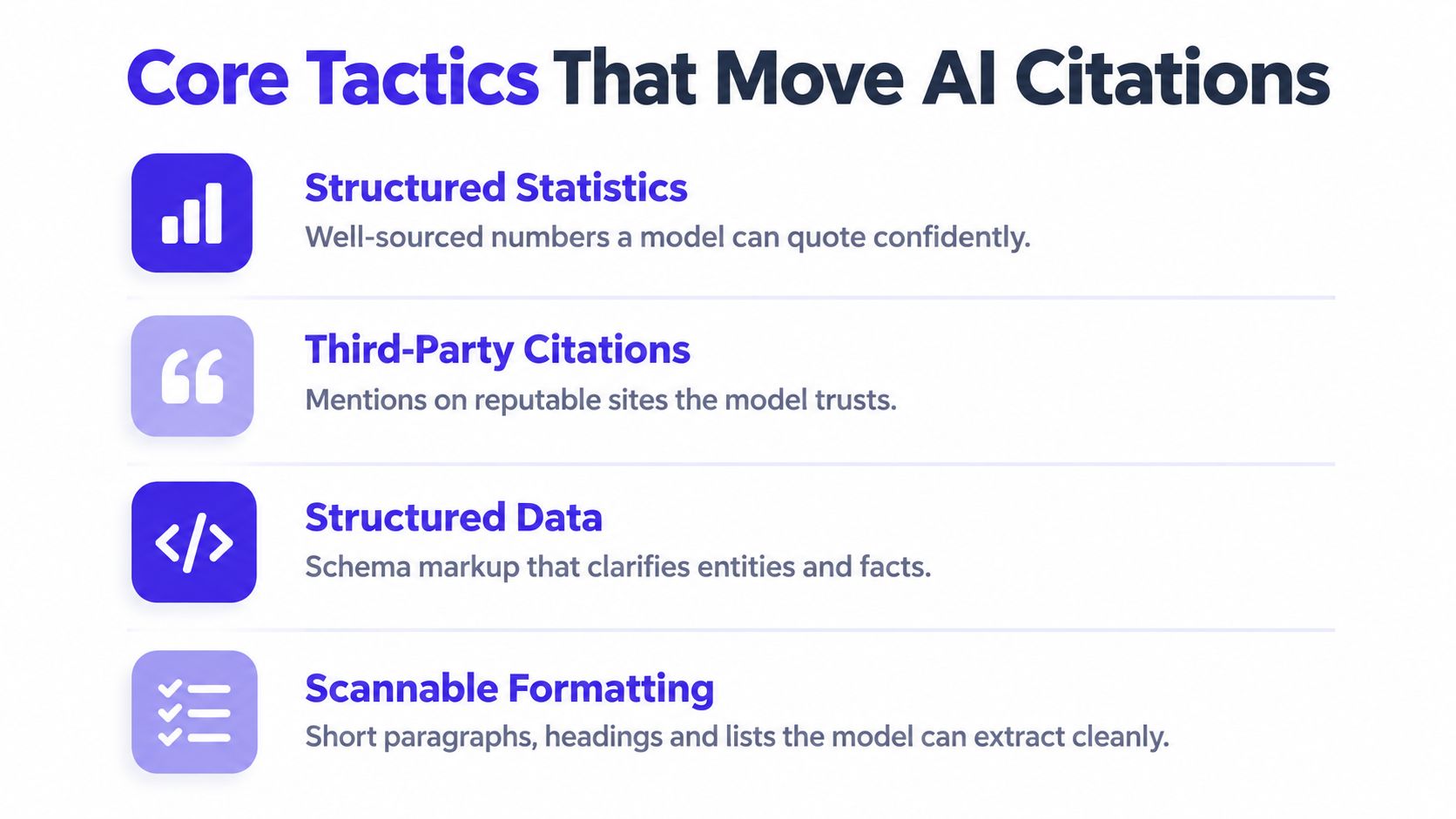
Earlier research on GEO reported visibility gains when pages added citations, quotations, and statistics in controlled experiments. Treat that finding as a practical direction, not a promise of identical results for every site.
A feature page should explain its audience, job, and constraints before using broad marketing language. “A smarter way to manage clients” gives an answer engine little to work with. A sentence that names the customer, task, and product category is easier to extract and summarize. If you include a number, define what it measures and link to the source. Clear boundaries make a claim safer to reuse than an unsupported slogan.
Build third-party corroboration
Your homepage states what you want buyers to believe. Independent pages show how other people place the product in its market. Relevant directories, comparison articles, newsletters, podcasts, communities, and review pages can all provide useful context when the surrounding topic matches your category.
An indie founder launching a writing tool might contribute a practical explanation to a community discussion, pitch a comparison post to a creator newsletter, and keep the product description consistent across reputable directories. The goal is accurate repetition, not manufactured popularity. Each reference should connect the brand with the problem it solves.
Founders who browse AI creation use cases can use adjacent topics to find publications and communities already discussing their category.
Clarify entities with structure
Schema markup can help machines distinguish an organization, product, article, author, or frequently asked question. Use Organization, Product, Article, and FAQPage schema only where each type matches the page.
Visible copy must support the markup. Keep product names consistent, describe the same offer across page elements, and avoid marking up claims that users cannot see. Schema organizes evidence. It does not replace evidence.
Distribute where retrieval already happens
Publishing on your own domain gives you message control, but it limits the places where systems can encounter your brand. Relevant directories, industry publications, founder communities, and user-generated platforms create more opportunities for accurate associations with the language buyers use.
Use this order when improving a real website:
- First, fix clarity: State who the product serves and what it replaces.
- Next, add evidence: Support important claims with named, accessible sources.
- Then, expand corroboration: Seek relevant references that describe the product accurately.
- Finally, format for extraction: Use descriptive headings, concise paragraphs, lists, and comparison tables.
Why AI Search Behavior Changes the Stakes
Your product can rank on Google and still disappear from an AI answer. That gap matters because answer engines are becoming another place where buyers form shortlists, compare options, and decide which sources deserve attention.
One benchmark cited by HubSpot reports that Perplexity processed 230 million search queries per month in August 2024 and about 780 million monthly queries by 2026, a projection described in HubSpot's generative engine optimization statistics. The figures show a growing answer-engine surface, although they do not show whether your audience uses it.
The visit may also end differently once an AI summary appears. The same HubSpot coverage reports that users clicked traditional search links in 8% of visits when AI summaries were present, compared with 15% when no AI summary appeared, a 54% drop in click-through rate. For a small business, the practical implication is clear: your page may influence a decision through the summary, even when the visitor never opens it.
Google's AI Overview behavior also points to broader use. In January 2025, 91.3% of queries triggering AI Overviews were informational, while by October 2025 that share was 57.1%. AI-generated results were therefore appearing across more than purely educational questions.
Commercial prompts compress several buying steps into one request. A prospect might ask for the best lightweight CRM, compare alternatives for a small team, or seek tools for a particular workflow. If your product is absent from that shortlist, a page-one ranking may never affect the choice.
SEO helps place your content in the source pool. GEO focuses on whether an answer engine recognizes that source as relevant enough to cite. That changes the work from ranking alone to measuring visibility and distributing clear evidence where retrieval systems can find it.
Measuring GEO Without Losing Your Mind
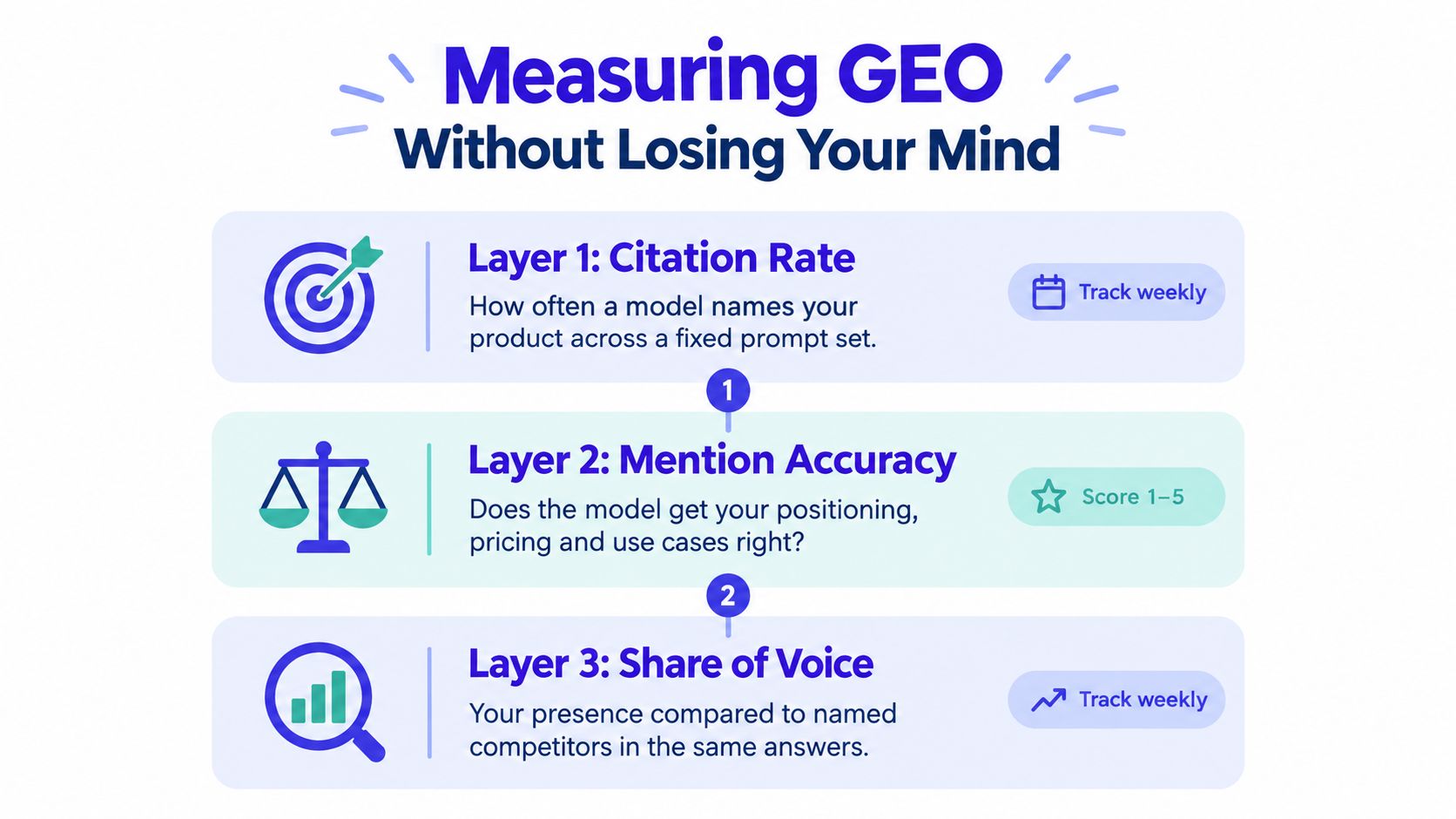
Don't begin with an expensive dashboard or a vague goal such as “show up more in AI.” Start with a fixed set of buyer questions and three separate measurements. Recent GEO monitoring coverage describes the shift toward prompt sampling, citation analysis, dashboards, and share-of-voice tracking, because a single manual check can't reveal whether visibility is stable.
Layer one is citation rate
Create a prompt library containing 20 high-intent questions about your category, alternatives, use cases, and objections. Run the same questions weekly across ChatGPT, Perplexity, Gemini, and Google AI Mode. Record whether your brand appears, whether your URL is cited, and which competitors are named.
Citation rate answers: How often does the system select us? It's a visibility measure, not a revenue measure.
Layer two is mention accuracy
A model can mention your company and still misrepresent it. Score whether it gets your audience, core use case, features, limitations, and pricing approach right. A simple one-to-five score works if you define what each score means before testing.
This layer protects you from celebrating inaccurate visibility. A misleading recommendation can create poor-fit leads, support requests, and distrust.
Layer three is downstream impact
Use analytics to identify referrals from AI surfaces where the data is available, then connect those visits to signups, demos, or purchases. Some answers won't generate a click, so treat referral traffic as one outcome rather than the entire value of a citation.
Keep this weekly checklist in Notion:
- Refresh prompts: Add new objections and competitor terms as buyers raise them.
- Keep a baseline: Record which competitors appear beside you.
- Inspect sources: Note the pages answer engines cite for each prompt.
- Check accuracy: Flag outdated product descriptions or incorrect comparisons.
- Review conversions: Separate AI referrals from other organic and referral sessions.
- Update evidence: Refresh pages when their claims, features, or sources change.
A 30 60 90 Day GEO Plan for Indie Founders
A page can rank on Google and remain absent from AI answers. A solo founder needs a plan that exposes that gap first, builds evidence second, and measures distribution before adding more content.
Days 1 to 30, audit the current picture
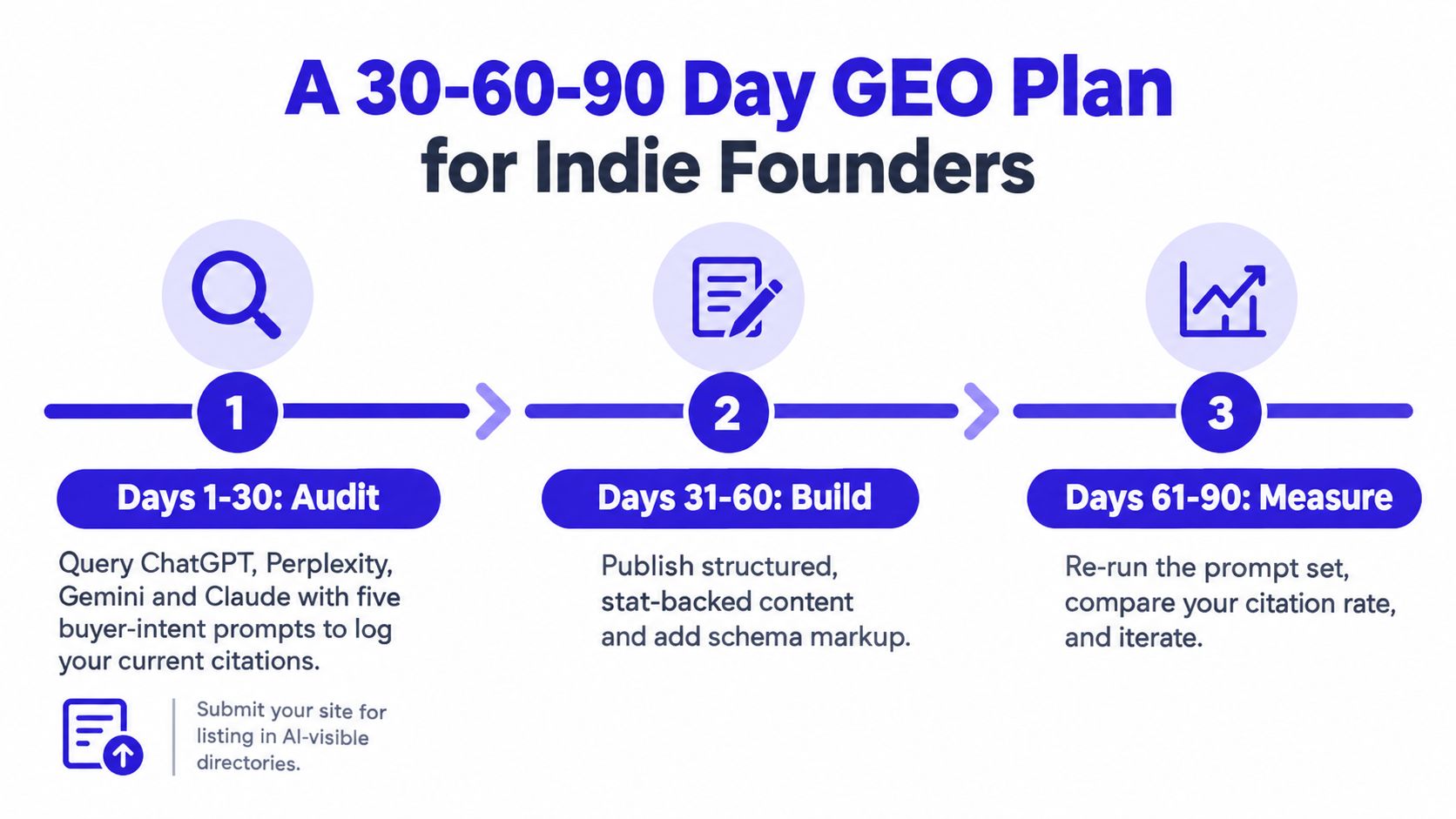
Write five buyer-intent prompts: a category question, an alternatives question, a comparison, a use-case question, and a problem-focused question. Run them through ChatGPT, Perplexity, Gemini, and Claude. Save the answers, cited pages, and competitor names so you have a baseline rather than relying on memory.
Classify every result as mentioned, cited, misrepresented, or absent. Then look for repeated sources. If the same directory, review site, newsletter, or comparison page appears across prompts, treat it as a distribution target. A strong ranking is useful, but it does not guarantee that an answer engine will retrieve or cite the page.
Submit an accurate product listing to relevant directories, including IndieTool, where founders can create a structured listing and access launch-oriented distribution and analytics features. Add basic Organization and Product schema to the homepage and key landing pages. Check that the markup describes the visible copy rather than making claims the page does not support.
Days 31 to 60, build evidence and reach
Refresh the pages that matter most to buyers. Place a direct answer near the top, explain what the product does and does not cover, identify sources for factual claims, and show when the page was last updated. Add statistics only when they clarify scale, performance, market context, or a meaningful comparison.
Distribution gives those pages more chances to become source material. Pitch two comparison articles and one data-led original piece to publications or newsletters your buyers already read. Favor outlets with topical relevance or a record of syndication. One accurate, relevant mention can contribute more to AI visibility than several unrelated placements.
Days 61 to 90, measure and repeat
Run the original prompt set again and compare the new results with your first records. Review citation rate, mention accuracy, named competitors, cited URLs, and referral sessions. Select the two channels producing the most relevant mentions, then direct more effort there.
Publish one useful piece of user-generated or community content each week, such as a workflow explanation, transparent build note, or category tutorial. Keep the product context accurate and avoid repeating promotional copy. Readers need a reason to trust the contribution, while AI systems need clear topical evidence they can retrieve.
Use this operating checklist:
- Audit: Prompt tests, citation log, competitor baseline.
- Build: Product listing, schema, sourced pages, comparison outreach.
- Measure: Prompt rechecks, accuracy review, channel allocation, conversion tracking.
The Mindset Shift From Ranking to Being Cited
A ranking tells a person where your page appears. A citation gives an AI system material it may use to explain your category, compare products, or recommend a solution. Those outcomes overlap, but neither guarantees the other.
The practical shift is to stop treating GEO as a formatting trick. It's a compounding visibility discipline built from clear product language, trustworthy evidence, and repeated distribution in places answer engines can retrieve. Keep your technical SEO and content foundations, then add an AI visibility check to the growth routine.
This week, choose one high-intent prompt and run it across three AI engines. Record whether your brand appears, whether the description is accurate, and which sources the system relies on. Within the next 30 days, improve one source page and take one distribution action aimed at the gap you found.
IndieTool helps indie founders place products in a structured discovery directory, distribute launch information, and monitor listing activity through a founder dashboard. Use IndieTool to create a clearer web presence for your product, then test whether that presence is being reflected in the AI answers your buyers use.