Indietool
What Is Programmatic Distribution for SEO
Programmatic distribution uses templates and structured data to publish many distinct URLs without hand-writing each page, and it isn't the same thing as programmatic advertising. Publishing 1,210 pages doesn't mean Google will crawl or index all 1,210.
The popular advice is to find a keyword pattern, generate pages, and let search traffic follow. That skips the difficult part: deciding which pages deserve to exist. For an indie founder, the useful opportunity isn't a bigger sitemap. It's a connected directory where each page helps someone discover, compare, or choose a product.
Table of Contents
- What Programmatic Means for Web Publishing
- Programmatic Advertising Versus Programmatic Publishing
- How One Record Becomes Many Indexable URLs
- SEO and Crawl Gains From a Page Network
- Programmatic Distribution on IndieTool
- When Scale Becomes Scaled Content Abuse
- Decide If Your Launch Needs Programmatic Distribution
What Programmatic Means for Web Publishing
Programmatic publishing uses a database and reusable templates to create distinct URLs instead of asking an editor to write every page. In advertising, the same word describes software buying and selling ad impressions, often through algorithmic auctions. The shared idea is automation, but the output is different: ad placements versus web pages.
Think of a library catalog. Manual publishing resembles preparing a separate catalog card whenever someone asks about a book. Programmatic publishing draws from the same catalog to prepare entries for titles, subjects, and related books.
The catalog is useful because those entries serve different needs. Someone searching for a particular title wants its record. Someone exploring a subject wants a shelf of relevant options. Someone comparing related titles needs information that explains the differences.
A software directory follows that pattern. Its database stores products, while its templates present them as individual listings, category collections, and meaningful comparisons.
Publishing models change who does the work
The following comparison describes possible operating patterns, not fixed page-count limits. A manual site can become large, and a programmatic site can deliberately stay small.
Manual, programmatic, and hybrid publishing
| Model | Who creates each URL | Typical scale | Indexation effect | Main risk |
|---|---|---|---|---|
| Manual publishing | An editor writes each page | A small, individually maintained collection | Few crawl targets and slow coverage | Important topics never get a page |
| Programmatic distribution | Templates fill pages from a database or catalog | A catalog-wide network | Many internal links and potential indexation points | Thin, duplicate, or empty combinations |
| Hybrid publishing | Templates plus unique editorial or verified fields | Targeted clusters, not every permutation | Useful entities provide reasons for discovery | Unchecked intersections still go live |
For founders, hybrid publishing is often the most practical design. Software handles repeated presentation, while a person checks the information that determines whether a page is useful.
A template can display supported platforms consistently. It can't establish that a product supports those platforms unless someone supplies reliable information. Likewise, an alternatives page needs an actual comparison, not just products sharing a broad category.
Practical rule: Automate the repeated structure, not the judgment about whether the page helps someone.
Build an information system, not a page factory
The architectural shift is from individually authored documents to a browsable information system. Instead of treating every page as a standalone article, you define entities, their attributes, and the relationships between them.
For example, a founder launching a design tool might belong on a product page and a relevant design category page. A comparison page becomes reasonable only when another product gives readers a genuine choice.
Google's March 2024 spam-policy announcement draws the boundary around purpose: generating pages primarily to manipulate rankings rather than help users can constitute scaled content abuse, whether humans, automation, or both produce them.
The useful building blocks are entity pages, category hubs, use-case collections, and supported alternatives pages. Each gives readers a different route through the same underlying catalog.
Programmatic Advertising Versus Programmatic Publishing
If you search “what is programmatic,” you'll often encounter advertising explanations first. Programmatic advertising means using software, data, and algorithmic auctions to buy and sell digital advertising inventory rather than negotiating every placement manually.
An IAB report citing Zenith's 2019 Programmatic Marketing Forecasts estimated that programmatic would represent 68% of worldwide digital advertising spend in 2020, with more than two out of every three display-ad dollars spent programmatically. Those are historical figures, not a current market estimate, but they explain why advertising became the familiar meaning of the term.
The shared principle resembles a sorting system: people establish rules, then software applies those rules repeatedly. The distinction is what the system decides.
Different systems, different decisions
| Question | Programmatic advertising | Programmatic publishing |
|---|---|---|
| What does software manage? | Advertising transactions | Page creation and relationships |
| What does it evaluate? | Audience, context, inventory, and bid price | Entity fields, taxonomy, and page eligibility |
| What does it produce? | An ad placement | A URL with content and internal links |
| What must people judge? | Business objectives and acceptable buying conditions | Information quality and usefulness |
Advertising systems can evaluate bids in milliseconds across publishers and devices. Publishing systems decide whether a product deserves a page, which category should contain it, and which related pages should link to it.
Display, video, mobile, and connected television are advertising formats or environments. They aren't publishing page types, and creating a directory doesn't mean you're participating in an advertising auction.
Neither meaning implies a hands-off operation. Advertisers still choose objectives and constraints. Publishers still own their data, editorial rules, and maintenance decisions.
For a founder trying to make a newly launched product discoverable in search, the relevant meaning is programmatic publishing. The work starts with the product record and the page network around it, not with a bidding platform.
How One Record Becomes Many Indexable URLs
Start with the entity, not the keyword list. A product record should contain information you can maintain accurately and reuse without changing its meaning.
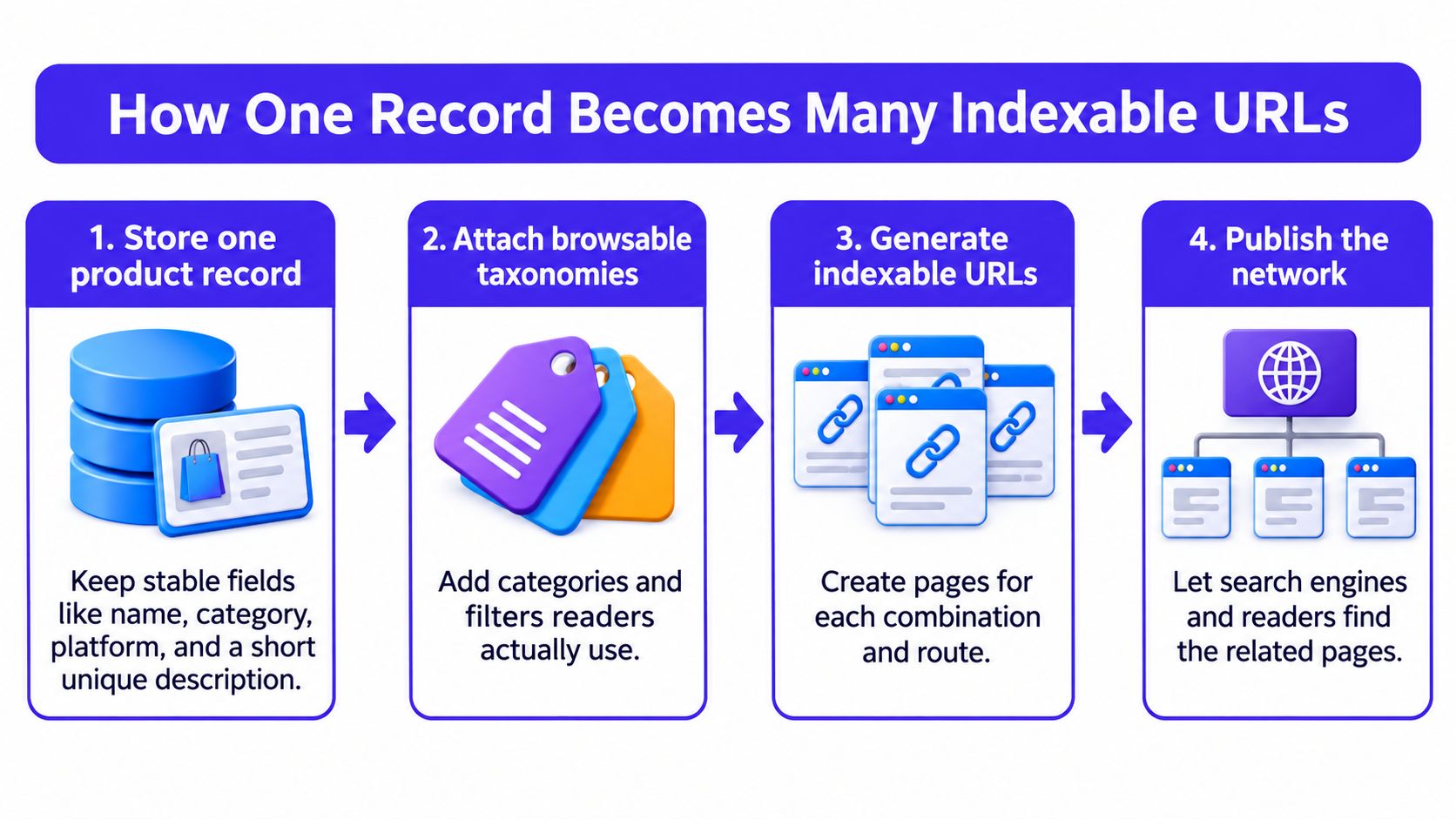
This workflow shows how that record connects to a publishable network.
Build the routes in a controlled order
Store stable product fields. Keep the name, category, supported platforms, destination, and a short unique description in a structured record. Separate factual attributes from promotional copy so you can validate them independently.
Attach browsable taxonomies. Choose categories and use cases readers recognize. A browser-based design tool might belong under Design and a specific design task, but it shouldn't inherit every remotely related marketing label.
Render meaningful routes. Use clean, stable paths for the entity and relevant hubs. An alternatives route should explain a real trade-off, such as collaboration features versus offline access, rather than list arbitrary neighbors.
Connect the pages contextually. Link from the category hub to the product, from the product to its category, and between related products. Use descriptive anchor text that tells readers what they'll find.
Publish a selective XML sitemap. Include the canonical URLs you want search engines to consider. Consolidate near-duplicates and keep empty or unfinished combinations out of the indexable set.
If you use generated copy to draft descriptions, the MyMentions guide to AI product descriptions is a useful companion for that writing task. Verify capabilities against the product itself before those descriptions populate multiple pages.
Publishing isn't the same as indexing
Google's crawl-budget documentation distinguishes crawl capacity, what your infrastructure and Google's crawling systems can handle, from crawl demand, how much Google wants to crawl based on factors including popularity, freshness, and uniqueness; publishing 1,210 pages doesn't guarantee that all 1,210 will be crawled or indexed.
Capacity is a technical constraint. Demand is a reason to visit. A fast server helps Google fetch pages, but speed alone doesn't give an empty comparison page useful information.
Concentrate attention on unique descriptions, substantive comparisons, fast responses, and a manageable set of routes. Avoid filter controls that expose endless combinations as crawlable links.
For troubleshooting, use the guide to getting a website indexed by Google to separate discovery problems from pages that Google has discovered but hasn't indexed.
A sitemap is a list of pages you want considered, not a reservation in Google's index.
For a complementary video explanation, watch the following overview.
The engineering outcome should be a navigable system that exposes useful information, not just a successful batch-generation job.
SEO and Crawl Gains From a Page Network
A page network can give a founder more relevant ways to be discovered. The benefit comes from matching different questions to appropriate pages, not from spreading the same launch announcement across different addresses.
Consider a browser-based research tool. Its product page explains what it does. A research-tools category helps someone explore the market. A carefully developed alternatives page helps someone decide whether to switch from another application.
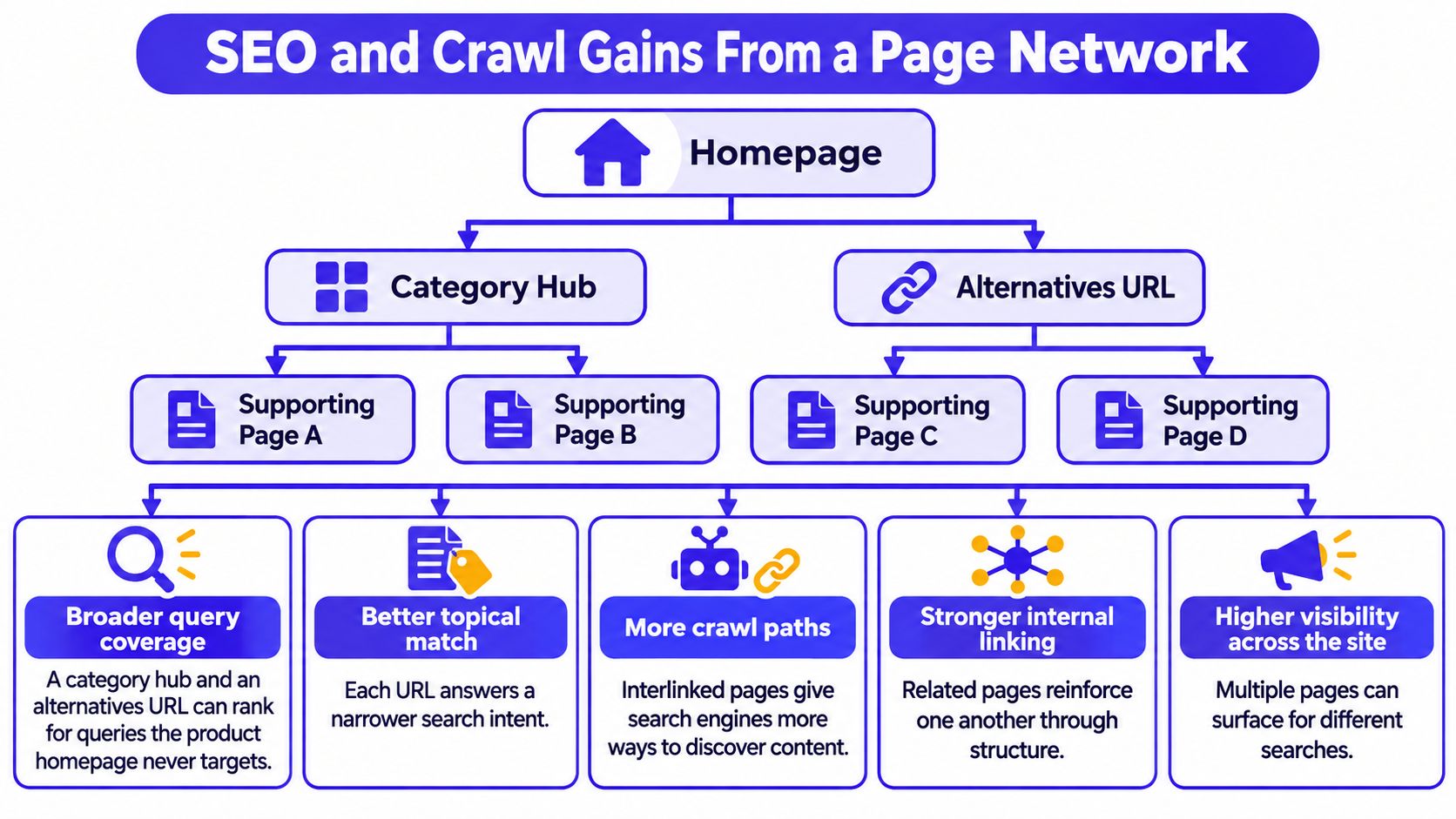
The diagram illustrates how those entry points connect.
Connect each benefit to its mechanism
Broader query coverage. A category hub can answer a market-level question that a product homepage doesn't address. A comparison page can answer a switching question without forcing that discussion into the main product description.
More discovery paths. Contextual internal links give readers and crawlers additional routes into a listing. That's particularly useful when a new product has little external visibility, although internal links don't replace external recognition.
Maintainable freshness. Updating a verified field in the source record can update the listing and the hubs displaying that field. Refresh the actual information, not merely the timestamp.
Long-tail entry points. Searches shaped like “alternatives to X” or “AI tools for Y” need different answers. Taxonomy pages can serve those intentions when their selection criteria and contents differ.
Observable browsing demand. Page views, unique visitors, and outbound clicks help you identify which collections people use. Treat them as evidence to investigate, not as proof that Google will rank those pages.
When planning those relationships, Rankira's explanation of how to distribute authority through internal links provides a useful framework. Prioritize links that help someone continue a task rather than adding unrelated links to every footer.
Check the gap between publication and discovery
These gains assume differentiated pages; a larger URL count doesn't itself increase relevance. Even a well-connected site needs pages that deserve to be found independently.
In Google Search Console, compare submitted sitemap URLs with the Page indexing report. Inspect representative examples from product, category, and alternatives groups instead of treating the total indexed count as the only success measure.
Keep the distinction between fetching and inclusion clear. The explanation of what Google crawling means can help you interpret whether a problem concerns discovery, crawling, or indexation.
For a live directory pattern, examine the reader's journey from a broad collection to a specific product and then to a relevant comparison. That journey is a better architectural test than the number of generated routes.
Programmatic Distribution on IndieTool
Say you're launching a browser-based tool that turns research notes into organized project briefs. The product has a clear audience, a supported platform, a primary use case, and capabilities you can describe without relying on vague claims.
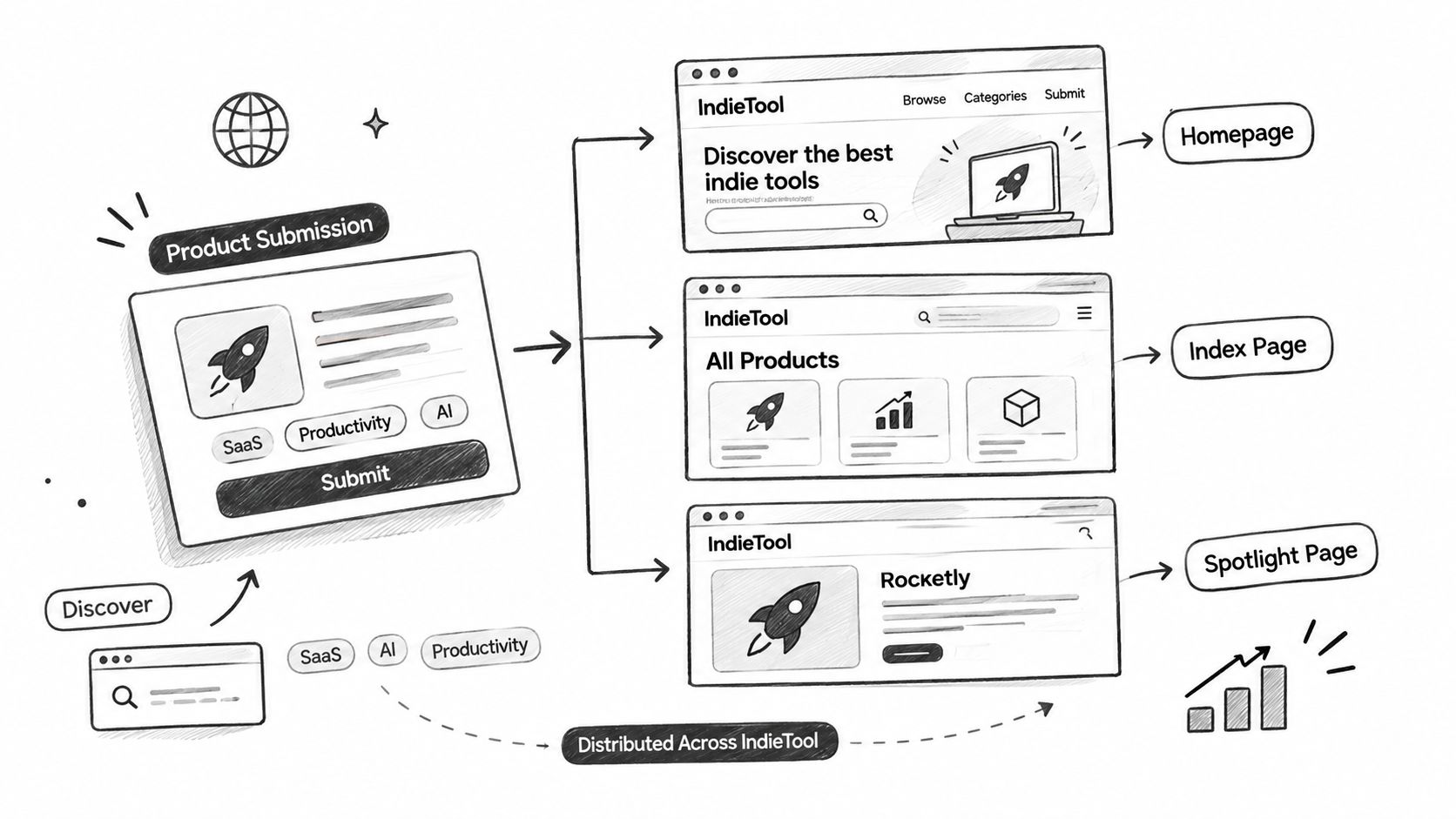
On IndieTool, a submitted product becomes an entity in our browsable directory. Its record can be represented on index and spotlight pages, within a relevant category, and on alternatives-style pages where there's a meaningful relationship. Our stated distribution surface covers 1,210+ index, category, and alternatives URLs, not a promise that every listing appears on every URL or that Google indexes every page.
The following illustration shows the relationship between submission and the surrounding pages.
Follow the product through the directory
The founder begins by choosing an accurate category. Our directory vocabulary includes AI, SEO, Design, Productivity, Marketing, Web3, Fintech, E-commerce, Agency, Business, Academic, and Lifestyle.
For the research-brief tool, Productivity might provide the clearest starting context. AI would be appropriate only if it accurately describes the product, not merely because the founder wants exposure to a popular category.
A useful category page lets someone understand why the product belongs alongside its neighbors. A useful alternatives page goes further: it helps a reader recognize whether the tool meets a particular need better than another option.
- The entity provides the facts. Readers need a clear description of what the tool does and where it operates.
- The collection provides context. Category placement should make sense alongside the other products presented.
- The onward action provides purpose. A reader should be able to inspect the relevant product or continue comparing suitable options.
This is distribution through relationships, not duplication of a press release.
Keep the record useful after launch
Founders can update product details from our dashboard, so the directory doesn't have to remain frozen at launch day. If the tool changes platforms or introduces a capability, the underlying record needs to reflect that change.
For the founder, the maintenance task is concrete: replace outdated descriptions, correct inaccurate categorization, and make the destination useful to someone arriving from a comparison page. Repeating an obsolete claim across a network makes the mistake more widespread, not more credible.
Our audience includes indie hackers and early adopters looking for tools. That audience gives the directory a user purpose beyond search-engine discovery: people need a way to browse unfamiliar products and decide what merits closer attention.
The same publishing surface becomes a liability when descriptions are copied or category intersections contain nothing useful. A route should exist because a visitor has a task to complete, not because the database can produce another combination.
When Scale Becomes Scaled Content Abuse
Scaled content abuse means creating many pages mainly to manipulate rankings rather than help people. In a tool directory, the failure is easy to recognize: a visitor arrives expecting help choosing software and finds interchangeable text surrounding a keyword.
Google's spam policies apply this principle regardless of whether people, scripts, templates, or generative AI produce the content, and warn against creating separate pages for query variations to manipulate rankings or AI responses. The practical question isn't which tool wrote the page, but what useful work the page does.
Signals that a programmatic URL should or should not be indexed
| Page signal | Helps a user decide | Indexation call |
|---|---|---|
| Verified product attributes and platform fields | Yes | Keep indexable |
| Alternatives explained by capability gaps | Yes | Keep indexable |
| Update timestamps and a real outbound action | Yes, when attached to substantive information | Keep indexable |
| Keyword swapped into an otherwise identical template | No | Do not index |
| Missing fields or duplicate descriptions | No | Block or rewrite first |
| Empty category or use-case intersection | No | Exclude from sitemap or noindex |
| Separate URL for every query variation | No | Do not create |
Apply controls to the actual failure
Canonicalize near-duplicates when different routes represent substantially the same information and you need a preferred version. Canonical tags aren't a way to make an otherwise empty page valuable.
Remove low-value URLs from the sitemap so your submitted set reflects your intended search inventory. Removing a URL from a sitemap doesn't prevent search engines from discovering it through links.
Keep unsuitable pages out of search with an appropriate noindex directive when they must remain accessible to users. Don't block crawler access to a page and expect the crawler to read its noindex instruction.
An accurate timestamp and a working button don't rescue a page that contains no useful information.
Consider an “AI + Fintech + alternatives” intersection. It deserves a route only when real products and a distinct comparison support the selection. Otherwise, it's a filter result masquerading as an answer.
Review clusters before publishing
Use a page-level review rather than approving a template and assuming every output is acceptable.
- Unique information: Does this page contain facts or analysis unavailable from its near-duplicates?
- A supported decision: Can a reader choose, compare, or narrow options using what's present?
- Relevant connections: Do internal links lead to related entities rather than arbitrary pages?
- An exclusion plan: Will incomplete outputs stay unpublished or outside search until they're useful?
A shared template isn't the problem. Unsupported multiplication is. Your publishing rules should reject bad combinations before they become part of the public network.
Decide If Your Launch Needs Programmatic Distribution
Choose programmatic distribution when your product has structured information that readers can use to find and evaluate it. Category, use case, platform, and genuine alternatives give a directory something meaningful to organize.
A new product with few authoritative links can benefit from relevant discovery routes, but that condition alone isn't enough. If you can't describe the product distinctly, multiplying its appearances won't solve the underlying positioning problem.
Match the method to the launch
Programmatic or manual distribution by launch condition
| Launch condition | Choose |
|---|---|
| New product with few authoritative links | Programmatic distribution |
| Filterable fields such as category, use case, platform, and alternatives | Programmatic distribution |
| One story and no distinct data for extra URLs | Manual publishing |
| Missing fields or copied descriptions | Manual until fields are fixed |
Treat the first row as an opportunity, not an automatic prescription. It works best alongside the structured information in the next row.
Manual publishing is the stronger choice when your launch needs a carefully argued story, an original demonstration, or an explanation that doesn't fit a catalog. You can publish that story well without inventing extra destinations.
Prepare the record before submitting
Write a unique description, confirm the supported platform, select the closest category, and identify alternatives through actual capability differences. Leave unsupported comparisons out rather than filling every available field with a guess.
If you're weighing directory discovery against other launch methods, compare the options in our guide to distribution channels for marketing. Choose a channel because its audience and format fit your product, not because it promises more places to paste the same announcement.
For a structured product launch, prepare those fields and submit the record to our directory. Give readers enough information to understand why they should click before asking a publishing system to distribute it.
IndieTool offers a browsable product directory and programmatic distribution across connected index, category, and alternatives pages. Paid submissions use instant automated indexing and go live in under 60 seconds, which describes our publishing process, not a guarantee of Google indexation. Visit IndieTool with your unique product description, accurate category, and verified platform details ready to submit.