Indietool
What Is AI Search? How It Works and Why It Matters

You type a question you would have opened five tabs for last year. A paragraph appears above the links, with small source chips under it, and you almost stop there. That is the moment AI search changes the job. You are no longer only choosing a page. You are deciding whether a written answer, built from other people's pages, is good enough to trust.
Table of Contents
- What AI Search Means in Plain Terms
- How AI Search Differs from Traditional Search
- How an AI Search Answer Gets Built
- Where and How People Use AI Search Today
- Benefits, Limits and How to Verify an Answer
- How to Measure Visibility in AI Search
- Put Your Product Where AI Search Can Find It
What AI Search Means in Plain Terms
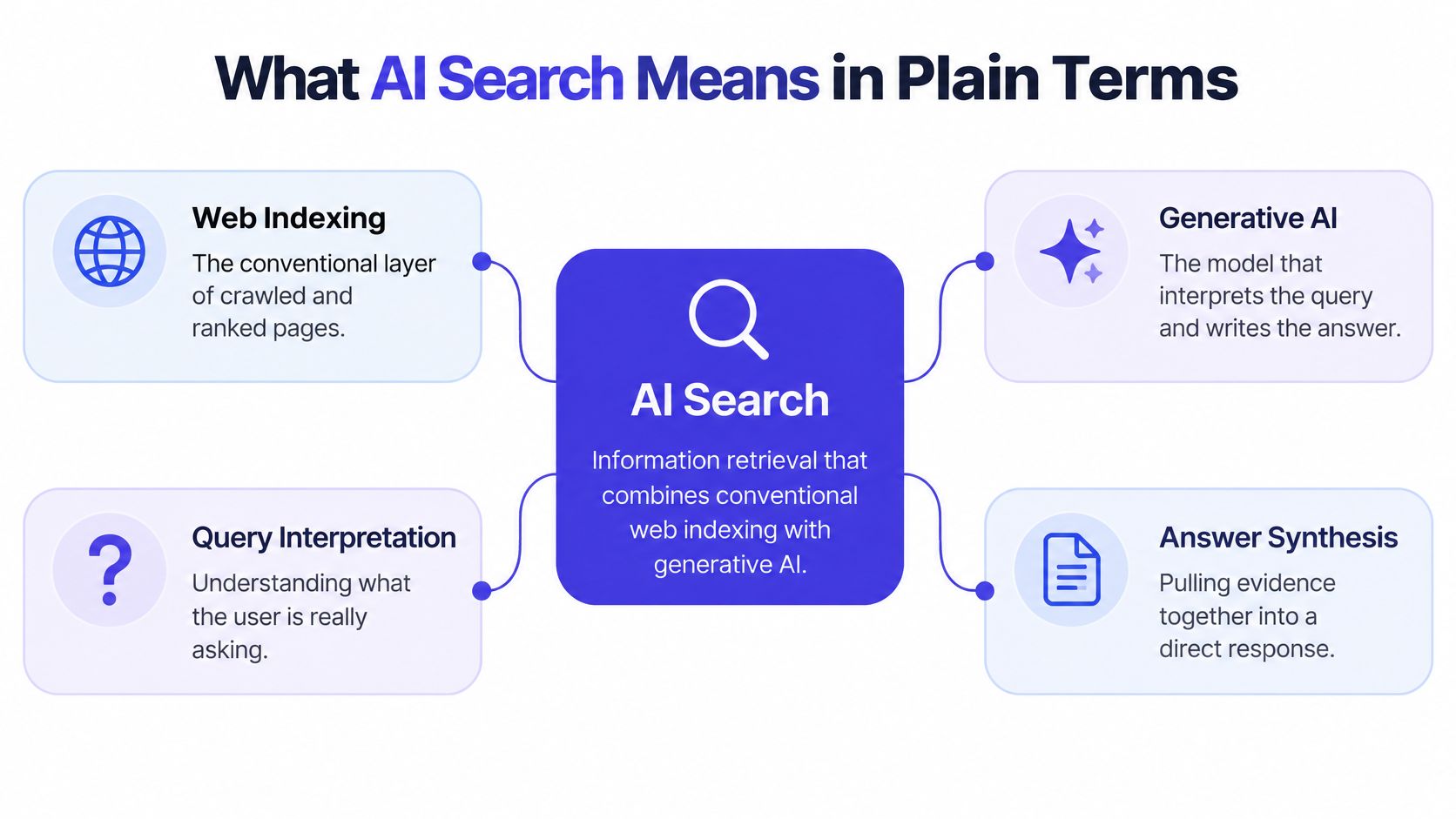
AI search is a form of information retrieval that combines conventional web indexing with generative AI. A large language model interprets the query, pulls relevant pages from an index, and writes a conversational summary, often with citations or links you can check. The Wikipedia entry on AI Overviews describes that shift away from a ranked list alone.
Say you ask how to pick a free invoicing tool for a two-person company. You don't get ten blue links and a blank stare. You get a short answer that names a few options, states a condition or two, and footnotes the claims. It feels like a research assistant who read several pages, wrote the summary, and left the footnotes for you.
How the interface changed
Google's path shows this is an evolution of search, not a separate category. It announced Search Generative Experience at Google I/O in May 2023 as an opt-in Search Labs experiment, began testing AI-generated answers in the main search experience in March 2024, and launched the renamed AI Overviews to U.S. users on May 14, 2024. Google later said AI Overviews had reached more than 1.5 billion monthly users across over 200 countries and territories, while queries eligible to show the feature grew by more than 10% in major markets such as the United States and India, as that same AI Overviews history records.
The discovery system still depends on crawled and indexed web pages. The new layer is machine-written interpretation. Familiar versions include Google AI Overviews and ChatGPT search. For a business, showing up now includes being selected, cited, or described inside the answer, because the summary can settle the question before a click.
Plain definition: AI search retrieves indexed web evidence and uses a language model to turn it into a direct, cited answer.
How AI Search Differs from Traditional Search
A founder types "free tools for a two-person startup" and gets two different handoffs. Traditional search returns a ranked list and leaves the reading to the founder. AI search writes a short answer, attaches citations, and often ends the session before any site is opened.
| Aspect | Traditional search | AI search |
|---|---|---|
| Result format | Ranked list of links | Synthesized answer with citations |
| Query handling | Matches keywords to pages | Interprets intent and conditions in the whole question |
| Source use | User reads each page | System merges several sources into one answer |
| Click pattern | Users click through to pages | Many sessions end on the results page; cited sources are rarely clicked |
| Success measure | Rank position and click-through rate | Mentions, citations, answer inclusion and referral visits |
| Main failure mode | Irrelevant or low-quality links | Confident answers with claims the sources do not support |
What the click row actually means
A ranked list is a reading list. An AI answer works like a classmate who already read the pages and hands you one paragraph. "Two-person" and "free" stay part of one request, rather than loose keywords waiting to match a title.
Clicks shrink because the summary tries to finish the job. A 2026 study of one month of browsing data from a representative panel of 900 U.S. adults found that clicks to sources cited in Google AI Overviews occurred in only about 1% of AI Overview visits. The feature was also associated with fewer clicks overall and more sessions ending on the results page. That pattern does not prove every AI-search visit sends zero referral traffic. It does show that click-through rate, by itself, misses visibility that never leaves the answer.
What "winning" looks like now
A high rank used to mean a visit. A generated summary can matter through the wording of the answer, the citation, the brand mention, and a decision the reader makes later, even with no click. Google's AI Overviews placed those generated summaries above conventional results, so the summary is often the first thing a searcher sees.
A citation can look like proof. It is only a pointer. The merged paragraph can still state something none of the linked pages said. Readers can check by opening the cited page and matching the claim to a sentence on it. Publishers need a second scoreboard besides rank: whether the product is mentioned, whether the citation is accurate, and whether any visit follows.
For an early product, crawlable and clearly structured pages have to serve both channels: the classic result list, and the systems that retrieve and summarize web evidence.
Ask of any page you publish: does it win the answer, not only the click?
How an AI Search Answer Gets Built
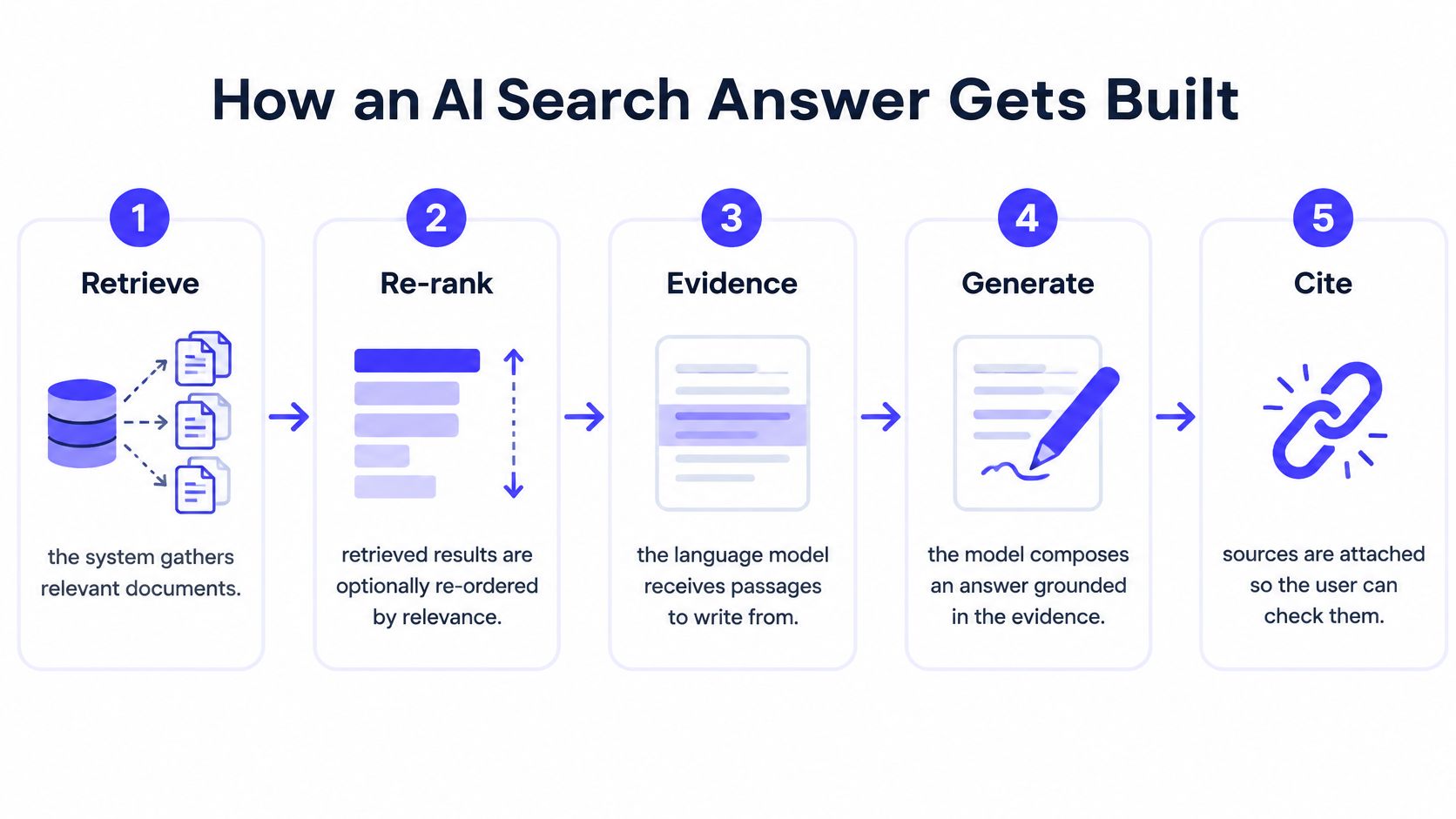
AI search is a retrieval-augmented generation system, or RAG. It retrieves relevant documents, may re-rank them, and then gives a language model evidence to write from. It is not a conventional ranked-results page with a paragraph glued on top.
One question through the pipeline
A freelancer asks which invoicing tool supports multiple currencies. Query interpretation treats "multiple currencies" and "invoicing tool" as the intent, not two loose keywords. Retrieval pulls three review pages. Re-ranking keeps the two with current pricing and drops a stale roundup. Generation merges a price from one page with a feature list from another. Citation attaches the links so the freelancer can check the merge.
| Stage | What it does | What goes wrong |
|---|---|---|
| Query interpretation | Rewrites the question and identifies intent | Ambiguous or multi-part questions are read too narrowly |
| Retrieval | Pulls candidate documents from an index | The right page never enters the evidence set |
| Re-ranking | Orders candidates by relevance to the question | Weaker passages outrank stronger ones |
| Generation | Writes the answer from retrieved passages | Adds claims the sources do not support |
| Citation | Links claims to supporting passages | Cites a page that covers the topic but not the claim |
Where a correct page still loses
The break is often earlier than the sentence you read. A strong page can be missed at retrieval, so it never influences the answer. A page that merely mentions invoicing can be cited for a currency claim it never makes.
Retrieval is often the limit on quality. One cited evaluation found GPT-4 reached 56% accuracy with real retrieved context versus 89% when it was given ground-truth context, a 33-percentage-point gap, as reported in this RAG evaluation paper. Discoverable, tightly focused pages are more likely to enter the evidence set. A factually strong page that the retriever never finds cannot shape the answer.
When an answer is wrong, check two things in order. First, was the right source retrieved? Second, does the written answer follow that source? Measure context relevance, answer faithfulness, and citation support separately from keyword rank.
Three layouts use this idea differently. Some answer engines show retrieved sources before they write. Generative overviews sit above a normal result list. Multi-step agentic search runs several queries, then answers.
Where and How People Use AI Search Today
Weekly use of generative AI for obtaining information rose from 11% to 24% across six countries in 2025, according to the Reuters Institute figures summarized by FirstPromoter.
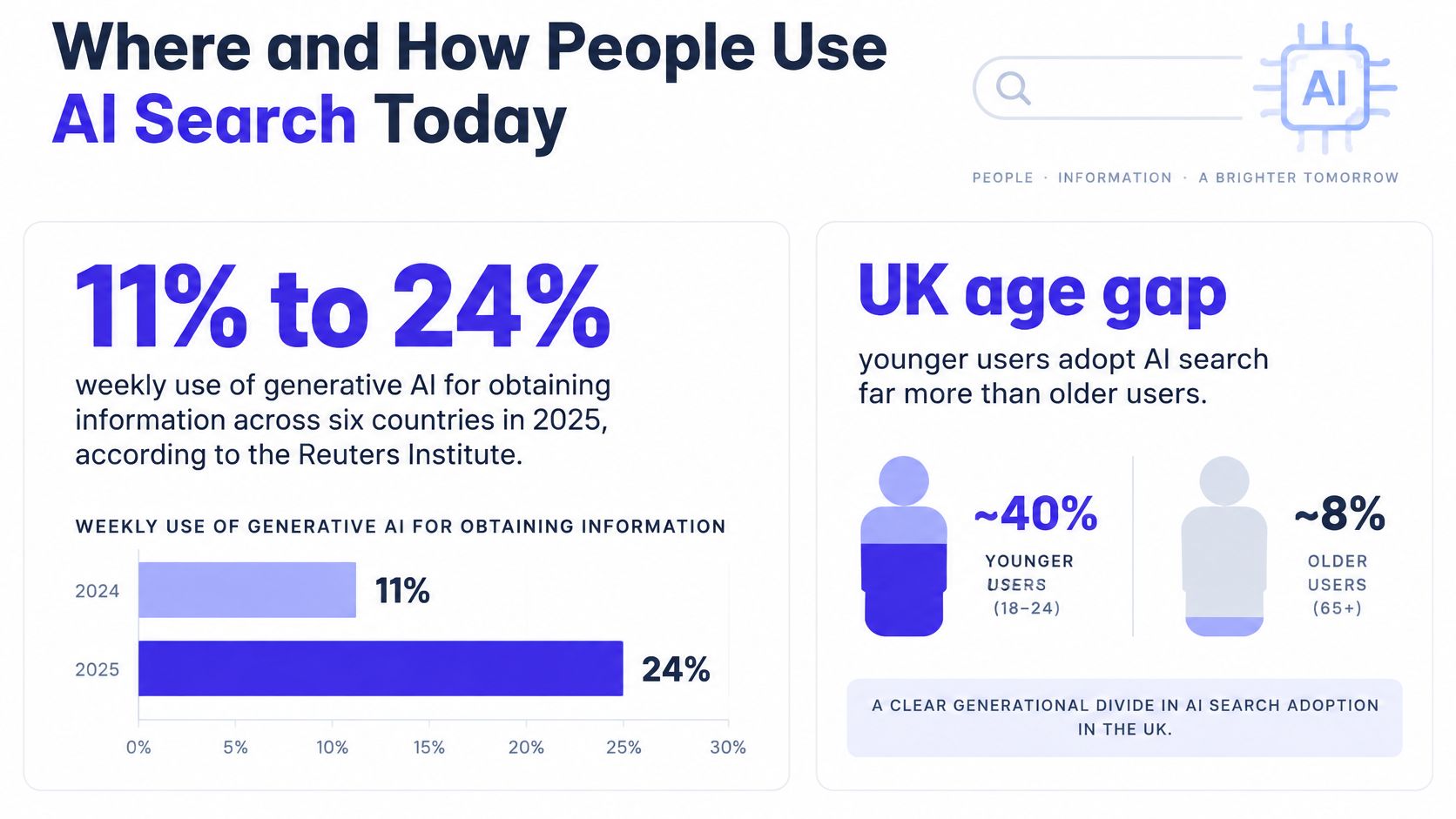
The habit is not evenly spread. In 2025, 24% of UK respondents aged 16–24 said they most often used an AI product for the same questions, compared with 4% of respondents aged 65 and over, from UK Competition and Markets Authority consumer survey data reported by BlazeHive. Shopping is already in the mix. In 2025, 61% of more than 1,000 surveyed U.S. consumers said they had used general-purpose AI tools such as ChatGPT or Gemini to help shop online, a March 2025 consumer study cited by Xcentium.
The jobs people hand it
People reach for these tools in a fairly stable order.
- First-pass research: Get oriented on a topic before opening primary pages.
- Comparing options: Hold two or three products against the same conditions.
- Summarizing reviews: Compress a pile of opinions into a short read.
- Finding a tool for a job: Name the constraint, such as "free" or "works offline," and ask for a short list.
- Checking a description: See how a product is characterized before visiting the site.
A solo founder asks for free tools to name a product, gets a short list with sources, and clicks two of them to confirm the details. The answer did the sorting. The clicks did the checking.
Where it is a poor fit
Live prices, medical or legal decisions, and anything that needs a primary record are weak jobs for a synthesized answer. A publisher should assume the reader may meet the product inside that answer before they ever land on the site.
Benefits, Limits and How to Verify an Answer
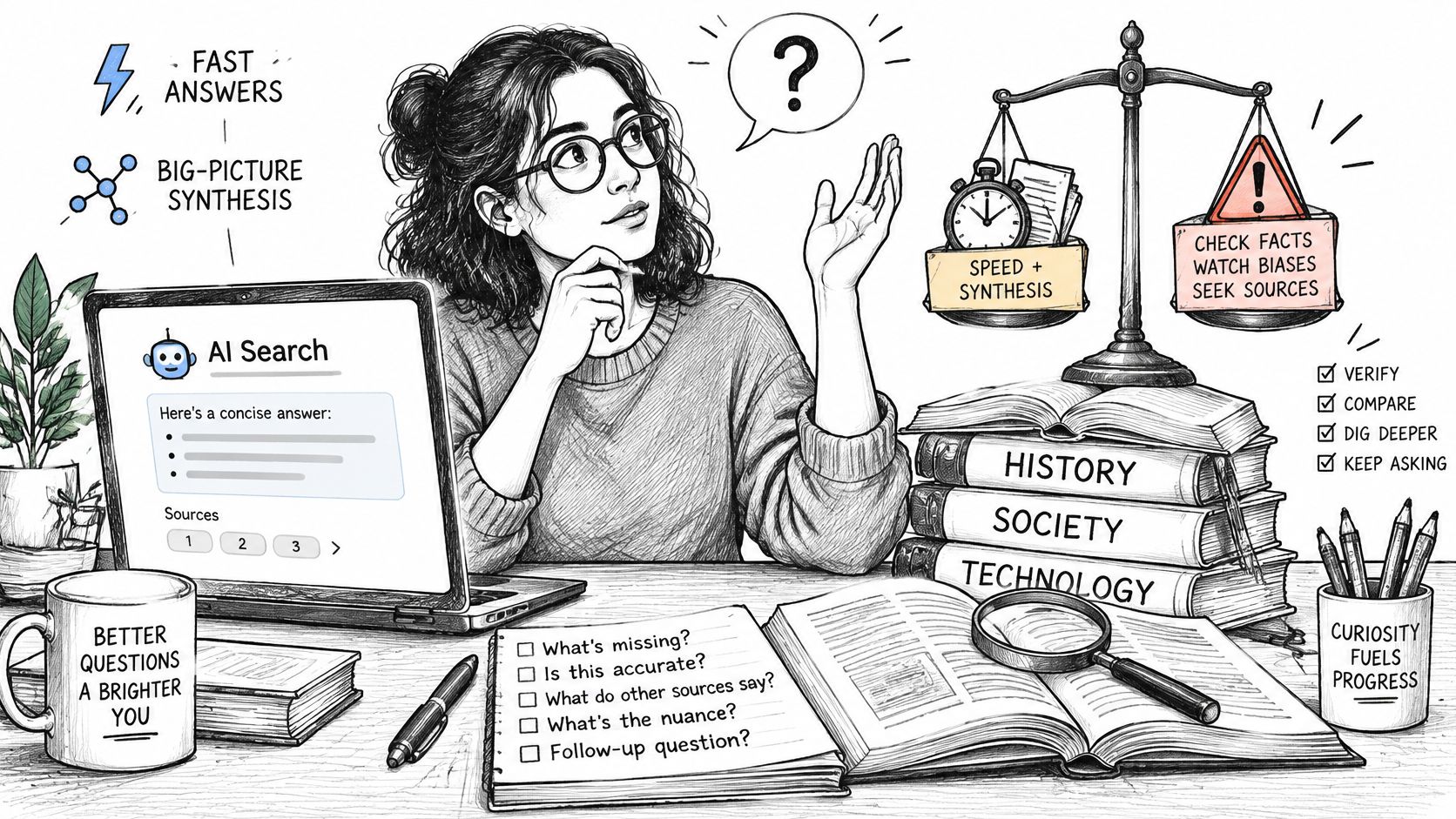
You ask for a short comparison of three note-taking apps. One paragraph comes back, with three blue links under it. That speed is the benefit: a synthesis across several sources, follow-up questions in the same thread, and citations you can see. The same tidy display can make a weak answer look finished.
A citation works like a footnote in a student essay. It shows that a page was named, not that the sentence matches what that page says. Systems also cite syndicated copies, or list more sources than they used. Participants in a 2025 ACM study hovered over an average of 1.08 sources and clicked only 0.48 sources when information appeared in aligned, source-cited answer-engine results. They also became confused when a system displayed more retrieved sources than it used.
What the source checks found
Tests of several AI search tools have found incorrect source identification on a notable share of news-related queries. Some tools failed more often than others. A visible citation can still raise trust while the match between sentence and page stays weak. Stopping at the link list checks the costume of the answer, not the claim. Common failure patterns are laid out in this guide to AI search problems.
A four-step check
Treat the summary as a draft someone handed you, not as the record.
- Separate the claims. Write down what the summary asserts, apart from what the sources merely discuss.
- Open the cited passage. Confirm it supports that exact sentence, not a nearby topic.
- Check date and publisher. Note the publication date and whether the page is the original publisher or a copy.
- Escalate high-stakes claims. Confirm them with a primary record, an official source, or a conventional search you control.
Use AI search to discover and summarize. Use verified sources to decide.
How to Measure Visibility in AI Search
Rank position and referral traffic describe only part of what an answer engine does. Exposure is not the same thing as a visit, a citation, or a conversion. An answer can summarize several sources, cite a copy, omit the original publisher, or settle the question with no click at all.
Google reported in May 2025 that queries triggering AI Overviews produced more than a 10% increase in Google usage in the U.S. and India, according to Google's I/O 2025 marketing brief. That is a usage shift, not a traffic guarantee for any one site. Ordinary rank and referrals are incomplete proxies, because answer systems have also fabricated links or cited copied versions rather than original articles.
Recall, precision, and a small metric set
Citation recall asks whether claims have supporting citations. Citation precision asks whether the cited passages are relevant and necessary. Research on automated citation generation notes that titles, abstracts, and tighter claim-to-source matches improve citation accuracy, including for indirect questions, as discussed in this paper on citation generation. A directory listing or a backlink can help discovery. Neither one guarantees a place in the answer.
| Metric | What it shows | How to track it |
|---|---|---|
| Mention frequency | How often your brand appears in answers to a prompt set | Run the same prompts weekly and count mentions |
| Citation accuracy | Whether the cited source actually supports the claim | Check a sample of answers sentence by sentence |
| Source-page inclusion | Whether your own page is cited rather than a syndicated copy | Compare cited URLs with your domain |
| Branded versus unbranded prompts | Visibility when the user does not name your product | Track both prompt groups separately |
| Referral sessions | Visits that arrive from AI answer links | Filter analytics by referral source |
| Answer sentiment | How the product is described in the answer | Score the tone of each answer on a simple scale |
Results change by model, country, language, prompt wording, freshness, and whether the query needs current facts. Tools built for AI visibility analytics can organize that log, but the method itself is simple. Pick a fixed prompt set, run it weekly across several answer engines, and compare the rows over time.
Put Your Product Where AI Search Can Find It
A page the retriever cannot find cannot be cited. This week, work the page and the measurement, not a vague "optimize for AI" checklist. The short walkthrough below shows how a listing page is meant to be read by both people and crawlers.
Four moves for this week
- Write one question per page. State facts in plain sentences. Use the same product name, category, and one-line description everywhere, so systems can tie the entity to a claim.
- Make the page crawlable. Check
robots.txtand whether AI crawlers are allowed. Put pricing, use cases, and features in text, not only inside images or scripts. - Add an indexable directory page. IndieTool is a launchpad and startup directory for indie hackers and solo founders, with exposure across 1,210+ index pages. Our TikTok Slideshow service includes structured entity indexing meant to help ChatGPT, Gemini, and Perplexity cite a startup. A listing supports discoverability. No single placement guarantees inclusion in an AI answer. The wider practice is often called generative engine optimization.
- Log ten prompts. Run them on two answer engines. Record mentions and the cited URLs. That first sheet is the baseline, not a verdict.
Start with the measurement. Ten prompts, two engines, one week of notes. You will see whether the answer names you, cites you, or describes you in a way the sources do not support.
IndieTool is a launchpad and startup directory for indie hackers and solo founders who need crawlable pages and consistent product details that answer engines can retrieve. A listing will not force a citation, but it gives your product an indexable home alongside the pages you already control. See how IndieTool fits the visibility work you just mapped.