Indietool
SEO Backlinks Strategy That Earns Links That Rank
96.6% of all content gets zero backlinks, according to Ahrefs-reported link-building data. That changes the question. The problem usually isn't whether you can publish more articles. It's whether you can create something relevant enough to reference, put it in front of the right people, and build a backlink profile that looks like genuine corroboration rather than manufactured volume.
A practical SEO backlinks strategy starts with one useful asset, targeted distribution, and disciplined measurement. It favors qualified referring domains over inflated backlink counts, contextual placements over sitewide clutter, and steady progress over a frantic campaign that burns time and money.
Table of Contents
- Why Your SEO Backlinks Strategy Matters More Than Ever
- Building Linkable Assets That People Actually Want to Reference
- Choosing How You Will Earn Links From Outreach to Directories
- Shaping Anchor Text and Internal Links for Relevance
- Monitoring Maintaining and Growing Your Backlink Profile
- Your Next Moves for a Sustainable Backlinks Strategy
Why Your SEO Backlinks Strategy Matters More Than Ever
A page that earns references from relevant sites gives search engines stronger evidence that its content belongs in a topic. Google's PageRank, introduced in 1998, treated links as votes of confidence, making link-based authority part of the search engine's ranking model, as documented in this history of link building and PageRank. The details have changed, but the practical lesson remains: independent references help validate a page beyond what it claims about itself.
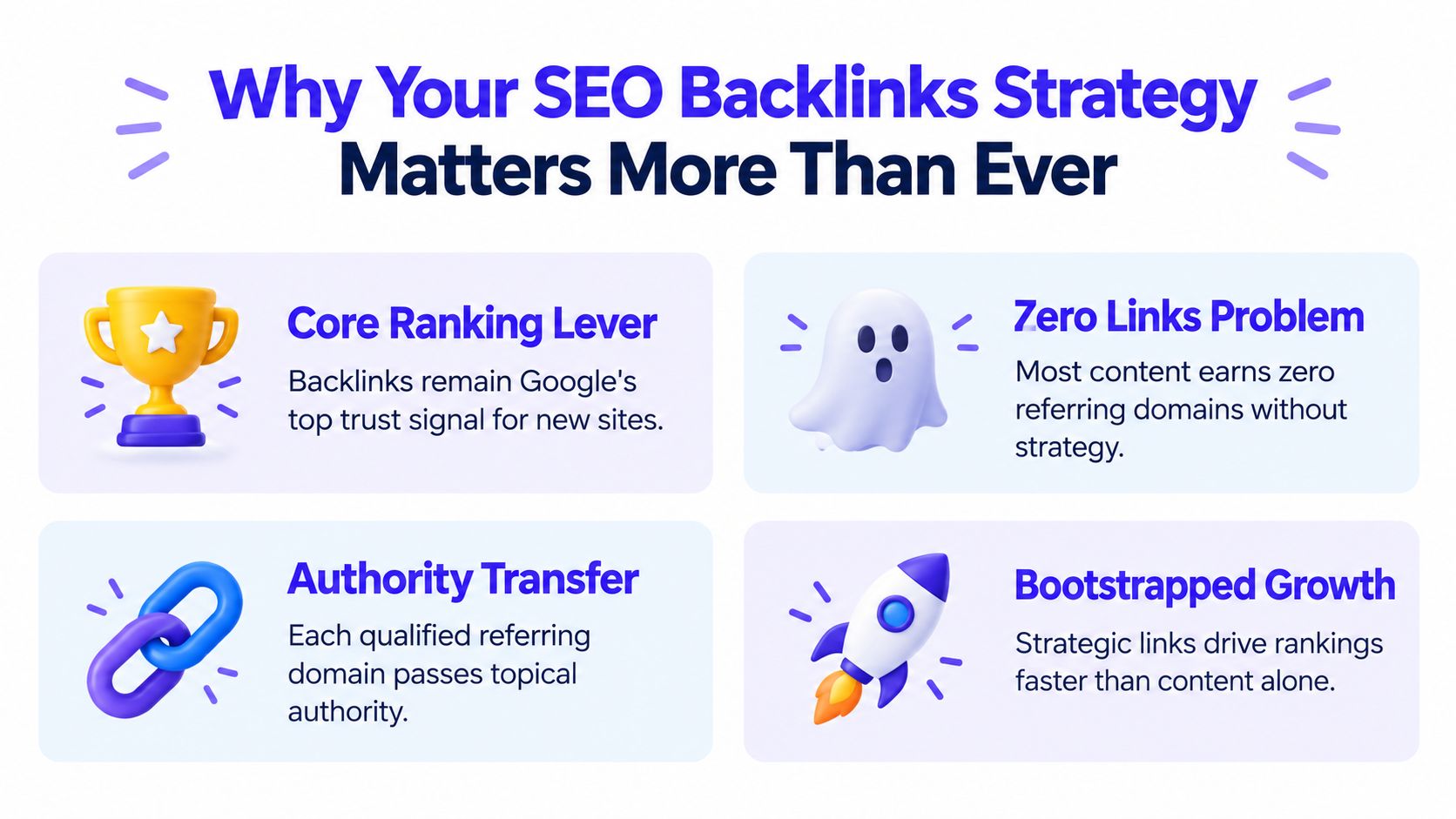
The supply of genuine references is limited. Ahrefs-reported industry data says only 6% of pages ever earn even one external backlink, while higher-ranking pages tend to attract more new followed referring domains over time. For a bootstrapped company, that makes another generic article a weak growth bet. A smaller set of relevant citations can create a clearer corroboration footprint for Google and AI search systems.
Authority also accumulates across competing results. A large-scale SERP study found that the number-one Google result has about 3.8 times more backlinks than results in positions two through ten, as reported by Search Logistics' link-building statistics. The useful takeaway is not to chase a large backlink total. Build references steadily from publishers, directories, and communities that serve the same audience.
The strategy is smaller than most teams think
A workable operating model has four parts:
- Create one anchor asset: Build a guide, comparison, tool, or original resource around a clear query and reference need.
- Support it internally: Connect related pages so authority and topical context reach commercially important URLs.
- Distribute it repeatedly: Contact journalists, publishers, resource-page owners, communities, and directory editors with a relevant reason to cite it.
- Measure qualified domains: Track new relevant referring domains, placement quality, and links that remain live, rather than celebrating raw link volume.
Aim for a sustainable pace of 5-15 referring domains per month when the site and market support it. Permanent, relevant directories can provide a foundation, while editorial mentions and useful community references add corroboration over time. This mix takes longer than guest-post chasing, but it creates a backlink profile that is easier to explain and maintain.
Context determines value. The surrounding page, anchor language, destination, and publisher audience should all make the reference useful to a reader.
Practical rule: If you cannot explain why a real reader benefits from the link, the placement probably adds little to your strategy.
For the technical distinction between link attributes, see this guide to what do-follow backlinks are. Do-follow status should not decide the entire evaluation. A nofollow mention from a relevant publication can support discovery, relationships, and brand corroboration, while a do-follow link from an unrelated page may contribute little.
Building Linkable Assets That People Actually Want to Reference
Most companies start link acquisition too early. They write a normal product article, send a generic email to dozens of sites, and blame outreach when nobody responds. Publishers don't owe you a link because your page exists. You need to give them a reason to cite it.
Start with a topic that already creates a reference need. A journalist may need a definition, a benchmark, a visual explanation, or a useful source for readers. A blogger may need a comparison table. A founder may need a free calculator or a directory of tools. The strongest assets answer one of those needs directly.
Pick one anchor asset
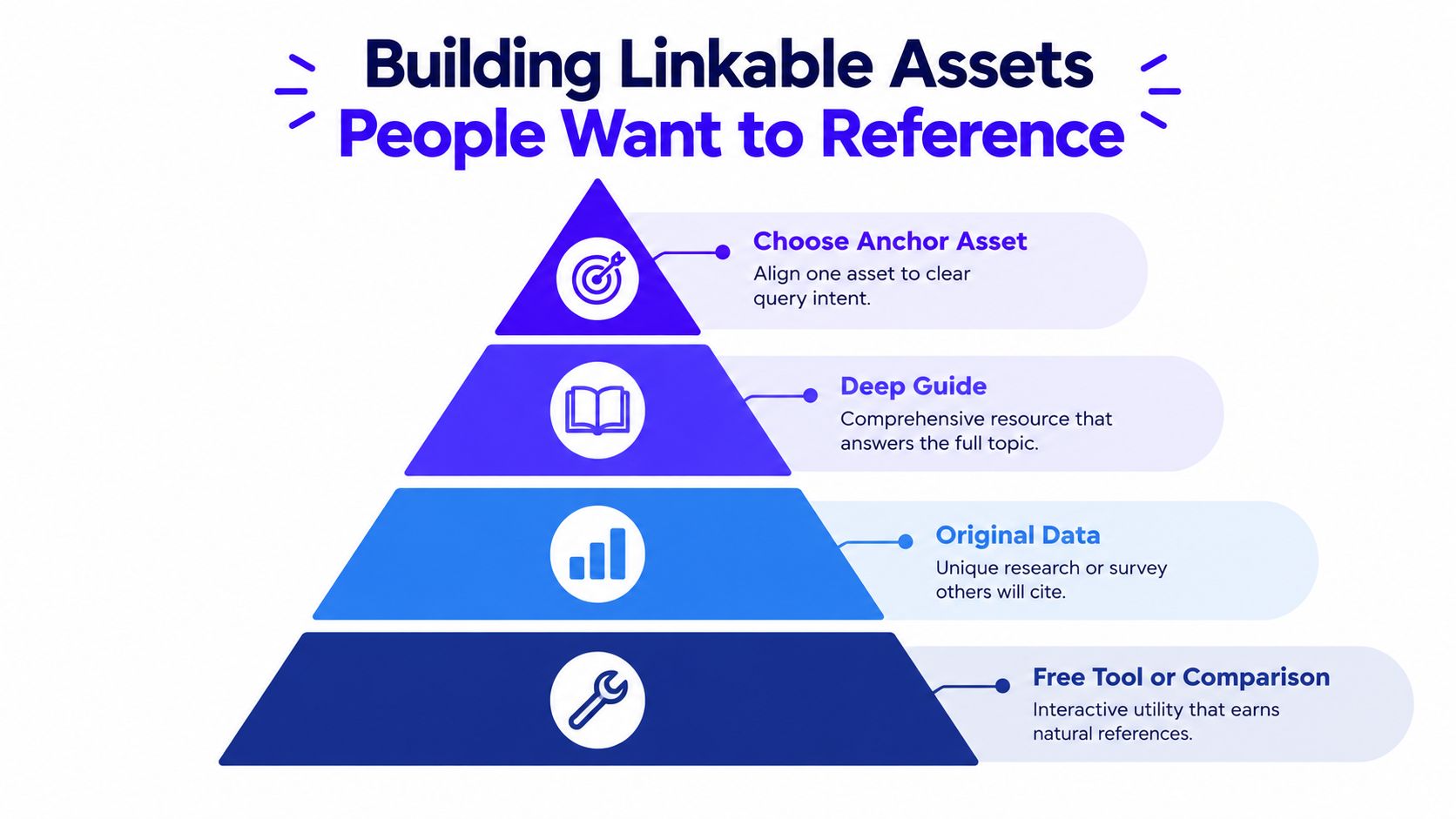
Choose the format based on the reason someone would cite it:
- Deep guide: Use this when the subject is complex and readers need one page that explains the full process. Organize it around decisions, not a pile of keywords.
- Original data: Collect information others can't easily produce, then publish the methodology, limitations, and practical interpretation. Transparent data earns more trust than a bold conclusion with no evidence.
- Free tool: A calculator, generator, checklist, or diagnostic can attract references because it gives another site something useful to recommend.
- Comparison: Make the choice easier. Include consistent criteria, clear trade-offs, and details that competing pages leave vague.
A long article isn't automatically linkable. The cited SERP study found that content of 3,000 words or more earns about 3.5 times more backlinks than shorter content in its dataset, but length works only when it creates utility, coverage, or original insight. Padding a page to reach a word count gives editors nothing worth citing.
Design for citation
Make the asset easy to quote and easy to scan. Put the key definition near the top, use descriptive subheadings, include tables where readers compare options, and add original visuals when they clarify a process. Write short sections that can stand alone, because a publisher may link to one specific answer rather than endorse the entire article.
Then connect the asset to your site. Link to relevant feature pages, documentation, use cases, and supporting articles, but keep the links helpful. A resource page that earns attention shouldn't become an internal-link dump.
For an indie SaaS launch, a useful asset might be a pricing calculator supported by a guide explaining the assumptions behind it. For a developer tool, it could be a migration comparison that shows commands, compatibility constraints, and a decision tree. The product can appear naturally, but the asset must still work for someone who isn't ready to buy.
The video below offers another practical perspective on planning content and SEO workflows.
Before outreach, ask three questions:
- Who would cite this? Name the publication, community, directory, or practitioner.
- What problem does the citation solve? Define the reader benefit in one sentence.
- What makes this page different? Identify the data, utility, framework, or detail competitors lack.
If the answers are vague, improve the asset before sending emails. Outreach amplifies a worthwhile page. It can't manufacture one.
Choosing How You Will Earn Links From Outreach to Directories
Link acquisition works best as a mix of relevance, corroboration, and control. Outreach can earn strong editorial references, but it demands research and persistence. Guest posting gives you more influence over the topic and destination, yet weak campaigns create repetitive articles on sites built mainly to sell links. Resource pages can fit useful assets, while permanent, relevant directories provide a dependable foundation.
| Tactic | Best For | Effort Level | Link Durability |
|---|---|---|---|
| Digital PR outreach | Newsworthy data, launches, expert commentary | High | High when editorially covered |
| Targeted resource-page outreach | Useful guides, tools, and references | Medium | Medium to high |
| Guest posting | Demonstrated expertise and audience education | High | Variable |
| Relevant directories | Product discovery and foundational references | Low to medium | High when listings are permanent |
| Community participation | Relationships, mentions, and referral discovery | Medium | Variable |
Industry surveys favor digital PR over guest posting. One 2026 link-building survey found 34% of SEO professionals chose digital PR as their top tactic, compared with 18% for guest posting. Another survey reported 48.6% rated digital PR most effective, compared with 16% for guest posting, as summarized in recent link-building statistics. The samples and questions differ, so the figures are not directly comparable. The practical lesson is consistent: editors are more likely to reference a credible story than publish a thin article shaped around an anchor-text request.
Where each method earns its place
Use digital PR for a real announcement, original dataset, strong expert view, or unusual product story. Pitch the story and supporting evidence, not the backlink. A journalist links when your material helps explain a subject to readers.
Use resource-page outreach when your asset fills a clear gap. Personalize the message around the page's audience and identify the exact section where your resource belongs. Generic link requests force the recipient to do the evaluation, which is why they tend to waste time.
Use guest posts selectively. Choose sites with a real audience, clear editorial standards, and topical overlap. A thoughtful contribution can build a relationship and earn a relevant reference. A batch of interchangeable posts creates a footprint that says little about your expertise.
Directories should form the permanent base of the campaign, not its entire link profile. A relevant listing can establish a clear brand reference, support product discovery, and give later outreach a destination with basic credibility. Founders comparing backlink building sites should check editorial standards, permanence, topical fit, link attributes, and genuine discovery value.
A practical directory link building framework helps separate useful listings from paid clutter. Aim for a sustainable pace of 5-15 referring domains per month, then assess whether each new mention adds topical context or corroborates the same product, expertise, or use case. Directories are easier to obtain and more controllable. Editorial outreach usually offers stronger contextual validation. Combining both creates a broader footprint for Google and AI search without relying on guest-post volume.
Shaping Anchor Text and Internal Links for Relevance
A backlink becomes useful when its source, wording, and destination make the relationship obvious. A homepage mention may reinforce brand recognition, while a reference to a relevant guide can clarify the subject for readers and search systems. The goal is a coherent relevance and corroboration footprint, not a collection of isolated placements.
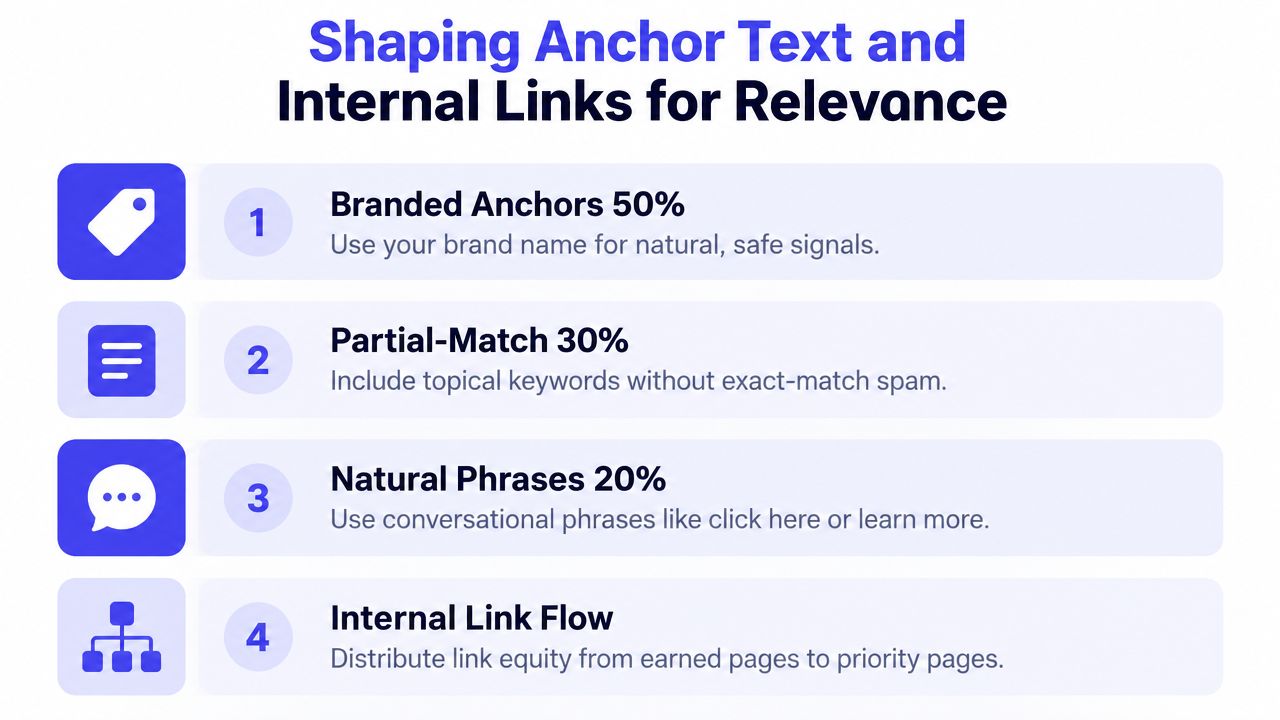
Anchor text should read like an editor's choice for the sentence. Brand names provide a dependable default. Partial-match phrases describe the topic without forcing an exact keyword, and natural wording works when the surrounding context already explains the destination.
Use anchors that fit the sentence
Suppose an indie analytics product publishes a guide about SaaS retention. These anchors communicate different levels of context:
- Branded: “IndieTool's retention guide explains the main inputs.”
- Partial match: “This guide to SaaS retention metrics compares practical formulas.”
- Natural: “You can learn more about the calculation method here.”
The weak pattern is repeating the same exact-match phrase in every placement, especially when the linking page barely discusses the topic. A publisher's wording should help readers understand why the reference belongs there. Forced anchors create an artificial profile and can make otherwise useful coverage look manufactured.
Prioritize links embedded in relevant editorial paragraphs. A paragraph that explains the subject gives the destination a clear reason to exist. Sidebar and footer links can still support navigation or brand visibility, but repeated sitewide placements usually provide less context and may appear across pages unrelated to the linked resource.
Move authority toward commercial pages
The asset that earns links may not be the page that converts visitors. Internal links connect that asset to the pages that support a purchase or product decision:
- Link the asset to the relevant feature or use-case page.
- Link related supporting articles back to the asset.
- Write descriptive internal anchors that match the destination without repeating one phrase mechanically.
- Check that important pages are not orphaned or buried several clicks deep.
- Remove links that interrupt the reader or lead to weak, outdated pages.
A comparison guide for project-management tools might point readers to a product's templates, integrations, and pricing pages. It does not need links to every page on the site. Follow the reader's next decision, then give that decision a clear path.
Anchor text should describe the destination, not advertise your SEO target.
Review new backlinks regularly for repeated wording, irrelevant placements, and destinations that do not fit the source topic. If a publisher selects an anchor you would not have chosen, leave it alone when the wording is accurate and editorially natural. Independent phrasing often creates a healthier profile than tightly controlled anchor text.
Monitoring Maintaining and Growing Your Backlink Profile
A backlink campaign earns its keep when you can identify useful references, maintain good relationships, and stop repeating tactics that produce no movement. Raw backlink totals can rise without improving visibility. Qualified referring domains provide a clearer measure because they show how many distinct, relevant sites choose to cite your work.

For many sites, 5 to 15 new referring domains per month is a practical planning range. It is not a quota. A new business in a narrow niche may find fewer legitimate opportunities, while a newsworthy launch can attract more attention without forcing the pace. Relevance and corroboration matter more than chasing a monthly total. A steady footprint also gives Google and AI search systems more consistent signals about what your business does and who considers it useful.
Track quality before velocity
Keep a lightweight monthly record covering:
- Referring domain: Record the site and its topical relationship to your business.
- Placement URL: Save the exact linking page, not only the domain.
- Target page: Note whether the link supports an asset, feature page, or homepage.
- Link context: Capture the surrounding paragraph and anchor text.
- Indexation status: Check that the linking page can appear in search and remains live.
- Business signal: Record referral visits, signups, assisted conversions, or useful introductions.
Use Google Search Console to compare query and page trends with the timing and quality of new references. Third-party tools can help discover links, but manual review still determines whether a placement fits. A high-authority domain with no topical connection may contribute less than a smaller specialist publication whose readers need your product.
A broader brand footprint also includes references that do not pass conventional do-follow equity. Editorial mentions, profiles, community discussions, images, and nofollow links can support recognition and corroboration across search surfaces. Reviewing key SEO citation metrics helps separate simple link counts from the wider set of signals associated with your brand.
Maintain what you earn
Links disappear. Redesigns, changed URLs, and removed resources can erase useful placements. Reclaim legitimate mentions by contacting the author, identifying the exact page, and offering a relevant replacement. Keep linked assets accurate, repair broken destinations, and make updates easy for publishers to approve.
Do not disavow every unfamiliar link. First assess whether the placement is manipulative, irrelevant, or harmful. A profile built gradually from varied, relevant sources is easier to maintain than one dependent on a single outreach tactic or a burst of low-context placements.
Use backlink-building tools to organize prospect research and inspect larger link sets, but keep the workflow simple enough to run each month. Record what earned the placement, whether it sends qualified visitors, and whether the relationship merits another relevant collaboration. A dashboard nobody updates will not protect the strategy.
Your Next Moves for a Sustainable Backlinks Strategy
A sustainable backlinks strategy turns one useful asset into a relevant footprint that supports both Google and AI search. Build corroboration across editorial mentions, directories, communities, and partner sites rather than chasing a high link count.
The first 30 days
Days 1 to 7, finish one linkable asset. Choose a clear search intent and create a guide, tool, comparison, or research page that solves a real reference need. Add evidence, visuals, a usable structure, and internal links before outreach begins.
Days 8 to 12, qualify prospects. List relevant publishers, resource pages, directories, communities, and potential partners. Check topical fit, editorial standards, audience overlap, and authority before writing. Survey data shows 91% of SEOs set a minimum DR threshold, with 52% requiring DR 50 or higher, according to Reporter Outreach's state of link building. Treat DR as a screening input, not proof that a placement deserves your time.
Days 13 to 20, match the message to the recipient. Give journalists a timely angle, page owners a useful resource, and publishers a practical contribution. Explain why the asset fits their page or audience. One generic email rarely works across all three groups.
Days 21 to 25, establish a permanent foundation. Add the product to one relevant directory when it offers genuine discovery value and clear link terms. A permanent directory listing can provide baseline corroboration while editorial outreach builds stronger context. Keep the foundation limited, then continue earning references.
Days 26 to 30, review the signals. Record replies, new referring domains, indexed pages, target-page movement, referred visitors, and assisted conversions. Keep tactics that create qualified opportunities. Cut activity that produces appearances without useful traffic or relationships.
Aim for a steady 5 to 15 referring domains per month, adjusted for your market and available assets. Relevance, consistent mentions, and a varied source mix create a stronger footprint than mass acquisition. Avoid buying weak placements or accepting links with no meaningful connection to the surrounding content. Industry research on backlink strategy also supports a relevance-led approach over indiscriminate volume.
As a bootstrapped founder, focus is an advantage. One strong asset, a carefully screened prospect list, and a monthly review can sustain progress without turning link building into a full-time guessing exercise.
IndieTool lets founders submit products to a browsable directory with a permanent do-follow backlink, index and category page distribution, and basic analytics for views, visitors, and outbound clicks. Review IndieTool to decide whether its listing fits your SEO backlinks strategy.