Indietool
Online Decision Maker Tools and Methods for 2026

You've launched a product, posted about it, and watched the first wave of attention arrive. Then the tabs multiply. A prospect finds your homepage through search, checks a review, asks an AI assistant for alternatives, opens your pricing page, looks for a competitor, and returns days later with a completely different question. A launch rarely fails because nobody saw it. More often, buyers saw it, but couldn't assemble enough trustworthy evidence to choose it.
That's the reality facing today's online decision maker. Discovery may happen through an AI summary, a social post, or a directory, but commitment usually requires a longer sequence of comparisons, checks, and return visits. The practical advantage belongs to founders who design for that sequence instead of optimizing one announcement or one landing page.
Table of Contents
- Why Buyers Research Longer Than Ever Before
- Defining the Online Decision Maker
- The Signals an Online Decision Maker Weighs
- Comparing Decision Tools and Methods Side by Side
- How FlipSimu Can Help
- When Speed Is the Wrong Goal for a Decision
- Real Founder Decisions Using These Methods
- Launch and Growth Playbook for Indie Founders
- Habits, Pitfalls, and Quick Answers
Why Buyers Research Longer Than Ever Before
A buyer finds your product through a launch post, then disappears into tabs. One tab checks your pricing page. Another pulls up a review. A third asks an AI assistant for alternatives. By the time that buyer returns, they are no longer deciding whether your product looks interesting. They are deciding whether your claims still hold up after comparison, verification, and a second opinion.
Today's online decision maker faces a longer, messier path to commitment. Search, reviews, documentation, marketplaces, community threads, and AI summaries all play a part, but none of them close the case alone. Buyers stitch together their own proof. If one source feels thin, outdated, or inconsistent, they keep researching.
Google reported that 60% of consumers in surveyed markets take six or more actions before deciding to buy a brand or product that's new to them. Comparing prices was reported by 80%, searching online for reviews and information by 75%, and visiting a brand website or app by 67%. The same research includes actions like checking marketplaces and reviewing return policies, which shows how people build confidence across multiple touchpoints instead of accepting a single pitch. Google's consumer research outlines that pattern clearly.
The launch-day version of this journey
A solo founder launching a small SaaS sees this up close. They post in a community, answer questions on Reddit, and watch interest rise after an AI assistant mentions the product alongside competitors. That mention creates awareness. It does not create enough certainty to buy.
The prospect still has to confirm a few things before committing:
- Current pricing: Does the live offer match what the AI summary or directory says?
- Product fit: Will the tool handle the buyer's workflow, integrations, or team setup?
- Independent evidence: Are reviews recent, specific, and believable?
- Alternatives: Is there a better option for this use case?
- Risk: Can the buyer export data, cancel easily, or test the product without getting trapped?
This is why search still matters after discovery. Google's research found that 40% of Google Search users said search helps them make smart and informed shopping decisions, compared with 28% for social media and 34% for online marketplaces. AI can introduce a category or compile options fast. Buyers still return to search and first-party pages to verify what is current and what is marketing spin.
Practical rule: Treat discovery as the start of evaluation. Build for verification.
What this changes for product launches
A launch needs more than attention. It needs pages that answer the questions buyers ask after the first click: category fit, alternatives, pricing, reviews, documentation, edge cases, and objections. Each page should reduce a different kind of uncertainty while keeping the core facts aligned.
Founders who separate discovery from verification usually make better launch decisions. They stop treating the homepage as the only proof point and give buyers a clearer path to check claims, compare options, and judge risk at their own pace. That matters even more for decisions with switching costs, privacy concerns, or financial exposure, where speed is often the wrong success metric.
Defining the Online Decision Maker
An online decision maker is an individual or group that uses digital channels to research options, compare them, validate claims, and commit to a purchase, hire, partnership, or product direction. The term covers a consumer choosing a subscription, a founder selecting a launch channel, and a procurement team evaluating software.
The difference between consumer and B2B behavior is usually not the need for evidence. It's the number of people, constraints, and approval steps involved. A consumer may compare return policies and reviews. A B2B buyer may need security details, implementation information, pricing clarity, documentation, and a path to human assistance.
Gartner describes four recurring B2B buying tasks: problem identification, solution exploration, requirements building, and supplier selection. Buyers revisit at least one task during a purchase, so the process isn't a straight funnel. Gartner also reports that buyers were 1.8 times more likely to complete a high-quality deal when supplier digital tools were used with a sales representative rather than independently. Gartner's buying journey research supports a model where self-service content and human help work together.
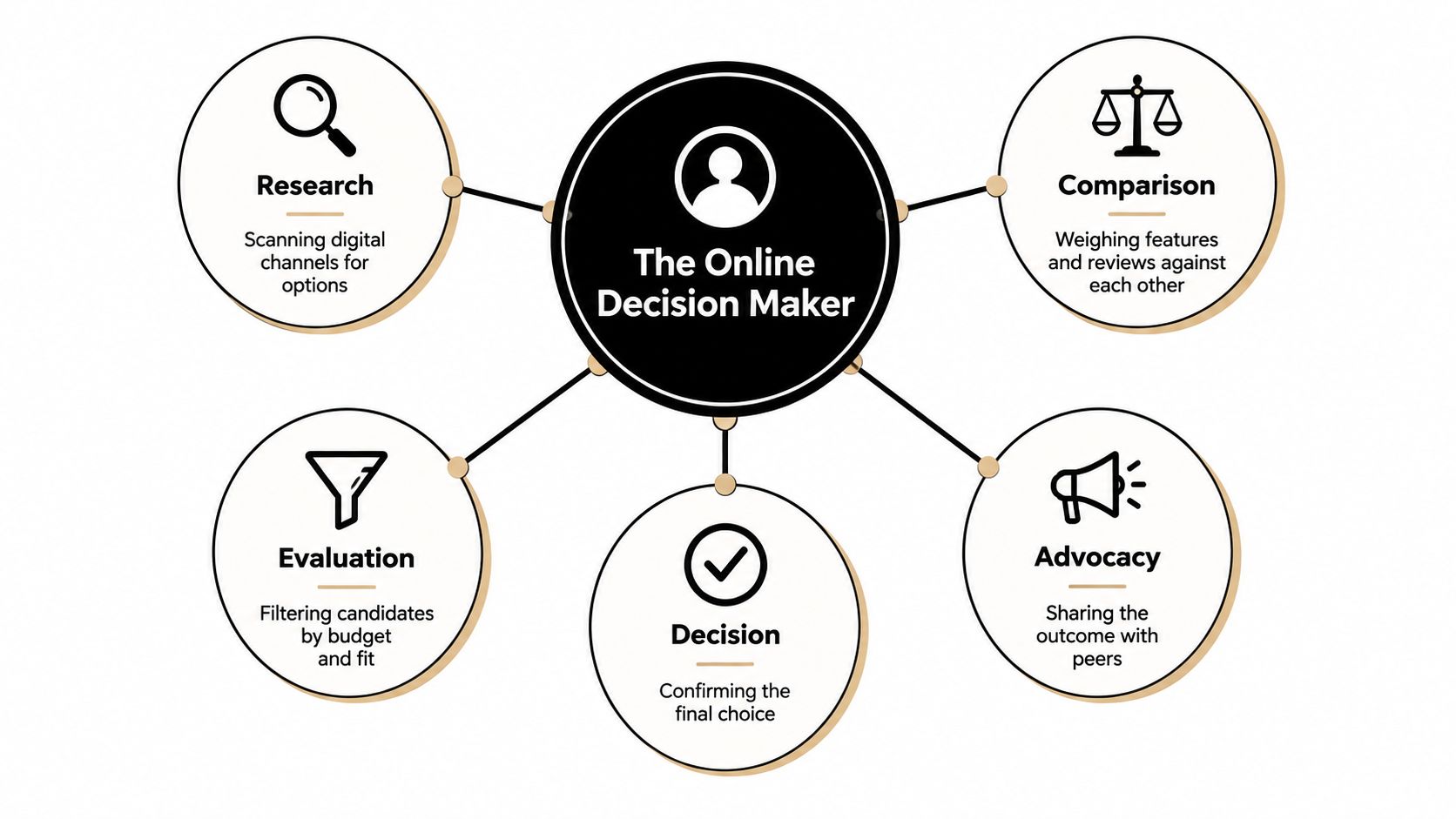
A detective, not a funnel passenger
The most useful analogy is a detective assembling a case. The detective doesn't accept one confident statement as proof. They compare accounts, inspect the quality of each clue, identify contradictions, and return to earlier questions when new evidence changes the picture.
That's how a serious online decision maker behaves:
- Problem identification: What needs to change, and how urgent is it?
- Solution exploration: Which categories, approaches, or vendors could solve it?
- Requirements building: What constraints are essential, and what would merely be convenient?
- Supplier selection: Which option has enough evidence, fit, support, and acceptable risk?
The fifth stage, advocacy, often follows the decision. A buyer shares the result with colleagues, posts a review, or recommends the product to another founder. That feedback then becomes evidence for the next decision maker.
For sellers, the implication is direct. A product page shouldn't only persuade a first-time visitor. It should remain useful when someone returns to check an integration, defend the purchase internally, or compare the product with a newly discovered alternative.
The Signals an Online Decision Maker Weighs
A buyer might first hear about your product through a directory, then search your category, ask an AI assistant for alternatives, scan reviews, open your docs, and return later to check pricing one more time. That path is messy, but the pattern is consistent. People stack different kinds of proof until the remaining risk feels acceptable.
As noted earlier, most buyers take several actions before they commit. That matters because no single asset carries the decision. The homepage does one job. Reviews do another. Search results, AI summaries, documentation, pricing, and policy pages each answer a different objection.
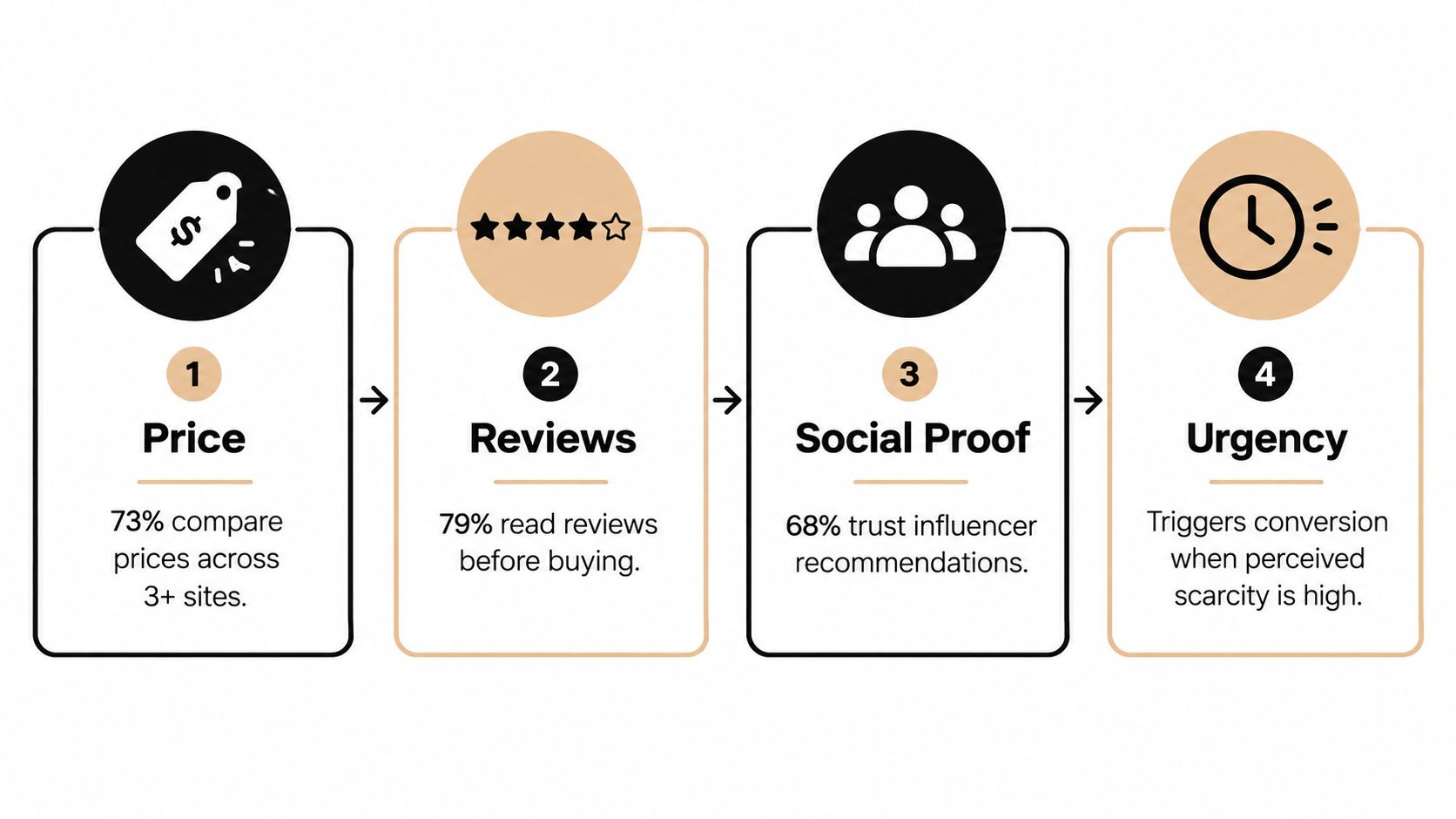
The evidence stack
Search visibility is usually the first credibility test. If a founder searches your brand, your category, and an “alternative to” query, they want to see whether you show up in all three places with a coherent story. Google's clickstream research found that purchasers often use search during research and switch between brand-specific and generic queries. In practice, that means weak category pages or missing comparison content can cost you even when branded demand exists.
Owned content closes the gaps left by listings and AI summaries. Buyers use it to verify scope, not to admire messaging. They look for pricing logic, feature limits, integration depth, setup steps, privacy details, and proof that the product is maintained. If those answers are scattered or vague, people fill the gaps with assumptions, and the assumption is usually “this will be harder than it looks.”
Third-party proof tests your claims under real conditions. Good reviews name the customer type, the use case, the trade-offs, and the outcome. That level of detail helps a prospect decide whether the reviewer resembles them. A generic five-star quote may look nice on a landing page, but it does little for a buyer who is trying to reduce implementation risk.
Comparison context shapes the shortlist. Buyers are not only asking whether a product is good. They are asking whether it fits their constraints better than the next option surfaced by search or AI. A useful alternatives page does not posture. It explains where your product is stronger, where it is narrower, and which buyer should pick something else.
Risk policies often decide the deal late in the process. Cancellation terms, refund rules, export options, support access, and security or privacy material matter most when the product touches workflows, data, or recurring spend. I have seen buyers accept a weaker feature set when the exit path was clearer and the support model felt safer.
Use this quick audit:
- Can a stranger understand the category? Drop internal language and explain the job clearly.
- Can a prospect compare you quickly? Publish structured facts, not only persuasive copy.
- Can they verify the important claims? Link to docs, demos, examples, or changelogs.
- Can they find the same answer later? Keep pricing, features, and policies consistent across surfaces.
- Can they identify the downside? Clear limits often build more trust than broad promises.
The strongest signal is the one that resolves the buyer's current uncertainty.
Comparing Decision Tools and Methods Side by Side
Different decisions require different levels of structure. A quick choice between two low-risk options may need a simple scorecard. A vendor selection involving migration, privacy, or recurring cost deserves weighted criteria and explicit verification.
A simple scorecard works when the criteria are obvious and the consequences are limited. Give each option a small set of pass or fail checks, then choose the candidate that clears the important requirements. It's fast, transparent, and easy to discuss.
A weighted decision matrix is better when criteria have unequal importance. Assign weights to factors such as fit, cost, support, portability, and implementation effort, then score each option. The matrix doesn't produce truth by itself. It exposes the assumptions behind the choice.
Generative AI assistants are useful for expanding the option set, translating vague requirements into search terms, and identifying questions you hadn't considered. They're poor substitutes for current pricing checks, first-party documentation, and direct product testing. An AI-generated shortlist is a research aid, not a decision record.
Curated directories support repeated discovery and comparison. They can be more useful than a one-off review when buyers return to inspect categories, alternatives, product details, and related tools. The trade-off is that a directory listing still needs complete, accurate information to become a useful decision asset.
| Method | Best For | Time Cost | Verification Needed |
|---|---|---|---|
| Simple scorecard | Low-risk choices with clear requirements | Low | Basic |
| Weighted matrix | High-impact choices with competing criteria | Medium | High |
| AI assistant | Early discovery and question generation | Low | Very high |
| Curated directory | Category discovery and repeated comparison | Medium | High |
A spreadsheet becomes counterproductive when you keep adding criteria without deciding which ones matter. Keep the model tied to the decision. For a product name, memorability and distinctiveness may matter more than a long feature checklist. For software, data handling and migration effort may outweigh a broad but rarely used feature set.
For naming exploration, a focused tool such as an app name generator can expand the candidate pool, but every serious option still needs domain, trademark, pronunciation, and audience checks.
How FlipSimu Can Help
Not every decision needs a research stack. Some choices are clearly binary, low-risk, and reversible. The mistake is using a randomizer to avoid thinking about a consequential decision, then calling the result evidence.
FlipSimu is an online collection of randomization and decision tools centered on a customizable Coin Flip Simulator. It also includes browser-based coin tosses, dice rollers, tarot-style yes or no responses, and number flashcards. The practical use is simple: make a decision rule first, then use randomness to break a tie when both options are acceptable.
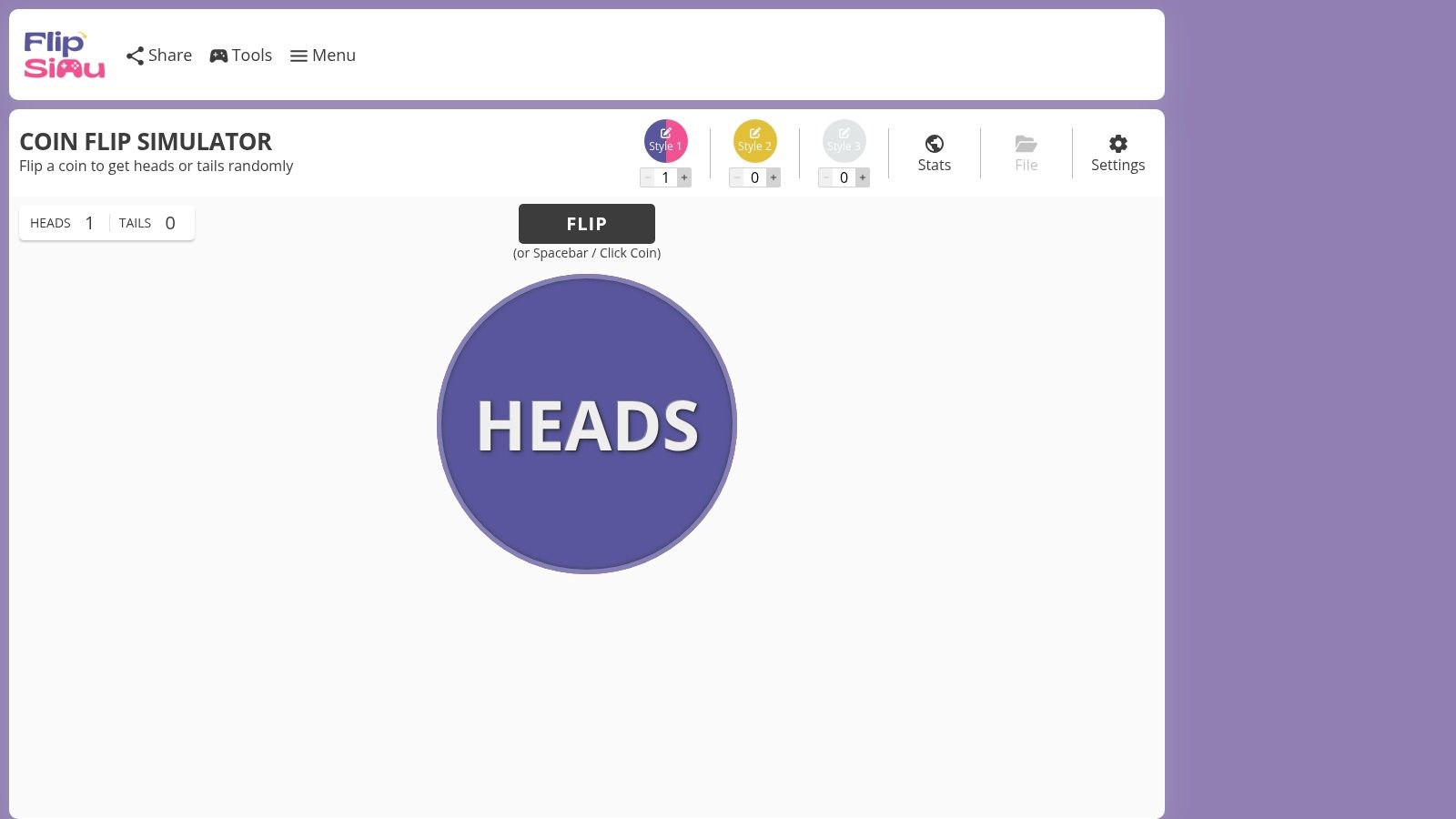
The platform supports configurable heads and tails labels, images, colors, backgrounds, flip energy, and sound. Purpose-built variants include Yes or No Coin, Stay or Go Coin, and 1 or 2 Coin. The Intuition Test lets users guess before a flip, while the Luck Test tracks streaks. Dice tools cover common polyhedral formats and tabletop combinations, and number flashcards support learning or activity prompts.
Its value increases when a recurring activity needs consistency. Users can manage up to three coin styles and up to 20 coins in a session, save up to five files, create three custom color sets, and access configurations across devices. Sharing and embedding options make a setup reusable for classrooms, games, team rituals, or websites.
A verification routine for random outcomes
Use the tool only after completing the analytical work:
- Define the decision in one sentence.
- List the acceptable outcomes.
- Identify any deal-breakers that randomness can't override.
- Set a review date or experiment boundary.
- Run the flip or roll.
- Notice your immediate reaction.
- Either commit or revise the criteria.
That last step is important. If the result produces instant resistance, the randomizer has revealed a preference, not discovered an objective answer. For a lightweight tie-breaker, FlipSimu, an online decision maker offers enough customization to make the process quick and repeatable without installing a separate physical tool.
When Speed Is the Wrong Goal for a Decision
You ask an AI assistant for the best launch channel, get a clean shortlist in seconds, and feel productive. Then the actual work starts. If the wrong choice burns weeks of outreach, confuses positioning, or forces a messy rollback, fast output was never the win. The useful question is about reversibility, downside, and how much proof you need before acting.
Adobe's February 2025 consumer research found that 36% of generative-AI users had replaced traditional search with AI assistants, 25% used AI for shopping or price comparison, and 18% used it for product recommendations. Among people already using AI platforms, 72% relied on them as their primary tool for researching products and brands. Adobe's research on generative AI referral traffic makes the shift hard to ignore. It does not mean AI answers are the same as verified buying evidence.

The trade-off shows up differently in each founder decision.
A solo maker picking between two names can move quickly because the choice is still easy to test. Say the names aloud. Check whether someone can spell them after hearing them once. Search for competing meanings. If one candidate fails, the cost of changing course is still manageable.
A bootstrapped SaaS team choosing a launch channel needs a slower standard. AI can surface communities, review sites, and directories, but discovery alone is weak evidence. The team still has to check audience fit, listing quality, whether buyers return later to compare options, and what kind of traffic shows buying intent. Good operators treat channel selection as a portfolio decision, not a single bet.
Pricing changes need even more caution. A small studio should not rewrite every tier because one summary or one loud customer suggests it. Run a reversible test. Set success and failure conditions before the change goes live. Learn what happens to qualified demand before creating migration pain for existing customers.
Stop and verify when the downside is severe, the information is stale, or the decision is hard to undo.
Use this verification protocol when AI gives you a shortlist:
- Define criteria first: Separate deal-breakers from preferences.
- Ask multiple systems: Compare recommendations instead of accepting one ranking.
- Inspect evidence: Trace each important claim back to its source.
- Check first-party pages: Confirm current pricing, availability, policies, and specifications.
- Add constraints: Re-test for budget, privacy, geography, accessibility, and switching costs.
- Assign confidence: Mark each conclusion as verified, plausible, or unresolved.
- Escalate sensitive choices: Use a qualified human for medical, legal, financial, security, or privacy decisions.
Bain reported that 80% of more than 1,100 U.S. consumers surveyed relied on zero-click AI results for at least 40% of their searches, while separate research indicates AI search still represents less than 1% of referral traffic. Bain's analysis of AI agents captures the core tension. AI can shape discovery early, while classic search, review pages, product sites, and comparison content still do much of the conversion work.
Measure assisted discovery accordingly. Watch branded searches, qualified visits, repeat visitors, direct traffic, and delayed conversions. An AI mention should be judged by whether it starts a serious research path, not only by whether it earns an immediate click.
Real Founder Decisions Using These Methods
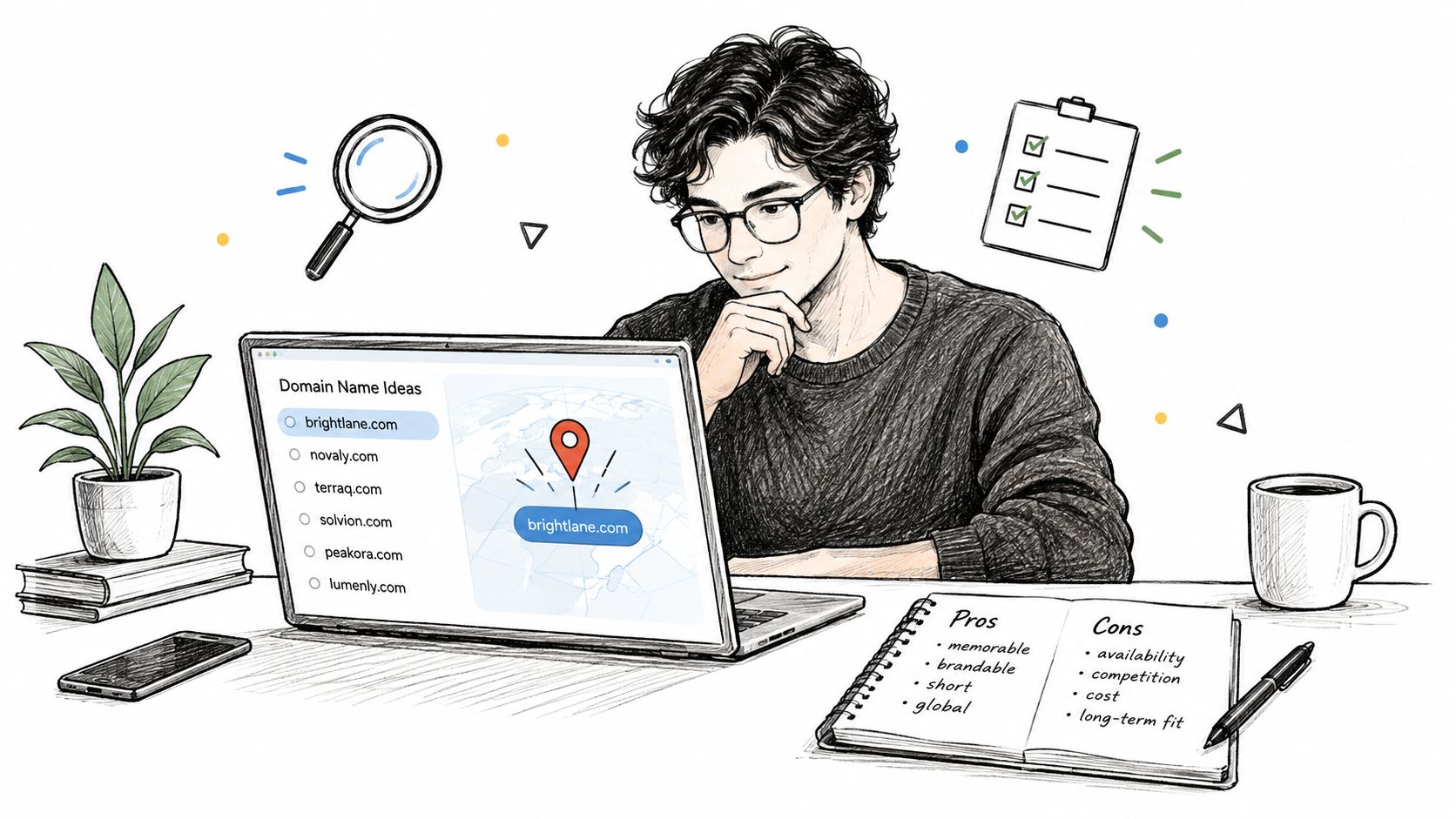
A founder naming a product usually starts wide, then gets strict fast. A generator can produce options, but the real work starts after that. Say each name out loud. Ask someone unfamiliar with the product to spell it back. Check for competing meanings, awkward pronunciations, and whether the name hints at the category or hides it. Then search and browse directories to see whether the name is distinct enough to earn recall instead of blending into a crowded results page.
A bootstrapped SaaS team has a different decision. It needs discovery, but it also needs proof that holds up when a buyer leaves, compares options, and returns later. AI summaries can create first contact. They rarely close the case on their own. Founders need a product page, a directory profile, current docs, and comparison content that answers the next question before the buyer asks it. Because buyers switch between branded and category searches, smart teams publish both a clear product page and an alternatives page so either research path reaches current evidence.
Pricing changes create another kind of pressure. A small studio cannot treat one loud customer as the market, and it should not push every account into a change that is hard to reverse. Set a test window. Watch qualified behavior, not just reactions. Talk to affected users. Keep a rollback option ready before changing packaging, limits, or price presentation.
A practical founder sequence
- Frame the decision: Write the problem clearly, not the answer you already want.
- Collect constraints: Include budget, audience, technical limits, privacy expectations, and timing.
- Map alternatives: Use search, AI assistants, communities, and directories to build the complete set.
- Separate discovery from proof: Mark claims as reported, observed, or verified.
- Build comparable pages: Publish use case, audience, pricing model, integrations, and boundaries.
- Test first impression: Ask unfamiliar users what they think the product does within seconds.
- Choose distribution surfaces: Combine owned pages with third-party places where buyers already research.
- Run a reversible experiment: Test naming, pricing, messaging, or channel assumptions before locking them in.
- Log the decision: Record criteria, evidence, confidence, owner, and review date.
- Revisit with new evidence: Update the call when buyer behavior contradicts the original assumption.
If you want to see how teams sequence these choices in the wild, review these product launch examples, then adapt the mechanics to your category, buyer, and margin for error.
Launch and Growth Playbook for Indie Founders
A strong launch sequence gives every research task a distribution purpose. The following checklist is designed for a founder moving from an unproven idea to a product that buyers can repeatedly discover and validate.
- Interview for the problem. Capture the language people use before you choose keywords or positioning.
- Create an AI-assisted competitor map. Use assistants to expand the list, then verify each competitor on its own site.
- Define decision criteria. Separate mandatory fit from attractive extras.
- Publish a structured product page. Include audience, use cases, integrations, pricing model, limitations, and support.
- Create comparison and alternatives content. Explain differences plainly instead of declaring universal superiority.
- Submit to relevant discovery surfaces. Choose directories and communities where your buyers already research.
- Request specific reviews. Ask users to describe their context, workflow, and trade-offs, not just provide praise.
- Test pricing or packaging reversibly. Set a clear observation period and rollback condition.
- Measure assisted discovery. Track branded searches, qualified visits, repeat visits, referrals, and later conversions.
- Re-evaluate quarterly or after a material product change. Update stale claims, screenshots, pricing, and alternatives.
B2B buyers often need both self-service information and human validation. McKinsey's survey of more than 1,000 B2B buyers across four countries found that 76% said speaking with a salesperson was helpful when researching a new product, while 46% were willing to purchase through a supplier website if the process was efficient. The same research found that 46% struggled to compare products accurately online. McKinsey's research on digital B2B buying supports a hybrid approach: make self-service clear, then offer human help where uncertainty remains.
Keep a decision log with five fields: question, criteria, evidence, confidence, and review date. That record prevents a later team from mistaking an old assumption for a permanent truth.
For a practical collection of launch resources, use this product launch toolkit as a starting point, then remove anything that doesn't connect to a real decision or distribution need.
Habits, Pitfalls, and Quick Answers
A careful buyer rarely decides in one pass anymore. They skim search results, open comparison pages, check reviews, ask an AI assistant for a summary, then come back later to verify the parts that could create regret. Good online decision makers build habits for that reality.
Three habits matter more than the rest. Verify first-party facts before repeating them. Pricing, availability, policies, integrations, and technical limits should be checked on the source that controls them. Prefer reversibility over speed when the downside is real. Trials, staged rollouts, and narrow tests beat a fast commitment you cannot unwind. Log the reasoning so the next decision improves instead of restarting from memory.
The common failures are predictable. Founders chase visibility in search or AI answers without checking whether that attention leads to qualified visits, repeat visits, or later conversions. They mirror a competitor's roadmap because it looks convincing, then discover the competitor was solving for a different market, margin, or support burden. Buyers make their own version of the same mistake when they trust a polished comparison but skip freshness checks, exclusions, implementation effort, or switching costs.
Quick answers
How can I tell whether AI discovery converts?
Track branded search, qualified visits, repeat visits, assisted paths, and later conversions. AI visibility and referral traffic are not the same thing, so measure discovery and conversion as separate outcomes.
When should I choose a directory listing over a paid review?
Use the format that matches the research job. A directory helps when buyers need categories, alternatives, structured facts, and a page they can revisit while comparing options. A paid review is stronger when the writer can add real testing, useful context, and credible judgment.
How often should founders revisit the checklist?
Review it after a meaningful change in product, pricing, audience, or channel. Revisit sooner if buyers keep finding conflicting information or asking questions your pages still do not answer.
If you're launching an indie product, publish the evidence buyers need before they ask for it. Create a clear listing, support it with comparison-ready details, and make your launch discoverable across the search and directory surfaces where prospects return to validate a choice. IndieTool can help you put that distribution layer in place with a one-time product listing and launch-focused discovery tools.