Indietool
Product Launch Toolkit: 10 Tools for Indie Founders
You've built the product, polished the landing page, and scheduled the announcement. Then launch day arrives, and the problem becomes obvious: a listing alone doesn't create durable demand. An indie founder needs a sequence that validates interest, captures sign-ups, creates discoverability, earns links and mentions, and measures actions that matter.
A practical product launch toolkit should support three stages. Before launch, you build demand and collect qualified prospects. During launch, you concentrate attention through a focused directory, community, or product platform. After launch, you extend discovery through search pages, backlinks, content, and outreach instead of treating launch day as the finish line. The SleekPost product launch playbook follows this broader view of launch promotion.
The ten resources below are organized around distinct jobs, not interchangeable directories. Some help you collect sign-ups, some create launch-day visibility, and others support persistent discovery or PR. Traffic, rankings, and conversions will vary by audience, category, positioning, and execution. Choose based on your bottleneck, setup capacity, and budget, then combine only tools that add a missing capability.
Table of Contents
- 1. IndieTool
- 2. Product Hunt
- 3. BetaList
- 4. Uneed
- 5. SaaSHub
- 6. PitchWall
- 7. KickoffLabs
- 8. Prefinery
- 9. Viral Loops
- 10. Connectively
- Top 10 Product Launch Toolkit Comparison
- Turn the Toolkit Into a Launch Sequence
1. IndieTool
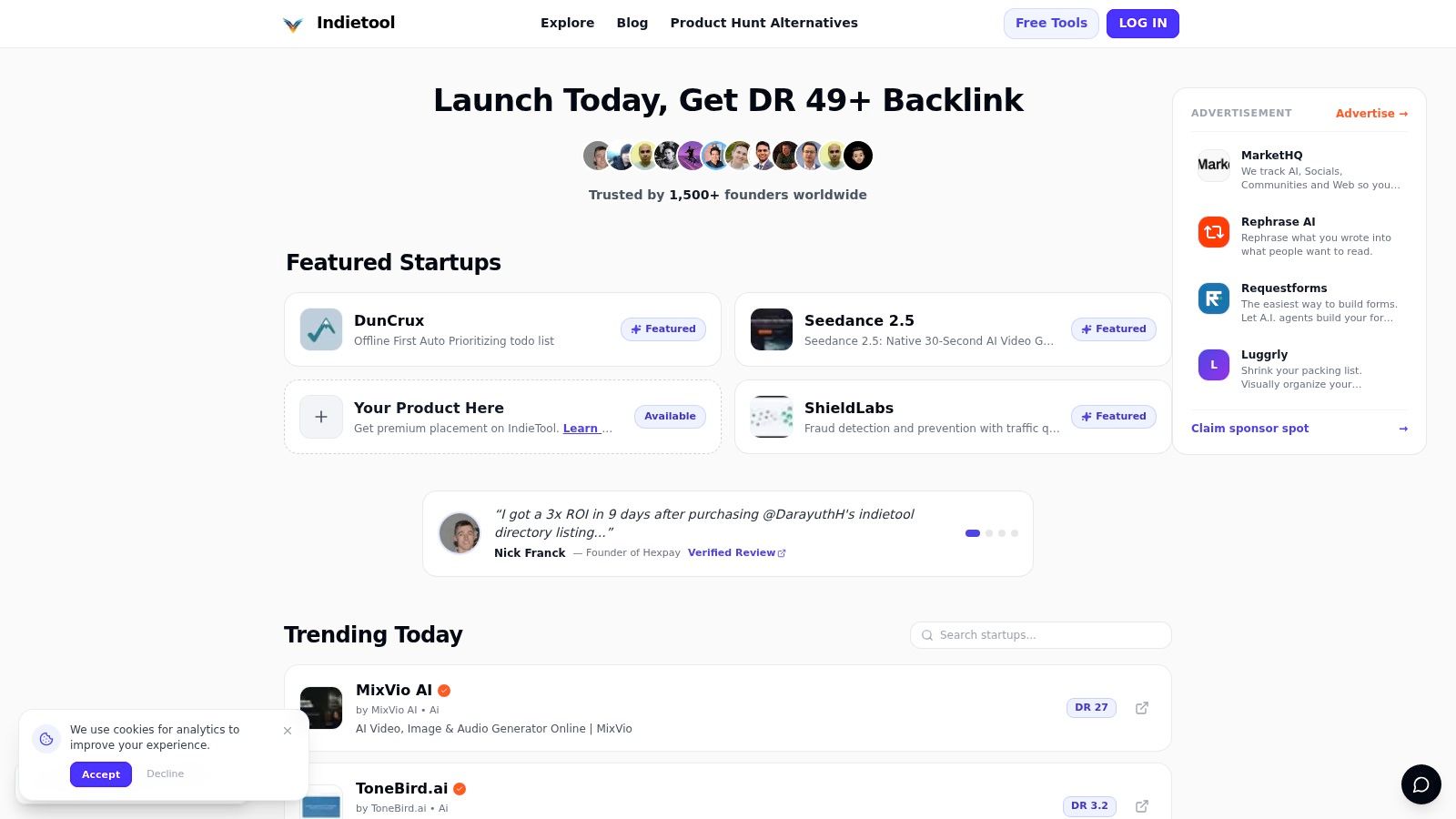
IndieTool is the strongest fit when your launch needs persistent discovery rather than a one-day spike. It's a launch-focused directory and distribution platform for indie founders, bootstrapped SaaS teams, startup studios, and makers building AI, productivity, or developer products.
The core offer is simple. You submit a product through one-time credits, and IndieTool creates a permanent listing with a direct do-follow backlink. The platform reports domain ratings in the DR 35+ to DR 49 range, while the listing and backlink can become active in about 60 seconds through automated indexing. IndieTool also distributes listings across 1,210+ index, category, and alternatives pages, giving search engines more places to encounter the product.
That doesn't make IndieTool a complete SEO strategy. A directory link can support early discovery, but it won't replace useful product pages, editorial links, customer mentions, or ongoing content. Results still depend on competition, relevance, and how clearly your listing explains the product.
Where IndieTool earns its place
The one-time model is valuable for founders who don't want another monthly subscription. Credits are available in packages of 1, 5, or 30 lifetime submissions, and the credits don't expire. The site displays different promotional and tier prices, including $29.99 and $54 in different places, so check the current checkout before buying.
The founder dashboard shows views, visitors, and outbound clicks using cookieless, privacy-friendly analytics. You can also update your listing after launch, which matters when pricing, positioning, screenshots, or product scope changes. Optional promotion includes a post on X through @indietool and inclusion in a builder-focused newsletter with roughly 1,000 to 1,500 subscribers.
- Best for: Early-stage products that need an indexable listing, a permanent backlink, and a modest builder audience.
- Useful extras: Free naming, logo, email, pricing-analysis, mission, productivity, and business-idea utilities for launch preparation.
- Main limitation: Exposure is an accelerator, not a substitute for sustained marketing, link building, or content.
For founders comparing launch directories, this Product Hunt, BetaList, and IndieTool comparison helps clarify how the platforms differ.
Practical rule: Use IndieTool to create a durable discovery asset after your core positioning is ready. Don't use it as a reason to skip customer research or product-specific content.
Website: IndieTool
2. Product Hunt
Product Hunt is the clearest choice when you want a concentrated launch moment in front of early adopters. Its native launch page supports a gallery, tagline, pricing, promotional codes, maker information, and pre-launch surfaces, so the page can function as both an announcement and a conversion aid.
The advantage is audience intent. People visit Product Hunt specifically to find new technology, which makes a well-demonstrated product easier to understand than it might be on a general business directory. A strong launch can also produce social proof through comments, profile activity, badges, and later references in product roundups.
The trade-off is competition. Your product needs a sharp promise, a credible maker profile, strong visuals, and a launch plan that gets supporters involved without resorting to low-quality promotion. Products that are difficult to demo, highly confidential, or aimed at a narrow enterprise buying committee may find the audience less useful.
Preparation matters more than the listing
Product Hunt provides current guidance for preparation, launch day, and follow-up through its official launch resources. Use those materials to understand platform rules and presentation expectations, but don't treat a playbook as a guarantee of ranking.
A practical setup includes a concise tagline, a short product video or animated walkthrough, clear pricing context, and a maker comment that explains why the product exists. Send visitors to one focused action, such as starting a trial or joining a waitlist. If your page asks people to inspect five unrelated features, the launch may generate attention without useful intent.
Website: Product Hunt
3. BetaList
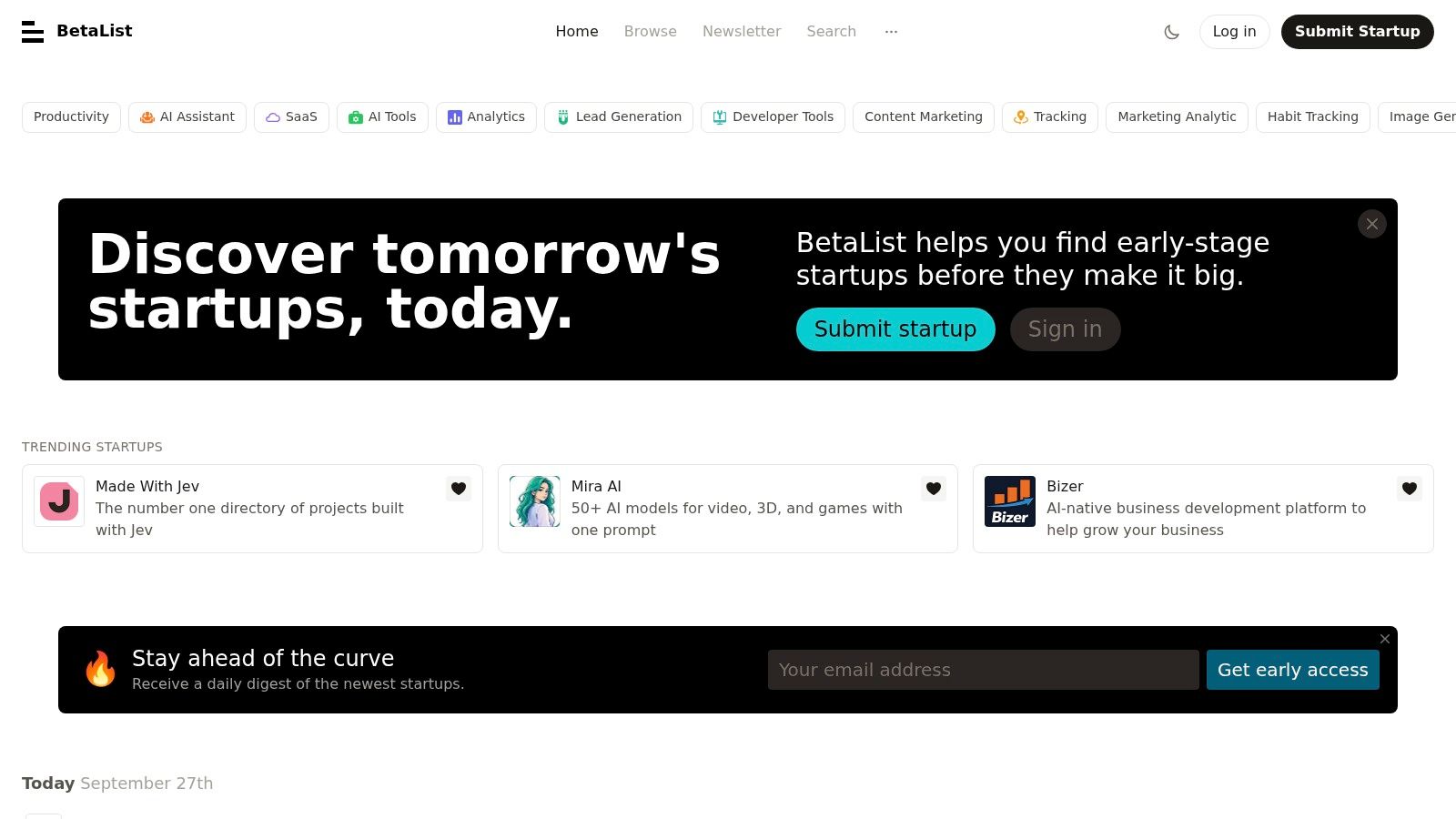
BetaList fits the moment between “we have an idea” and “we're ready for broad promotion.” It's designed for upcoming and newly launched startups, so the audience expects products that are still refining their positioning, onboarding, or feature set.
The main value is feedback from early adopters. A carefully written listing can attract sign-ups from people who are comfortable trying unfinished products and explaining what confused them. BetaList also supports UTM parameters, which lets you distinguish visits and sign-ups from this source inside your analytics rather than guessing from referral traffic.
Treat the listing as a research channel
BetaList now uses a paid submission model, and the impact can vary by category, timing, and how compelling the product page is. That makes it a poor choice if you're expecting a guaranteed volume of users. It's more useful when you've defined the feedback you want and can follow up with new sign-ups quickly.
Write the listing for a curious early adopter, not an investor. Explain the problem, show the product in use, and make the requested action explicit. If the product isn't ready for outside users, a listing may create support work before it creates learning.
Use this broader startup listing sites guide to compare BetaList with other discovery options before paying for multiple submissions.
Website: BetaList
4. Uneed
Uneed is useful when you want homepage visibility and a backlink in the same launch purchase. The platform positions itself as a social launchpad, with launch and relaunch options, scheduling, and a do-follow backlink from a high-domain-rating site.
The practical difference is predictability. Uneed offers a guaranteed homepage placement for the launch, including a “skip the line” option, rather than leaving every submission in an uncertain queue. Optional additions include newsletter promotion, featured placements, and hand-submission to roughly 100 directories for broader link-building coverage.
Use it selectively
Uneed publishes pricing for launches, relaunches, and advertising options, which makes budgeting easier than with platforms that require a sales conversation. The free waiting line is closed, so founders should expect to pay for participation. A homepage placement still won't guarantee qualified traffic, and category fit remains more important than visibility alone.
I'd use Uneed when the product has a clear audience on the platform and the launch timing matters. I wouldn't buy every add-on automatically. Start with the core placement, add newsletter or directory distribution only when you can track a specific acquisition or discovery goal, and avoid submitting identical copy everywhere.
Website: Uneed
5. SaaSHub
SaaSHub is a better fit for long-tail discovery and comparison traffic than for a dramatic launch-day event. Its directory pages help users compare software, evaluate alternatives, and discover products after the original announcement has disappeared from social feeds.
The basic listing and verification flow is free, with an optional Featured Product placement for added visibility. SaaSHub also offers a “SaaSHub Submit” tool that helps founders coordinate submissions to relevant communities and directories. That can reduce repetitive research, especially when you're preparing a broader distribution pass.
Don't confuse directory presence with authority
Editorial queues can take time, and links are often nofollow. Featured placement is paid, and its value depends on whether your product appears in a category where users are actively comparing solutions. The directory can support brand discovery, but it won't fix unclear positioning or weak product differentiation.
Write the listing around comparison questions. Who is the product for? What does it replace? Which workflow does it simplify? Which type of buyer shouldn't use it? Honest boundaries make comparison pages more useful and can reduce irrelevant clicks.
SaaSHub works well alongside a launch platform because it gives your product another discovery surface. It shouldn't replace your main launch announcement, waitlist, or product education.
Website: SaaSHub Submit
6. PitchWall
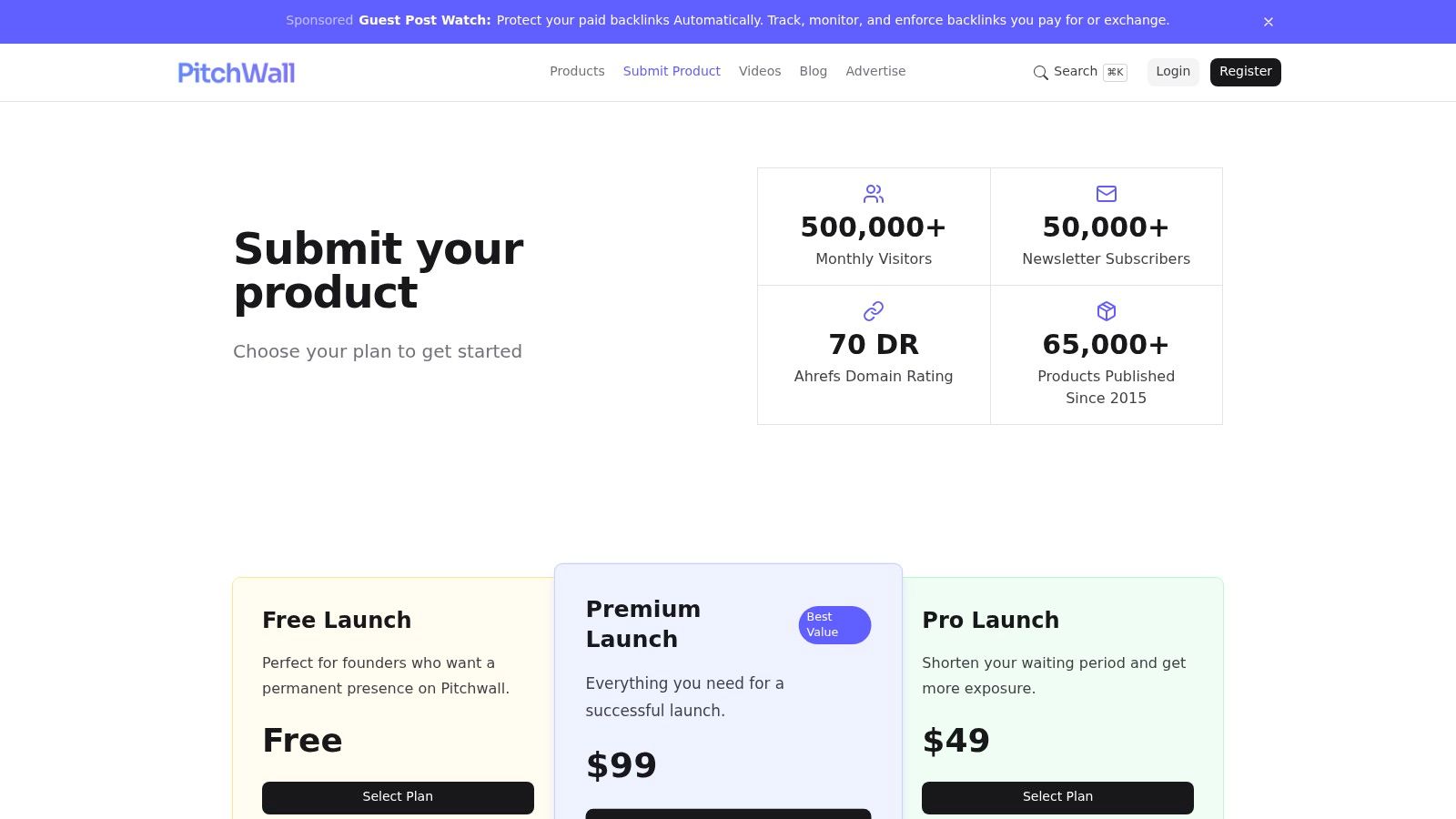
PitchWall focuses on AI tools, SaaS, and startups, with manual review intended to keep the catalog more relevant than an unmoderated submission dump. That niche focus makes it attractive for products aimed at makers, technical users, and early adopters already browsing new software.
The submission flow is straightforward, and founders can edit listings through a login after approval. Depending on the package, PitchWall may also promote a product through its X account. That combination gives the listing some ongoing utility, particularly when your product story changes after initial feedback.
The audience fit is the deciding factor
PitchWall is a newer, niche-skewed platform, so traffic can vary. Public pricing information is limited, and advertising options may require an inquiry. That makes it harder to compare costs in advance than a platform with a complete pricing page.
Use a specific product description rather than broad language such as “the future of work.” A reviewer needs to understand the buyer, the workflow, and the visible outcome quickly. If your tool serves a highly specialized offline industry, PitchWall may offer less value than a directory that ranks for your exact category.
Manual moderation is useful, but it isn't a substitute for a launch sequence. Pair the listing with a waitlist, a founder-led announcement, or outreach to people who already experience the problem.
Website: PitchWall
7. KickoffLabs
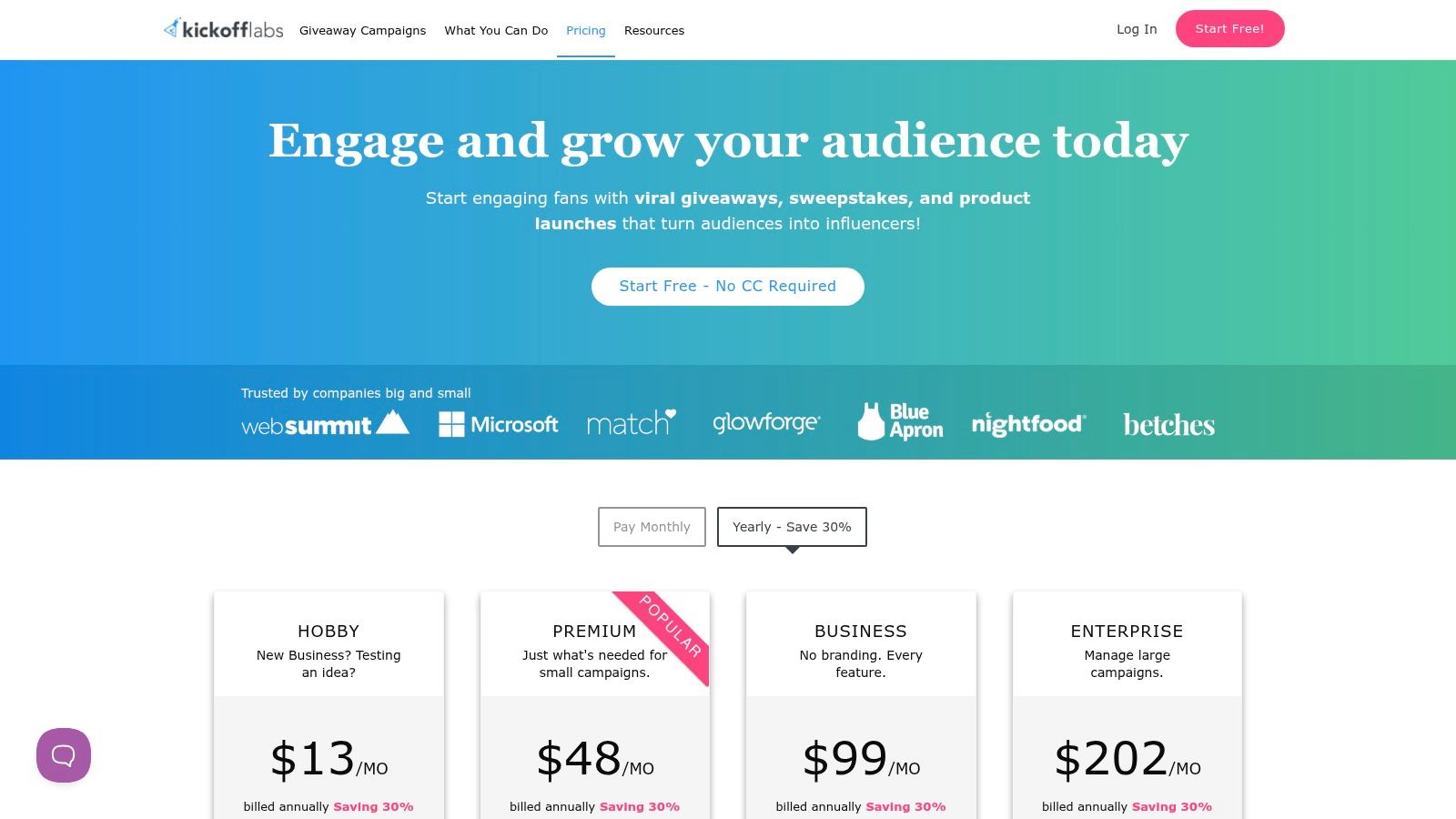
KickoffLabs belongs at the demand-capture stage, before you send traffic to launch directories. It provides hosted landing pages for waitlists, contests, and sweepstakes, with referral tracking, fraud prevention, A/B testing, email automation, pixels, and integrations.
The platform is useful when you want prospects to do more than submit an email. A referral campaign can reward people for inviting others, while a leaderboard can create a visible reason to share. That gives you a mechanism for turning an initial audience into additional reach without building referral logic from scratch.
Campaign operations still matter
KickoffLabs has lead-based plan limits, and overages can move you into a higher tier. Check the billing behavior before sending a large promotion. The platform also works best when you have a worthwhile incentive, a clear referral action, and someone available to monitor fraud, questions, and campaign performance.
Keep the landing page narrow. State what the product does, who it helps, what early access includes, and what the visitor should do next. Do not add a referral program just because the feature exists. If the product has no meaningful reward or shareable story, a plain waitlist may produce cleaner signals.
KickoffLabs is a strong choice for a founder who wants a fast, credible pre-launch campaign with built-in growth mechanics. It's excessive for a simple form that only needs to collect names and email addresses.
Website: KickoffLabs
8. Prefinery
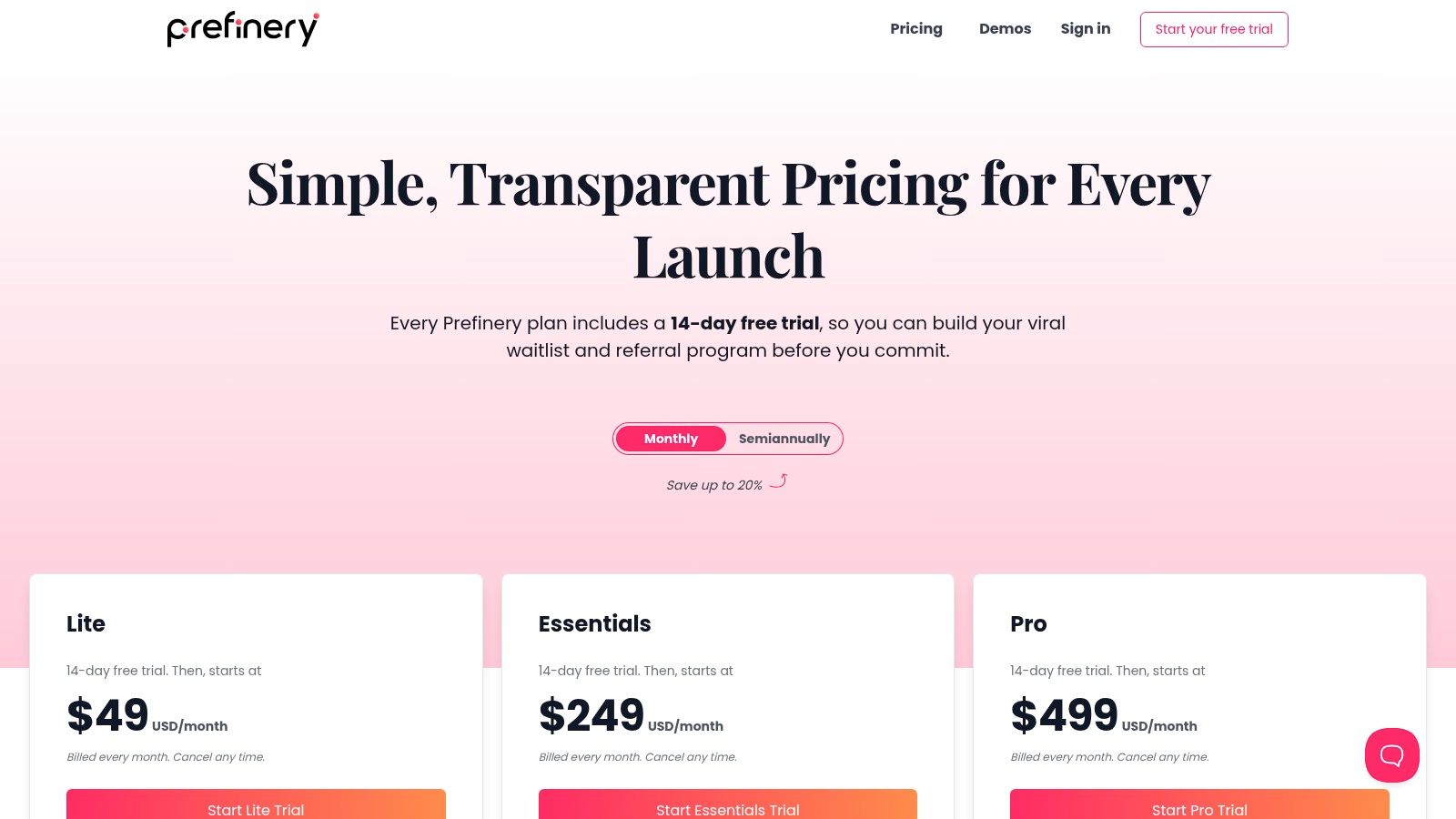
Prefinery is built for founders who want to manage a referral waitlist with more control than a basic landing page provides. It supports referral and reward mechanics, email notifications, drip sequences, webhooks, an API, and integrations with growth tools.
The strongest use case is a launch where intent matters. You can rank or segment prospects based on referral activity and engagement, then give the most interested users earlier access or more direct communication. Mature analytics and anti-fraud controls are useful when referral incentives start attracting low-quality or duplicate entries.
Choose it when the data justifies the setup
Prefinery uses usage-based pricing that scales with list size. The setup is heavier than a simple landing-page builder, and pricing steps plus semiannual billing may be more than a very small launch needs. You'll need to define rewards, referral rules, email sequences, and the handoff into your product or CRM.
That investment pays off when you need reliable referral data rather than a raw list. It also makes the platform a poor match for a founder who isn't ready to contact or qualify new leads. A waitlist only becomes useful when you have a plan for learning from, activating, and converting the people on it.
Before launching, map the events you care about, including sign-up, referral, invitation acceptance, product access, and activation. This optimization guide is useful when refining the page and the path from discovery to action.
Website: Prefinery
9. Viral Loops
Viral Loops is for founders who want proven referral mechanics without designing every campaign from a blank page. Its templates include startup pre-launch campaigns and leaderboard giveaways, with a rewards engine, fraud detection, participant import and export, and integrations with common marketing tools.
The template approach reduces implementation time. You can start with a campaign pattern that already reflects a familiar behavior, then adapt the reward and messaging to your product. That's particularly useful when launch preparation is competing with product development, support, and onboarding work.
Incentives determine the outcome
Viral Loops performs best when the reward is desirable and the campaign has active operational support. A referral widget alone won't make people share. You need a clear reason to invite friends, useful progress feedback, and timely communication when participants complete an action.
Pricing varies by plan and channel, so confirm current rates before committing. Also review how the campaign connects to your email system and product analytics. If referral data stays isolated, you may collect a large list without knowing which prospects are qualified.
Choose Viral Loops instead of KickoffLabs when the template library and campaign mechanics save more time than a hosted all-purpose launch page. Don't run both for the same waitlist unless each has a separate job.
Website: Viral Loops
10. Connectively
Connectively supports the PR side of a product launch. Journalists publish requests, and founders or brands pitch relevant expertise, examples, and commentary. The platform follows the modern HARO-style model, with request feeds, email digests, expert profiles, badges, early-access options, and tiered access using credits for pitches.
The opportunity is contextual. A launch can give you a timely reason to contribute to stories about a category, workflow, technical problem, or founder experience. A useful response may earn a press mention and an authoritative backlink, but only when the pitch answers the journalist's actual request.
Quality and relevance beat volume
Coverage isn't guaranteed, and credit-based pricing can become expensive during an aggressive PR push. You also need a process for responding quickly, checking journalist requirements, and avoiding generic promotional copy. Don't pitch every request that contains your product category. Pitch only when you can provide a specific insight, firsthand experience, or a useful explanation.
Prepare a short expert profile, a concise product description, and a few non-promotional observations about the problem you solve. Link to a relevant page only when the request allows it. Connectively is most effective as an ongoing outreach habit, not as a single burst on launch day.
Website: Connectively
Top 10 Product Launch Toolkit Comparison
| Platform | Core features | Quality & Reach ★ | Pricing & Value 💰 | Target audience 👥 | Unique selling points ✨ |
|---|---|---|---|---|---|
| 🏆 IndieTool | DR 35+ permanent do-follow backlink; instant indexing; 1,210+ pages; founder dashboard | ★★★★☆ strong SEO & fast indexation | 💰 One-time credits (1/5/30); promo ~$29–$54; credits never expire | 👥 Indie founders, bootstrapped SaaS, makers | ✨ Permanent DR links, instant live backlink, cookieless GDPR analytics |
| Product Hunt | Daily leaderboard; native launch pages; maker profiles & playbooks | ★★★★ High-intent, large single-day spikes | 💰 Free to launch; high ROI if well-prepared | 👥 Makers, early adopters, product hunters | ✨ Community-driven launch visibility & social proof |
| BetaList | Curated pre-launch listings; UTM tracking; submission guidelines | ★★★ Early feedback & signups | 💰 Paid submissions (curated) | 👥 Early-stage startups seeking feedback | ✨ Audience expects prototypes and early signups |
| Uneed | DR do-follow backlink; guaranteed homepage slot; add-ons (newsletter, directories) | ★★★★ Good DR + guaranteed visibility | 💰 Paid launch tiers; clear pricing | 👥 Founders wanting guaranteed homepage exposure | ✨ Skip-the-line launch + optional 100+ directory submissions |
| SaaSHub | Free listing & verification; Featured placement; "SaaSHub Submit" tool | ★★★ Ongoing discovery & comparison traffic | 💰 Free listing; paid Featured boosts | 👥 SaaS buyers, comparison shoppers, vendors | ✨ Long-tail comparison pages + multi-site submit tool |
| PitchWall | Manual review curation; editable listings; promo tweet on tiers | ★★★ Niche AI/SaaS audience | 💰 Tiered/quote-based (inquire) | 👥 AI/SaaS founders, niche early adopters | ✨ Human moderation to keep quality high |
| KickoffLabs | Hosted waitlists, contests, referral leaderboards; A/B & integrations | ★★★★ Strong prelaunch virality & conversions | 💰 Subscription plans (usage/lead limits) | 👥 Launch teams running viral campaigns | ✨ Built-in leaderboard & prize-driven referrals |
| Prefinery | Waitlists with referral mechanics; email drips; webhooks/API | ★★★★ Robust analytics & anti-fraud | 💰 Usage-based pricing; scales with list size | 👥 Startups needing referral/waitlist systems | ✨ Mature analytics + deep integrations |
| Viral Loops | Pre-built referral templates; fraud detection; integrations | ★★★★ Fast to deploy referral campaigns | 💰 Plan-based pricing (confirm rates) | 👥 Marketers & founders wanting referral templates | ✨ Ready-made referral templates for quick launches |
| Connectively | Journalist request feed; expert profiles; pitch credits | ★★★ Press & backlink opportunities | 💰 Credit-based tiers for pitching | 👥 PR-focused founders & startups seeking coverage | ✨ HARO-style journalist access for press mentions |
Turn the Toolkit Into a Launch Sequence
A product launch toolkit works when every resource has a defined job. Start with one demand-capture platform before launch, not three. KickoffLabs is a practical choice for a hosted waitlist with referrals, contests, and automation. Prefinery is better when you need more control over referral intent, integrations, and list behavior. Viral Loops makes sense when a template can get a referral campaign live faster than building the mechanics yourself.
Your pre-launch page should make one promise and collect one primary action. Explain the problem, show the product or concept, state what early access means, and make the next step obvious. Add referral mechanics only when the incentive and audience behavior support them. Otherwise, you'll create extra setup and noisy sign-ups without learning more about demand.
For launch day, choose one concentrated push. Product Hunt is suited to a visible technology launch with a demonstrable product and an early-adopter audience. BetaList works earlier, particularly when you want feedback and initial sign-ups. Uneed offers scheduled homepage visibility and paid distribution, while PitchWall can add a niche AI and SaaS audience. SaaSHub is more useful for ongoing comparison and alternative discovery than for a single dramatic event.
After the announcement, build the persistent layer. IndieTool can create a permanent listing, a direct do-follow backlink, broad index and category exposure, and lightweight analytics without a recurring subscription. Other relevant directories can complement it, but avoid copying the same description across every platform. Each listing should match the category, audience, and action available on that site.
Track every source with UTMs where the platform supports them. Review sign-ups, qualified visits, outbound clicks, activated users, replies, and press opportunities, not just impressions or leaderboard position. Use each platform's available analytics, then compare the quality of visitors after the initial launch period. A channel that sends fewer visitors but produces better product conversations may be more valuable than a channel with a larger spike.
The market reflects this shift from simple launch checklists to connected planning, distribution, and measurement. One industry report estimates the product launch software market at $3.44 billion in 2024, $3.76 billion in 2025, and $5.31 billion by 2029, with a projected 9.0% CAGR, as reported by the Global Product Launch Software Market Report. Another estimate places the category at $2.1 billion in 2023 and $4.5 billion by 2030, with an 11.2% projected CAGR from 2024 to 2030, and identifies tools such as HubSpot, Wrike, Asana, Trello, Monday.com, and Smartsheet as major vendors in the broader toolkit, according to Strategic Market Research.
The lesson for an indie founder isn't to buy more software. It's to select one tool per job, connect the handoffs, and keep the workflow understandable. A waitlist should feed launch communication. A launch listing should point to a focused conversion path. A directory listing should support continued discovery. PR outreach should offer useful expertise rather than repeat your landing-page copy.
Cloud-native workflows are becoming central to launch operations. A separate report estimates launch readiness software at $4.2 billion in 2025, projecting $9.8 billion by 2034, with cloud-based deployment accounting for about 78.2% of the market and product launch use cases representing 38.7% of revenue, according to Market Intelo's launch readiness software report. For a small team, that reinforces a practical principle: centralize the information you need, automate only repeatable steps, and keep human judgment focused on positioning, feedback, and relationships.
SurveyMonkey reports that 92% of users say its platform is easy to use, while its product research workflows focus on tracking product perception and satisfaction over time, as described on its product research resource page. That kind of lightweight feedback infrastructure can complement the tools above, especially when you need to validate messaging before sending a large launch audience to the product.
Finally, don't stop measuring when the launch listing goes live. Search visibility, backlinks, useful content, product comparisons, founder conversations, and journalist relationships can keep producing discovery after the announcement fades. The complete creator tools guide offers another perspective on assembling a practical stack without treating every available tool as mandatory.
Choose your bottleneck first. If you have no audience, capture demand. If you have sign-ups but no launch reach, choose one focused distribution channel. If you have launch traffic but no durable discovery, build listings, content, and outreach that remain useful after launch day. Confirm current pricing and submission rules before paying, then run the smallest sequence that can produce a clear learning signal.
IndieTool gives indie founders one-time listing credits, permanent do-follow backlinks, broad search exposure, founder analytics, and optional promotion through X and its newsletter. If you're ready to add a durable discovery and backlink layer to your product launch toolkit, visit IndieTool and submit your product.