Indietool
Marketing Strategy Process: 6 Steps for Indie Founders
You've shipped the product, posted about it twice, and got a handful of visits that went nowhere. Now you're staring at a blank week wondering whether to write a blog post, start another social account, or buy ads you can't really afford. That's not a motivation problem. It's a missing marketing strategy process. Run it as a 90-day operating loop, with fixed reviews at days 30, 60 and 90, and you'll know what to do next even when your traffic numbers are thin.
Table of Contents
- The Six Stages of a Marketing Strategy Process
- How to Research Your Market and Write a Positioning Statement
- Choosing Channels by Role, Cost and Time to Signal
- Setting Goals and a Launch Scorecard That Works
- Building a 90-Day Execution Roadmap
- Measuring Results When Attribution Is Unreliable
- Confirm Your Launch Plan This Week
The Six Stages of a Marketing Strategy Process
Treat the six stages as one connected sequence, not six separate chores. Each one produces a written output that the next stage needs. Skip an output and you'll pay for it later in random channel choices or numbers you can't interpret.
The six stages at a glance
| Stage | Question It Answers | Output | Owner |
|---|---|---|---|
| 1. Research | Who is the buyer and what do they already use? | Interview notes and a list of alternatives | Founder |
| 2. Positioning | Why should they choose you over the alternative? | One-sentence positioning statement | Founder |
| 3. Channel selection | Which two or three channels can reach them? | Channel roles and budget split | Founder or growth lead |
| 4. Goals and KPIs | What number proves the strategy works? | Scorecard with one primary metric | Founder |
| 5. Execution roadmap | What happens in each of the next 90 days? | Dated plan with named owners | Owner of each channel |
| 6. Measurement | Did it work, and what changes next? | Review notes and a reallocation decision | Founder |
Why the Order Matters
The sequence isn't tidy theory. A peer-reviewed study of 105 firms found that communication quality positively influenced cross-functional integration, which then affected strategic consensus, and that consensus subsequently influenced resource commitment during implementation. In founder terms, sharing what you learned shapes agreement on priorities, and agreement shapes what gets time and money. A solo founder holds every role, but writing each output down still matters, because an unwritten positioning statement changes every week.
Watch how a structured process connects decisions before money gets spent.
Two failure points show up most often. Skip positioning and channel selection becomes guesswork, since you don't know what message a channel should carry. Skip goals and measurement has nothing to judge, so you end up reporting activity instead of results. Guides that help you choose marketing channels with purpose are useful at stage three, but they can't rescue a product that hasn't finished stages one and two.
I would finish research and positioning before spending anything. Then set calendar dates now to review stages four to six at days 30, 60 and 90.
How to Research Your Market and Write a Positioning Statement
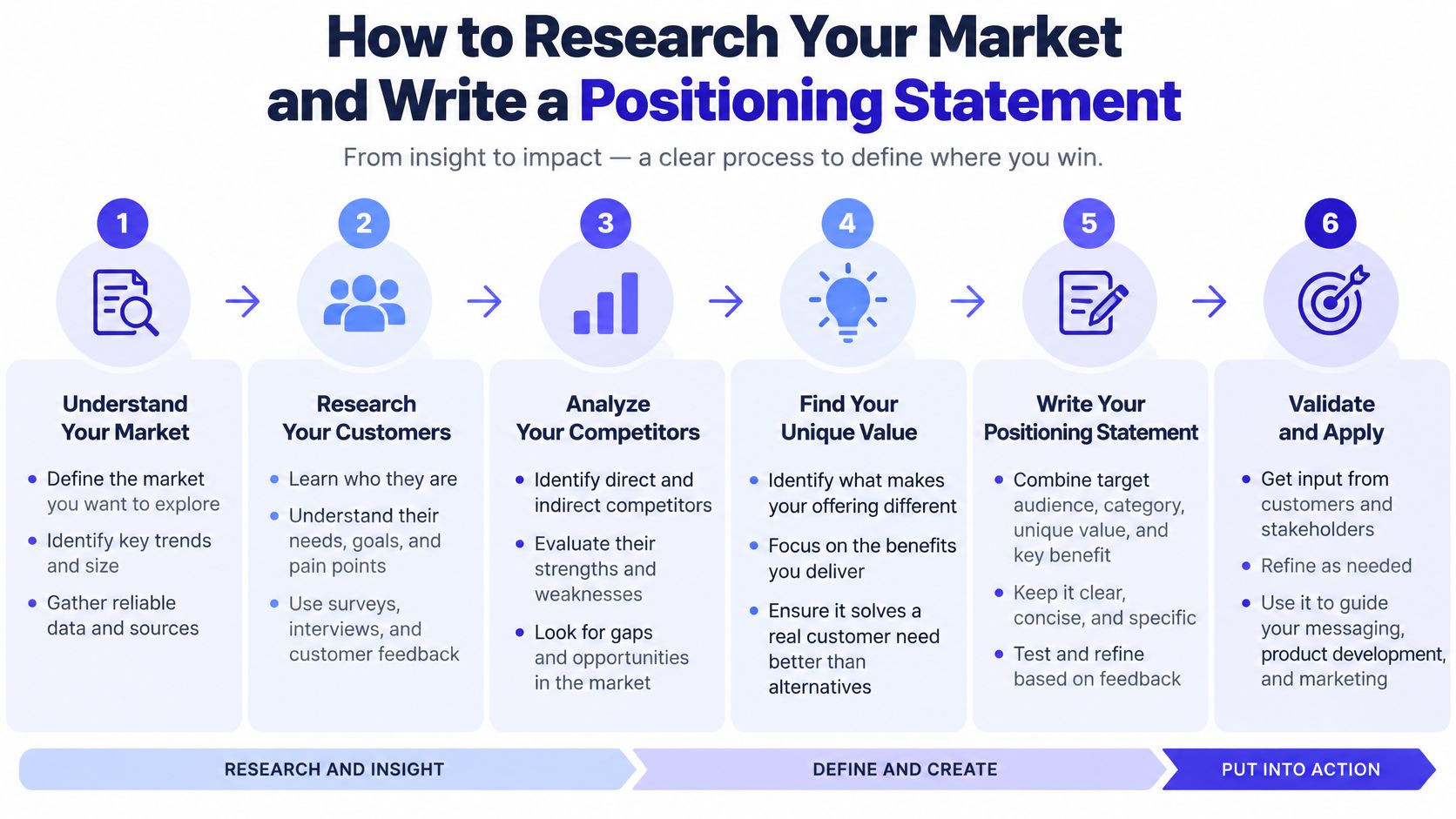
You can finish this procedure in one weekend plus a few evenings. It produces two things only: a one-page research summary and a positioning statement strangers can repeat back to you.
The Five Steps
- Interview recent buyers or trial users. Talk to ten to fifteen people and record the exact words they use for the problem and what they tried first. Skip friends and family, because they'll answer politely rather than candidly. Budget three to four hours spread across a week.
- List five alternatives. Write down what customers would use if your product didn't exist, including spreadsheets, agencies, freelancers and free tools. The common slip is listing only direct competitors with similar features. This takes about 30 minutes.
- Sort the quotes into three groups. Label each quote as pain, trigger event or desired result. You're looking for repeated wording, not clever themes. Allow about one hour.
- Draft the statement. Use this form: "For [who], [product] is the [category] that [outcome], unlike [main alternative]." Pick the alternative customers mentioned most, not the rival you most want to beat. Drafting takes about 30 minutes.
- Run the repeat test. Read the statement to five people who didn't help write it and ask each person to say it back in their own words. If they can't, the wording is too clever and you rewrite it in plainer language. Allow about two hours, including finding the people.
Your Output Checklist
- Research summary: Top three pains, top trigger events, and the five alternatives, each backed by a real quote.
- Customer language list: Twenty or so exact phrases you can reuse in headlines and listing copy.
- Positioning statement: One sentence that survived five strangers repeating it accurately.
- Rejected angles: Two or three claims you tested and dropped, with the reason, so you don't revive them next month.
If you want a worked method for reading how an existing brand presents itself before you rewrite your own, our guide on how to analyse a brand gives you a practical checklist to apply to competitors on your alternatives list.
Practical rule: If a stranger can't repeat your positioning after hearing it once, your landing page headline won't fix it.
Where AI Helps and Where It Doesn't
Use AI to summarise transcripts, cluster quotes into your three groups, and draft message variants from phrases customers said. Keep interview design, the choice of category, and the final wording with you. AI is fast at sorting language you collected. It can't tell you which alternative your buyer trusts, and it will happily produce a polished statement that sounds like every other tool in your category. I'd let it handle the sorting, then make the judgement calls myself.
Choosing Channels by Role, Cost and Time to Signal
Pick two primary channels and one test channel. Write down the budget share of each before launch, in cash and in hours per week. Every channel gets a job. If you can't state its job in one line, it doesn't make the list.
Channel roles, cash cost and time to first signal
| Channel | Main Role | Cash Cost | Time to First Signal |
|---|---|---|---|
| Search content and directory listings | Permanent discovery and backlinks | Low | 3 to 6 months |
| Community posts and forums | Early feedback and first users | Free | 1 to 4 weeks |
| Social posts (X, LinkedIn) | Launch spikes and audience building | Free to low | 1 to 3 weeks |
| Email newsletter | Repeat contact with interested users | Low | 1 to 2 months |
| Launch platforms | One-day traffic burst | Free to low | 1 day |
| Paid ads | Fast testing of messages | Medium to high | Set by a 14-day test |
| Partnerships and integrations | Borrowed audience | Low cash, high time | 1 to 3 months |
Reading the Table Like a Bootstrapped Founder
Search content and directory listings compound, but they won't save a weak launch month. Judge them at day 90, not day 7. On our platform, the automated crawler indexes listing metadata, generates a showcase page, and makes the backlink active within 60 seconds, but search value still builds over months. Community posts are your cheapest source of honest feedback and first users, provided you answer questions instead of dropping links. Social posts give you spikes and a growing audience, yet a spike tells you little about retention.
Email is the channel you own. Our newsletter delivers the latest startups, launch insights and maker stories to subscribers' inboxes, which shows the pattern worth copying, regular contact with people who already opted in. Launch platforms deliver a one-day burst that doesn't compound, so treat them as a spike inside a bigger plan. Paid ads belong in the test slot, where you're buying message feedback, not growth. Partnerships cost little cash but eat calendar time, so I would start one only when a partner's audience clearly matches your positioning.
Budget pressure is real even for larger teams. Nielsen's 2024 Annual Marketing Report says 72% of global marketers expected their advertising budgets to increase in 2024, up from 64% the previous year. You probably can't outspend anyone, so out-focus them instead. Founders comparing regional options can also review these marketing options for early-stage UAE founders for a market-specific view of channel costs.
For a deeper breakdown of how channels divide discovery, conversion and retention work, read our overview of distribution channels for marketing. My default pairing is one compounding channel, such as search or community, plus one faster channel, such as social or a launch platform.
Setting Goals and a Launch Scorecard That Works
A goal says "grow traffic." A scorecard names one primary business metric, a few diagnostic metrics, an owner, a baseline and a target. Only the second one lets you make a decision at day 30 without arguing with yourself.
Scorecard metrics and review cadence
| Metric Type | Example | Review Cadence | Decision It Drives |
|---|---|---|---|
| Acquisition input | Listing impressions, referral visits | Weekly | Keep or drop a channel |
| Qualified intent | Outbound clicks, trial starts | Weekly | Adjust the message |
| Activation | Users completing the first key action | Every two weeks | Fix onboarding |
| Business outcome | Paid conversions, retained users | Monthly | Scale or stop the strategy |
Write One Hypothesis and One Stop Rule
Every campaign on the scorecard needs a falsifiable hypothesis. For example, "if the search headline names the cost of manual reporting, trial starts from search visitors rise from 2 percent to 3 percent within 30 days." That sentence can fail, and that's the point. Vague hopes can't fail, so they never teach you anything.
Now write the stop-or-scale rule in the same sitting, before launch. For example, "if trial starts stay below the baseline after two message revisions, pause this channel at the day 30 review and move its hours to community posts." Decide the rule while you're calm. In the moment, sunk cost will argue for one more week, every week.
Counting posts published is the easiest way to feel productive while learning nothing. Count users who come back.
Match the Cadence to the Horizon
Pairing fast signals with slow outcomes isn't optional. Kantar's global survey of more than 1,000 senior marketers found that in 2025, 81% of marketers said combining short-term and long-term results was the most important approach to measuring campaign ROI. So check acquisition inputs and qualified intent weekly, activation every two weeks, and paid outcomes at days 30, 60 and 90.
At each review, move budget and hours from the weakest channel to the strongest one and record why. The mistake I see founders make most often is reporting activity, posts shipped and emails sent, instead of the outcome row. Activity belongs in your task list. It doesn't belong on your scorecard. If a metric can't change a decision at the next review, I'd cut it and keep the scorecard to one screen.
Building a 90-Day Execution Roadmap
Most strategies don't die from bad ideas. They die in execution. A review of research and practitioner evidence on marketing strategy implementation reports that estimates of strategy-implementation failure have consistently ranged from more than 60% to as high as 90%. The roadmap exists to make ownership and checkpoints visible before that drift starts.
The 90-day roadmap by phase
| Days | Phase Focus | Owner |
|---|---|---|
| Days 1 to 14 | Setup, positioning sign-off, analytics connected, one primary conversion chosen | Founder |
| Days 15 to 45 | Two launched experiments, each with one owner, reviewed at day 30 | Channel owners |
| Days 46 to 75 | Day 60 review keeps the stronger experiment and pauses the weaker | Founder |
| Days 76 to 90 | Scale the winning channel and document what was learned | Founder |
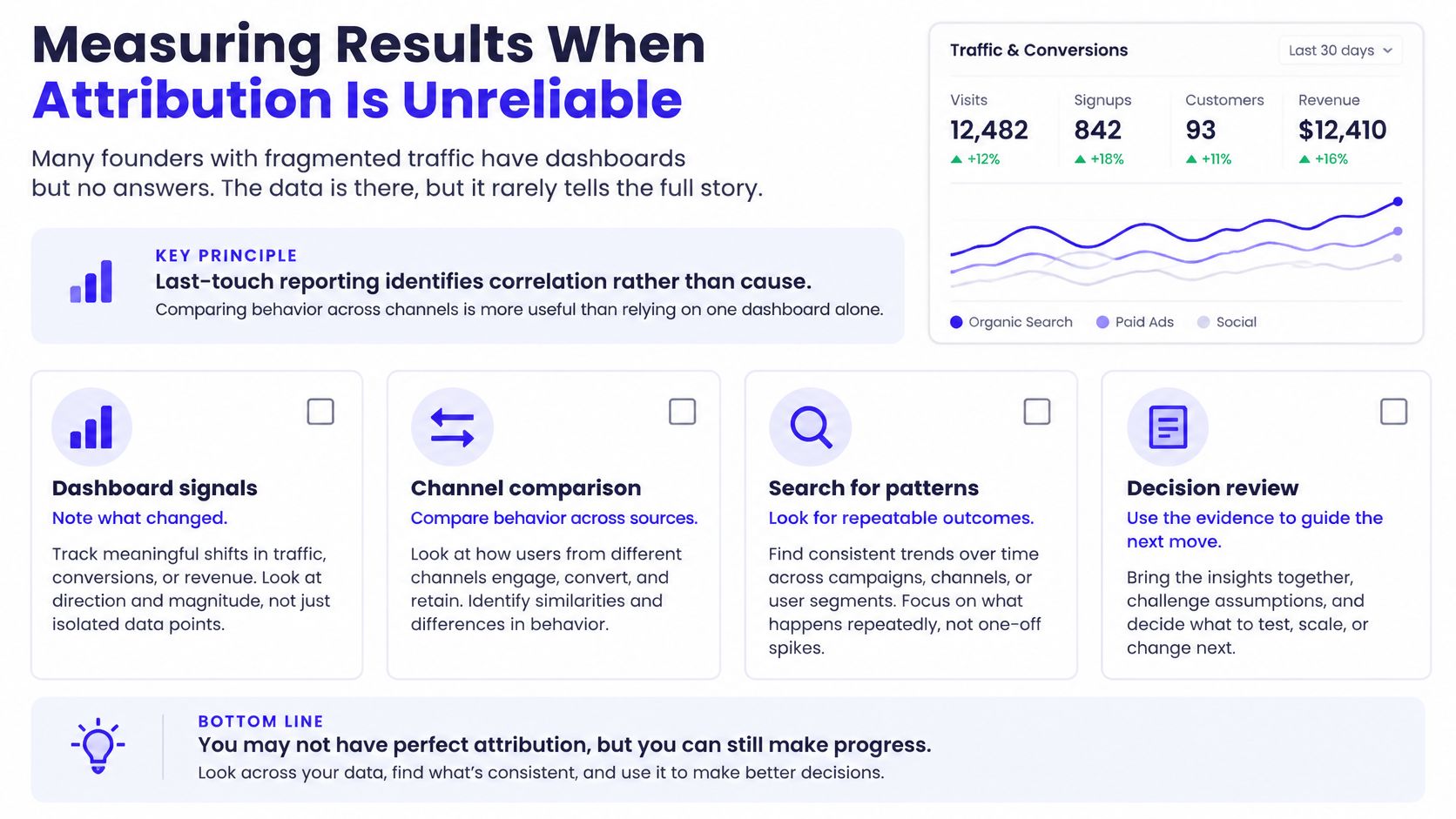
The checklist below shows how review discipline turns scattered signals into decisions.
Four Rules That Keep the Roadmap Honest
- Limit active channels. Run at most two in the first 30 days, so each one gets enough effort to produce a readable signal.
- Date and own every task. Each task carries a deadline and one named owner, even if that name is yours every time.
- Book reviews before launch. Put the day 30, 60 and 90 reviews in the calendar now, not when you feel ready.
- Record every decision. Write what you decided and the reason, in two lines, on the day you decided it.
A solo founder can run each formal review in about an hour, with a short weekly check of leading indicators in between. Bring the scorecard, the hypothesis, and the stop rule. Leave the vanity screenshots out.
A failed roadmap is easy to recognise. Three channels sit half-started, nobody recorded a baseline, and there's no review date on any calendar. Work feels busy and nothing ever gets killed, so weak channels keep eating hours. I would rather run two experiments properly and kill one at day 60 than keep four alive on hope. The kill decision is the roadmap working, not the strategy failing.
Measuring Results When Attribution Is Unreliable
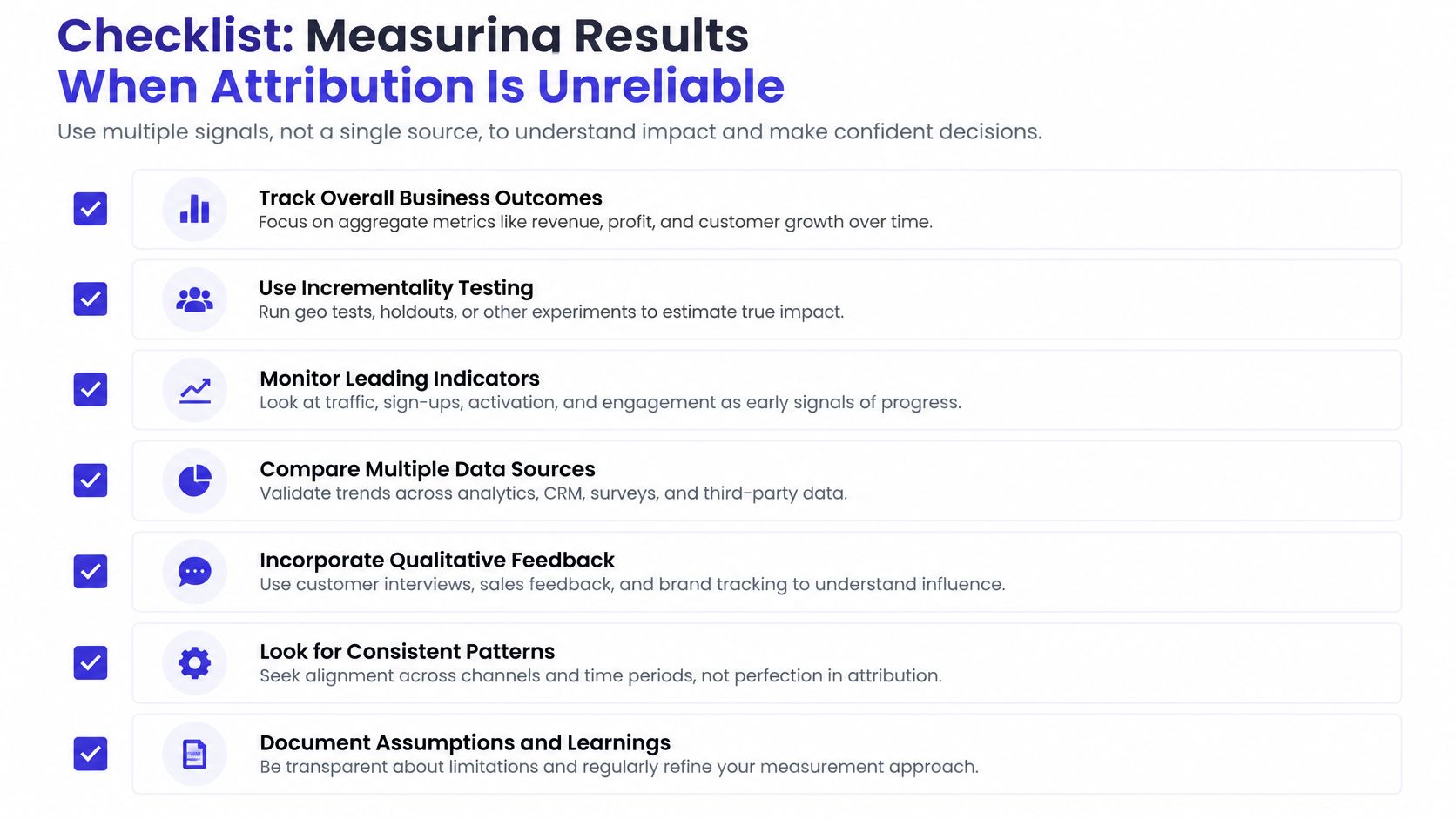
Your traffic arrives fragmented across search, social, communities, AI answers and direct referrals. You've got dashboards, but no dashboard tells you which post caused a signup three days later. Accept that limit first. Last-touch reporting identifies correlation, not cause, so treat it as a clue, never as proof.
A Six-Step Measurement Sequence
- Standardise campaign names and UTM parameters so every link you share carries the same naming pattern.
- Connect your records. Join web analytics, CRM, product events and revenue records, even if the first version is a weekly spreadsheet export.
- Define one primary conversion plus a small set of diagnostic metrics, and refuse extra metrics until a review needs one.
- Compare against a control where feasible, using a holdout group or geographic control instead of trusting before and after numbers.
- Reconcile with people. Check measured results against customer surveys and your own founder conversations.
- Report the blind spots. Write down confidence limits and what you know you're not seeing, next to every result.
Fragmented systems are the usual blocker. The Flint summary of attribution accuracy evidence cites a survey where data integration was the leading measurement barrier for 65.7% of marketers, followed by lack of expertise at 42% and difficulty tracking touchpoints at 41%. The same source places typical measurement error for incrementality testing around ±5 to 8%, versus approximately ±15 to 20% for marketing-mix modeling, though precision depends on sample size and conversion volume. You're unlikely to run either at full scale yet, but the comparison shows why a control group beats a prettier dashboard.
When Volumes Are Too Small to Test
With thin traffic, adding more analytics can make decisions worse, because tiny samples swing wildly. Use directional signals instead: branded search growth, referral clicks, indexed pages, waitlist sign-ups and interview quotes. Treat dashboard clicks as demand signals until you match them to downstream product events or a short post-launch survey asks users how they found you. Our guide to dashboard data analytics shows how to read views, visitors and outbound clicks without overclaiming what they prove.
Decision rule for thin data: If two independent signals point the same way, act. If only one dashboard does, wait for the next review.
Log AI as an Experiment, Not a Habit
Add AI to this process as a measured experiment. Log which tasks it handled, such as transcript summaries, quote clustering and message variants, then compare each output against a defined benchmark like reply rate or conversion. Keep a named human owner for the final decision on every AI-assisted asset. Without that log, you can't separate AI activity from results, and more content will pass for a strategy. I'd review the log at day 30 alongside the channel scorecard and cut any AI task that saved time but produced output nobody used.
Confirm Your Launch Plan This Week
Don't end with a summary. End with decisions, made this week, before you spend anything else.
- Finish the written outputs: One-page research summary and a positioning statement five strangers repeated back correctly.
- Lock the channels: Two primary channels and one test channel, each with a cash and hours budget.
- Write the scorecard: One primary metric, a baseline, a target, and a stop-or-scale rule per campaign.
- Enter the dates: The 90-day roadmap phases in your calendar, with the day 30 review booked now, not later.
Then decide where a permanent-discovery listing fits. If a directory category matches the positioning you chose, submit your product there and treat it as a long-horizon channel, not a one-week spike. Keep it current as your message improves. Founders can update their product name, landing page pitch, logo, category, and target URL at any time through the founder dashboard, so the listing can track each positioning revision.
Make the loop repeatable. Rerun the research when your customer changes, and rerun the scorecard every month. Before your day 30 review, do one thing: write down the stop rule for your weakest channel and the exact date you'll apply it.
Ready to give your 90-day plan a permanent discovery channel? IndieTool lists indie products in a browsable startup directory with a lasting showcase page, so buyers can find you long after launch week ends. Submit your product, pick the category that matches your positioning, and track views and outbound clicks from your founder dashboard as your scorecard fills in.