Indietool
How to Analyse a Brand Step by Step for Founders
Your homepage says one thing, your customers describe you another way, and Google barely connects either version to the problem you solve. Meanwhile, competitors with weaker products appear more often in searches, comparison pages, directories, and AI-generated recommendations. That's the point where founders usually start asking how to analyse a brand without turning the project into an expensive branding exercise.
A useful brand analysis is a decision system. It shows whether your audience understands the offer, whether your positioning differs from credible alternatives, whether your visual identity supports the message, and whether search engines and AI tools can find enough reliable evidence to represent the business accurately. The work below keeps the process rigorous, but practical enough to complete without agency bloat.
Table of Contents
- Why Brand Analysis Matters Before You Scale
- Define Your Scope and Competitive Set First
- Audit Audience and Uncover the Perception Gap
- Review Messaging and Visual Identity Against Competitors
- Assess SEO Backlinks and AI Search Visibility
- Turn Insights Into an Action Plan With Templates and KPIs
Why Brand Analysis Matters Before You Scale
A founder often notices the problem through symptoms rather than one dramatic failure. Sales calls take too long because prospects don't understand the category. Website visitors read several pages but don't convert. Content attracts traffic from people who were never likely to buy. Customers praise the product, yet they use language that doesn't match the positioning on the homepage.
Those symptoms usually point to a brand that hasn't been analysed as a connected system. The issue may sit in the audience definition, the competitive frame, the message, the customer experience, or discoverability. Changing the logo won't fix a category problem, and publishing more articles won't fix a vague promise.

Treat the audit as a set of decisions
Start with the decisions the analysis needs to support:
- Positioning: Which audience and problem should the business own?
- Messaging: What should a prospect understand within seconds?
- Product marketing: Which benefits deserve proof, explanation, or refinement?
- SEO: Which searches, pages, mentions, and links help qualified buyers discover the brand?
- Reputation: What do customers, reviewers, partners, and third-party sites say when the company isn't controlling the wording?
This approach makes the audit useful before a launch, a pricing change, a new market entry, or a major homepage rewrite. It also supports the broader business case for brand visibility as a growth asset, rather than treating visibility as a vanity metric.
What a complete analysis should reveal
By the end, you should be able to answer five practical questions:
- Who is the best-fit audience, and what alternative do they use today?
- What does the brand promise that competitors don't communicate as clearly?
- Where does intended identity differ from customer perception?
- Can buyers find credible, consistent evidence through search and AI experiences?
- Which changes should happen first, and how will you know they worked?
The order matters. Define the scope before collecting data. Compare intended positioning with real customer language. Audit the message and identity against competitors. Then examine SEO, backlinks, and AI-mediated discovery. That sequence prevents a common founder mistake, collecting disconnected metrics and calling the spreadsheet a strategy.
Practical rule: A brand audit is finished only when it changes a decision, a page, a proof point, or a distribution activity.
Define Your Scope and Competitive Set First
The fastest way to get a misleading brand analysis is to start gathering data before deciding what the analysis is for. “Understand our brand” sounds sensible, but it gives you no way to determine which audiences, competitors, searches, or customer signals matter.
Write a short research brief before opening a survey tool or SEO platform. Keep it to one page, but make each choice explicit.
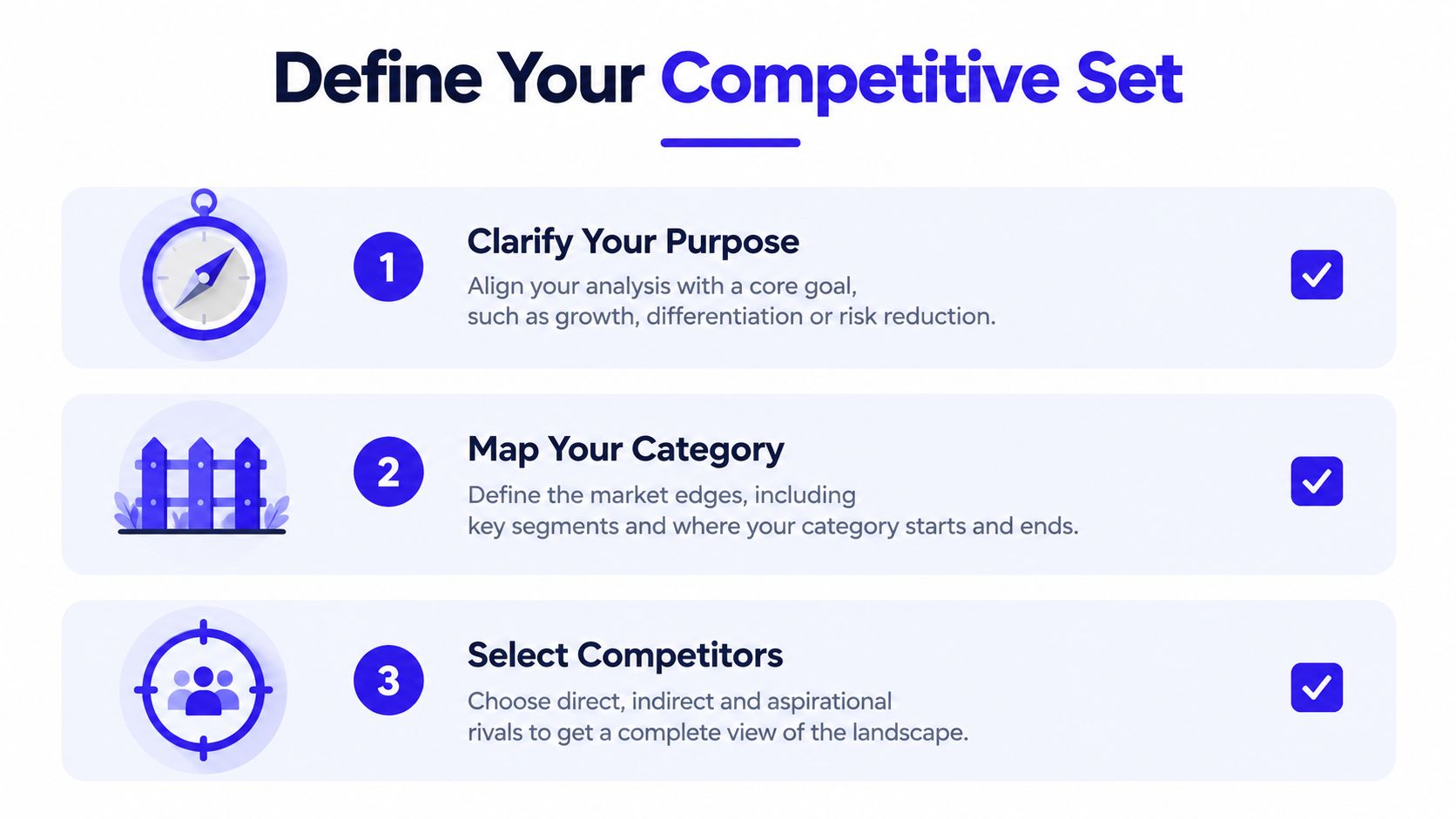
1. Clarify the decision
Choose one primary purpose. You might be deciding whether to reposition, entering a new segment, testing a new category label, or investigating why acquisition is attracting poor-fit customers. Secondary questions are fine, but they shouldn't overwhelm the main one.
A SaaS founder entering larger accounts needs a different study from a consumer app trying to improve first-purchase conversion. The first may need evidence about trust, integration, risk, and service. The second may need clearer associations with a use case, stronger proof, and better category discovery.
Record the audience, market, decision, evidence required, and deadline. This prevents interesting but irrelevant findings from taking over the project.
2. Draw the category boundary
Define what counts as a substitute. Include direct competitors that solve the same job, indirect alternatives such as spreadsheets or internal teams, and aspirational brands that shape buyer expectations even if they target a different segment.
Category boundaries affect every later comparison. If you call the market “project management software,” you may include a large set of products. If the actual problem is “helping small remote teams coordinate client deliverables,” the relevant alternatives become more specific.
Also document exclusions. A competitor can be well known but irrelevant if it serves a different buyer, price model, geography, or use case. A clear boundary makes your findings easier to explain and keeps the benchmark fair.
3. Select the competitive set
Build a working list, then divide it into three groups:
- Direct rivals: Products or services buyers compare with yours in the same buying situation.
- Indirect alternatives: Different solutions that address the same job or pain.
- Aspirational references: Brands whose clarity, trust, experience, or distribution sets a useful standard.
For each competitor, capture the target audience, category language, promise, proof, pricing signal, primary acquisition channels, content themes, visual cues, and customer objections. A practical guide to conduct competitor analysis for growth can help structure this inventory without turning it into a generic feature checklist.
Design the research before collecting responses
Survey design can distort the result. The order of questions can influence later answers, response options can push people toward the choices you expect, and a sample that doesn't represent the population can make a polished analysis unusable. These risks are documented in guidance on common problems in brand equity measurement.
For most populations, the commonly cited minimum is 383 to 384 completed responses for a 95% confidence level with a ±5% margin of error, and that requirement applies again when you need meaningful subgroup analysis. The same source warns that the study purpose, category boundary, and competitive set should be defined before collection, because an unstable frame can distort the benchmark.
Founders rarely need a large survey for every question. Use interviews, customer calls, reviews, support tickets, and open-text responses to generate hypotheses first. If you need a projectable quantitative benchmark, define the population and sample properly. Don't label a handful of friendly replies as market validation.
Audit Audience and Uncover the Perception Gap
Your target audience is a hypothesis until real people describe the problem in their own words. Founders often define customers by company size, job title, or industry, then discover that buyers choose the product for a different reason.
A brand analysis should separate intended identity from experienced meaning. Your identity might say “simple automation for growing teams.” Customers might describe the product as “a reliable way to avoid hiring another operations person.” Both statements can be positive, but they lead to different positioning, content, and search opportunities.
Start with the job, not the persona
Ask customers:
- What were you trying to accomplish before you found the product?
- What did you try instead?
- What made the old approach frustrating, risky, slow, or expensive?
- Which part of the promise made you trust the brand?
- What almost stopped you from buying?
- How would you explain the product to a colleague?
The last question is especially revealing. Customers rarely repeat a positioning statement word for word. Their descriptions show which benefits are memorable, which proof points create confidence, and which associations you may be missing.
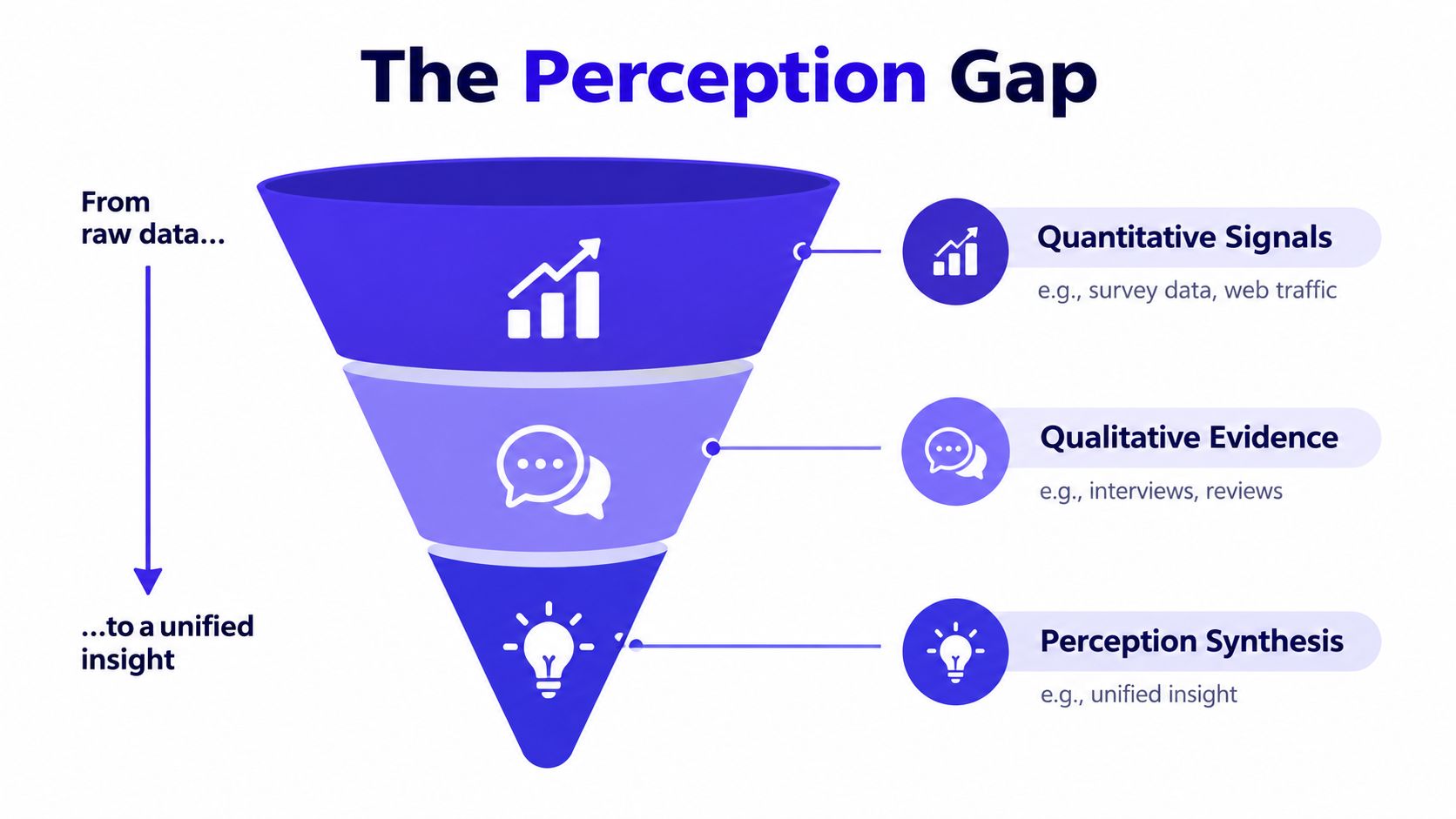
Use interviews for depth, reviews and support conversations for recurring language, and open-text survey responses for broader pattern detection. Social listening can add context, but don't treat mentions as representative by default. Loud opinions are useful signals, not automatic market truth.
Connect perception to commercial behaviour
A perception gap matters when it affects a business outcome. Cross-reference customer language with conversion paths, churn reasons, sales objections, expansion conversations, and lifetime value. The 2026 guidance on brand perception gaps recommends combining quantitative measures with interviews, focus groups, and social listening, then comparing those signals with churn, conversion, and lifetime value.
Build a simple evidence matrix:
| Intended identity | Customer language | Behavioural signal | Likely issue |
|---|---|---|---|
| Easy to adopt | “Powerful but hard to set up” | Prospects stall during trial | Promise and onboarding conflict |
| Trusted by experts | “I found you through a comparison list” | Buyers need third-party proof | Authority is under-distributed |
| Built for small teams | “We use it across several departments” | Larger accounts expand | Segment may be broader than assumed |
Don't force every comment into a neat theme. Keep contradictory evidence visible. A customer who calls the product easy after implementation may still have struggled during setup. That distinction can produce a more useful action than changing the headline.
Turn the gap into a positioning decision
Classify findings as misunderstanding, underproof, experience mismatch, or unclaimed strength. Misunderstanding calls for clearer language. Underproof calls for evidence such as reviews, comparisons, demonstrations, or transparent methodology. An experience mismatch needs product or onboarding work, not merely better copy. An unclaimed strength may reveal a stronger category angle.
You can also test the brand in AI discovery. Ask several assistants how they describe the company, who they recommend it for, what alternatives they mention, and what concerns they associate with it. Track the themes and cited sources over time, rather than treating one response as a definitive verdict. A practical guide to tracking brand mentions in AI search can help you turn those observations into a repeatable log.
Review Messaging and Visual Identity Against Competitors
A brand can be distinctive internally and still look interchangeable in the market. Founders see the months of product decisions behind the business. Buyers see a headline, a visual pattern, a few proof points, and a comparison with alternatives.
Audit the brand in the places buyers encounter it. Capture the homepage, pricing page, product pages, social profiles, directory listings, review profiles, sales deck, onboarding emails, and search snippets. Put the same assets from two or three competitors beside them. The side-by-side view exposes sameness faster than an isolated review.
Test the message for instant comprehension
Read each homepage headline without the surrounding page. Can a stranger identify the audience, problem, category, and meaningful outcome? If not, the page may be relying on cleverness or broad claims instead of useful positioning.
Review the value proposition against four questions:
- Audience: Who is this for, specifically?
- Problem: What situation does it address?
- Difference: Why choose this approach over an alternative?
- Proof: What evidence supports the promise?
Record the first answer a colleague gives after reading the page. If they describe a feature instead of a result, or confuse the product with a competitor, the message needs work. Don't solve this by adding more adjectives. Replace abstraction with a concrete job, constraint, or outcome.
Compare identity as a system
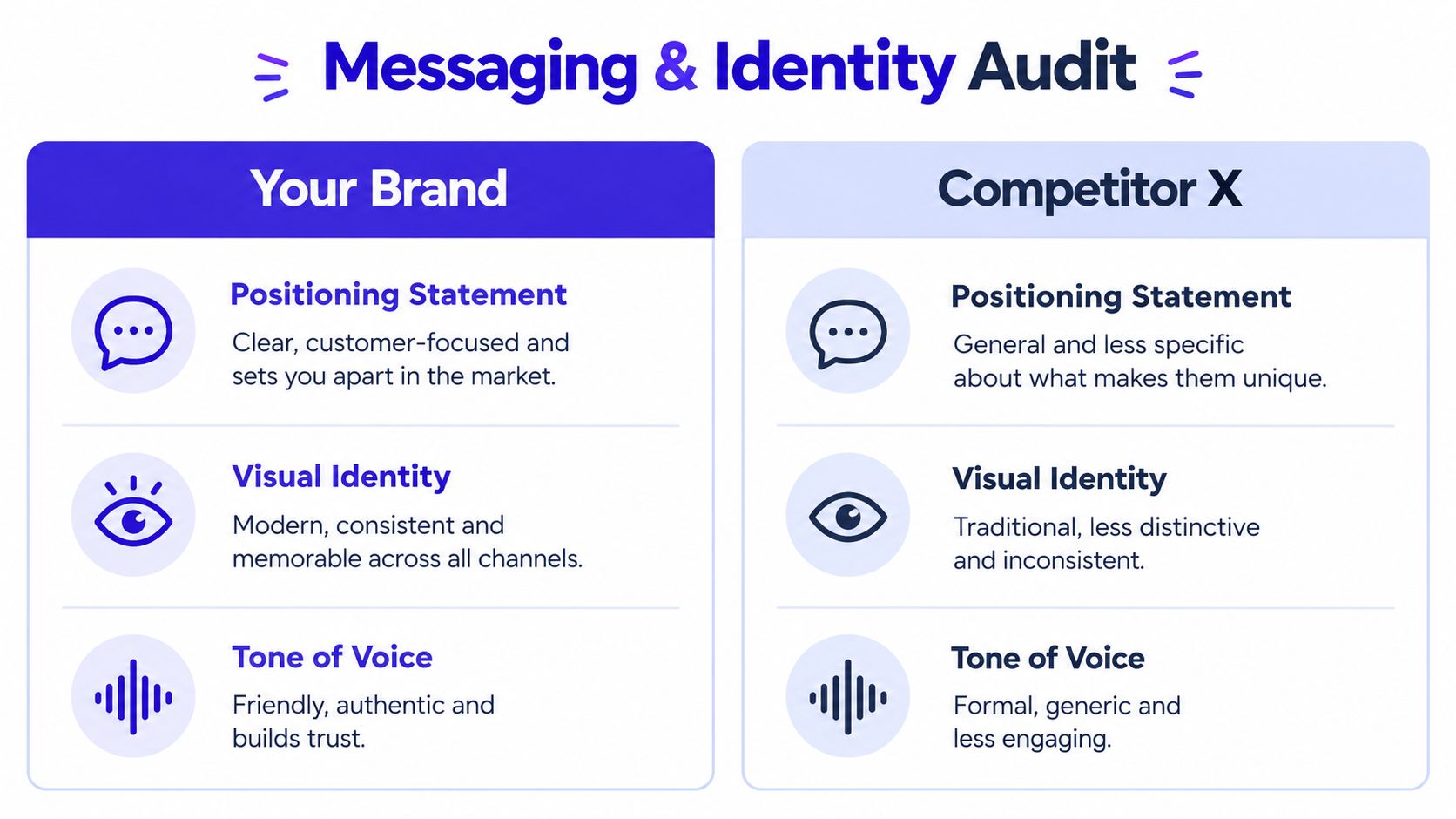
Visual identity includes more than the logo. Check colour, typography, spacing, imagery, illustration style, iconography, motion, and the consistency of those elements across touchpoints. Ask whether the visual system reinforces the category and personality, or whether it borrows familiar startup signals without adding recognition.
A basic comparison table is enough to begin:
| Audit Dimension | Your Brand | Competitor A | Competitor B |
|---|---|---|---|
| Positioning statement | Audience, problem, difference | Audience, problem, difference | Audience, problem, difference |
| Visual identity | Distinctive cues and consistency | Distinctive cues and consistency | Distinctive cues and consistency |
| Tone of voice | Clear, formal, playful, direct | Clear, formal, playful, direct | Clear, formal, playful, direct |
| Proof structure | Reviews, numbers, demonstrations | Reviews, numbers, demonstrations | Reviews, numbers, demonstrations |
| Search language | Category and use-case terms | Category and use-case terms | Category and use-case terms |
Use the table to identify a deliberate trade-off. A highly distinctive voice may improve memorability but reduce clarity in a technical category. A polished visual system may signal quality but make the brand resemble every other premium software product. The right answer depends on the audience and buying context.
A short visual explanation can help a founder align the team before making changes:
Don't confuse valuation with brand strength
A valuation model can look precise while resting on uncertain assumptions. Inputs such as royalty rates and estimated brand effects on revenue aren't directly observable, and a peer-reviewed review describes the resulting valuation uncertainty. Another source reports that average brand valuations were as likely to overstate value by more than 500% as to come within 20% of the actual transaction price, as discussed in this review of brand valuation uncertainty.
For an early-stage brand, use observable evidence instead. Examine trademark protection, enforcement, customer retention, market position, direct demand, branded searches, independent mentions, and the ability to command a clear preference. A single impressive valuation number won't tell you which message to fix next.
Assess SEO Backlinks and AI Search Visibility
Brand analysis becomes incomplete when it stops at perception and ignores discovery. A buyer can understand your positioning perfectly after landing on the site, but that clarity has limited value if the brand doesn't appear for the searches and questions that introduce the category.
Begin with branded search. Review the queries that include the company name, product name, founder name, misspellings, and common alternatives. Look for unanswered questions, outdated profiles, duplicate listings, negative pages, and competitor comparisons. Then examine non-branded searches connected to the jobs and problems identified during audience research.
Inspect the backlink profile
A backlink audit should answer more than “how many links do we have?” Check:
- Relevance: Does the linking site discuss your category, audience, or use case?
- Editorial context: Does the link appear in a meaningful article or a low-value page built mainly for links?
- Destination: Does it point to the page that deserves authority, or only the homepage?
- Anchor language: Does it reinforce the brand and category without looking manipulated?
- Distribution: Are useful pages discoverable through more than one source?
Also check whether important pages are indexed, whether new pages are discovered promptly, and whether internal links connect category pages, use-case pages, comparisons, and evidence. A directory listing, partner mention, customer story, or expert contribution can be more useful than a large pile of irrelevant links.
For founders who need a broader framework, this guide to master AI search visibility is a useful reference for connecting traditional discoverability with generative search.
Audit the AI-mediated journey
Generative AI now influences brand discovery, comparison, and review summarisation. Edelman reports that 55% of people use generative AI platforms, and among those users, 91% use them for shopping tasks such as researching brands, comparing products, and summarising reviews, according to its 2025 special report on brands and trust.
The audit should therefore include prompts such as:
- Which products solve this problem for a small team?
- What are the alternatives to this brand?
- What are the brand's strengths and weaknesses?
- Is this company suitable for a buyer with a specific constraint?
- Which sources support that recommendation?
Record the answer, cited pages, recurring descriptions, missing facts, and negative claims. Test across more than one assistant and repeat important prompts because AI responses can vary. Measure presence and accuracy as directional signals, not as a fixed ranking position.
Trust deserves its own review. Deloitte found that 74% of GenAI-aware or experimenting consumers and 62% of regular users say GenAI's growing popularity makes online information harder to trust, as reported in the same Edelman-linked evidence set. Make your own claims easy to verify, keep key facts current, and correct material inaccuracies with public, authoritative pages. A founder can also use AI visibility analytics for search optimization to organise monitoring, but the underlying source quality still matters more than a dashboard score.
Turn Insights Into an Action Plan With Templates and KPIs
An audit becomes useful when every finding receives a decision, an owner, and a next action. Don't create a report that says “improve differentiation” or “increase visibility.” Rewrite each observation as a task that someone can complete and evaluate.
Use three priority levels:
- Repair: Fix a harmful mismatch, such as a headline that attracts the wrong audience, an inaccurate directory profile, or a missing explanation for a major objection.
- Clarify: Strengthen the positioning, proof, category language, or visual cue that buyers already respond to but don't consistently understand.
- Compound: Build durable assets, including comparison pages, customer evidence, expert contributions, partner mentions, and authoritative pages that can be cited by search engines and AI systems.
Keep the templates operational
A one-page audit summary should include the current intended identity, observed customer perception, competitor distinction, discoverability gaps, and three recommended actions. For each action, record the owner, dependency, expected signal, and review date.
A messaging test sheet can compare two headlines, the audience each attracts, the problem each names, the proof each needs, and the qualitative response from sales calls or customer interviews. A visibility dashboard can track branded queries, important non-branded pages, referring domains, indexed assets, AI descriptions, cited sources, and inaccurate claims.
Choose KPIs that match the decision. For positioning, monitor qualified demo conversations and the language prospects use to describe the product. For SEO, monitor impressions, relevant landing-page engagement, referring-domain quality, and indexation. For reputation, track recurring themes and whether authoritative evidence appears where buyers look. Don't use traffic as a substitute for audience fit.
Sequence the work for a small team
Start with changes that improve several journeys at once. A clear category statement can help the homepage, sales deck, directory profiles, search snippets, and AI descriptions. A well-supported customer story can strengthen conversion, backlinks, trust, and third-party understanding.
Distribution deserves a permanent place in the plan. Submit accurate profiles to relevant directories, ask genuine customers for feedback, publish evidence that currently exists only in private conversations, and create pages that answer the questions prospects and AI systems repeatedly surface. IndieTool is one option for founders who want a directory listing, a permanent do-follow backlink, programmatic distribution across 1,210+ pages, and lightweight analytics for views, visitors, and outbound clicks.
Review the analysis on a recurring schedule, especially after a repositioning, product change, or new market launch. Keep the original evidence, record what changed, and compare new customer language with the previous baseline. Brand analysis should become an operating habit that guides decisions, not a polished document that disappears into a shared drive.
IndieTool helps indie founders turn brand analysis into distribution through directory listings, permanent do-follow backlinks, AI search visibility options, and a founder dashboard for basic traction signals. Visit IndieTool to submit your product, strengthen its discoverability, and give search engines and AI systems more reliable information to work with.