Indietool
How to Launch Advertising and Promotion in Real Time
You've scheduled the launch, approved the ads, checked the checkout flow, and opened the dashboard. Then the announcement goes live. Within seconds, traffic starts arriving from several channels, comments appear, branded searches increase, and someone on the team asks whether the landing page is converting. The campaign is no longer a plan. It's a live system under pressure.
That moment exposes the difference between launch advertising and promotion in real time and ordinary campaign management. A delayed report can tell you what happened yesterday. A connected launch operation helps you decide what to change while attention is still available.
Table of Contents
- The Real-Time Launch Mindset
- Setting Up Your Live Command Center
- Capturing the Three-Minute Window
- Choosing Your Real-Time Channel Mix
- Iterating Creative and Bids On the Fly
- Building for Long-Term Indexing and Growth
- Your Real-Time Launch Playbook
The Real-Time Launch Mindset
The launch button goes live at 09:00. By 09:01, one creative is collecting clicks, another is attracting impressions without meaningful engagement, and your first visitors are moving through the checkout page. The instinct is to watch everything at once. That's usually the wrong move.
A founder running a live launch needs a narrower focus: what changed, what does it mean, and what action is safe to take now? The objective isn't to react to every fluctuation. It's to identify signals that justify a controlled decision before wasted spend or broken messaging compounds.

A field study of ad click decisions found that users who clicked through took an average of 4.97 seconds to decide after an ad ended, while users who clicked back took 4.14 seconds, as reported in the study of ad click decision timing. The important lesson isn't that one number predicts every launch. It's that the attention-to-action window can be measured in seconds.
That changes the operating model. A traditional funnel assumes you can gather results, review them later, and adjust the next campaign. A real-time launch ecosystem connects the ad, landing page, product message, analytics, and response team so the next decision happens while the audience is still engaged.
Speed is a preparation problem
Fast execution doesn't mean improvising. It means preparing enough decisions in advance that nobody has to debate basic responses during the launch.
Before launch, define:
- The signal: Which metric or user behavior will trigger review?
- The threshold: How strong or weak must the signal be before you act?
- The response: Will you pause, replace, revise, or only observe?
- The owner: Who has permission to make the change?
- The evidence: Which dashboard view confirms that the change worked?
Personalization also belongs in this preparation. If different audiences respond to different messages, a practical guide to personalization for growth teams can help your team think beyond one generic launch experience.
The best launch operators don't worship speed for its own sake. They remove approval delays from decisions that can be safely reversed, while reserving human review for pricing, claims, brand risk, and major audience changes.
Practical rule: Treat launch day as a live operation, not a publication date. Your job is to protect the feedback loop between attention, action, and correction.
Setting Up Your Live Command Center
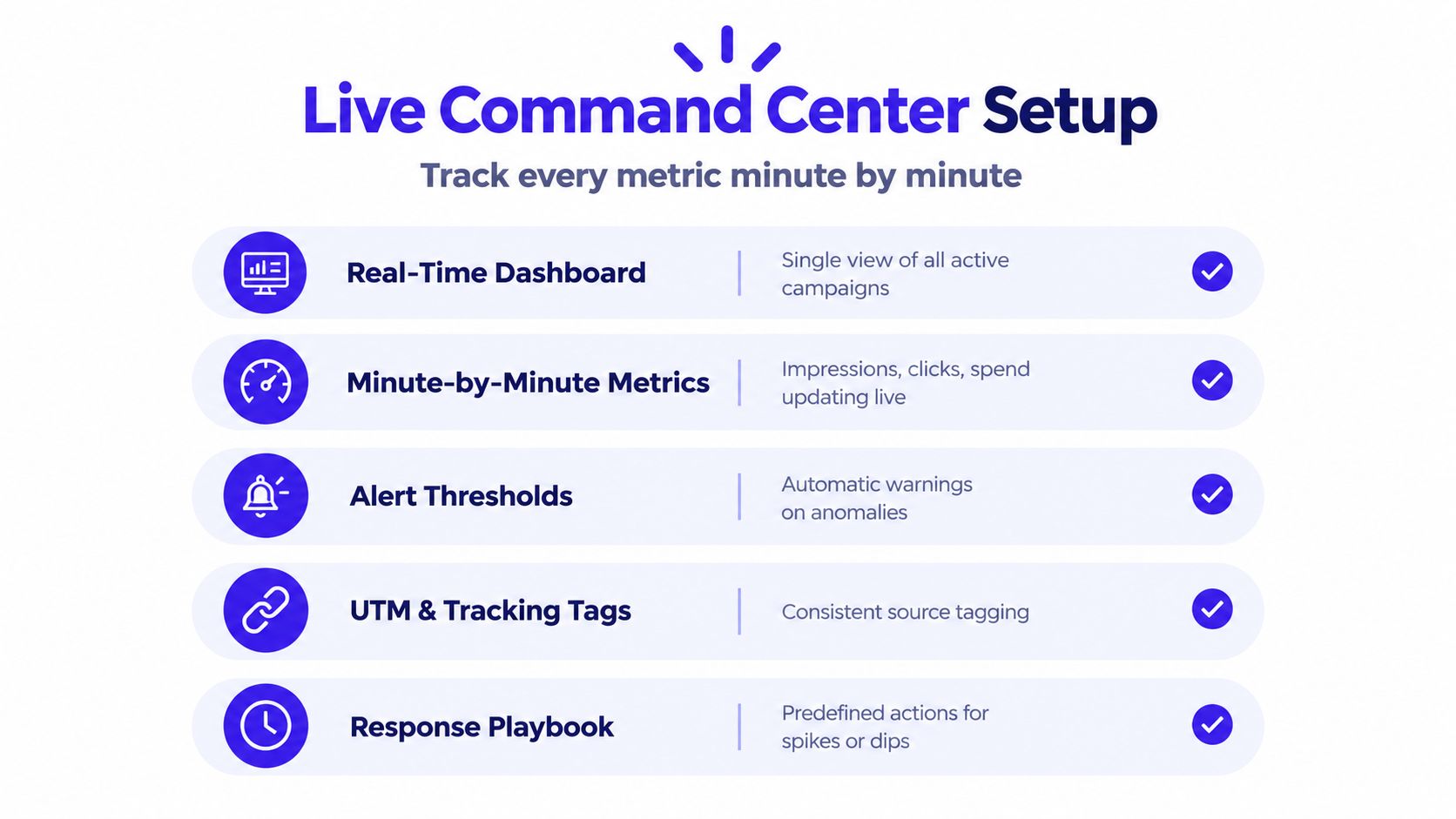
A useful launch dashboard answers one question quickly: where should attention or budget move next? If the answer requires opening several ad accounts, exporting spreadsheets, and reconciling different time zones, the dashboard is too fragmented for live work.
Build the command center before launch day. Connect every active channel, the landing page, analytics platform, checkout, and revenue events. Use consistent campaign names and tracking tags so that a visitor from a paid social ad doesn't appear as unexplained direct traffic later.
Start with the core operating metrics:
- CPC: Shows what you're paying for traffic.
- CTR: Indicates whether the message earns a response from the audience seeing it.
- Conversion rate: Connects the landing-page experience to the desired action.
- Traffic source: Reveals which channel, campaign, audience, or creative generated the visit.
- Revenue events: Confirm whether activity leads to a commercial outcome rather than empty engagement.
A real-time reporting workflow should also include a historical baseline. The launch dashboard guidance from Piwik PRO's real-time reporting guide recommends reviewing at least 30 days of history and standardizing KPIs before launch. The same source reports that 63% of marketers consider real-time analytics essential and that dashboard monitoring can make decisions 25% faster. Those figures matter less as universal promises than as a reminder that live visibility only works when the team agrees on definitions first.
Configure alerts around decisions
An alert should tell someone what to inspect, not merely announce that a number moved. Set warnings for unusual spend, broken conversion tracking, sudden traffic changes, and creatives that attract clicks without progressing toward the intended action.
Your playbook might read:
- Traffic rises, conversion holds: Keep the campaign live and monitor capacity.
- Traffic rises, conversion falls: Check page speed, message match, checkout, and source quality.
- CTR falls across one creative: Review the hook, visual, audience, or placement.
- Revenue events stop: Verify tracking and payment flow before changing bids.
- One channel outperforms: Shift cautiously, preserving enough coverage to compare results.
For teams collecting live web information to support campaign research or diagnostics, it's also worth comparing data extraction workflows, including a firecrawl alternative, before the launch stack becomes difficult to change.
A dashboard should stay readable under pressure. Put spend, traffic, conversion, and revenue in the first view. Keep diagnostic dimensions, such as device, geography, placement, and landing-page version, one click away. You can also use this dashboard data analytics resource to structure the reporting layer around decisions rather than vanity metrics.
Capturing the Three-Minute Window
A launch can create digital intent faster than many teams expect. Research on TV advertising found that nearly all immediate brand-search and price-search activity occurred within five minutes of a TV ad insertion, according to the research on immediate online responses to television advertising.
That finding has a direct operational implication. When an audience hears about a product through television, a podcast, a creator, a conference stream, or a major social post, the search results and landing page need to be ready immediately. A delayed page, missing product information, or weak branded result can waste the highest-intent part of the response.
Synchronize the response layer
At launch, check the following as one connected experience:
- The paid ad uses the same product name and promise as the landing page.
- The branded search result points to a current, crawlable page.
- The page explains the offer without requiring visitors to reconstruct the message.
- Analytics identifies the original channel and campaign.
- The checkout or signup path works on the devices receiving the traffic.
- Customer support can answer the questions appearing in comments and search queries.
The “three-minute window” is a useful operating shorthand, not a universal timer. Some audiences respond immediately. Others need more consideration. The point is to design for the short response layer instead of assuming that every visitor will return later.
Separate immediate intent from later conversion
The same research describes a longer conversion layer. In HP's Home and Home Office store, the average time from Google search to purchase was about one to two weeks, while advertising effects can continue for days or weeks after a campaign starts. The first minutes capture intent. Follow-up promotion, remarketing, content, and product education help convert the people who weren't ready to buy on the first visit.
That means a launch team should avoid two opposite mistakes. Don't ignore the first few minutes because conversion may take longer. And don't judge the entire launch from immediate clicks when the product naturally requires evaluation.
A good live sequence looks like this:
- Before attention peaks: Confirm pages, tracking, branded information, and creative variants.
- During the initial response: Watch search demand, traffic quality, errors, and first actions.
- After the spike: Build audiences for follow-up, answer objections, and improve the pages based on observed intent.
- Across the launch window: Keep the strongest message visible while testing new angles carefully.
Real-time promotion works when the immediate and downstream layers share data. Otherwise, the first team sees traffic, the second sees conversions later, and nobody can connect the two.
Choosing Your Real-Time Channel Mix
The best channel mix isn't the one with the largest theoretical reach. It's the mix your team can monitor, edit, and explain while the campaign is live.
Google Ads is useful when people are already searching for a category, problem, competitor, or product type. It captures existing intent, but search demand can be limited for a new concept with no established vocabulary. Build specific landing pages and watch search terms closely, because a high click-through rate can still hide weak message fit.
Paid social gives you room to test hooks, visuals, demonstrations, and audience angles quickly. It works well when the product needs to create demand rather than just capture it. The trade-off is that engagement can look healthy while purchase intent remains uncertain.
Influencer bursts can create concentrated attention and credible explanation, especially for products that benefit from demonstration. They're harder to standardize because timing, audience quality, and creative execution depend on the partner. Use unique tracking links and prepare a landing page that can handle a sudden shift in message or traffic source.
Native distribution and founder communities can work well for technical products, niche software, and tools that benefit from context. They may generate fewer immediate visits than broad paid campaigns, but the audience can arrive with stronger understanding.
| Launch condition | Suitable starting mix | Main live risk |
|---|---|---|
| Existing search demand | Search ads plus branded landing pages | Paying for broad or weakly relevant queries |
| New category or unfamiliar product | Paid social plus creator education | Mistaking reactions for buying intent |
| Technical product | Community distribution plus search coverage | Explaining too much after the click |
| Small team with limited monitoring capacity | One paid channel plus owned email and organic posts | Splitting attention across too many surfaces |
Timing also needs flexibility. A 2026 timing source describes campaigns beginning 6 to 8 weeks before a target purchase date, another recommendation uses 4 to 8 weeks before peak search interest, and a separate framework maps launch planning across a 13-week sequence with a distinct public-launch week, as summarized in guidance on timing marketing initiatives. These are planning ranges, not rules. Market readiness, seasonality, competitor moves, and distribution constraints should determine the lead time available to you.
Iterating Creative and Bids On the Fly
Live optimization fails when every change becomes a reaction to a single unusual result. It also fails when a team refuses to act until a campaign has spent enough to produce a perfect answer. The workable middle is a controlled decision process.
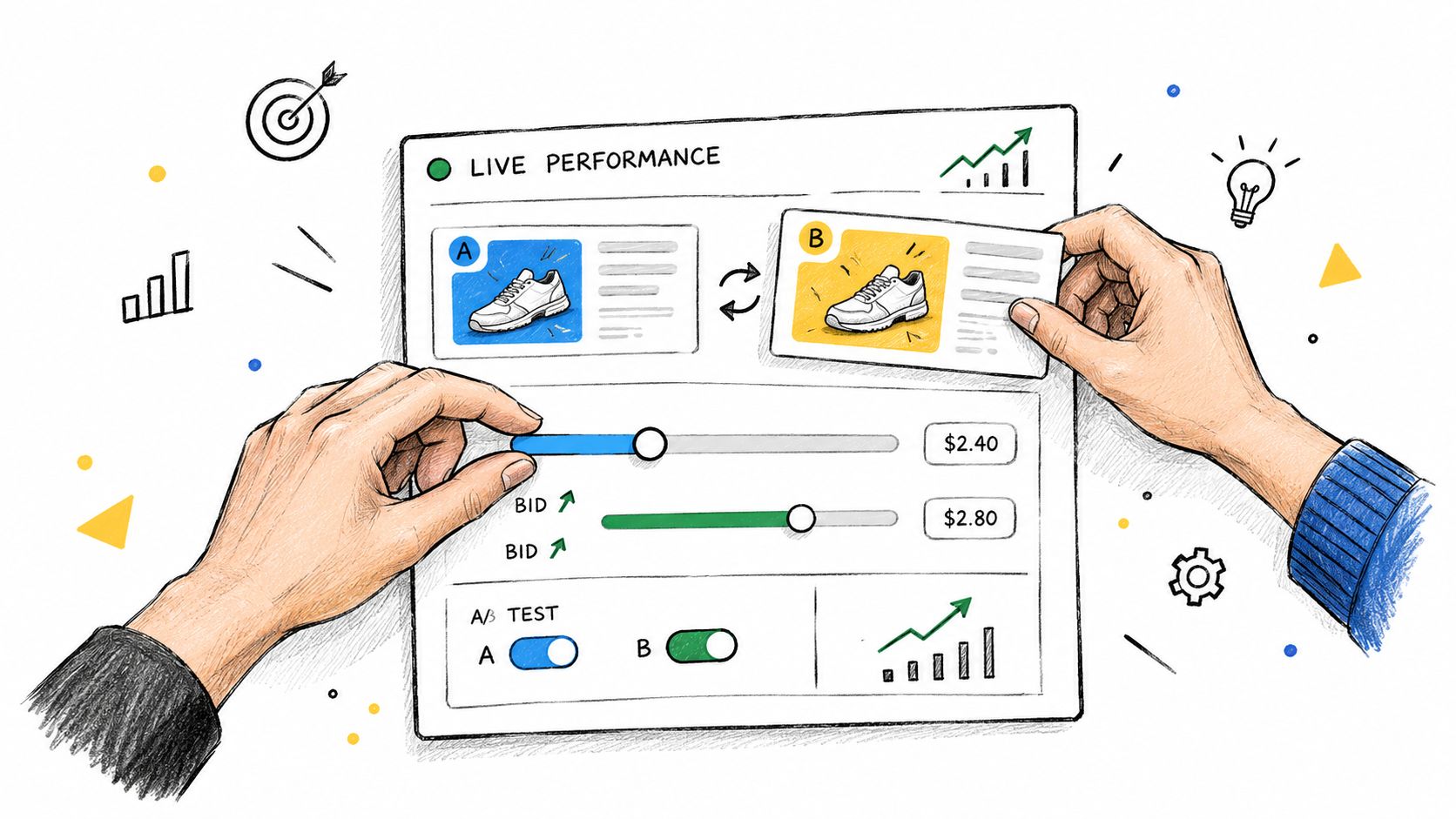
Start with a small set of meaningful variations. Change one major variable at a time when possible, such as the opening claim, product visual, audience angle, or call to action. Keep the destination page and measurement consistent so you can interpret the result.
Use a pause, replace, and learn cycle
When a creative underperforms, don't immediately rewrite the entire campaign. First check whether the problem is delivery, audience fit, placement, tracking, or the creative itself. If the evidence points to the creative, pause it, introduce a prepared replacement, and record the reason for the change.
A live test log should capture:
- Version: The exact headline, visual, offer, and call to action.
- Audience: The segment and placement receiving it.
- Signal: CTR, CPC, conversion behavior, or revenue event.
- Decision: Continue, pause, replace, or hold.
- Reason: The observed problem, not a guess about the future.
- Next check: When the team will review the new version.
Bid changes deserve the same discipline. Increase exposure when a channel delivers qualified actions and the page can handle additional demand. Reduce exposure when spend rises without useful downstream behavior. If tracking breaks, stop making performance decisions until the data is trustworthy.
A controlled test protects momentum. A frantic test only creates more uncertainty.
Creative adaptation can also happen outside the ad account. Search query language, comments, support questions, and AI Search brand mentions can reveal the words people use when they describe the product. Feed those observations into landing-page copy, FAQ sections, creator briefs, and new ad variants. Distribution platforms can then extend the strongest explanation beyond the original placement.
Teams looking for additional ideas around Trendy social media growth tools can use that category of tooling as a prompt for channel research, but the tool should support a defined experiment rather than replace one.
Use this startup marketing tools guide to audit the rest of the launch stack, especially if analytics, content production, and distribution are spread across separate systems.
Avoid the most expensive live mistakes
Don't optimize for CTR alone when the business outcome is a purchase or qualified signup. Don't rotate every creative at the same time, because you'll lose the comparison that tells you what caused the change. And don't let an automated rule spend freely while the landing page, inventory, onboarding, or support process is under strain.
The strongest operators make fewer, clearer changes. They preserve a control version, document each intervention, and give the new version enough context to distinguish a meaningful shift from ordinary noise.
Building for Long-Term Indexing and Growth
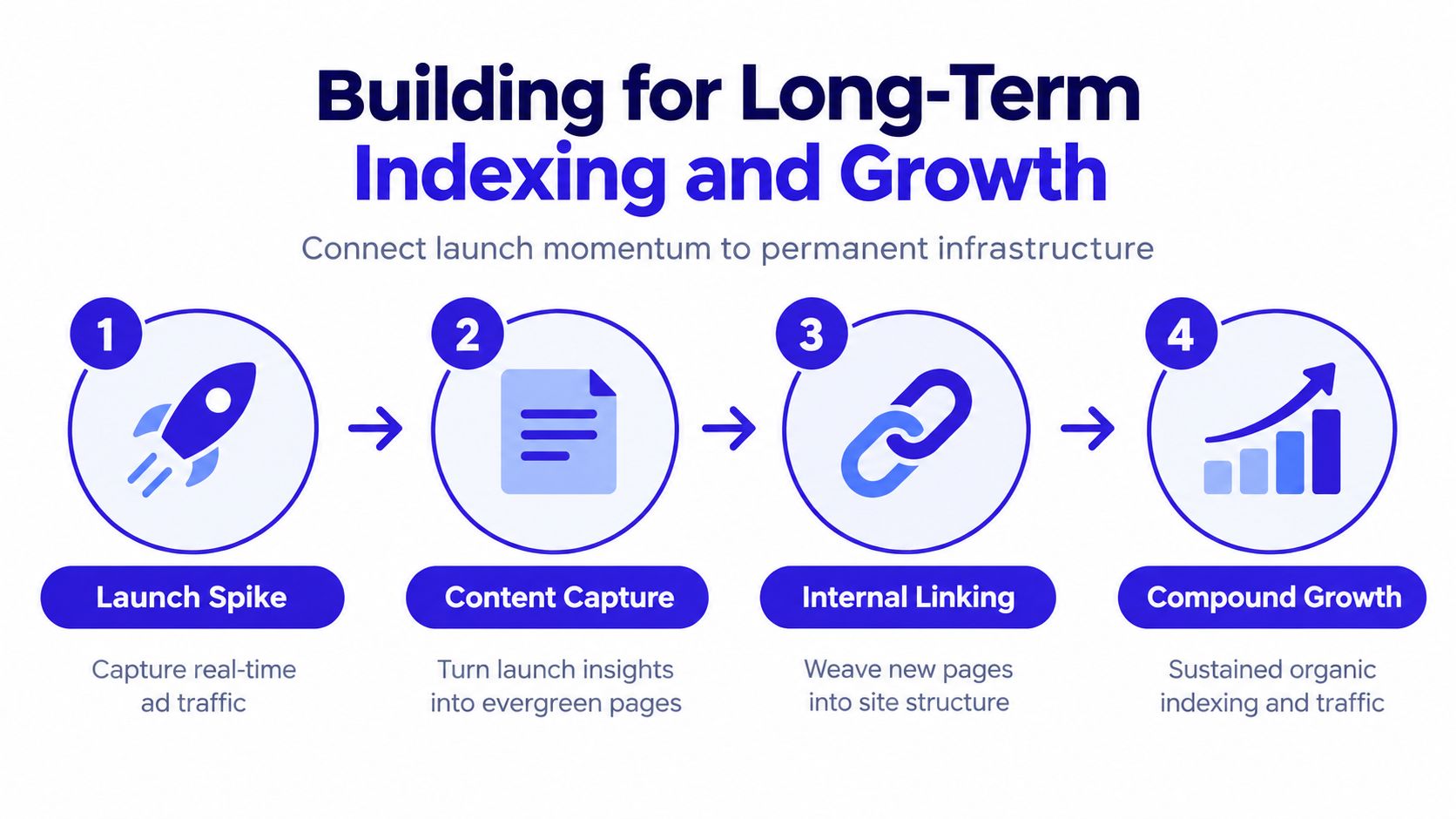
A launch spike has little long-term value if it leaves no useful asset behind. The paid campaign should reveal which problems, phrases, objections, and use cases deserve permanent coverage on your website.
Turn live observations into durable content. If visitors repeatedly search for a comparison, publish a comparison page. If they ask how the product works, improve the product page and add a concise explanation. If a creator's demonstration produces strong interest, convert the underlying lesson into a guide, FAQ, or use-case page.
Connect the spike to site architecture
Real-time advertising tells you what deserves attention now. SEO infrastructure determines whether that insight remains discoverable after the campaign ends.
Create a simple flow:
- Capture: Save high-intent queries, objections, and conversion paths from launch traffic.
- Create: Turn recurring themes into focused, useful pages rather than thin variations.
- Connect: Add internal links from relevant guides, category pages, and product documentation.
- Maintain: Update titles, descriptions, screenshots, examples, and calls to action as the product changes.
Indexing is not the same as ranking, and a page being published doesn't guarantee immediate visibility. A clear site structure gives crawlers and users better paths through the material. This guide to what indexation means is useful when checking whether your launch content is being discovered and included in search systems.
Permanent external references can support the broader discovery system, but they shouldn't replace useful content. Directory listings, partner pages, product databases, founder profiles, and editorial mentions each work best when they describe the product accurately and point visitors to a relevant destination.
Build a feedback asset, not a temporary report
At the end of the launch window, keep the useful outputs:
- Search language that reflects real customer intent.
- Creative angles that earned qualified attention.
- Landing-page objections that blocked action.
- Channels that produced meaningful visits or revenue events.
- Questions that support and sales teams answered repeatedly.
- Pages that deserve updates, expansion, or internal links.
That archive becomes the starting point for the next campaign. Paid promotion creates concentrated learning. Content and site structure preserve it.
Your Real-Time Launch Playbook
At launch, open the command center before you open the ads. Confirm tracking, pages, checkout, alerts, owners, and prepared creative replacements. During the first response window, watch the relationship between attention and action, not isolated engagement.
Use one channel or a manageable mix, keep a control creative, and change bids only when the evidence supports it. If performance drops, check infrastructure before blaming the audience. If a message works, adapt it into landing-page copy, support answers, search content, and follow-up promotion.
A stalled launch isn't automatically a failed launch. Fix broken paths first, narrow the audience, replace the weakest creative, and preserve the learning. Then turn the strongest live insights into indexed pages that continue working after the ads stop.
IndieTool gives founders a directory and distribution platform for launching products, with listing credits, permanent do-follow backlinks, automated listing activation, founder analytics, and optional promotion through X and its newsletter. Visit IndieTool to add launch distribution and measurable discovery to your real-time promotion workflow.