Indietool
Google Listing Optimization That Actually Drives Calls
A customer searches for “electrician near me,” scans the map results, and calls the business that looks available, credible, and easy to contact. Your company may already appear there, but if the category is vague, the hours are wrong, the photos are stale, and recent reviews have no replies, a complete listing elsewhere can win the click.
That's why Google listing optimization should be treated as an operating process, not a profile-filling exercise. Google Business Profile creates a measurable visibility layer across Google Search and Maps, where you can track impressions, search queries, website clicks, calls, and direction requests through the Performance report. The practical work is to improve the signals that create discovery, then measure whether that discovery turns into action.
Table of Contents
- Why Google Listing Optimization Matters Right Now
- Laying the Foundation for Accurate and Consistent Listings
- Optimizing Content Signals That Influence Relevance and Clicks
- Turning Reviews and Photos Into Ranking and Trust Engines
- Building Citations and Authority Beyond Your Profile
- Monitoring Performance and Keeping Listings Optimized Over Time
Why Google Listing Optimization Matters Right Now
A branded search happens when someone already knows your business. A discovery search happens when someone searches for a service, product, or category and chooses among unfamiliar options. Google's Business Profile reporting distinguishes between these kinds of discovery, showing how people found the profile and what they did next through actions such as calls, website visits, and requests for directions. Google's Performance report documentation explains the available visibility and interaction data.
That distinction changes the job. Direct searches can confirm existing demand, but discovery views introduce your business to people who weren't looking for your name. A profile that consistently matches relevant services, demonstrates activity, and earns trust has more opportunities to convert that unfamiliar searcher into a call.
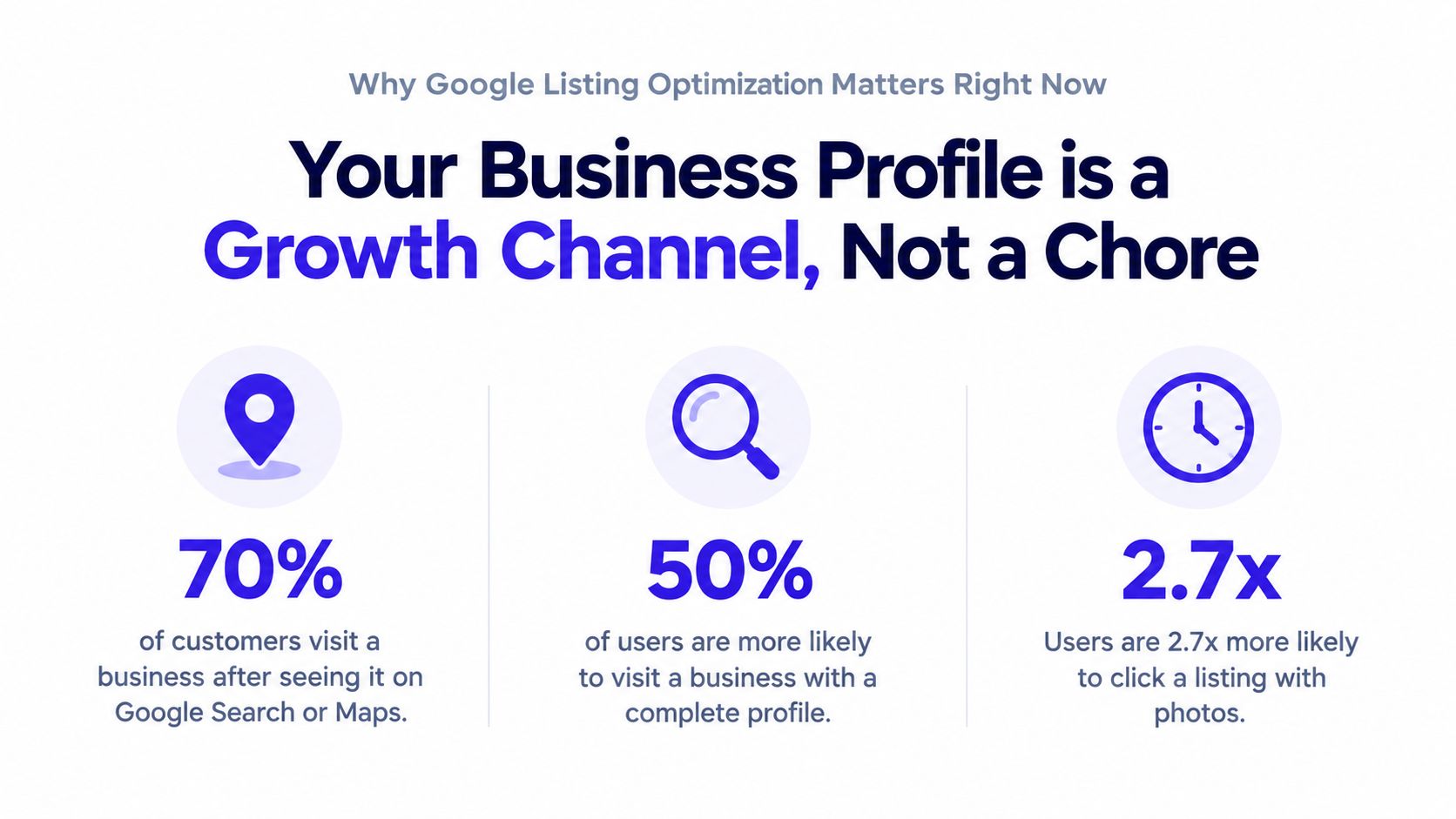
Third-party benchmarks in a 2026 industry summary report an average of 1,009 searches per month for a small business profile, including 228 direct views and 781 discovery views. The same summary claims Maps views grew 61% year over year, while Search views grew 28%. These figures are benchmark claims rather than Google's own universal averages, so use them as market context, not as a promise for your business. The Google Business Profile Performance reference remains the right place to validate your own results.
Completeness is only the starting point
A filled-in profile can still underperform. Recent coverage of Google Business Profile changes describes a stronger emphasis on fresh photos, regular posts, review replies, and ongoing engagement, while reduced low-volume query reporting makes it harder to connect one small edit to one ranking movement. The coverage of recent Google Business Profile changes supports a more practical model: maintain useful activity, monitor outcomes, and avoid treating one optimization pass as finished.
The same principle applies beyond Maps. Your profile supports local pack visibility, while the linked website and supporting local content can strengthen organic results. If your business also sells online, a resource on how to rank higher with ecommerce SEO can help connect local discovery with broader search strategy. For newer search behavior and AI-assisted discovery, see this guide to GEO search.
Measure the channel through discovery impressions, direct searches, website clicks, calls, and direction requests. A “complete” badge or a polished description matters only when it helps the right person find, trust, and contact you.
Laying the Foundation for Accurate and Consistent Listings
Google's local ranking guidance centers on relevance, distance, and prominence. Relevance asks whether the profile matches the search. Distance considers proximity to the searcher or the location term. Prominence reflects how established and well-known the business appears, with Google identifying signals such as links from other websites and review volume as relevant inputs. Google's explanation of local ranking provides the governing framework.
Before adding posts or requesting more reviews, remove structural problems. A profile with incorrect hours or a duplicate location can lose trust before its content signals have a chance to help.
Clean the business identity
Start with the name customers encounter in the world. Don't add service keywords, locations, or promotional phrases to the business name to influence rankings. That creates inconsistency and can make the listing look manipulated.
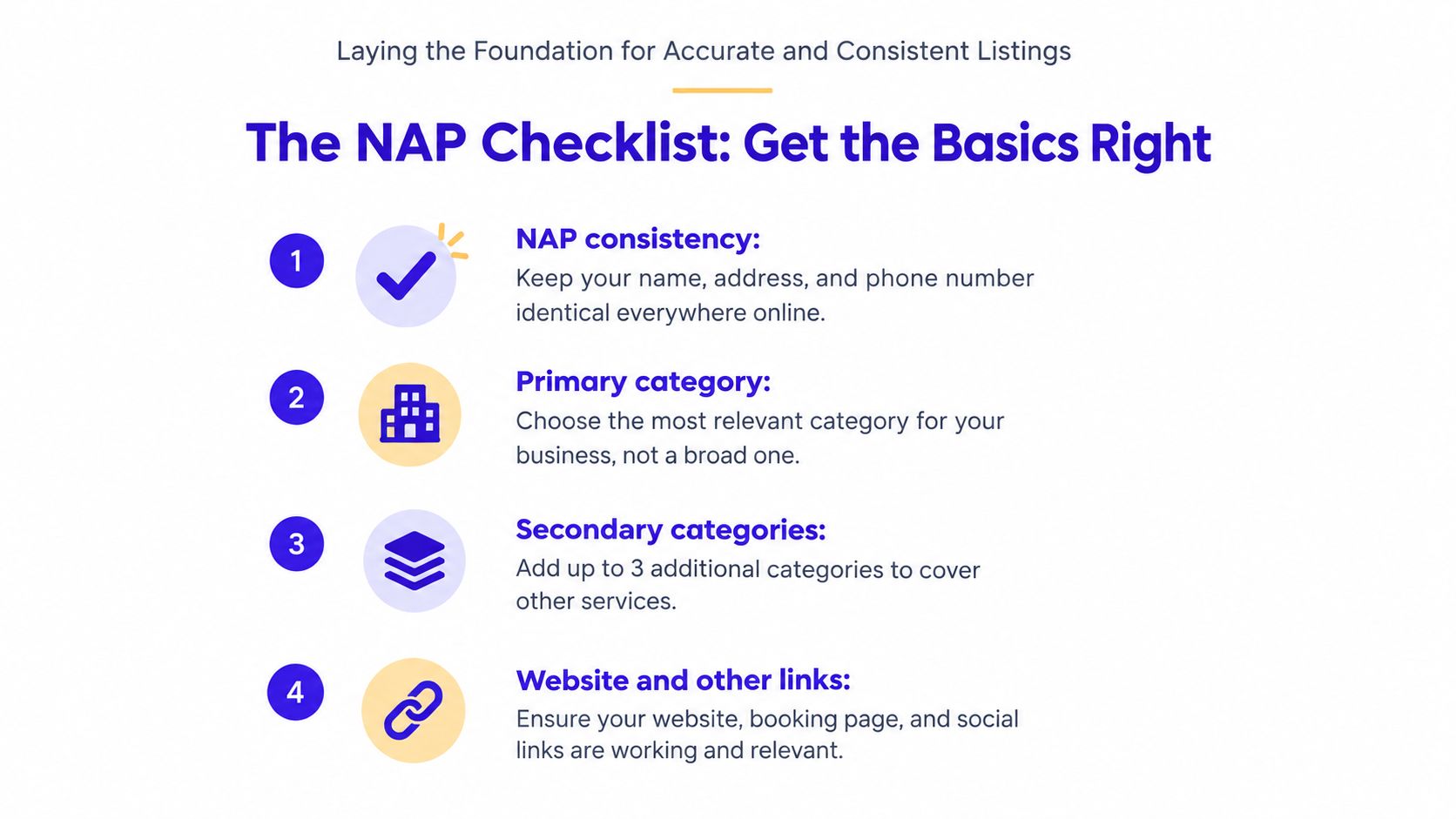
Audit the core identity across your website, directories, social profiles, trade associations, and local references:
- Name: Use the legitimate trading name consistently.
- Address: Match the real-world location format, including suite details where relevant.
- Phone: Use a number customers can answer and that appears consistently elsewhere.
- Website: Send visitors to the relevant location or service page, not a broken redirect.
- Hours: Include regular hours, holiday schedules, and special closures.
- Links: Test appointment, booking, ordering, and contact links on mobile.
A multi-location business should give every branch its own accurate profile, local landing page, phone details, and location-specific media. A service-area business should follow Google's address-display rules rather than publishing a residential address that customers can't visit.
Choose categories with discipline
Your primary category carries substantial relevance weight because it tells Google what the business is. Choose the closest accurate category, not the broadest category that sounds commercially attractive. Add secondary categories only when they represent real, meaningful services.
An electrician might need a category that reflects electrical contracting, then use services and website content to describe emergency repairs, rewiring, inspections, or commercial work. A practical industry-specific reference on GBP for UK electricians can help trade businesses think through category, service, and profile presentation decisions without turning the name field into a keyword list.
Duplicate listings create another avoidable problem. Search Google Maps for variations of the business name, old addresses, and previous phone numbers. Resolve duplicates through the proper ownership and support process, then update external directories so the old information doesn't continue circulating.
Practical rule: Fix contradictions before adding decoration. Accurate identity information makes every later signal easier for Google and customers to interpret.
Optimizing Content Signals That Influence Relevance and Clicks
Once the foundation is reliable, build content around the questions customers ask. The profile should quickly answer what you do, where you do it, when you're available, and what a customer can expect after clicking or calling.
Write for relevance without stuffing
Use the business description to explain the offer in ordinary language. Lead with the core service, include the genuine service area, and mention the customer types or problems you handle. Don't repeat the same keyword in every sentence, insert city names unnaturally, or turn the description into an advertisement packed with claims.
Service entries deserve more attention than many owners give them. Name each significant service clearly, then describe what it includes and who needs it. “Emergency boiler repair” is more useful than “repair services,” while a detailed service description can clarify availability, equipment, or the type of property served.
Use products or service menus to support distinct commercial intents. Keep the wording aligned with the website, because a profile that promises one thing and a landing page that describes another creates friction after the click.
Add useful activity
Google Posts can highlight updates, offers, events, services, or useful announcements. A good post has one purpose, one clear action, and enough context for a person to decide whether to continue. Rotate subjects instead of publishing near-identical keyword paragraphs.
Questions and answers can reduce sales friction when you seed them with genuine customer concerns. Explain parking, appointment requirements, service boundaries, accessibility, accepted payment methods, or emergency availability. Don't use the feature to create fake customer questions or stuff in search terms.
Photos should show the business as it exists. Upload the storefront, team, interior, work process, completed projects, products, and service vehicles where relevant. Use descriptive file names and captions on the website, but don't assume hidden metadata will compensate for weak visual content.
For the website connected to the profile, use a clear local landing page with consistent contact details, relevant service copy, visible location information, and LocalBusiness structured data where appropriate. Schema can help search systems interpret the page, but it won't repair an inaccurate profile or substitute for useful content.
What works: Content that answers a customer's decision question. What wastes time: Repeating a city name, publishing thin posts, and treating metadata as a ranking shortcut.
Turning Reviews and Photos Into Ranking and Trust Engines
Reviews and photos do different jobs, so don't manage them as one generic “activity” task. Reviews contribute to prominence and social proof. Photos help a searcher judge the place, people, products, and quality of the experience before making contact.
A local-ranking dataset covering 16,098 Google Business Profiles found a wide difference in top-three visibility by review count. Profiles with 1–5 reviews reached the top three 39.3% of the time, compared with 73.0% for profiles with 201–500 reviews. The dataset also found that photo volume was the only measured factor without a ceiling, continuing to improve beyond 500 images. The Localo local-ranking analysis contains the full methodology and figures.
Those findings don't mean a business should chase reviews or upload filler photos indiscriminately. They show why a neglected profile has a weak prominence signal and why useful visual evidence can keep contributing over time.
Build a review request system
Ask for feedback after a clear service moment, such as a completed installation, delivered order, or resolved support issue. Make the request easy to complete, but don't script the sentiment. Incentivized, gated, or selectively solicited reviews can create policy and trust problems.
Give staff a repeatable prompt:
- Timing: Ask when the customer has experienced the finished service.
- Access: Provide the direct review path through a receipt, follow-up message, or printed card.
- Specificity: Invite honest comments about the service, not a five-star rating.
- Ownership: Assign someone to monitor and respond consistently.
Reply to positive reviews with a human acknowledgment and a relevant detail. For negative feedback, recognize the concern, avoid arguing in public, and move the resolution to a private channel when personal information is involved. Don't paste the same response across every review, and don't force keywords into emotional situations.
Choose between reviews and photos
When time is limited, prioritize based on the profile's current weakness. A business with very few reviews should establish a legitimate request process first. A business with steady review activity but outdated visuals should schedule a photo session and recurring uploads.
Photograph real changes: new products, completed work, staff introductions, seasonal displays, accessible entrances, and different areas of the customer experience. Customer-submitted images add another layer of authenticity, so improve the real-world experience rather than trying to control every image that appears.
The ranking signal and the conversion signal overlap, but they aren't identical. Review volume can strengthen prominence, while a clear project photo may be the reason a prospect calls today.
Building Citations and Authority Beyond Your Profile
A Google Business Profile doesn't exist in isolation. Other websites help establish whether the business identity, location, and services appear consistently across the local ecosystem. Google's guidance connects prominence with external references, including links and reviews, so citation cleanup and authority building belong in the same operating plan.
Start with an audit, not a mass submission campaign. Record the business name, address, phone number, website, category, and status of each listing. Mark duplicates, old addresses, wrong phone numbers, unclaimed profiles, and directories that present misleading information.
Prioritize quality over directory volume
A useful citation usually has a clear reason to exist. Consider local chambers, trade bodies, recognized industry directories, suppliers, local publications, and relevant professional associations. A page that helps customers find the business is more valuable than a directory created only to host a name and phone number.
For each important citation, check:
- Identity: Does the listing match the verified business details?
- Relevance: Does the directory serve the industry, location, or audience?
- Uniqueness: Is the page distinct rather than a duplicate?
- Control: Can the business owner correct future changes?
- Link quality: Does the page provide a useful path to the official site?
Backlinks need the same judgment. Earn links through local partnerships, supplier pages, sponsorships, useful resources, expert contributions, and genuine community involvement. Don't buy a large batch of irrelevant links and call it local authority. Google may ignore weak links, while a pattern of manipulation can create a broader risk.
Connect distribution with indexation
Programmatic distribution can help a new or updated business presence reach multiple relevant pages faster, but scale doesn't excuse inconsistency. Every distributed record should use the same approved identity data, and someone should review the highest-value placements after publication.
For a broader explanation of local authority, the Alpha Omega Digital SEO guide offers useful context on citations, links, and local search strategy. Businesses building a broader distribution layer can also review directory link building as a supporting tactic, provided each placement is relevant and accurate.
IndieTool is one directory and distribution option for indie products and startups. Its paid listing credits provide permanent do-follow backlinks, distribution across index and category pages, automated indexing, and a dashboard for views and outbound clicks. It's not a replacement for local directories or a verified Google profile, but it can fit an authority plan for a software business that serves local customers or publishes a related product.
Monitoring Performance and Keeping Listings Optimized Over Time
The Performance report gives you a practical feedback loop. Google says it can show how often the profile appeared in Search and Maps, which queries triggered impressions, and which actions followed, including website clicks, calls, and direction requests. Use those signals to decide what deserves more work instead of judging the profile by completeness alone.
Compare consistent time periods and annotate major changes. If you add a service, correct hours, publish a photo set, or repair a citation cluster, record the date. Look for directional relationships between the change and actions, while remembering that seasonality, competition, weather, and demand can affect local behavior.
Use a lightweight operating rhythm
A weekly routine is easier to maintain than a large quarterly cleanup:
- Monday: Check hours, service availability, contact links, and any user-suggested edits.
- During the week: Reply to new reviews with specific, courteous responses.
- Midweek: Publish a useful update or add fresh visual content when there's something real to show.
- Friday: Review calls, website clicks, direction requests, and discovery activity against the prior period.
- Monthly: Audit priority citations, duplicates, location pages, and major changes in competitors' profiles.
For multiple locations, use a dashboard and data analytics workflow that makes ownership clear. The tool matters less than the discipline: one person should know who approves edits, who responds to reviews, and who investigates performance changes.
Troubleshoot before changing everything
A sudden decline can come from an address move, suspension, duplicate profile, category change, inaccurate hours, or a competitor becoming more relevant. Check verification status, policy notifications, map placement, website availability, and citation consistency before rewriting the entire profile.
Reduced query detail can also limit diagnosis. When Google reports fewer low-volume queries, shift your measurement toward broader discovery trends and customer actions. Don't conclude that an edit failed because one phrase disappeared from a report.
Google listing optimization compounds through repeated, accurate behavior. Keep the profile truthful, publish only useful updates, earn reviews ethically, add real photos, maintain citations, and let Performance data determine where the next hour goes.
IndieTool helps founders and small teams distribute products through directory, category, and alternatives pages while tracking views, visitors, and outbound clicks from a founder dashboard. Visit IndieTool to review the listing options and decide whether its permanent backlink and distribution layer fits your broader search visibility plan.