Indietool
What Is Geo Search and How It Impacts Local SEO
Geo search means search results adapt to a person's location or a place named in the query. 46% of all Google searches are reported to have local intent, making location-aware discovery a major part of how people find businesses, services, and products online.
You're standing in an unfamiliar neighborhood, your phone is low on battery, and you type “coffee shop near me.” You aren't asking for the world's best coffee shop in the abstract. You want a useful option close enough to reach now, with accurate hours, directions, and enough trust signals to justify walking through the door.
That small moment captures the difference between ordinary keyword matching and modern local discovery. Search engines combine what you typed with geographic context, then decide whether a map listing, a local website result, or an AI-generated answer best fits your intent. For indie founders, understanding that decision is more useful than memorizing another list of SEO tactics.
Table of Contents
- Understanding Geo Search and Location Awareness
- The Commercial Power of Near Me Queries
- How Search Engines Rank Local Results
- Traditional Map Packs Versus AI Overviews
- Building Prominence for Indie Product Launches
- Your Action Plan for Search Visibility
Understanding Geo Search and Location Awareness
A founder in Austin searches “web designer near me,” while another types “web designer in Austin.” The service is similar, but the location signal differs. In the first query, the search engine can use the device's position. In the second, the place is stated directly.
Geo search, also called local search, connects a query with a geographic area. The area may come from the wording, the searcher's location, or both. Local searches include requests for directions, nearby services, and product availability. Google and Think with Google have reported that 91% of respondents had used local search for nearby information needs.
From keywords to coordinates
A conventional search can match “accounting software” with pages containing that phrase. Geo search adds a practical question: where should the result apply? The system interprets the query, identifies relevant businesses or entities, and evaluates their relationship to the searcher's location.
Local discovery therefore works as a location-ranking problem as well as a keyword problem. A nearby bakery can be the better result than a highly authoritative bakery several towns away, if its listing is relevant, accurate, and trustworthy.
Location signals also matter for businesses without storefronts. A SaaS product may serve a specific region through localized pricing, compliance details, availability, or customer support. A digital product does not need a shopfront to benefit from geographic relevance. City names should reflect an actual customer need, not appear as decoration across otherwise unchanged pages.
Practical rule: Treat location as part of the user's intent, not as a keyword decoration.
Why proximity matters
A query can carry geographic intent without naming a place. For searches such as “pharmacy” or “lunch,” Google may estimate proximity from the searcher's location. That can give a physically closer business an advantage, even when a distant competitor has stronger content.
The local geo targeting guide provides context for geographic relevance without reducing the work to repeated location phrases. For indie founders, the next decision is format: does the customer need directions or a nearby provider, or does the query call for an explanation assembled from multiple sources?
That distinction connects to what search visibility means for an indie business. Visibility means qualifying for the result format that fits the situation, not merely appearing somewhere in a web index. Traditional local search may favor a map listing, while newer GEO, or Generative Engine Optimization, can surface a business inside an AI Overview. Clear place signals support the first path. Useful, well-supported information helps with the second.
The Commercial Power of Near Me Queries
Location-based searches often signal a decision that is close to happening. Someone searching “best restaurants” may still be comparing options. Someone searching “restaurant open now near me” is more likely choosing a place, contacting it, or visiting.
That difference matters for indie founders because search visibility has two paths. A map-based local search helps people find a nearby provider. GEO, or Generative Engine Optimization, can help an AI Overview explain which product or service fits a location-sensitive need. The page must match the decision, not repeat a place name.
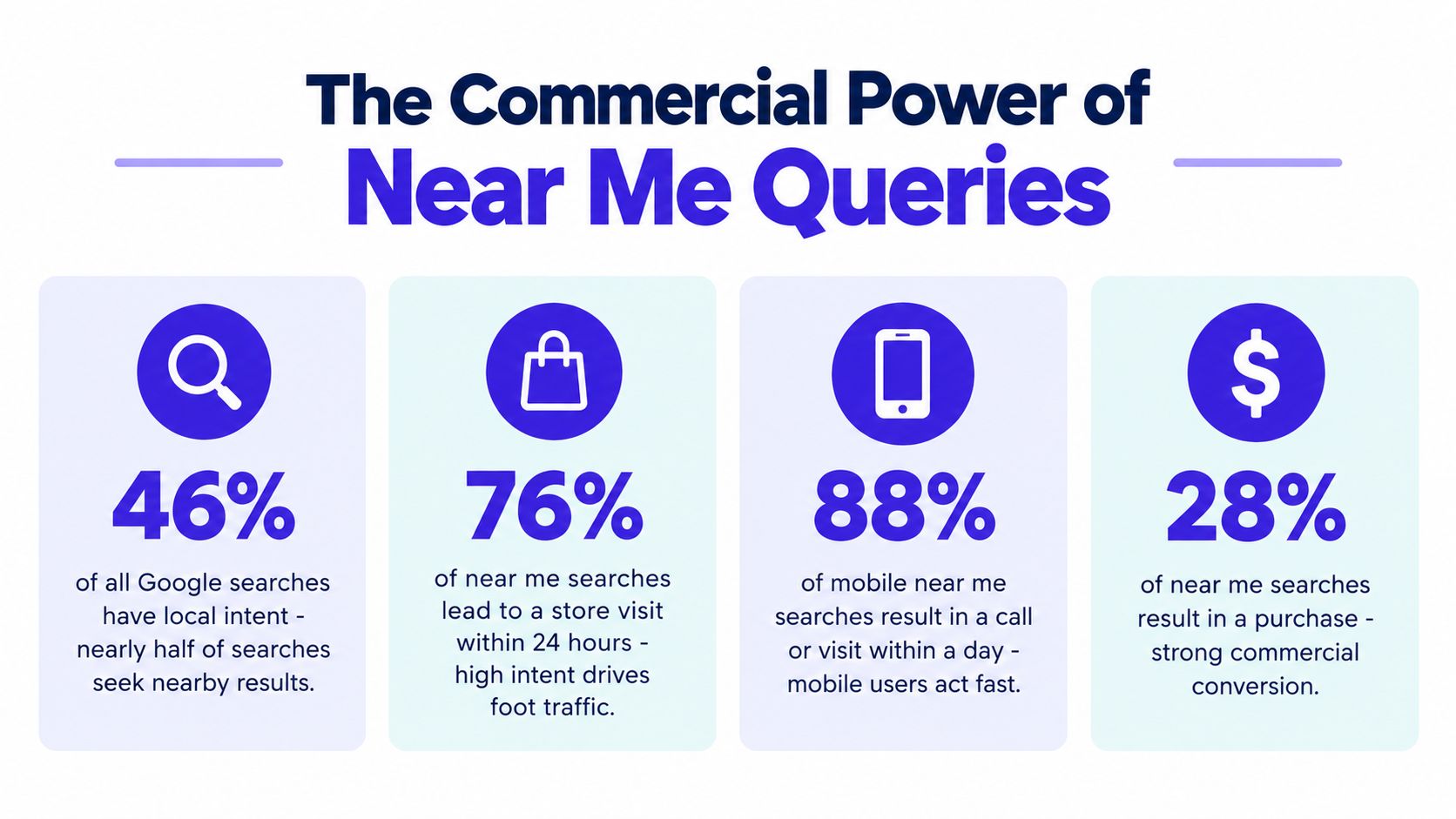
The scale of local discovery is substantial. 46% of all Google searches are reported to have local intent, while 80% of U.S. consumers search for a local business online at least once a week and 32% do so daily, according to the industry summary from Social Edge. Local discovery is a recurring behavior, not an occasional emergency action.
Why urgency changes the value of a query
Google-cited local search statistics report that 76% of people who perform a near-me search visit a business within 24 hours, and 28% of local searches result in a purchase. The same coverage reports that 90% of consumers searching for local information buy within one week (Rio SEO's local consumer search behavior coverage).
These figures do not mean every local query converts immediately. They show why founders should separate casual research from action-oriented intent. A page answering “what does a tax advisor do?” serves an explanatory moment. A profile showing availability, contact options, service area, and directions supports a decision that may happen now.
Near-me behavior has also expanded at scale. Industry reporting cited by Rio SEO describes 1.5 billion near-me searches per month, or roughly 50 million per day, alongside a reported 900% increase in near-me and close-by queries over two years. Searches containing “open now near me” reportedly grew by 400% over the same period.
What this means for indie founders
A digital-first founder can identify moments when location changes the buying decision:
- Service area: State where onboarding, installation, delivery, or support is available.
- Regional fit: Explain local regulations, currencies, languages, or operating conditions when they matter.
- Immediate action: Make booking, calling, visiting, or starting a trial obvious.
- Availability context: Keep hours, coverage, and product access accurate across important profiles.
The commercial opportunity comes from matching each page or listing to a real, location-sensitive decision. Choose a map listing when proximity and directions matter. Build clear, well-supported content when an AI Overview may need to summarize the fit.
How Search Engines Rank Local Results
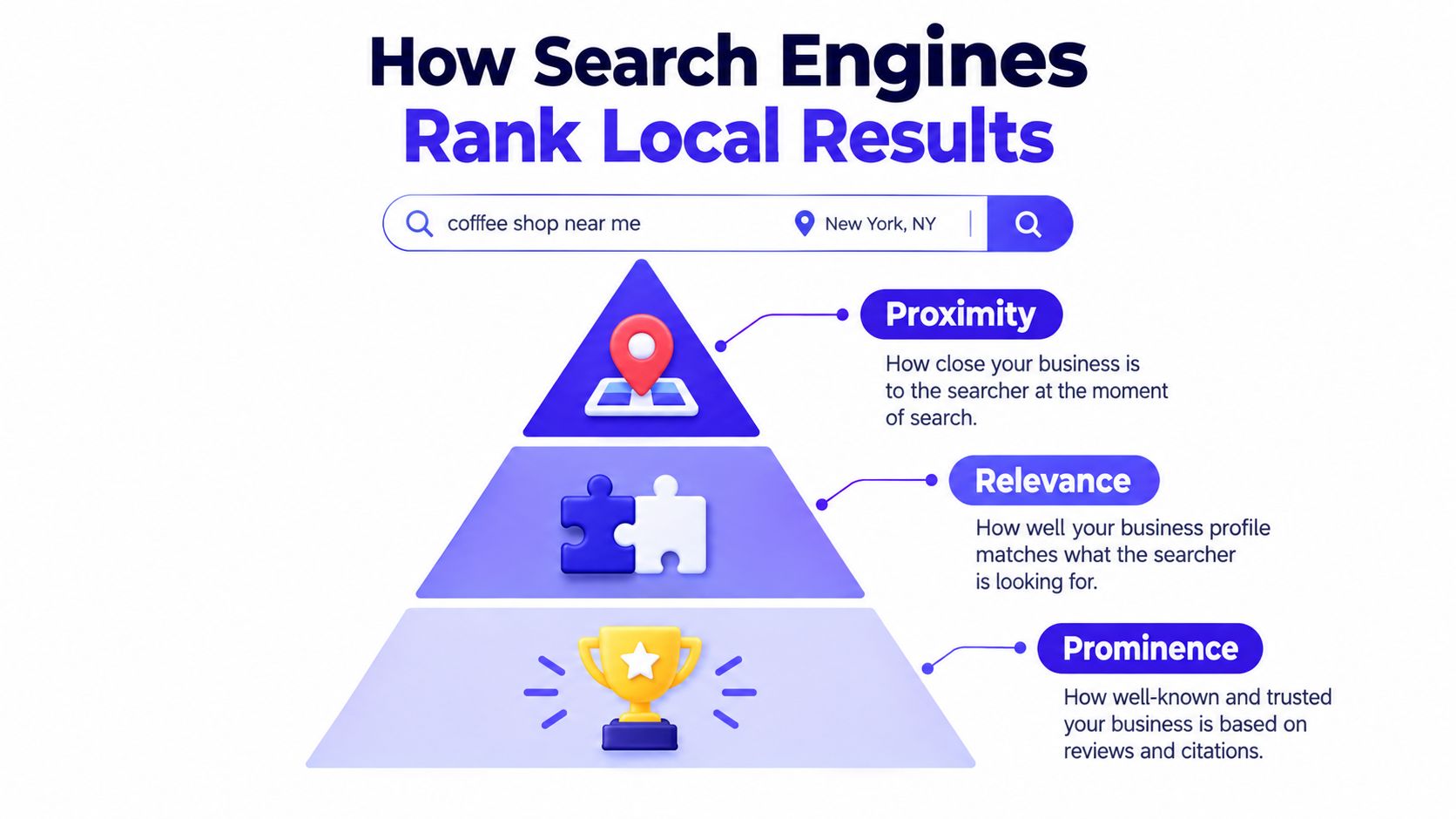
Google's local system evaluates results primarily through proximity, relevance, and prominence (Search Engine Journal's explanation of physical proximity in local rankings). Think of these signals as a three-part screening process.
Proximity asks whether the business is close enough to serve the searcher. Relevance asks whether the business matches the requested product or service. Prominence asks whether the business appears established and trusted through signals such as reviews, links, and citations.
The three signals in practice
Imagine a search engine choosing a mechanic for someone whose car has just broken down.
- Proximity: A nearby garage starts with a practical advantage. Content alone can't erase physical distance when the query clearly requires a local provider.
- Relevance: A garage specializing in electric vehicles may fit the query better than a general repair shop, even if both operate nearby.
- Prominence: Reviews, citations, links, and recognizable business information help the system assess whether the provider is credible.
A widely cited 2026 local-search factor breakdown assigns 32% to Google Business Profile signals, 19% to on-page signals, 16% to review signals, 11% to link signals, 8% to behavioral signals, and 7% to citation signals (Bigeye Agency's local SEO and GEO guide). These figures are best read as a directional framework, not a promise that changing one field produces a predictable ranking outcome.
Align the entity, not just the page
Your business profile, website, directories, and reviews should describe the same underlying entity. Keep the name, address, phone number, categories, service descriptions, and operating details consistent wherever customers and search engines encounter them.
For founders, the practical sequence is straightforward:
- Clarify the offer: Use categories and page copy that describe the actual service.
- Complete the profile: Add accurate business details, photos, hours, and service information.
- Build corroboration: Earn legitimate mentions, citations, links, and reviews.
- Watch user behavior: Check whether people request directions, call, visit, or engage with the listing.
Traditional Map Packs Versus AI Overviews
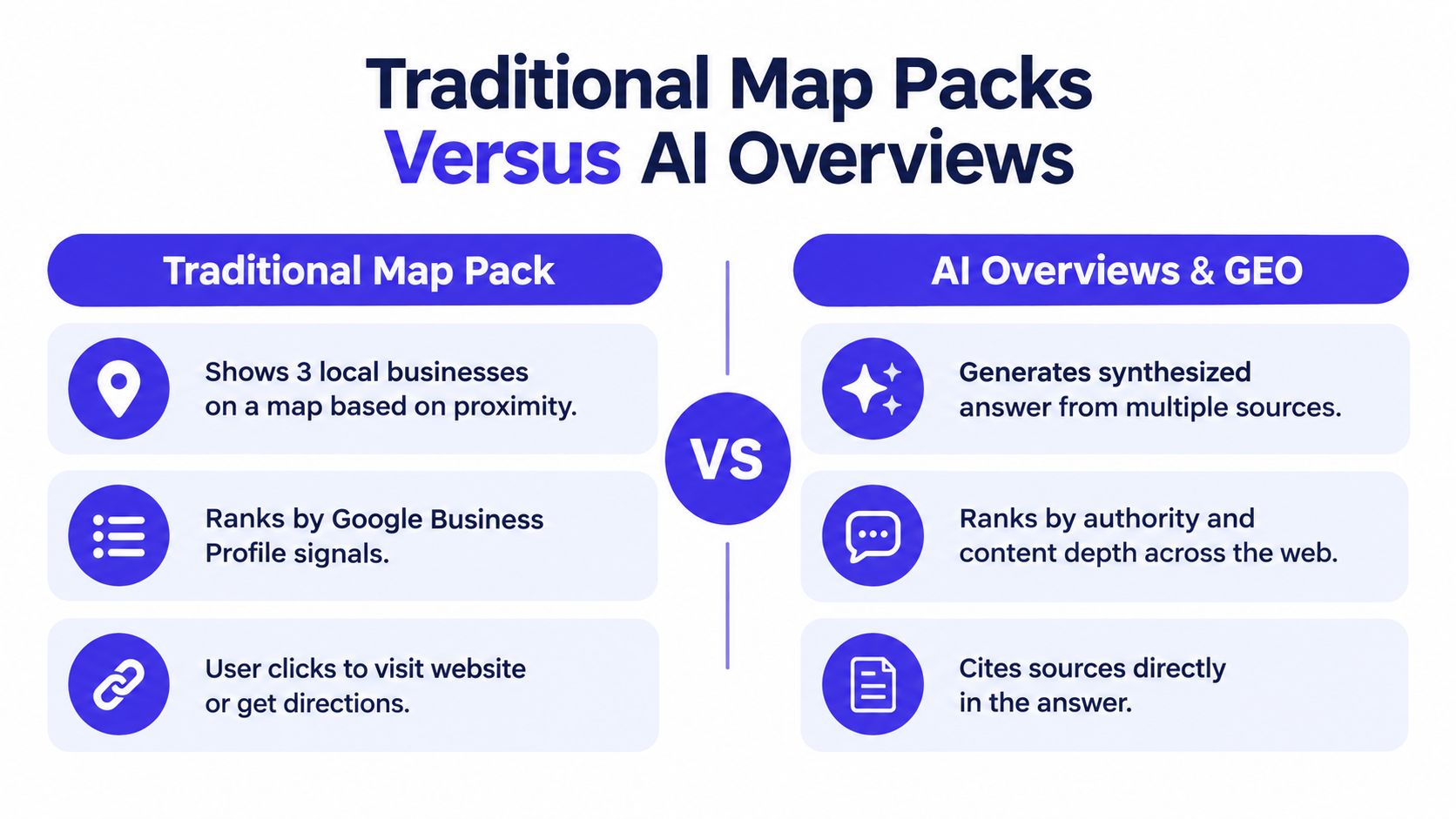
The phrase GEO creates confusion because it can mean two different things in search conversations. Geo search is location-aware retrieval, usually associated with Maps, local packs, and place-based listings. Generative Engine Optimization, also called GEO, focuses on making a brand's information clear and authoritative enough to be reused or cited in AI-generated answers.
The distinction matters because the result format changes with intent. Recent local-search data found that AI Overviews appeared on 68% of local-business queries on average, while local packs appeared on 39% (Incremys' analysis of geo search). But the mix varies sharply. AI Overviews appeared on 15% of simple local queries and 92% of informational local queries in the cited analysis.
Use the query shape as your decision tree
Ask what the searcher is trying to do:
- “Dentist near me” or “cafe open now”: Prioritize Google Business Profile accuracy, proximity, categories, hours, reviews, and conversion actions. The map pack is likely the more natural surface.
- “Which dentist treats nervous patients near me?”: Support both local and informational intent. Build a detailed service page, explain the relevant experience clearly, and keep the local profile aligned.
- “How does local tax software work for freelancers in Canada?”: Focus on GEO-ready content. Publish direct answers, supporting details, clear headings, structured data where appropriate, and credible references.
- “Best project management tool for remote teams in Berlin”: Combine both approaches. The product page needs topical authority, while regional language, availability, and relevant third-party mentions help establish fit.
Traditional map visibility depends heavily on place data and local entity signals. AI visibility depends more on whether systems can retrieve, interpret, compare, and cite your information across the web. The two paths overlap, but they aren't interchangeable.
A map listing needs accurate coordinates and business details. An AI answer needs concise, self-contained explanations that make sense when extracted from a larger page. That's why improving brand visibility in AI search engines requires more than copying local SEO tactics into a generative-search context.
Building Prominence for Indie Product Launches
A local shop has an address, storefront, phone number, and customer reviews. An indie SaaS product often launches with none of those traditional trust signals. Its challenge is still a prominence problem, but the evidence comes from product directories, relevant editorial mentions, founder communities, documentation, comparison pages, and links from established sites.
The useful mental model is entity corroboration. Search systems need to connect the product name with its category, purpose, audience, and distinctive features. If one page calls the tool an AI writing assistant, another calls it a workflow automation platform, and a third uses only a vague slogan, the founder has created ambiguity instead of authority.
Create consistent discovery points
Start with a concise product description that answers four questions:
- What is it? Name the category in plain language.
- Who is it for? Identify the intended user or team.
- What problem does it solve? State the practical outcome without unsupported superlatives.
- Where can people verify it? Connect the product to its website, documentation, profiles, and public demonstrations.
Directory distribution can help a new product create several legitimate indexation points, but founders should assess each platform for audience fit, link attributes, editorial quality, and update control. IndieTool is one example of a distribution platform that offers product listings, permanent do-follow backlinks, programmatic placement across 1,210+ index, category, and alternatives pages, and privacy-friendly cookieless analytics, according to the publisher's provided product information. Its listing credits are one-time purchases, and the platform also provides launch utilities such as naming and content tools.
Make the launch understandable to machines and people
A directory listing won't compensate for a confusing website. Build a focused homepage, a detailed product page, documentation that uses clear headings, and comparison or alternatives content where it helps buyers. Use consistent terminology across these assets so a search engine or AI system can tell that every reference points to the same product.
Links matter, but relevance matters too. A mention from a community or directory that serves your audience can support discovery more naturally than a pile of unrelated placements. The same applies to social promotion. Early conversations can expose the product to people who may test it, discuss it, and create additional references, but visibility should follow genuine usefulness rather than manufactured engagement.
For a practical breakdown of how directories can support this process, see directory link building for indie products. The principle is simple: give search systems multiple consistent ways to understand what you built, while giving real users enough context to decide whether it belongs in their workflow.
Your Action Plan for Search Visibility
Geo search optimization becomes manageable when you separate the work by result type. A physical business should prioritize local profile accuracy and place-based trust. A digital product should build entity clarity and authoritative references. A hybrid company needs both.
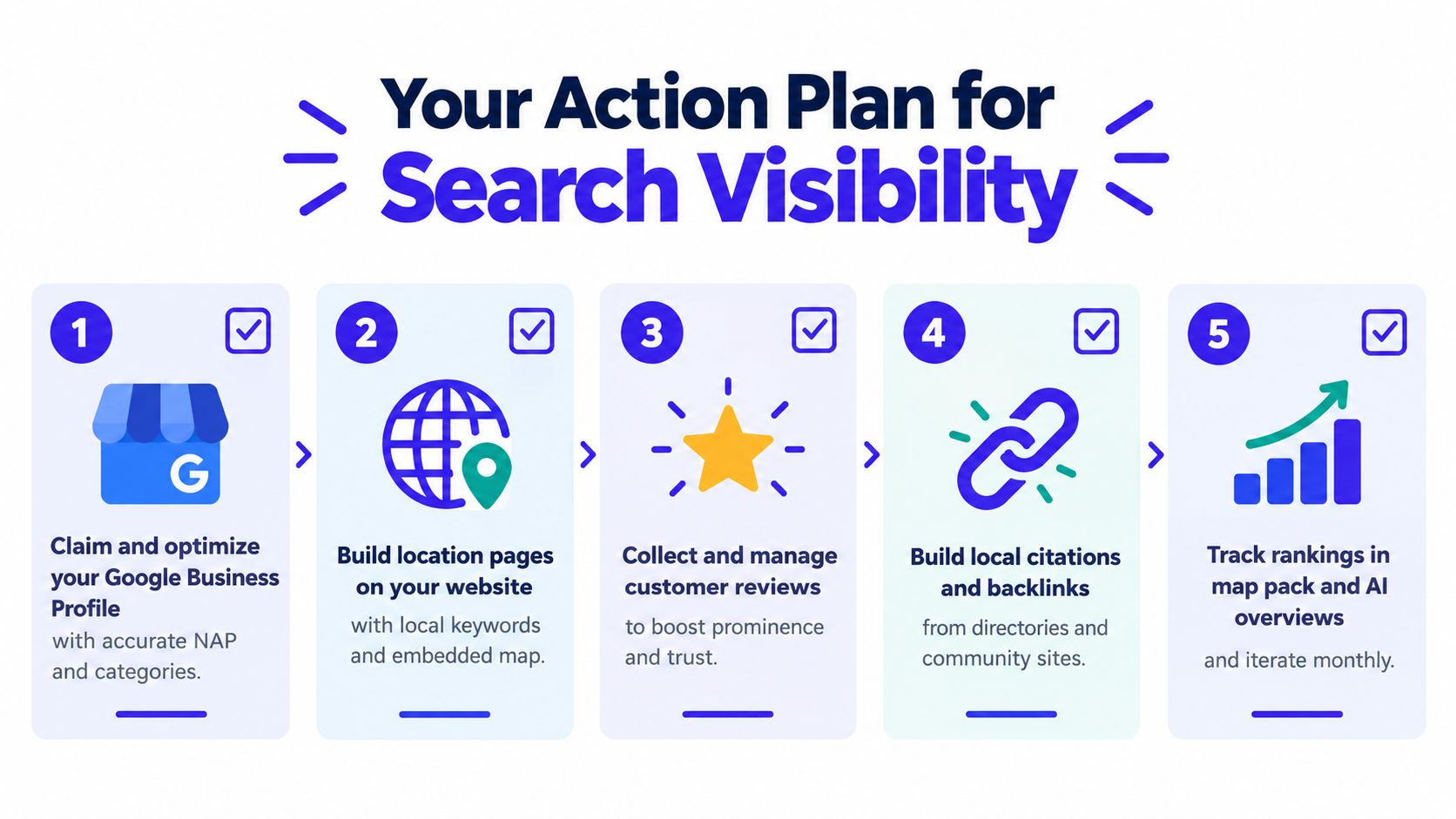
A practical launch sequence
Claim and clean up core profiles. For a local business, verify the Google Business Profile, business name, address, phone number, categories, hours, services, and photos. For a digital product, make sure the official site and product name are consistent across every public profile.
Publish pages for real location needs. Create service-area or location pages only where you can provide useful, distinct information. Include coverage, availability, local contact details, directions, or regional requirements. Don't create empty pages that swap one city name for another.
Earn and manage trust signals. Ask genuine customers for reviews when appropriate, respond to feedback professionally, and correct inaccurate business details. Digital founders should seek relevant mentions, product reviews, community references, and documentation links.
Distribute through relevant surfaces. Submit the product or business to reputable directories, category pages, and community resources that match the audience. Track whether each placement provides a crawlable page, a useful referral path, and accurate information that you can maintain.
Measure both map and AI visibility. Monitor map-pack presence for local queries, branded searches, referral clicks, calls, direction requests, and qualified site actions. For AI Overviews, review whether systems represent the product accurately and whether cited sources reflect your strongest pages. Use cookieless analytics when you want lightweight measurement without invasive tracking.
Choose the next action by query intent
If your target query contains an immediate local need, improve the business profile and service information first. If it asks for education, comparisons, or recommendations, make the website content easier to parse and cite. Hybrid queries deserve a coordinated audit, because a founder can lose visibility by optimizing only the map listing or only the long-form guide.
Review your presence regularly. Search results change with query wording, location, business information, reviews, and the sources available to AI systems. A monthly check of your profiles, important pages, citations, and answer representation gives you a practical way to catch drift before it becomes a discovery problem.
IndieTool helps indie founders distribute apps and startups through directory listings, permanent do-follow backlinks, broad category and alternatives coverage, and privacy-friendly analytics. Visit IndieTool to create a clearer search footprint for your next product launch and support visibility across traditional search and emerging AI answers.