Indietool
GEO AI Search Optimization: A Practical Guide for 2026
AI search visits grew from 15.6 billion in Q1 2025 to 27.4 billion in Q1 2026, a 42.8% increase, according to 2026 AI search visibility research. For an indie founder, that shift changes the budget question. You're no longer deciding only whether to publish another article or pursue another Google ranking. You're deciding how to make a small brand clear, credible, and widely discoverable enough for an AI system to mention and cite.
GEO AI search optimization is the practical discipline behind that work. It combines technical SEO, entity clarity, structured content, and third-party distribution so systems such as Google AI Overviews, ChatGPT, and Perplexity can understand what your product is, whom it serves, and why it belongs in an answer.
Table of Contents
- How AI Answers Reshaped Search Results
- What GEO AI Search Optimization Means
- Why AI Search Visibility Is Reshaping Discoverability
- The Four Entity Signals AI Engines Read First
- On-Site Tactics for GEO AI Search Optimization
- Why Distribution Breadth Beats More Content for New Brands
- A 30 Day GEO Plan and How to Measure the Lift
How AI Answers Reshaped Search Results
A traditional search page presents a list. An AI search experience presents a conclusion first, then selected sources. That change compresses user attention. A page can still rank well and receive little visibility if the answer engine chooses different evidence for its response.
The shift is structural. The tracker cited earlier recorded AI search platform visits rising from 15.6 billion in Q1 2025 to 27.4 billion in Q1 2026, a 42.8% increase. Its AI Overviews dataset showed appearances on roughly 20% or more of Google searches. A separate analysis of 21.9 million searches reported AI Overviews on 25.11% of queries. These figures use different datasets and should not be treated as one universal rate, but they point in the same direction: generated answers now occupy a meaningful part of search discovery.
From ranked pages to selected evidence
A conventional results page asks, “Which pages should appear first?” A generated answer asks, “Which sources can support this response?” The system might retrieve a product page for a feature, a directory listing for category context, and a comparison article for alternatives. It combines those pieces into an answer that may satisfy the user before a website visit happens.
For an indie founder, that creates four practical jobs:
- Define the product clearly: Use consistent language for the brand, category, audience, and problem solved.
- Strengthen entity signals: Connect the product to an organization, founder, location, and relevant topics.
- Make pages quotable: Write direct answers, structured comparisons, concise definitions, and evidence-backed claims.
- Measure inclusion: Track mentions, citations, prompts, and referrals instead of relying on rankings alone.
The underlying model is closer to an editor selecting evidence than a directory sorting pages. A product page may explain what a tool does, while a review, directory profile, or partner mention confirms that the product exists and fits a category. Distribution gives the system more consistent places to verify the same entity.
Chat assistants also depend on accessible web information when retrieving current answers. A private knowledge base or a product's self-description cannot provide the surrounding corroboration on its own.
Why this matters to a one-product company
Suppose you run IndieTool, a small SaaS product for founders launching apps. A large software company may have years of reviews, partner pages, and editorial coverage. You may have one polished homepage and a few articles. In that situation, producing more content is not automatically the best budget choice. A tightly defined product, repeated consistently across relevant third-party surfaces, can give an AI system clearer evidence than a larger pile of loosely connected articles.
Practical rule: A thin brand does not need endless publishing. It needs to become easy to identify, verify, and cite across relevant surfaces.
Build the page-level foundation, clarify the entity, expand distribution selectively, and establish a baseline before claiming that AI visibility improved.
| Engine or surface | Share of queries with AI answer | Trajectory |
|---|---|---|
| Google AI Overviews, dataset A | About 20%+ | Expanding |
| Google AI Overviews, dataset B | 25.11% | Expanding |
| AI search platforms overall | Not directly comparable | Visits rising rapidly |
What GEO AI Search Optimization Means
GEO AI search optimization improves the chance that a brand will be included, named, and cited inside an AI-generated answer. Classic SEO helps pages rank for queries. GEO adds a second job: make your content usable as evidence when a retrieval system builds its response.
For an indie founder with one product, the difference is practical. Classic SEO gets your product onto the shortlist. GEO helps the system quote or recommend it in the answer a potential customer reads before visiting any site. You are not trying to publish an endless library of articles. You are making one product easy to identify, understand, and verify across the web.
The distinction matters because a mention and a citation aren't identical. An AI system can name a product without linking to it, or cite a page without giving the brand much attention. One large study of 12,000 AI responses found that only 23.1% of brand mentions were paired with a citation, while another study reported that 62% of AI citations didn't lead to a brand mention (study summary). A useful GEO measurement plan tracks both signals.
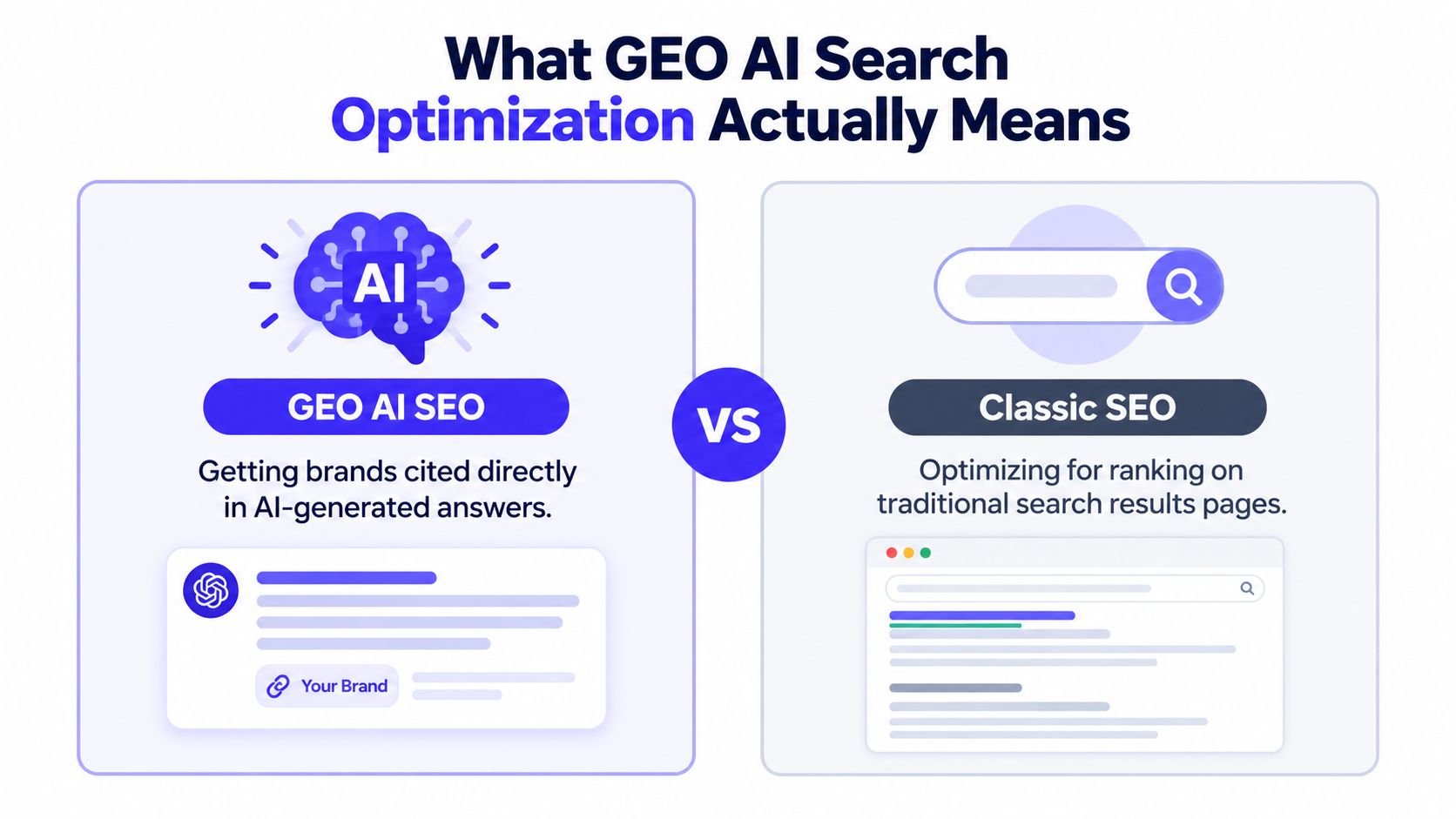
GEO is layered onto SEO
GEO does not replace crawlability, indexing, internal links, page relevance, or useful content. It relies on them. If an AI crawler cannot access a page, or the page does not state clearly what the product does, promotional wording will not make that source dependable.
The Princeton-led research published in November 2023 and presented at ACM KDD 2024 helped make GEO measurable. On a 10,000-query benchmark, targeted changes improved visibility in generative engine responses by up to 40%. Adding quotations increased visibility by up to 41%, adding statistics produced roughly 30% to 40% improvement, and citing sources delivered about 30% improvement. Keyword stuffing performed worse than making no optimization at all (study overview).
For an introduction to geographic context and discovery, read IndieTool's guide to what geo search means. Local brands should separate web-based GEO from social-media location tactics. A guide explaining how to use geo tags for local businesses covers a different distribution channel. GEO focuses on how AI systems interpret and select web evidence.
Why AI Search Visibility Is Reshaping Discoverability
AI search changes how impressions become visits. A user may encounter your category, feature, or competitor comparison inside an answer without opening the cited page. Your site remains technically visible, while the synthesized response controls the first impression.
The 2026 tracker cited earlier shows why founders should treat this channel as part of discovery planning, not as a short experiment. AI answers often mediate the initial encounter, while traditional links support verification and deeper research. For an indie founder with one product and limited budget, that changes the first optimization decision. Start with the page that explains the product's category, audience, problem, and difference most clearly. More content is less useful if the core entity remains difficult to identify.
Citation selection changes the competition
An answer may use only a small set of sources, and the highest-ranking pages do not automatically become those sources. Retrieval systems assess relevance, authority, clarity, freshness, and whether a passage can support the answer's wording. A concise definition with clear product context may be easier to cite than a longer article that buries its point beneath general commentary.
That gives low-authority startups another route into discovery. Instead of spending months pursuing a difficult head term, a founder can make the product findable across comparison pages, directories, integration documentation, and independent mentions. Distribution breadth supplies repeated context. Entity signals connect those references to the same product. Together, they can matter more than publishing a larger volume of loosely related articles.
The competitive question becomes practical: can an answer system find a precise, trustworthy passage about the product? The GEO-bench research benchmark illustrates why query coverage matters. It contains 10,000 queries drawn from nine sources, spanning 25 domains, nine query types, and multiple difficulty levels. A product may appear for an informational prompt, disappear for a transactional one, then surface again for a multi-faceted comparison.
No universal CTR benchmark applies across engines, queries, devices, and answer formats. AI citations can change which result receives attention, but a generic table cannot predict the effect for one business. Founders should record referral visits from relevant pages before making changes, then compare the same sources and query groups afterward. That before-and-after view provides a useful budget signal: improve the page or distribution channel that produces qualified referrals, rather than assuming every visibility gain has the same business value.
The Four Entity Signals AI Engines Read First
Before an AI system can decide whether your advice is useful, it needs to identify what the advice is about. For a product, that means connecting a name to a category, organization, founder, audience, location, and supporting references.
Structured data
Schema markup gives machines explicit labels. A product page can identify the item as a Product, connect it to an Organization, describe offers, and expose breadcrumbs. The markup doesn't replace visible page content, but it reduces ambiguity between a product name, a company name, and a generic phrase.
Use JSON-LD where your CMS supports it, and keep the structured data aligned with what visitors can see. Incorrect or exaggerated markup creates confusion instead of confidence.
Consistent business identity
For a local company, NAP means Name, Address, and Phone. Keep those details identical across the website, business profiles, directories, and relevant listings. A software company without a physical location still needs the same discipline for its brand name, domain, founder identity, product category, and official social profiles.
A spelling variation may look harmless to a person. To a retrieval system, it can suggest that two references describe different entities.
Author and organization entities
Create a clear founder or author profile. Connect the profile to the organization, product, professional background, and published work. Use bylines, author pages, About pages, and consistent profile links rather than scattering disconnected names across the site.
This signal becomes stronger when the author discusses the same problem across multiple relevant pages. The objective isn't to manufacture authority. It's to make real responsibility and subject context legible.
Independent mentions and citations
Third-party references provide context that your own homepage can't supply. Relevant roundup articles, integration pages, directories, reviews, podcasts, and community discussions can all help establish that the product exists beyond its own marketing copy.
For founders researching content-market fit, understanding the search intent that drives growth can help you choose which external pages and queries deserve attention. A directory listing may be more useful when it matches a real comparison or discovery prompt than when it repeats a generic slogan.
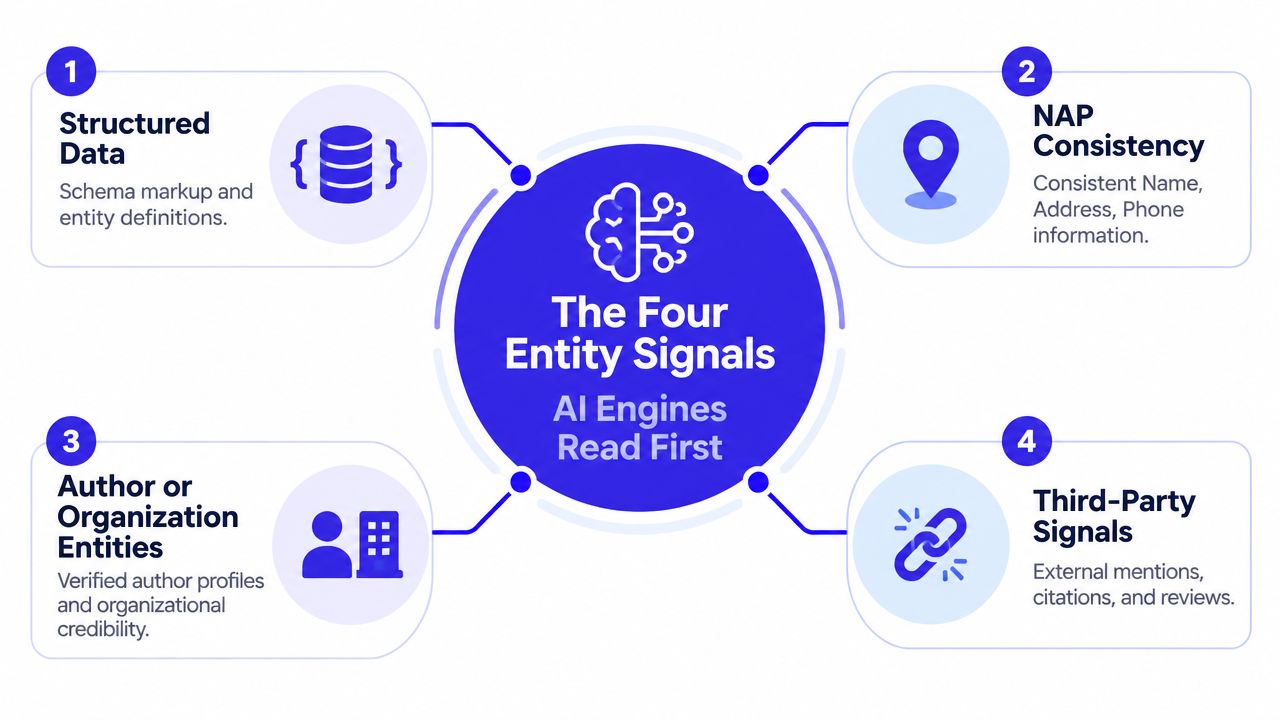
Treat each signal as a confidence vote, not a magic switch. Structured data explains the entity, consistent identity stabilizes it, author context adds accountability, and independent mentions corroborate it.
On-Site Tactics for GEO AI Search Optimization
Start with the pages that describe the product directly. Your homepage, product page, pricing page, documentation, integrations, and About page should use the same category language and state the product's audience and job in plain English.
A strong product introduction answers three questions quickly:
- What is it? “A browser-based backlink monitoring tool for indie SaaS founders.”
- Who is it for? “Built for solo founders and small marketing teams.”
- What does it help them do? “It tracks referring domains, anchor text, and lost links in one dashboard.”
That wording gives an AI system a self-contained passage it can reuse. It also gives users a faster way to decide whether the page matches their intent.
Add machine-readable context
Deploy JSON-LD through reusable templates rather than adding isolated markup by hand. A product template might identify the product and organization, an article template can identify the author and publication, and FAQ content can mark genuine questions and answers.
Use the markup types that describe the page accurately:
- Product: Product name, description, brand, and offer details that appear on the page.
- Organization: Legal or public brand identity, official URL, logo, and profile references.
- FAQPage: Questions with visible, complete answers.
- BreadcrumbList: The page's position within the site hierarchy.
Don't hide critical facts inside images, PDFs, or inaccessible tabs. Put definitions, pricing context, integrations, and use cases in HTML with descriptive headings. Clear sections give retrieval systems smaller, safer units to evaluate.
Build useful geographic context
If your service has regional intent, create a genuinely useful page for each priority service area. Explain availability, local use cases, supported customers, delivery boundaries, or relevant regulations. Avoid swapping place names into identical templates with no meaningful local information.
A local page can use LocalBusiness schema when the business qualifies, but the visible content must carry the same identity details. Connect the page to your main service page with internal links, and include it in the XML sitemap.
Protect crawl and index paths
Review your XML sitemap, robots rules, canonical tags, status codes, and internal links. AI systems can't cite a page they can't retrieve reliably. Keep important pages linked from navigational or contextual hubs, and avoid creating thousands of near-duplicate URLs that dilute the site's entity structure.
Google's guidance on AI features and SEO frames this work as part of normal SEO rather than a separate technical loophole. For a practical companion to these foundations, see IndieTool's guide on improving brand visibility in AI search engines.
Why Distribution Breadth Beats More Content for New Brands
A new brand can publish one more 2,000-word article and still remain nearly invisible to AI search. The problem is often distribution, not writing volume. If the web contains only one consistent description of the product, additional words on that same domain create limited independent evidence.
For an indie founder with one product, no established authority, and a real budget constraint, the choice is concrete. Spend a $0 budget split across two relevant directory listings and one comparison page, or spend that same effort producing another long article. The first option places the product in three different discovery paths. The second improves depth on one path. Neither guarantees a citation, but breadth gives AI systems more consistent places to encounter and verify the entity.
The 12,000-response study cited earlier separates brand mentions from citations. Being named and being sourced are different visibility outcomes. A product needs clear pages on its own site, plus credible references elsewhere that describe what it does, who it serves, and how it differs from alternatives.
Think in surfaces, not posts
For a bootstrapped product, useful distribution surfaces include:
- Comparison pages: “Product A alternatives for small teams,” with a fair explanation of fit, limitations, and relevant use cases.
- Integration directories: Listings that connect the product to the tools it supports.
- Category profiles: Pages that place the product in a narrow, accurate market context.
- Community answers: Helpful responses in forums or Reddit-style discussions where someone has stated the problem the product solves.
- Founder appearances: Podcast pages, interviews, event profiles, and transcripts that identify the founder and product consistently.
- Templates and utilities: Practical assets that earn their own search intent instead of repeating homepage copy.
Each surface acts like another signpost to the same entity. The signposts work together only when the name, description, category, and audience remain consistent. A directory calling the product an analytics platform, a comparison page calling it a reporting tool, and the homepage using a third category create weaker signals than aligned descriptions.
Make the budget decision economically
Compare distribution options by cost per durable surface, not only by cost per published word. A pillar article may explain the category well, while a set of relevant listings and supporting pages can expose the same product to different query types. That advantage disappears when pages are thin, unlinked, copied, or abandoned.
No verified dataset supports a universal citation share for these surfaces, and no fixed page count guarantees better AI visibility. Test breadth deliberately. Publish a small set of distinct pages, record which prompts produce mentions or citations, and expand the surfaces that match real demand.
The practical position is simple: once core pages are clear, another generic article may be less valuable than another credible place where the same product can be independently discovered. For a new brand, distribution breadth gives limited content more chances to become recognizable, retrievable, and citable.
A 30 Day GEO Plan and How to Measure the Lift
Consider a hypothetical founder launching a small analytics app for independent SaaS companies. In week one, the founder standardizes the product description, adds Organization and Product JSON-LD, creates an author page, and checks that the homepage, documentation, and pricing page use the same entity language.
Week two focuses on access and local or regional relevance where it naturally applies. The founder adds FAQPage and BreadcrumbList markup to suitable templates, creates a useful page for each priority region, verifies the sitemap and canonical tags, and submits the URLs through Search Console. If Bing is part of the acquisition plan, the founder can also use IndexNow after publishing.
Week three expands distribution without turning the site into a content warehouse. The founder creates focused comparison, integration, directory, and problem-led pages, then earns relevant external mentions through communities, partnerships, and founder-led outreach. Week four measures whether the changes correlate with AI visibility rather than assuming that any new mention proves causation.
| Week | Focus area | Key deliverables | Measurement |
|---|---|---|---|
| One | Entity foundation | Consistent descriptions, Organization and Product markup, author page | Record baseline prompts and existing mentions |
| Two | Technical access | FAQ and breadcrumb markup, relevant regional pages, sitemap review | Check indexation and retrieval of target URLs |
| Three | Distribution breadth | Comparison, integration, directory, and community assets | Log new mentions and citations by prompt |
| Four | Evaluation | Repeat prompt tests and analytics review | Compare results with the week-zero baseline |
Build a defensible baseline
Use a fixed prompt set covering informational, transactional, comparison, and problem-led searches. Query the same prompts across the systems that matter to your audience, record whether the brand appears, note the cited sources and their positions, and repeat the process on a consistent schedule.
Track referral visits from chat interfaces in analytics, but interpret them carefully. A citation win may increase awareness without producing an immediate visit. Ranking changes, branded demand, product launches, and external coverage can also affect traffic.
For practical monitoring, use IndieTool's guide to tracking brand mentions in AI search alongside your own prompt log. Keep screenshots as supporting evidence, not as the whole measurement system, because answer surfaces can change as systems update.
IndieTool offers indie founders one-time directory listing credits, permanent do-follow backlinks, distribution across 1,210+ index, category, and alternatives pages, AI-search visibility options, and a founder dashboard with views, visitors, and outbound click analytics. It can be evaluated as one distribution surface within a broader GEO measurement plan, not as a substitute for clear pages and independent relevance.
Measurement rule: Count mentions and citations separately, compare them with your baseline, and document the exact prompt, engine, date, cited URL, and referral outcome.
Start this week by fixing one product description, one schema template, one technical access issue, and one relevant external surface. Then record what changes before you publish more. That sequence gives a small brand a clearer path to learning whether GEO is creating incremental visibility or merely adding activity to an already noisy marketing system.
IndieTool helps indie founders distribute products through directory listings, permanent do-follow backlinks, indexable category and alternatives pages, and analytics for views and outbound clicks. Visit IndieTool to evaluate its listing and launch tools as one part of your GEO AI search optimization plan.