Indietool
How to Generate Startup Name Ideas That Actually Work
Most startup naming advice starts in the wrong place. It tells you to brainstorm until something feels clever, then check whether the domain is available. That approach produces attractive dead ends: names that collide with existing brands, fail when spoken aloud, disappear in search results, or force a rushed rebrand after launch.
To generate startup name ideas that can survive contact with the market, treat creativity as the opening move, not the finish line. The useful workflow is a staged funnel: define the brief, generate broadly, filter for pronunciation and flexibility, score candidates, run collision searches, then secure the online identity. A name earns its place when it's memorable, searchable, pronounceable, and defensible.
Table of Contents
- Why Most Startup Names Fail Before Launch
- Build a Creative Brief Before You Open a Generator
- Four Naming Patterns That Produce Strong Candidates
- Best Tools to Generate Startup Name Ideas
- Score Every Candidate With a Decision Matrix
- Run the Knockout Search Across Trademark, Domain, and Social
- Finalize the Name and Lock In Your Online Identity
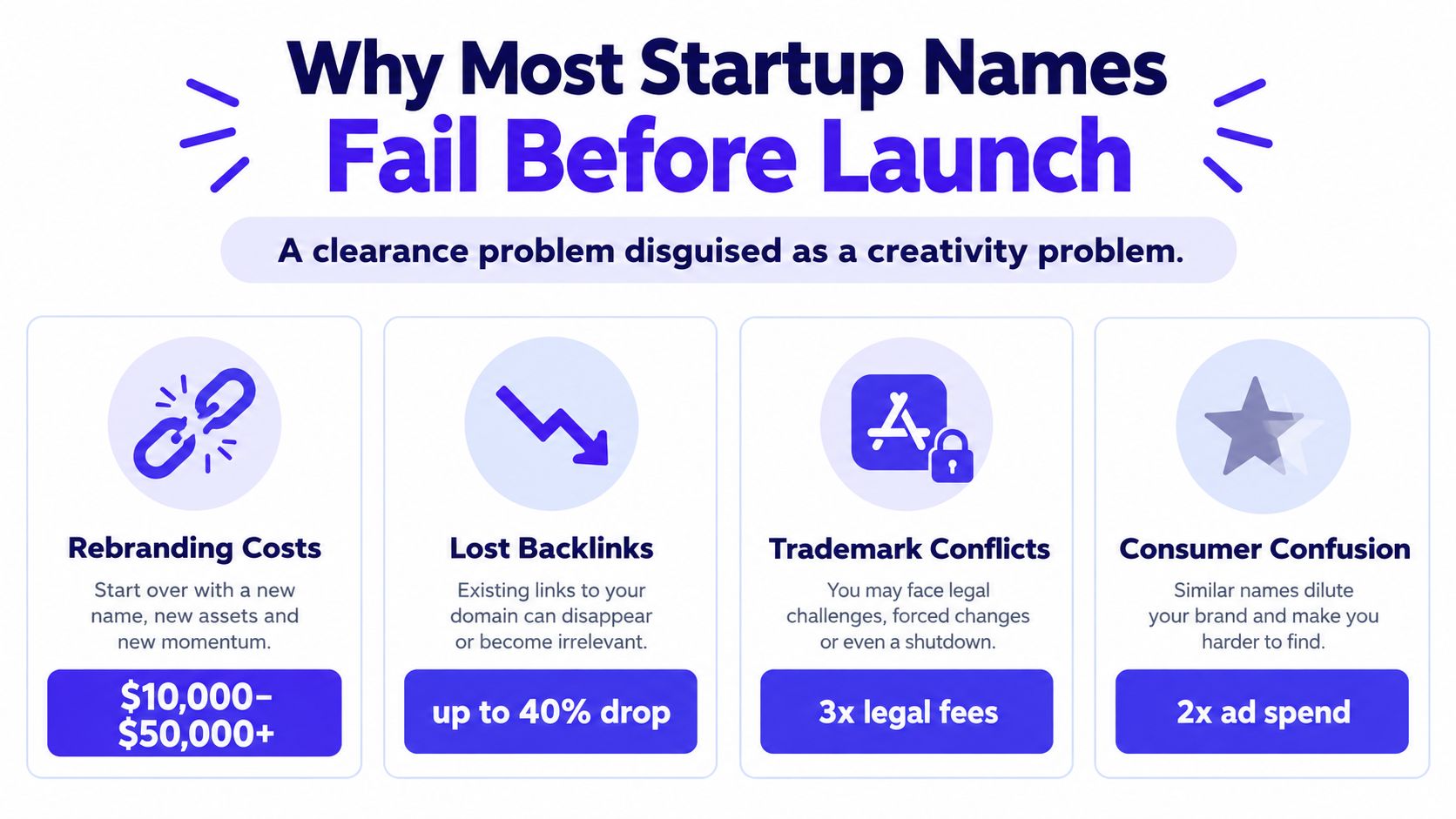
Why Most Startup Names Fail Before Launch
A clever name isn't enough. Your startup name sits inside a legal system, a search index, an app marketplace, a domain ecosystem, and the memory of every person who hears it. If it fails in any of those environments, your branding work becomes expensive rework.
A bad name can force you to replace a logo, rewrite product pages, migrate URLs, update app listings, explain the change to customers, and rebuild references that pointed to the original brand. It can also create a quieter SEO problem. If people misspell the name, confuse it with another company, or can't tell what result belongs to you, your content has to work harder to earn the click.
Distinctiveness changed the naming game
Startup naming has already moved away from literal descriptions. A 2015 analysis comparing companies founded before and after 2012 found that invented names rose from 17% to 41%, while evocative names increased from 7% to 17% (Black Enterprise summary of the analysis). That shift reflects practical pressure to stand out in search, secure a usable domain, and avoid conflicts with existing marks.
Indie founders face this pressure without a brand agency or a large legal budget. They often ship quickly, use personal networks for feedback, and make naming decisions between product releases. That speed is useful for testing a product, but dangerous when a name gets treated as a reversible experiment after public launch.
Practical rule: Don't ask whether a name is clever until you've asked whether you can safely use it.
Use broad naming inspiration, such as this guide to a tag on startup names, for raw ideas. Then switch modes. The job becomes eliminating candidates that create legal, linguistic, domain, app-store, or search problems. A generator should widen your options, not make you falsely confident about the first appealing result.
Build a Creative Brief Before You Open a Generator
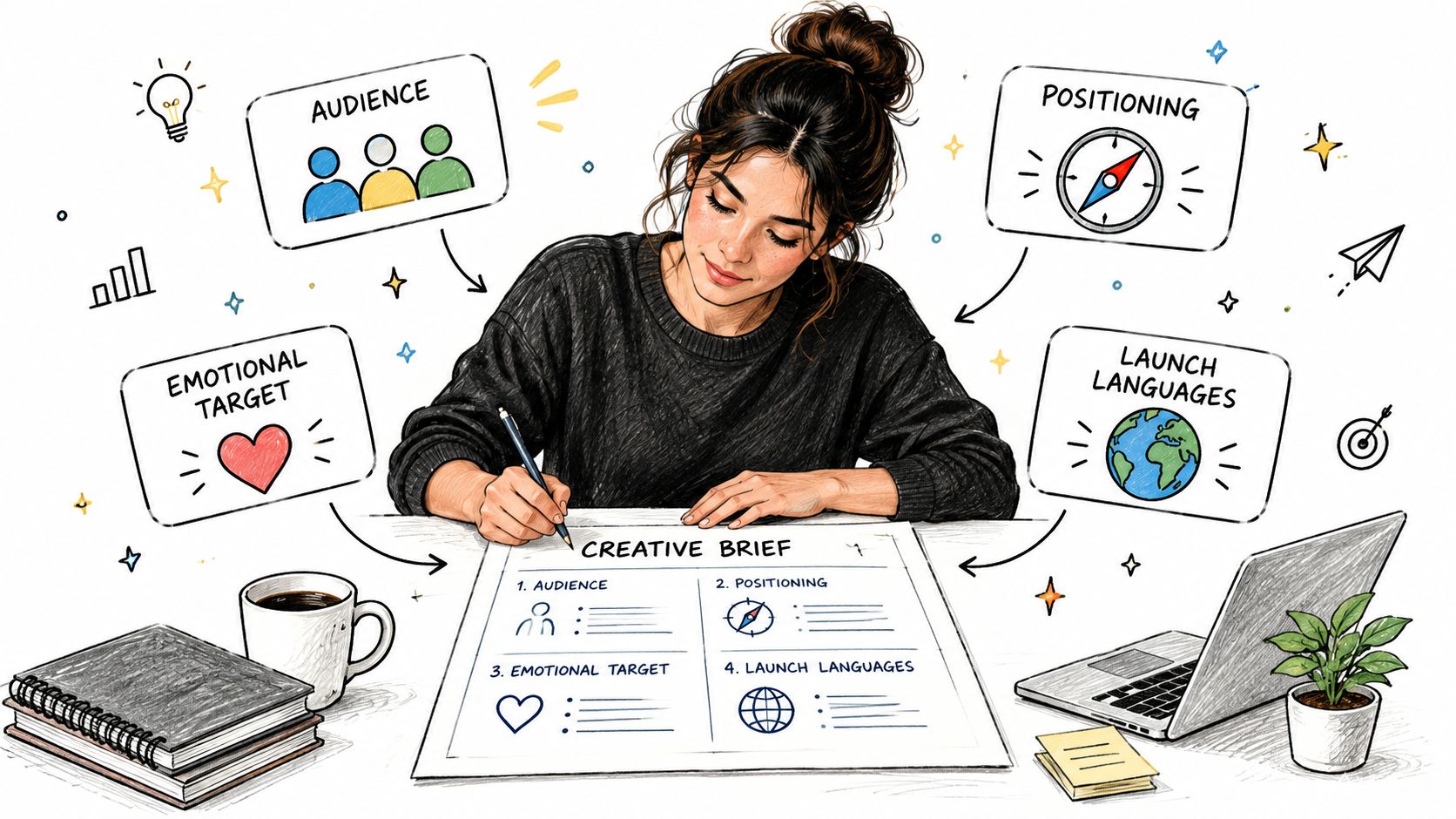
Opening a generator too early is how founders collect hundreds of names with no way to judge them. Write a one-page creative brief first. It gives every candidate a job to perform and makes weak suggestions easy to reject.
Your brief should answer five questions:
- Audience: Who will use or buy the product, and what language do they use?
- Positioning: What problem does the startup solve, and what does it do differently?
- Emotional target: Should the name feel calm, precise, playful, secure, fast, premium, or human?
- Launch markets: Which countries and languages matter at launch or soon after?
- Forbidden territory: Which words, sounds, competitor references, slang terms, and previously rejected marks are off limits?
Add a practical constraint for scope. Write what the product might become, not only what it does today. A name tied too tightly to one feature may explain the first release while making the next product expansion sound unrelated.
A brief example for an AI note-taking app
Suppose you're naming an AI meeting assistant. A useful brief might look like this:
Audience: Small remote teams and independent consultants.
Positioning: Turns scattered meeting audio into clear decisions, owners, and follow-up tasks.
Emotional target: Calm, organized, trustworthy, quietly intelligent.
Markets: English first, with potential expansion into European languages.
Avoid: “Note,” “scribe,” “minutes,” obvious AI clichés, confusing spellings, and names that imply recording without consent.
Future scope: Should still work if the product adds project planning or knowledge management.
The brief doesn't tell you the final name. It defines the boundaries around useful ideas. You can also use this guide to analysing a brand to pressure-test the emotional and strategic role your name needs to play.
Keep the document visible while generating. If a name sounds exciting but violates the audience, language, or scope criteria, reject it immediately. Your taste will change as you see more candidates. The brief keeps your decision anchored to the business rather than to temporary enthusiasm.
Four Naming Patterns That Produce Strong Candidates
Generators work better when you give them a naming pattern instead of a vague prompt. Use the pattern that matches the job your name needs to do, then combine the strongest candidates with your creative brief.
Semantic names
Semantic names use familiar roots connected to the product or outcome. For a workflow tool, candidates such as Clearpath or Taskwell communicate direction and completion without spelling out every feature.
They suit products that need immediate category recognition, especially when users discover them through search or recommendations. The risk is weakness in trademark protection and a narrow identity if the product expands beyond its original use case.
Metaphorical names
Metaphorical names borrow imagery from another domain. Lantern could suit a research tool, while Harbor might fit a secure collaboration product. These names create emotional room and can make an abstract service easier to remember.
The trade-off is explanation. A metaphor may sound distinctive but require stronger copy, visual identity, and onboarding to connect it to the product. Check translations and cultural associations before you commit.
Compound names
Compound names combine two recognizable ideas. SignalNest could work for an alerting platform, while FlowLedger might suit a finance workflow tool. This pattern gives you more semantic direction than a purely invented name while keeping room for a brand personality.
Avoid compounds that become awkward when spoken or produce an unintended phrase. Test the complete word, not just each component.
Phonetic names
Phonetic names use invented but pronounceable syllables. Velora and Nuvani are examples of the style. They can travel beyond a narrow category and offer more room for a distinct web identity, provided people can say and spell them.
Research summarized by Copenhagen Business School finds that easy-to-pronounce names are generally easier to recognize and recall, with first-try pronunciation and spelling serving as a practical benchmark (Copenhagen Business School summary).
Naming test: Show someone an unfamiliar candidate, ask them to say it, then ask them to write it after hearing it once.
Use semantic and compound patterns when clarity matters. Use metaphorical and phonetic patterns when long-term distinctiveness matters. The strongest shortlist often mixes both, as discussed in this guide to great startup names.
Best Tools to Generate Startup Name Ideas
No tool can replace clearance work. The useful difference between tools is how well they help you move from raw ideas to candidates you can actually investigate.
For indie founders, IndieTool's free startup name generator is a practical starting point because it sits alongside other launch utilities and a startup directory. You can use it to create candidate directions, then take the shortlist into separate domain, app-store, social, and trademark checks. Its role is ideation and workflow support, not legal approval. Try the IndieTool name generator after you've written the brief.
| Tool | Candidate Style | Domain Check | Trademark Hint | Best For |
|---|---|---|---|---|
| IndieTool generator | Startup, brand, semantic, and invented directions | Useful for moving candidates into a domain-check workflow | Preliminary only | Indie founders building a shortlist |
| Namelix | Short, brandable, often invented candidates | Availability can vary by result and extension | Not a clearance substitute | Fast visual exploration |
| Shopify Business Name Generator | Clearer keyword-led suggestions | Domain-oriented follow-up is needed | No legal clearance | Early category brainstorming |
Namelix is useful when you want a large range of short, brand-like sounds and visual directions. Its output can feel polished, but polish isn't the same as protectability. Shopify's generator is more useful when you need straightforward category cues, although keyword-heavy suggestions often require more work to become distinctive.
Use tools at different points rather than asking one generator to solve the whole problem. Start with several naming patterns, save the candidates that fit the brief, and export or copy only the names you're willing to investigate. Then stop generating. More options won't help once your bottleneck becomes legal and linguistic screening.
A short video can help you understand the kind of workflow a naming platform supports:
The best tool is the one that gets you to a clean shortlist quickly. It isn't the one that produces the most names.
Score Every Candidate With a Decision Matrix
A long generator list creates the illusion of progress. Reduce it with a simple 1–5 decision matrix, then eliminate anything with a serious legal warning before you admire its total score.
Score each candidate for:
- Distinctiveness: Does it stand apart from competitors and generic category language?
- Pronunciation fluency: Can a new person say it naturally?
- Spelling predictability: Can they type it after hearing it?
- Semantic fit: Does the feeling or meaning match the product?
- International safety: Does it avoid obvious slang, offensive meanings, and awkward sounds in launch markets?
- Search cleanliness: Do results clearly separate the name from unrelated brands, places, or concepts?
- Legal risk: Are there identical or confusingly similar marks in relevant categories?
Legal risk is a veto
Imagine three fictional candidates for a collaboration product: Relaybird, Tavora, and Cohereon. Relaybird might score well for clarity but feel crowded in search. Tavora may be easy to say and flexible, yet needs careful language checks. Cohereon sounds strategically relevant, but a similar mark in adjacent software services could make it unusable.
Don't average the legal score into a comforting total. A candidate with strong memorability and a trademark collision is still a bad candidate. Mark legal risk as pass, investigate, or reject, and remove a reject even if every other dimension scores highly.
This discipline matters because the collision field is crowded. The World Intellectual Property Organization estimated approximately 11.7 million trademark applications worldwide in 2024 and 93.2 million active registrations across 155 offices, with active registrations up 6.1% from 2023 (WIPO trademark highlights).
Use the matrix to choose three or four finalists, not one winner. A shortlist preserves your options while you check domains, app stores, social handles, and registries. It also prevents the common founder mistake of falling in love with a name before testing whether the name can survive outside a spreadsheet.
Run the Knockout Search Across Trademark, Domain, and Social
Your finalist isn't cleared because the exact spelling produces no result. Search for confusion, not just duplication. AI generators can suggest names without checking registered or pending marks, common-law use, related goods-and-services classes, or international conflicts, a risk highlighted in this report on AI-generated brand-name risks.
Start with the trademark layer:
- Search the exact name in the relevant national register.
- Search singular and plural forms, spacing changes, hyphenation, and reversed word order.
- Search phonetic equivalents, obvious misspellings, similar visual forms, and related meanings.
- Review live marks in the same or adjacent goods-and-services classes.
- Check the markets where you'll sell, not only the country where you incorporated.
For a U.S. launch, use the USPTO trademark search system. For European coverage, check EUIPO eSearch. For broader international discovery, use WIPO's Global Brand Database. These searches are preliminary screening, not legal clearance.
Search the identity people will actually encounter
Check company registries, app stores, social platforms, and general search results. Search the candidate in quotation marks, without quotation marks, with the product category, and with common misspellings. Look at the first page of results and ask whether a customer could distinguish your product from existing companies, apps, communities, or media properties.
Then check domains and handles together. A domain that looks available may still create confusion with an established company using a different extension. A clean domain won't solve a crowded app-store result, and a free social handle won't make a conflicted trademark safe.
Record the outcome in a repeatable format:
Candidate:
Trademark exact matches:
Phonetic or conceptual matches:
Relevant classes and markets:
Company and app-store conflicts:
Domain and social status:
Search-result concerns:
Verdict: reject, investigate with counsel, or proceed to testing.
If the result points toward registration, get jurisdiction-specific advice before filing. Founders operating in the United States can also review practical guidance on how to file a California trademark, but a state filing doesn't answer every federal, international, or category-specific question.
Finalize the Name and Lock In Your Online Identity
Once a candidate passes the knockout search, stop treating it as a naming idea. Treat it as an asset. Secure the strongest practical domain, claim the matching social handles that matter to your audience, and reserve the product identity in the app stores where you expect customers to look.
Don't distort a good name to force an exact domain if the result becomes hard to spell. A clear, defensible alternative is better than a clever variation that users forget. Record the chosen spelling, pronunciation, capitalization, approved short form, and any words your team shouldn't use in product copy.
Build a launch-ready identity file
Create one document containing:
- Approved name and pronunciation
- One-sentence positioning
- Domain and handle inventory
- Trademark search dates and notes
- App-store display name
- Search-result screenshots
- Rejected alternatives and reasons
- Brand usage rules
This file saves time when a contractor writes a landing page, a designer creates a logo, or a launch platform asks for a product description. It also protects you from reopening the same debate every time a new team member suggests a more descriptive name.
Your full funnel should now be simple:
- Write the creative brief.
- Generate across semantic, metaphorical, compound, and phonetic patterns.
- Filter for pronunciation, spelling, scope, and language safety.
- Score the shortlist and veto legal risks.
- Run trademark, registry, domain, app-store, social, and search checks.
- Test the surviving names with real users.
- Secure the identity and document the decision.
The most common failure is stopping after step two. The most expensive failure is launching before step five. A name should earn confidence through evidence, not through the emotional rush of seeing it rendered in a logo.
IndieTool can support the early naming and launch workflow with free utilities, while its directory gives founders a place to present a validated product and track listing activity. Once your name has passed screening, use the IndieTool platform to prepare the launch profile, connect the product to its public identity, and give early visitors a clear path from discovery to the product.