Indietool
10 Email Generator for Business Tools Compared
A business email generator isn't one category of tool. Some products create a polished draft and stop there. Others improve an email you're already writing, add CRM context, build a prospecting sequence, or send the campaign themselves. Treating them as interchangeable is the fastest way to buy overlapping software, lose personalization, or mistake fluent copy for a complete email workflow.
This comparison evaluates each option by the job it performs: template depth, output quality, personalization context, workflow integration, pricing structure, and sending capability. The practical question isn't just which tool has the best AI. It's whether you need a quick draft, stronger brand control, CRM-based personalization, outbound automation, or performance coaching inside your existing inbox.
The shortlist covers practical routes for founders, marketers, sales teams, and businesses already committed to a CRM or email service provider:
- Flexible drafting: Copy.ai and Writesonic
- Brand governance: Jasper
- Performance feedback: Anyword
- Email production and sending: Hoppy Copy and Mailchimp
- CRM-native generation: HubSpot
- Prospecting and sequences: Lemlist and Apollo
- Existing-email coaching: Lavender
The best tool depends on the email job, not the most impressive feature list.
Table of Contents
- 1. Copy.ai
- 2. Jasper
- 3. Writesonic
- 4. Anyword
- 5. Hoppy Copy
- 6. Mailchimp
- 7. HubSpot AI Email Writer
- 8. Lemlist
- 9. Lavender
- 10. Apollo
- Top 10 Business Email Generator Comparison
- Choose the Workflow Before the Generator
1. Copy.ai
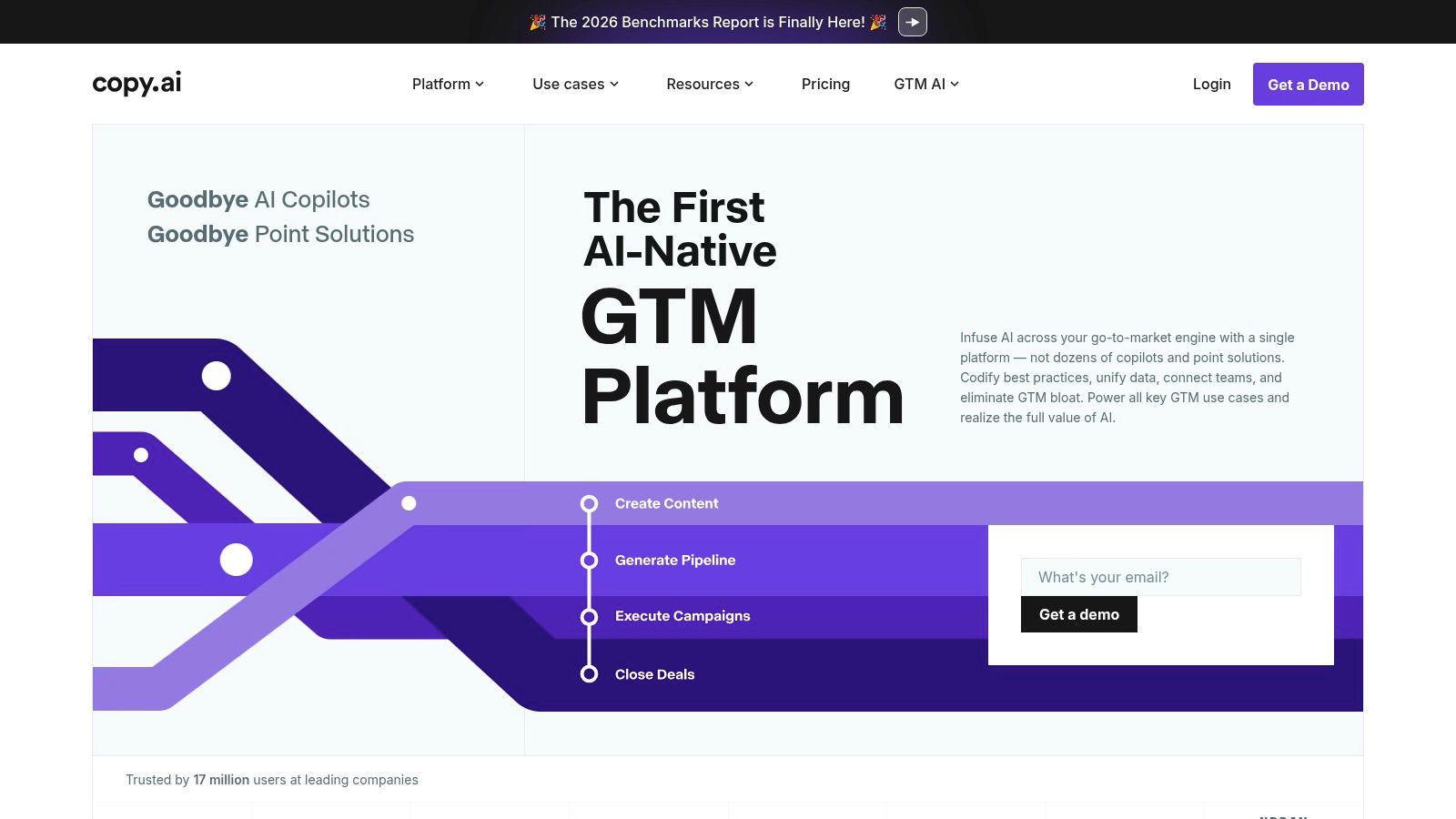
Copy.ai is a strong starting point when a founder or small go-to-market team needs more than one isolated draft. Its value comes from combining an AI email generator for business with templates and no-code workflows that can support research, drafting, personalization, and a handoff to sending tools.
The platform is particularly suited to cold emails, follow-ups, and campaign copy. Prebuilt workflows can reduce the blank-page problem, while integrations with systems such as Salesforce and HubSpot make it more useful than a standalone chat window. The distinction matters. Copy.ai can help operationalize a process, but it isn't automatically the same thing as an email service provider or a complete outbound engine.
Best workflow for Copy.ai
Use Copy.ai when a team starts with scattered prospect or company information and wants a repeatable route to a personalized first draft. A useful workflow might define the audience, collect research, create an opener, draft a follow-up, and pass the result to the system responsible for sending.
Its free tier gives teams a way to test basic generation, but advanced automations and larger seat requirements move the decision into paid plans. Usage-based credits also mean that the cost of a workflow depends on how heavily the team runs automations, not only on how many people log in.
Practical rule: Treat Copy.ai as a workflow layer first and a writing interface second. The more useful the process becomes, the more carefully you should define prompts, approval steps, and credit consumption.
Copy.ai is a good fit for fast personalization at scale, but users shouldn't expect excellent results from vague prompts. Supply the recipient's role, business context, offer, desired action, and reason for contacting that person. Human review remains essential, particularly for claims about a prospect or a product.
2. Jasper
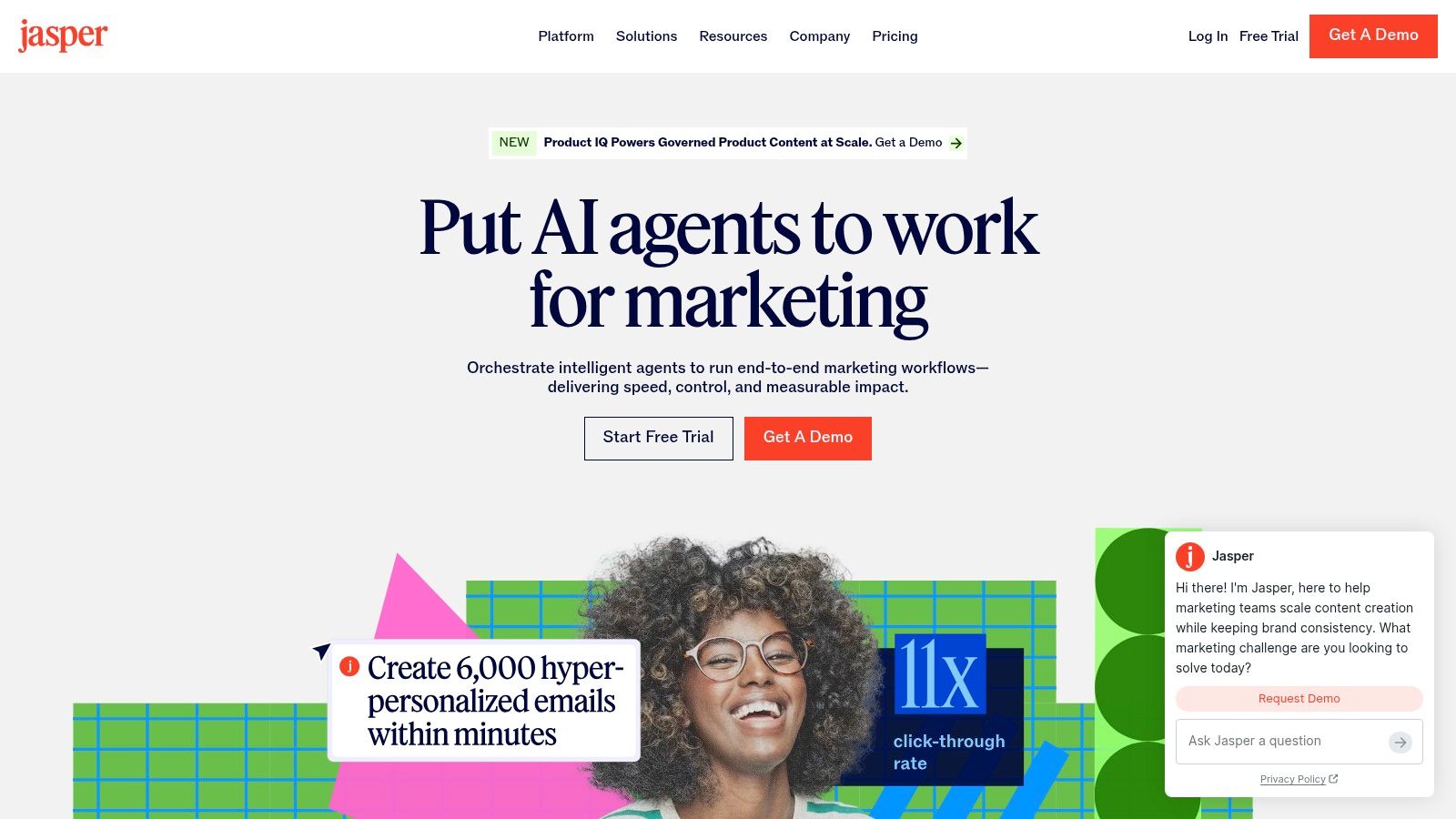
Jasper is built for marketing teams that need consistent brand expression across email campaigns and other channels. Its email templates, tone controls, Brand Voice, Knowledge features, and agent-based automations give it a different emphasis from tools that mainly optimize for quick cold-email output.
The strongest use case is a team with established messaging rules. A marketer can set guidance about tone, terminology, audience, and positioning, then use those instructions while creating campaign copy. Jasper also supports writing inside Gmail and Outlook through its Chrome and Edge extension, which makes it relevant when the draft begins in an everyday mailbox rather than a dedicated campaign editor.
Where Jasper earns its place
Jasper is more compelling for organizations that must control language across multiple contributors than for a solo founder who needs one short follow-up. Its enterprise-oriented controls can help reduce tonal drift, but they don't eliminate the need for editorial judgment. Brand consistency isn't the same as factual accuracy, and an on-brand claim can still be wrong or poorly suited to the recipient.
A seven-day Pro trial is available for evaluating fit. Advanced features use credits, so teams should verify which capabilities and usage allowances are included in the current plan. The Business plan requires an annual commitment, which makes the trial and a realistic workflow test more important before adoption.
Use Jasper if the email is one part of a broader content system. If you only need occasional messages, the platform's breadth may be more than you need. If several people create campaigns and sales material, its brand controls can justify choosing a governed workspace over a simpler prompt box.
3. Writesonic
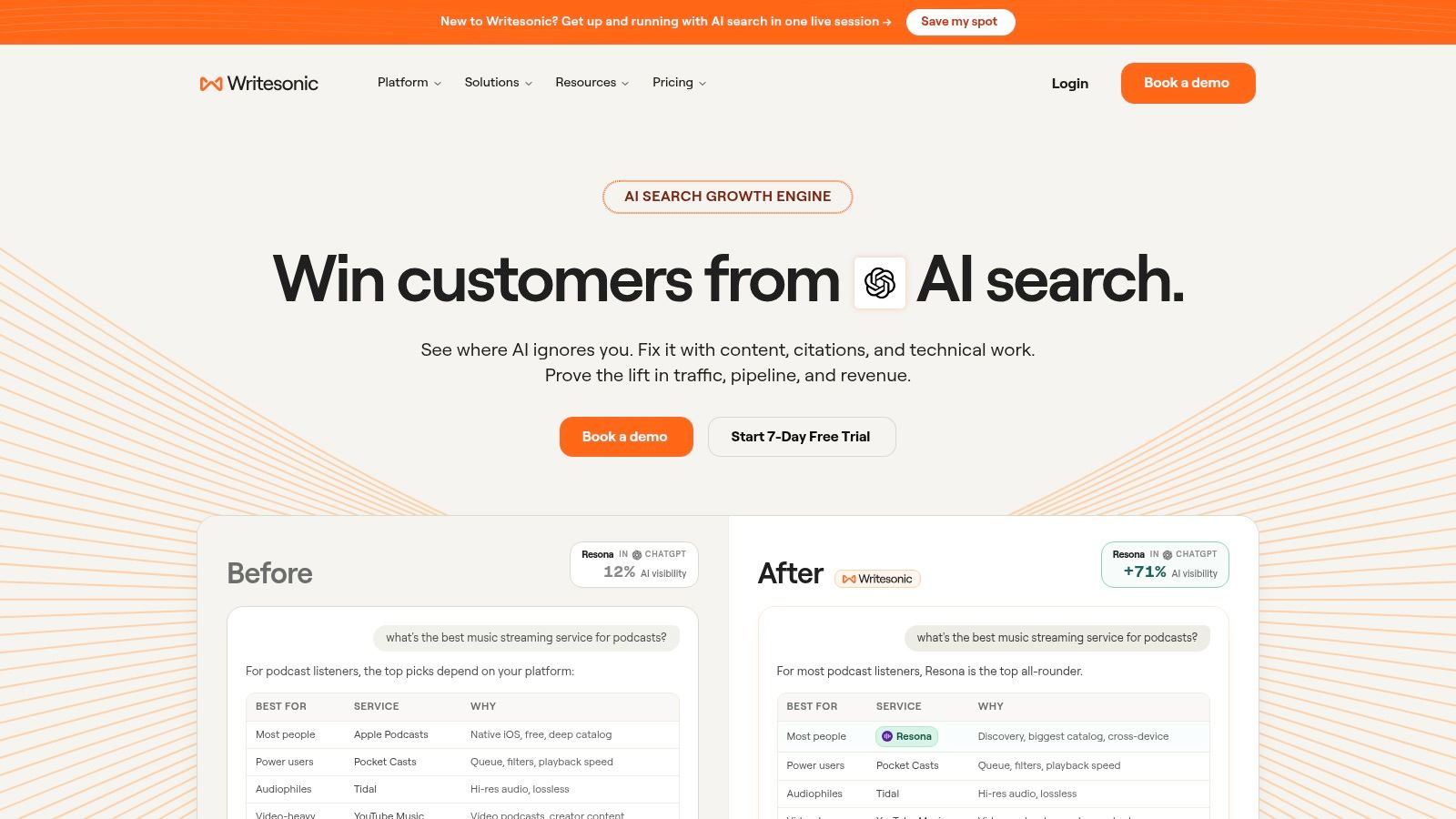
Writesonic makes sense for teams that want email creation alongside broader marketing production. Its email templates and subject-line tools cover the immediate task, while Chatsonic provides a conversational environment for drafting, revising, and comparing different approaches.
The platform's access to multiple models, including GPT-4o, Claude, and Gemini, gives users flexibility when a particular tone or structure isn't working. That doesn't mean every model will produce a better business email. It means the team can experiment with different generation approaches without building separate workflows around each model.
A useful choice for mixed content teams
Writesonic is a practical fit for a small marketing department that creates newsletters, product emails, landing pages, and blog content. The same workspace can support campaign ideation and related copy, which may reduce tool switching. Higher tiers also offer API access, making it possible to connect generation with a custom content process.
The trade-off is focus. A team that only wants a dedicated business email generator may find the feature set broad and the product harder to evaluate than a specialist tool. Pricing tiers and inclusions have changed over time, so buyers should verify current model access, limits, API availability, and team features before committing.
Start with a defined use case rather than testing every feature. Give the tool a real campaign brief, ask for several subject-line directions, and then revise the strongest draft using the actual audience and offer. Writesonic is most useful when email is part of a larger marketing workflow, not when a user wants an all-in-one sending platform.
4. Anyword
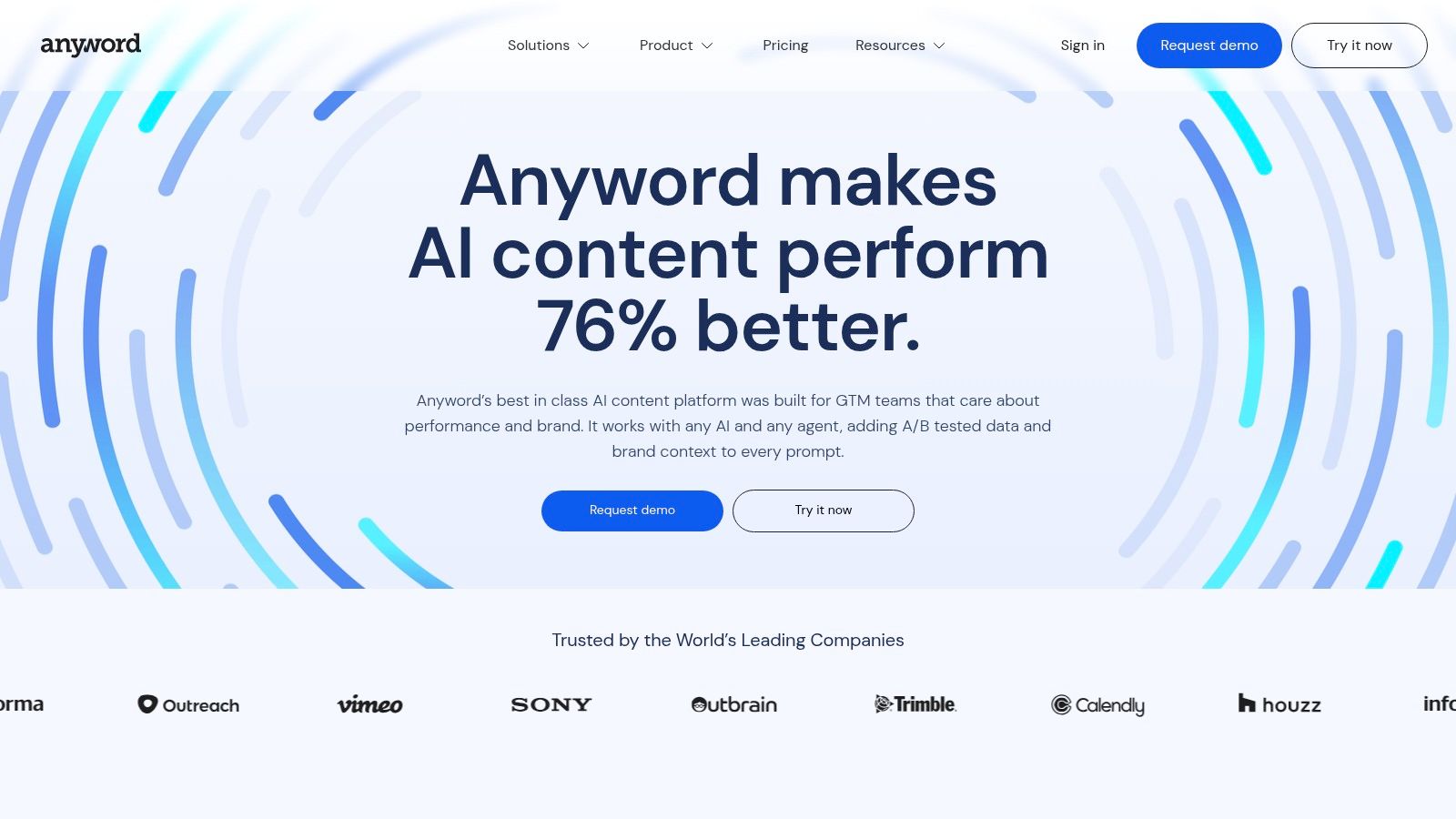
Anyword takes a performance-oriented approach to email generation. Alongside cold and promotional email templates, it offers a Predictive Performance Score intended to give users guidance about the likely effectiveness of copy. That makes it different from tools that judge a draft mainly by grammar, tone, or brand fit.
For a non-copywriter, a score can provide a useful reason to question a weak subject line or an unclear call to action. Anyword also supports brand voice and rewrite modes, so a user can adjust the message without starting over. The platform can connect with systems such as HubSpot and use historical campaign information to shape future drafts, which is where its value becomes more distinctive.
The data requirement matters
Anyword's feedback is more useful when the team can provide relevant historical data. Without that context, a performance score should be treated as directional guidance, not a guarantee that an email will generate replies or conversions. No score can replace a clear offer, accurate targeting, sound deliverability, or a human assessment of whether the message deserves to be sent.
Paid plans offer unlimited words, which can reduce concern about drafting volume. Seats and usage controls can still make the purchasing decision more complicated for teams. Founders should ask whether they have enough campaign history and a defined review process to use the scoring feature meaningfully.
Choose Anyword when the main question is, “Which version deserves testing?” Choose another tool if the main problem is sending, CRM synchronization, or managing a full campaign. It is a feedback and optimization layer first, even though it also generates the underlying copy.
5. Hoppy Copy
Hoppy Copy is designed around email rather than treating email as one template among many. It focuses on newsletters, promotional messages, and sequences, with a brand library and voices intended to make recurring campaigns faster to produce.
The platform also offers competitor email monitoring for inspiration. That can help a marketer study patterns in positioning and structure, but inspiration must not become imitation. A competitor's message may be aimed at a different audience, governed by different permissions, or built around claims your business can't support.
Drafting and sending in one place
Hoppy Copy's optional native sending, automations, landing pages, and forms make it relevant to solo email marketers and early-stage SaaS teams that don't want to assemble a separate writing tool and ESP. Its email-first interface can move a user from campaign idea to production without changing applications.
That convenience can create overlap. If the business already has an established ESP, Hoppy Copy's sending and form features may duplicate tools the team pays for and already understands. Its template depth is also oriented toward marketing email, so it may be less suitable for nuanced partnership notes, executive communication, or sales emails requiring detailed CRM history.
Before switching, compare the complete workflow rather than the generator alone. Check subscriber management, authentication, consent handling, unsubscribe behavior, analytics, and migration requirements. Hoppy Copy is a good choice when email production and sending belong together. It is less compelling when the business already has a mature delivery system.
6. Mailchimp
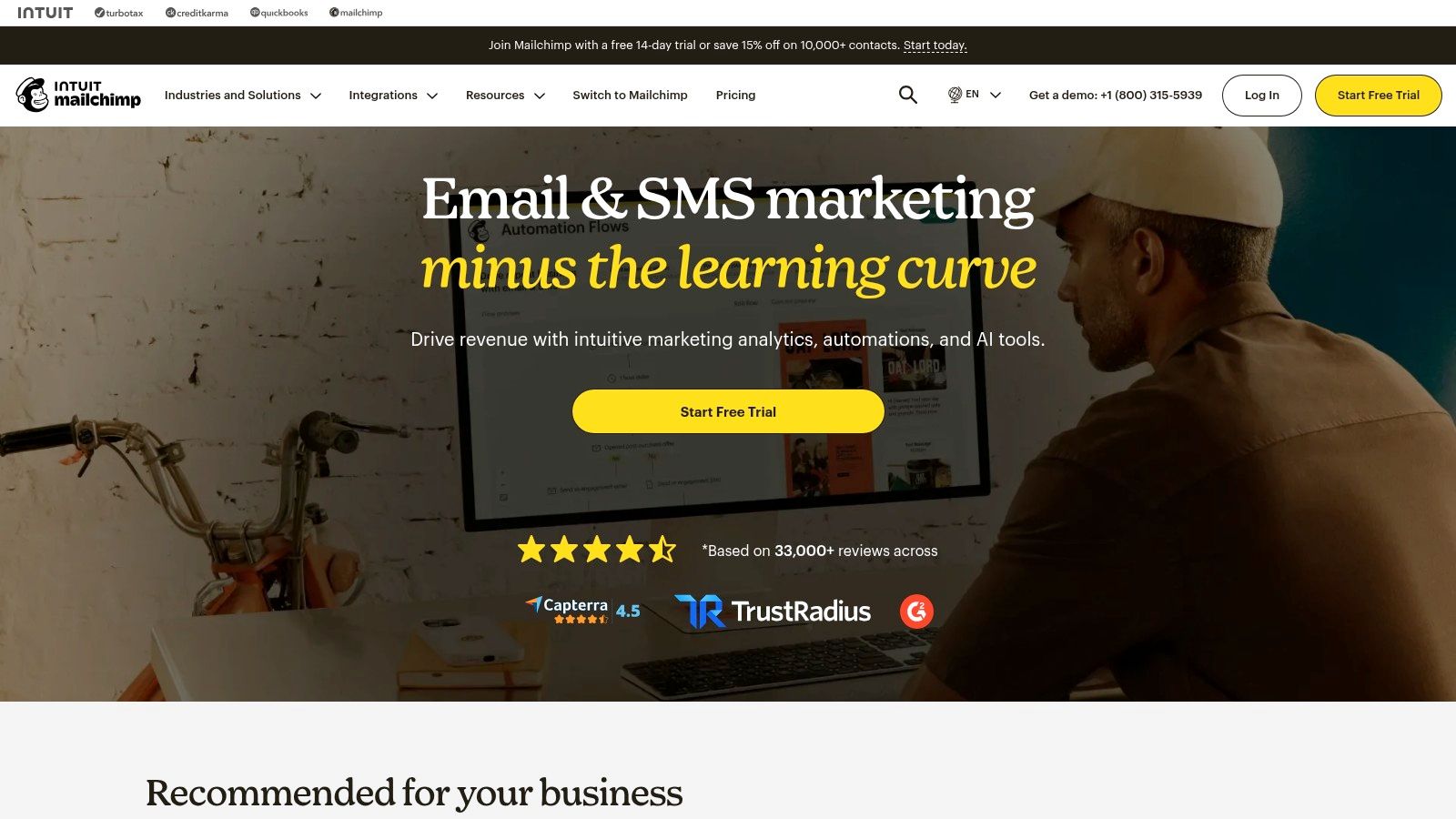
Mailchimp is the pragmatic option for teams that don't want to add a separate AI writing application to an existing email platform. Its AI features sit inside the email builder, where users can generate sections or fuller copy from a prompt or source material such as a URL, then edit the result for tone and brand voice.
That placement changes the buying decision. Mailchimp isn't merely an email generator for business. It combines generation with campaign construction, testing, scheduling, and deliverability tools. For a founder running a small newsletter or early lifecycle campaign, fewer handoffs can be more valuable than access to a specialized writing interface.
The platform is part of the cost
Mailchimp's full feature set depends on the selected plan and contact tier. AI content access and availability can also vary by geography. Buyers should confirm the current plan's sending, testing, automation, and AI provisions rather than assuming that a visible generator includes every campaign capability.
Its main advantage is operational continuity. The team can generate, edit, schedule, and measure in the same environment. Its limitation is that AI copy won't solve poor segmentation, weak consent practices, or authentication problems. Mailchimp is best for businesses that want email-first production with native sending, not for sales teams building complex multichannel prospecting sequences.
7. HubSpot AI Email Writer
HubSpot's AI Email Writer is the clearest choice for teams that already work inside HubSpot CRM. It can draft subject lines, calls to action, and email bodies using CRM fields, while HubSpot's builder, tracking, automation, and analytics keep the generated message connected to the contact and campaign record.
That CRM context is the product's defining advantage. A standalone tool can create a professional sentence, but HubSpot can use the information already associated with the contact, provided the data is accurate, permitted, and configured for use. Teams can connect to HubSpot when they need a broader integration path, although the best experience remains inside HubSpot's own ecosystem.
Strong context, substantial platform dependence
The AI writer is available as a free writing option, but the wider value depends on the HubSpot Hubs and features the business uses. Broader Hubs and enterprise capabilities can become more expensive as the operation grows, so teams should separate the cost of generation from the cost of the CRM, automation, reporting, and contact management around it.
HubSpot is also a useful reference point for lightweight alternatives such as IndieTool's email generator. A focused generator can be faster when the user needs a draft but doesn't need CRM records, automated enrollment, or campaign analytics.
Choose HubSpot when the email must reflect contact history and move directly into a tracked workflow. Don't choose it solely because the writing feature is available. The platform makes most sense when the business is already committed to HubSpot and can maintain clean CRM fields.
8. Lemlist
Lemlist is an outbound platform first and an email generator second. It combines cold-email drafting and rewriting with enrichment, verification, warm-up, deliverability features, and multichannel sequences that can include email, LinkedIn, calls, SMS, or WhatsApp on higher plans.
That makes it suitable for prospecting teams that need to move from a target account to a live sequence. AI agents can assist with research and messaging, while inline rewriting and coaching help users refine a draft before it enters the sequence. The result is a workflow that extends beyond copy creation, but it also introduces more operational settings than a simple generator.
Volume, credits, and deliverability
Lemlist's volume-based Email plan can appeal to indie founders who don't want a strictly per-seat structure. Enrichment and AI functions consume credits, however, so active teams need to monitor usage rather than treating those features as unlimited. Advanced multichannel capabilities can also increase the cost per user.
A tool with warm-up and deliverability controls still doesn't make every campaign safe to send. Teams must validate prospects, respect consent and unsubscribe requirements, authenticate their domains, and watch complaint signals. For a lighter route to cold outreach, ColdReach AI may be worth comparing before adopting a full outbound platform.
Use Lemlist when the business needs prospecting execution, not just better sentences. It can consolidate several outbound functions, but that consolidation creates setup work. If the team only sends occasional one-to-one outreach, a simpler writer and the existing mailbox may be the more sensible combination.
9. Lavender
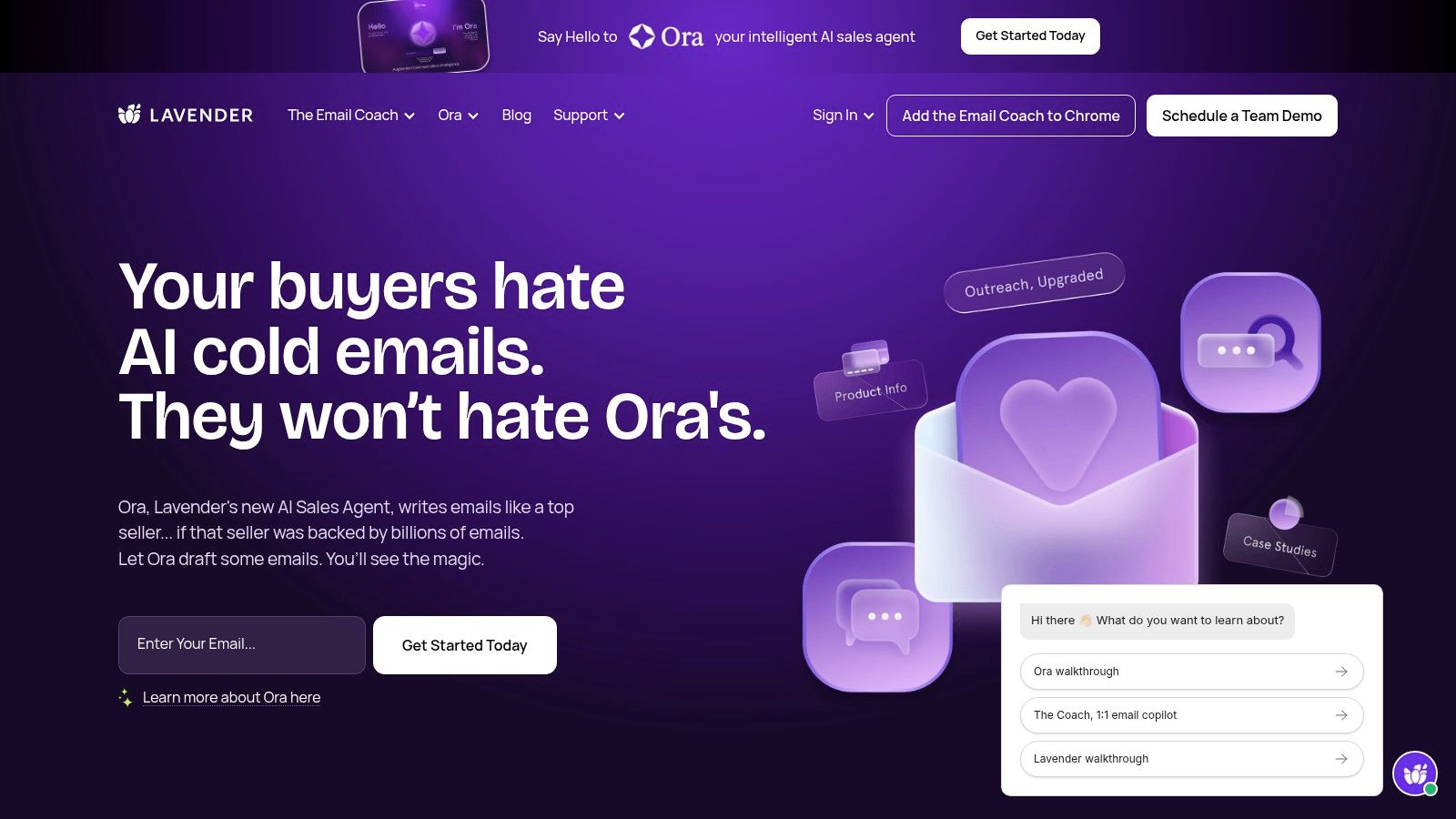
Lavender focuses on improving sales emails that already exist. Its AI writer and coach can score messages, suggest edits, generate rewrites, and provide guidance inside Gmail or Outlook 365. That makes it a different kind of email generator for business. The product is concerned with the quality of an outbound message in context, not just the production of a fresh draft.
The coaching model is useful for teams that want to improve salesperson judgment rather than replace the existing ESP or CRM. Team dashboards can help managers identify recurring problems in outreach, while security features including SOC2 and GDPR positioning matter to organizations reviewing sales tooling.
Coaching isn't the same as sending
Lavender is purpose-built for outbound improvement, but it isn't a full ESP. Teams still need a separate sending, sequencing, and contact-management system unless they use Ora, its AI sales agent that can research, write, and send with a higher-priced approach.
That distinction is valuable because many teams don't need another campaign platform. They need a second set of eyes on relevance, clarity, personalization, and the next step. Lavender can fit that gap without forcing a migration, although Ora's premium pricing makes it a different buying decision from do-it-yourself outreach.
Human review still matters most when the email affects a relationship. A 2025 study of more than 1,000 full-time U.S. professionals found that supervisors were viewed as sincere by 40% of respondents for messages involving high AI assistance, compared with 83% for low-assistance messages. The findings are reported by Euronews.
Use Lavender for sales coaching and message refinement. Don't mistake a stronger score for permission to automate sensitive feedback, apologies, partnership communication, or motivational leadership messages without meaningful personal editing.
10. Apollo
Apollo combines B2B prospect data, sequencing, and AI-assisted email generation. It can create complete sequences with personalized openers and dynamic variables, while also supporting calls and LinkedIn steps. That makes Apollo a strong fit for a sales team that wants prospect discovery and outreach automation in one application.
Its writing assistant, snippets, coaching, and sequence API support both manual and more structured processes. A team can create a repeatable sequence, insert approved variables, and reduce the number of systems required to launch a campaign. The advantage is less tool switching. The risk is that an integrated data and automation platform requires careful configuration to avoid sending generic or poorly matched messages at scale.
The all-in-one trade-off
Apollo's pricing depends on plans, add-ons, and credits, so teams need to use its pricing calculator and identify which data, sequencing, and AI capabilities they require. AI word caps also require usage planning for active teams. A low entry price can become less meaningful if the workflow depends on multiple paid allowances.
Apollo is strongest when the business needs data plus sequencing plus copy. It is unnecessary complexity for a marketer preparing one newsletter or a founder writing a single partnership email. Before automating, clean the audience, define personalization fields, and establish an approval rule for claims and sensitive language.
Teams comparing Apollo with a lighter outbound tool can also review EmailListCleaner.org as part of list hygiene planning. Better targeting and cleaner data often improve the workflow more reliably than adding another generation prompt.
Top 10 Business Email Generator Comparison
| Product | Core features ✨ | UX / Quality ★ | Pricing & Value 💰 | Best for 👥 | Unique strength 🏆 |
|---|---|---|---|---|---|
| Copy.ai | Cold emails + sequences; no-code workflows; CRM sync | ★★★★, strong templates, quick setup | 💰 Usage-based credits; free tier | 👥 Founders & small GTM teams | 🏆 Fast personalization + workflow library |
| Jasper | Brand-safe email + tone/voice controls; browser extensions | ★★★★, enterprise-ready UX | 💰 Credit-based; business plans require annual | 👥 Marketing teams & brands | 🏆 Brand voice + enterprise controls |
| Writesonic (Chatsonic) | Multi-model drafting; chat interface; email templates | ★★★★, flexible, iterative drafting | 💰 Tiered plans; API/model access varies | 👥 Teams needing email + broader marketing copy | 🏆 Multi-model access & chat drafting |
| Anyword | Email templates + Predictive Performance Score; CRM training | ★★★★, data-driven recommendations | 💰 Paid plans; best ROI after historical data import | 👥 Founders optimizing conversions | 🏆 Predictive scoring for effectiveness |
| Hoppy Copy | Email-first generator; competitor monitoring; optional sending | ★★★★, fast idea→send workflow | 💰 Affordable for solos; can replace small ESP | 👥 Solo email marketers & early-stage SaaS | 🏆 All-in-one email + native sending |
| Mailchimp | AI content in-builder; testing, scheduling & deliverability | ★★★, pragmatic ESP integration | 💰 Contact-tiered pricing; AI features vary by plan/region | 👥 Small teams wanting single ESP + AI | 🏆 Native ESP with in-builder AI |
| HubSpot AI Email Writer | CRM-token personalization; AI templates in builder | ★★★★, deep CRM-context UX | 💰 Free AI writer; best with paid HubSpot Hubs | 👥 Teams already on HubSpot | 🏆 CRM-driven personalization (free AI) |
| Lemlist | AI rewriting/coaching; enrichment; warm-up; multichannel | ★★★★, consolidated outbound experience | 💰 Volume-based plans; enrichment credits | 👥 Indie founders doing outbound at scale | 🏆 Outbound + deliverability in one app |
| Lavender | Real-time coaching & scoring; personalized rewrites; Ora agent | ★★★★, focused sales coaching | 💰 Tiered; Ora (autopilot) is premium | 👥 Sales reps & outreach teams | 🏆 Real-time coaching + autopilot agent |
| Apollo | B2B data + sequencing + AI-assisted copy | ★★★, powerful but setup-heavy | 💰 Plan/add-on/credit complexity; calculator recommended | 👥 Teams needing integrated data & sequences | 🏆 Data + AI-driven sequences in one platform |
Choose the Workflow Before the Generator
The right choice becomes clearer when you name the job the team needs to complete.
Choose Copy.ai when you want flexible drafting connected to no-code go-to-market workflows. It suits founders and small teams that need cold-email and follow-up templates, research-to-draft processes, and integrations with tools such as Salesforce or HubSpot. Choose Writesonic when email is only one part of a wider marketing workload and the team values multiple model options, conversational iteration, and access to related content tools.
Choose Jasper when brand governance matters more than minimal setup. Its Brand Voice, Knowledge features, tone controls, and business-oriented automation are more relevant to teams with several contributors than to someone writing an occasional note. Choose Anyword when performance-oriented feedback is central. Its Predictive Performance Score can give non-copywriters a structured way to compare drafts, but the strongest use requires relevant historical campaign data and sensible interpretation.
Choose Hoppy Copy or Mailchimp when the business wants email-first production and sending. Hoppy Copy is oriented toward newsletters, promotional campaigns, and sequences, with optional native sending, forms, and automations. Mailchimp is the more practical route when the team already wants an established ESP with generation, testing, scheduling, and deliverability functions in one platform. In both cases, check current plans, contact limits, geography-dependent AI access, and migration requirements before buying.
Choose HubSpot when CRM context is the deciding factor. Its AI writer can use CRM fields and connect the draft to tracking, automation, and analytics, but the platform makes the most sense for teams already using HubSpot Hubs. A standalone generator will be faster and less expensive to operate if all you need is copy without contact records or campaign reporting.
Choose Lemlist or Apollo for prospecting and sequences. Lemlist emphasizes outbound execution, enrichment, verification, warm-up, and multichannel automation. Apollo combines prospect data with sequencing and AI writing. Both require more setup and operational discipline than a basic writer, and both make credits, data quality, authentication, and sending controls part of the decision.
Choose Lavender when the team already has an inbox, CRM, or ESP but needs better sales outreach. Its coaching and rewrites can improve the message without requiring a full platform change. Its AI sales agent is a separate, more automated path, not a reason to treat all sales communication as safe to send without review.
For fast, focused business email copy without adopting a broader marketing or sales platform, try IndieTool. Its AI Email Generator supports business proposals, follow-ups, cold outreach, thank-you messages, meeting requests, partnership inquiries, newsletters, and event invitations. Users select an email type and tone, provide the recipient's role and key points, and receive three variations with subject lines and structured bodies that can be copied, downloaded, or bookmarked.
Generation is only the drafting stage. Email has supported business communication for more than five decades, from shared-computer messaging in 1965 to Ray Tomlinson's first networked email in 1971, as documented in the history of email from MailStore. Its durable fields, including sender, recipient, subject, body, and call to action, explain why a useful generator should structure information rather than produce an unedited block of text.
Sending introduces a separate technical risk. Google and Yahoo require bulk senders to use SPF and DKIM, while DMARC must at least be configured at a monitoring level, and Microsoft has moved toward similar authentication expectations. Mailgun's 2025 research found that 61% of senders used DMARC, while 12% were still implementing it, 13% were unsure, and 14% didn't use it, according to its deliverability impact report. Before sending, validate authentication, alignment, unsubscribe handling, sending volume, list quality, and complaint thresholds.
AI adoption also points to an assistant model rather than blind automation. Ascend2's survey found that AI use for email marketing among companies with 500 or more employees rose from 26% in 2022 to 57% in 2023, with 25% planning near-term adoption, as reported by Marketing Dive. The same survey identified privacy and data protection, data quality, internal expertise, and strategy as major concerns. A 2026 industry benchmark likewise reported that 70% of marketing teams had deployed AI in production while 88% still required moderate-to-substantial human editing, and 95% of generative-AI email users considered it effective, according to Knak's benchmark summary.
That evidence supports a simple purchase rule. Pick the lightest tool that solves the actual workflow, keep sensitive data exposure under control, review every meaningful personalization, and never confuse polished copy with permission, deliverability, or trust.
IndieTool offers a focused AI email generator for business proposals, follow-ups, cold outreach, meeting requests, partnerships, newsletters, and other common messages. Visit IndieTool to create structured email variations without adopting a full CRM, ESP, or outbound platform.