Indietool
What Is Product Optimization and How to Do It Right
Product optimization is the continuous, data-driven process of improving a live product's usability, performance, and business outcomes after launch by observing user behavior, making targeted changes, and measuring whether engagement, retention, conversion, or revenue improves. If you've already launched and people are visiting but not signing up, activating, or sticking around, product optimization is the work that turns that traffic into learning and, eventually, growth.
A lot of founders think the hard part ends when the product ships. Then launch week arrives, a few people click around, some bounce, a couple sign up, and your dashboard becomes a source of low-grade stress. You know something is off, but you can't tell whether the problem is the onboarding, the pricing page, the page speed, the messaging, or the fact that people who do sign up never come back.
That confusion is normal. It happens because most advice splits optimization into separate buckets. UX over here. SEO over there. Pricing in another folder. Retention in a different tool. A solo founder doesn't experience the product that way, and users definitely don't. They experience one thing: “Does this solve my problem fast enough, clearly enough, and at a price that feels worth it?”
That's the mental model to keep. What is product optimization? It's not a redesign project. It's not a last-mile polish task. It's the operating rhythm of improving what already exists, with evidence instead of guesses.
Table of Contents
- What Product Optimization Actually Means
- The Five Pillars That Make Up Modern Product Optimization
- UX and Conversion Rate Optimization for Indie Products
- Performance and SEO as an Optimization Layer
- Pricing, Retention, and the Revenue Side of Optimization
- A 30-60-90 Day Optimization Playbook for Solo Founders
- Common Misconceptions and Your Optimization Checklist
What Product Optimization Actually Means
You launch. Traffic arrives. Some visitors click your hero button. Fewer finish signup. Fewer still reach the moment where they understand the value. That's the moment product optimization starts.
Modern product teams treat optimization as an ongoing process, not a one-time redesign. It's commonly framed as improving a live product by combining quantitative signals such as funnels, retention cohorts, event tracking, and conversion rates with qualitative evidence such as session replays, heatmaps, rage taps, and crash logs, then measuring whether the changes improved the KPI that mattered (UXCam on product optimization).
The simplest definition that holds up
Product optimization means running a loop:
- Observe behavior
- Form a hypothesis
- Ship a focused change
- Measure what happened
That's it.
If users open your app but never finish onboarding, you don't need a brand refresh. You need to find the friction point, change one part of the flow, and see whether activation improves. If people land on your pricing page and leave, you don't need ten new features. You need to figure out whether the problem is trust, clarity, offer structure, or intent mismatch.
Practical rule: If you can't name the behavior you want to change, you're not optimizing yet. You're just editing.
Why founders get this wrong early
First-time founders often confuse optimization with “making the product nicer.” Nicer can help. But optimization is narrower and more useful. It asks, “What specific friction is blocking value, and what evidence do we have?”
There's also a deeper shift behind the term. Product optimization grew out of a move from feature-building to evidence-based improvement. Today it's widely defined as refining and improving a product to make it more valuable to current users and more attractive to new ones, using data analysis, experimentation, and incremental refinement instead of relying on occasional relaunches (ProductPlan's definition of product optimization).
For indie founders, this matters earlier than many realize. With a small user base, each signup and drop-off is visible. You can often watch the exact point where someone gets confused. That makes optimization one of the most effective things you can do before spending more on acquisition.
The connected version most guides miss
The useful way to think about optimization is as one discipline with several surfaces:
- UX and conversion decide whether visitors understand what to do
- Performance decides whether the product feels fast enough to trust
- SEO decides whether the right people arrive in the first place
- Pricing decides whether the value feels worth the ask
- Retention decides whether your gains stick
A founder doesn't need five departments to work on those. You need one habit: notice friction, change the right thing, and verify whether the outcome improved.
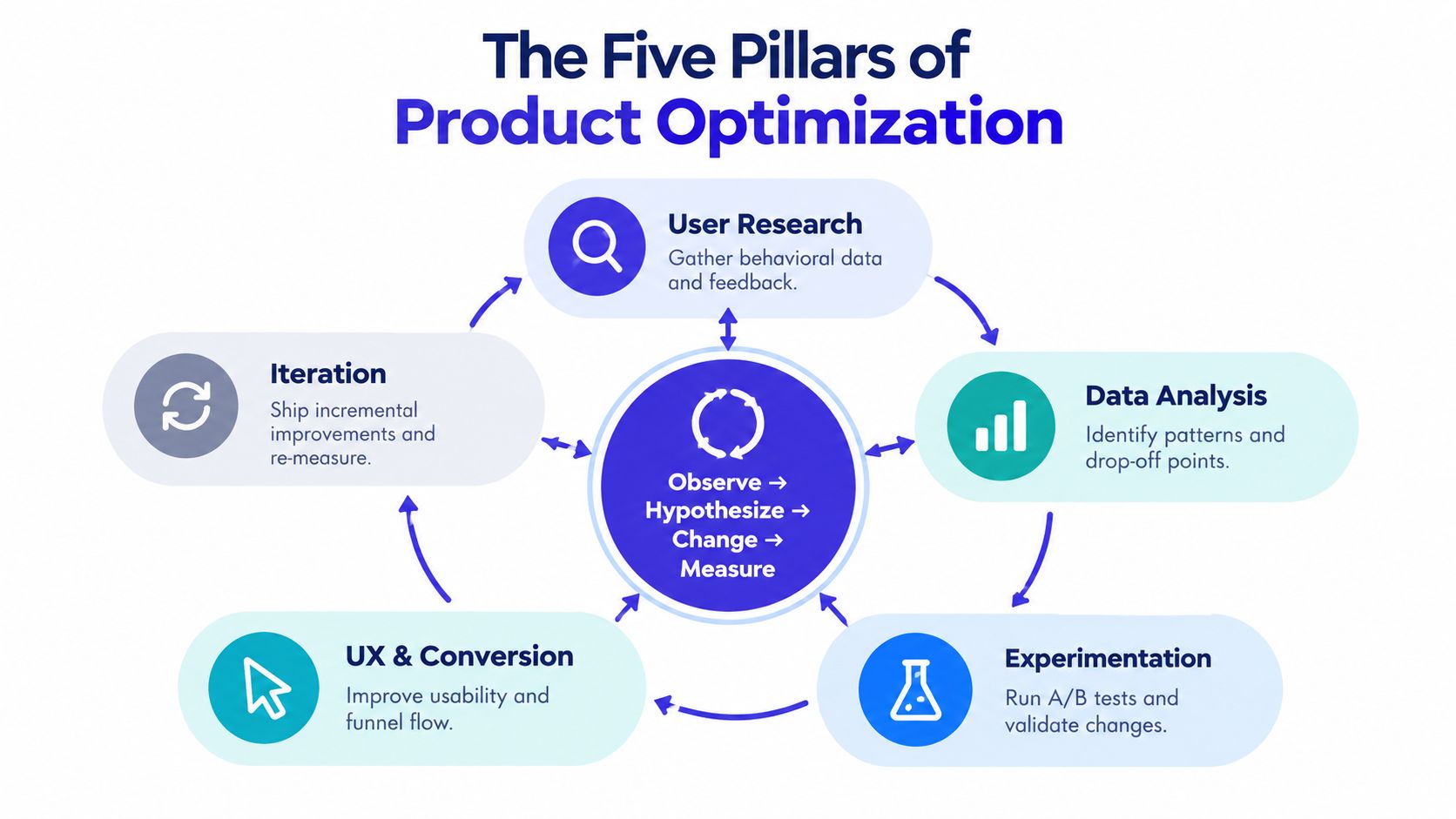
The Five Pillars That Make Up Modern Product Optimization
Silos form by accident. Marketing works on SEO. Design works on onboarding. Engineering works on speed. Nobody owns the full path from search result to retained customer. That's where optimization breaks.
A better model is a thermostat. A thermostat has sensors, a target, an action, and feedback. Product optimization works the same way. Your product collects signals, you define the outcome you want, you change something, and you check whether the system moved closer to the goal.
The loop that connects everything
The connective tissue is always the same:
- Observe what users do
- Hypothesize why the friction exists
- Change the smallest useful thing
- Measure whether the outcome improved
That loop applies whether you're rewriting a CTA, compressing images, changing plan names, or fixing a search landing page.
If you want a practical way to structure experiments so you don't confuse activity with learning, this guide to A/B testing best practices is useful because it forces discipline around variants, measurement, and interpretation.
The five pillars in plain language
UX and conversion
This pillar answers a simple question: Can users move from interest to action without confusion?
You look for drop-offs, dead clicks, hesitation, and abandoned steps. The fixes are often small. Better labels. Fewer form fields. Clearer onboarding copy. One less step between intent and value.
Performance
This one asks: Does the product feel responsive enough to keep trust?
Founders often underestimate how much slowness changes behavior. Users rarely file a ticket saying, “Your app is technically usable but just annoying enough to lower intent.” They just leave.
SEO
SEO is not separate from product optimization. It asks: Are the right users entering the system with the right expectations?
You can rank for a term and still fail if the landing page attracts people with a different problem than the product solves. Search visibility without message match is a leaky bucket.
Pricing
Pricing tells you whether users understand the value exchange. It's not just a finance decision. It's product communication.
A pricing page can create clarity or hesitation. Bad packaging can make a strong product feel confusing.
Retention
Retention is where all the earlier work gets audited. If an optimization lifts signups but the users never come back, you didn't improve the product. You improved a surface metric.
Optimization only works when the gain survives past the first click.
Why single-pillar thinking fails
An SEO win that sends mismatched traffic wastes onboarding work. A cleaner onboarding flow won't help much if the app loads slowly. A pricing tweak that boosts purchases but attracts the wrong customer can show up later as churn.
That's why “what is product optimization” is really a systems question. You're not tuning isolated screens. You're tuning a chain.
UX and Conversion Rate Optimization for Indie Products
When founders say, “We should improve UX,” they often mean “the product should look more polished.” Sometimes that's true. More often, the problem is friction, not aesthetics.
UX and conversion rate optimization are the disciplines of finding where user intent dies. A person wanted to do something. Something in the interface stopped them. Your job is to locate that moment.
The three signals worth setting up first
You don't need an enterprise stack. Start with three kinds of evidence.
- Heatmaps and scrollmaps show attention. They help you see whether people even reach the information they need. If your pricing explanation sits below where most visitors stop reading, that's not a copy problem first. It's a layout problem.
- Session replays show confusion. You can watch people hesitate, backtrack, rage click, or re-read the same step. That gives context numbers alone can't.
- Funnel reports show intent-to-action gaps. If lots of people start signup and few complete it, the issue is likely inside the flow rather than in your homepage promise.
If your product collects sensitive intake data, especially in health-related workflows, a tool built as a HIPAA-compliant form platform can matter because trust and compliance shape conversion too.
How each signal maps to an action
Different signals suggest different fixes.
| Signal | What it usually reveals | Likely fix |
|---|---|---|
| Heatmap | Users miss key information or CTA | Change placement, hierarchy, or button clarity |
| Session replay | Users get confused mid-flow | Rewrite copy, remove ambiguity, reduce steps |
| Funnel drop-off | Users quit between two actions | Simplify transition, improve form logic, remove blockers |
Here's a common indie example. You run a landing page for a lightweight invoicing tool. Visitors click “Start free,” but many stall on the account setup screen. Session replays show them pausing at “Workspace name” and “Team size.” That suggests they don't yet feel committed enough to answer setup questions. The fix isn't a prettier page. It might be removing those fields until after first use.
Qualitative and quantitative need each other
Numbers tell you where. Watching behavior tells you why.
A funnel report can show that people leave on your pricing page. It can't tell you whether they felt the plans looked too similar, whether a term was unclear, or whether they were searching for one feature that was hard to find. Replays and support messages close that gap.
That's one reason product optimization works best as an iterative loop rather than a giant redesign. One hypothesis. One change. One metric. Then decide.
For founders working on marketplace or catalog pages, IndieTool has a guide on product listing optimization that's useful because listing clarity often affects both conversion and search visibility at the same time.
Watch five real sessions before you rewrite a page. You'll usually learn more than you do from arguing about design in Slack.
Performance and SEO as an Optimization Layer
Many founders separate speed and SEO into different projects. Users don't. A slow page and a mismatched search landing page produce the same business outcome: the visitor leaves.
Treat performance and SEO as one layer that controls discoverability and first impression. One gets the right person in. The other keeps them around long enough to care.
Start with speed that supports trust
If your homepage, blog, or app shell loads slowly, every later optimization has less room to work. Visitors form a judgment before they've read your copy.
In practical terms, the fastest wins for indie teams are often boring:
- Compress large images
- Subset fonts and remove weights you don't use
- Cache route-level content
- Reduce heavy scripts on high-intent pages
- Render critical pages closer to the user when your stack allows it
You don't need perfection. You need pages that feel dependable.
The SEO side is intent alignment
Search traffic only helps if the page matches the reason someone searched. That means the headline, subhead, metadata, and page structure should reflect the problem the user had in mind before clicking.
A strong SaaS content engine usually treats blog posts as part of a larger acquisition path, not isolated articles. This SaaS content funnel approach is a good way to think about that path from educational query to product-fit page.
Internal links matter here too. If your site explains concepts that support buying intent, link those pages intentionally. For example, a founder exploring rankings and discoverability will benefit from a plain-English guide to search visibility before they start rewriting title tags blindly.
A simple way to review the layer
You don't need precise benchmarks to start a useful review. A lightweight scorecard is enough.
| Metric | Good Threshold | Indie Baseline | Conversion Impact |
|---|---|---|---|
| LCP | Fast enough to feel immediate | Varies by stack and page type | Slower pages create drop-off before value is clear |
| INP | Responsive enough to feel usable | Often worsens with heavy scripts | Delayed interactions reduce trust |
| CLS | Stable enough to avoid layout jumps | Common issue on image-heavy pages | Jumping layouts interrupt clicks and reading |
A common failure pattern looks like this: a founder writes a useful blog post, it starts getting search traffic, but the page loads slowly, the CTA is buried, and the signup page asks for too much too soon. They'll think “SEO isn't converting,” when the issue is that performance, page structure, and funnel design are all leaking at once.
Fixing those together is what product optimization looks like in practice.
Pricing, Retention, and the Revenue Side of Optimization
Pricing is one of the most neglected optimization surfaces in indie products. Founders pick a plan structure, publish a pricing page, and avoid touching it because changing prices feels risky. Leaving a confusing pricing model untouched is also risky. It just feels quieter.
The better view is simple. Pricing is a product decision with revenue consequences. It shapes who signs up, what they expect, and whether they stay long enough to become a healthy customer.
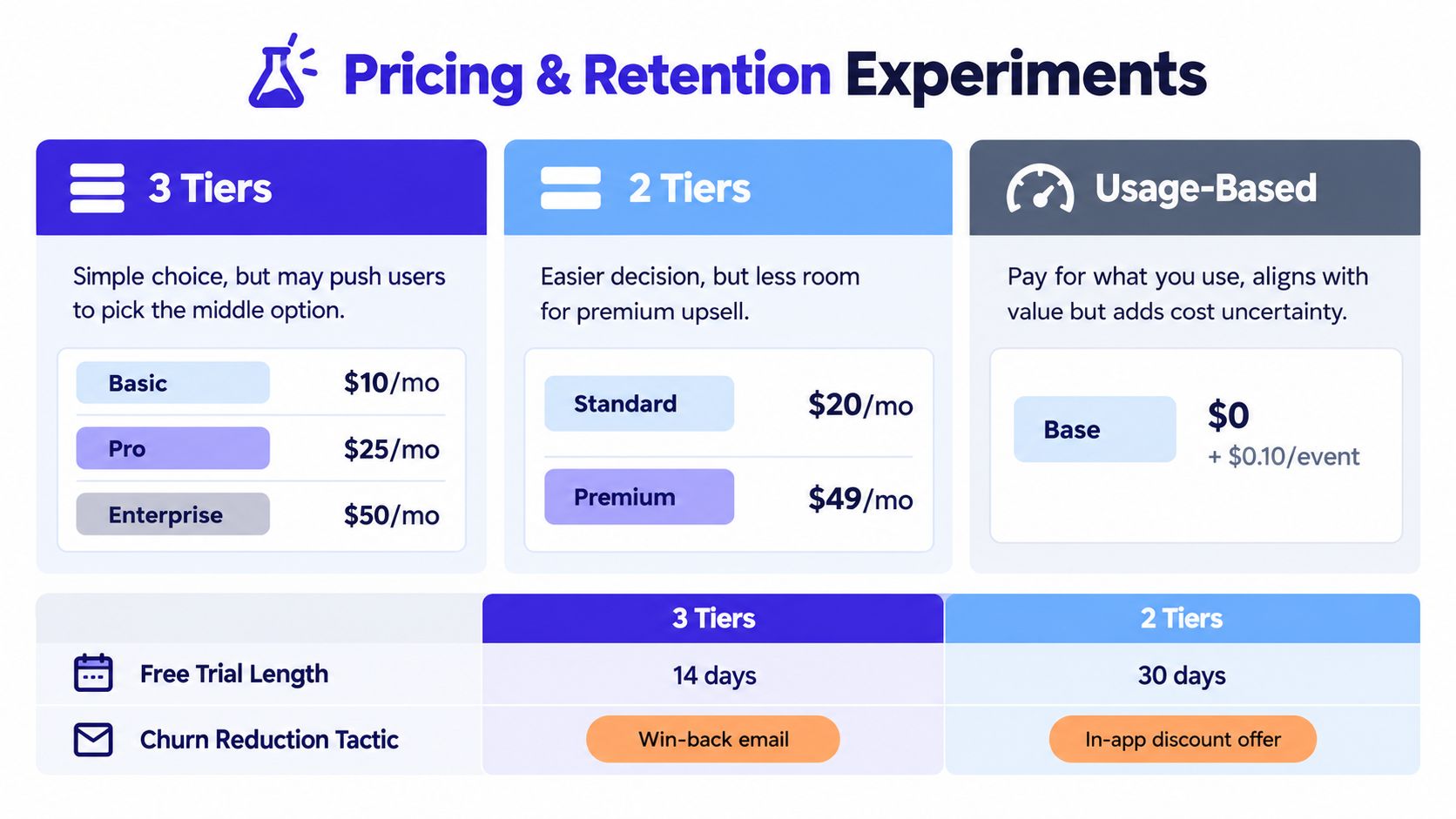
The main pricing choices founders actually face
Most indie pricing experiments fall into a few buckets.
Tier structure
A three-tier model gives users contrast and a natural middle option. A two-tier model reduces decision fatigue. Usage-based pricing can align cost with value, but it can also create uncertainty for buyers who want predictable spend.
None is universally right. The useful question is which model helps your ideal customer understand the offer fastest.
Trial design
A free trial can reduce purchase anxiety, but the length only helps if users can reach value within that window. If your setup takes time, a very short trial may punish serious users. If the product becomes useful immediately, a longer trial might just delay a decision.
Feature gating
Founders often gate the wrong features. They hide the very capability that helps users understand why the product matters. A better approach is usually to let users experience core value, then gate scale, depth, collaboration, or advanced controls.
Retention tells you whether pricing helped or hurt
A pricing change can look successful at first and still damage the business later. More signups don't mean better customers. Higher initial revenue doesn't mean lower churn.
That's why retention cohorts matter. They show whether the users acquired under a new plan structure stick around, activate properly, and continue finding value. Pricing without retention review is just packaging with delayed consequences.
A pricing page doesn't just convert demand. It sets expectations you'll have to satisfy later.
What to test before rewriting your whole model
Start with page-level experiments before rebuilding your monetization logic.
- Clarify the buyer path by naming the plans around user type or use case instead of vague labels
- Strengthen the value cue by placing proof, reassurance, or a refund policy near the purchase decision
- Reduce comparison friction by highlighting the meaningful difference between plans, not every tiny feature row
- Test annual framing to see whether commitment language helps or creates hesitation
The most useful revenue lens for a founder is a small triad: average revenue per user, net revenue retention, and the lag between activation and paid conversion. Those numbers don't need to be fancy to be useful. They just need to tell you whether the business is becoming healthier or merely busier.
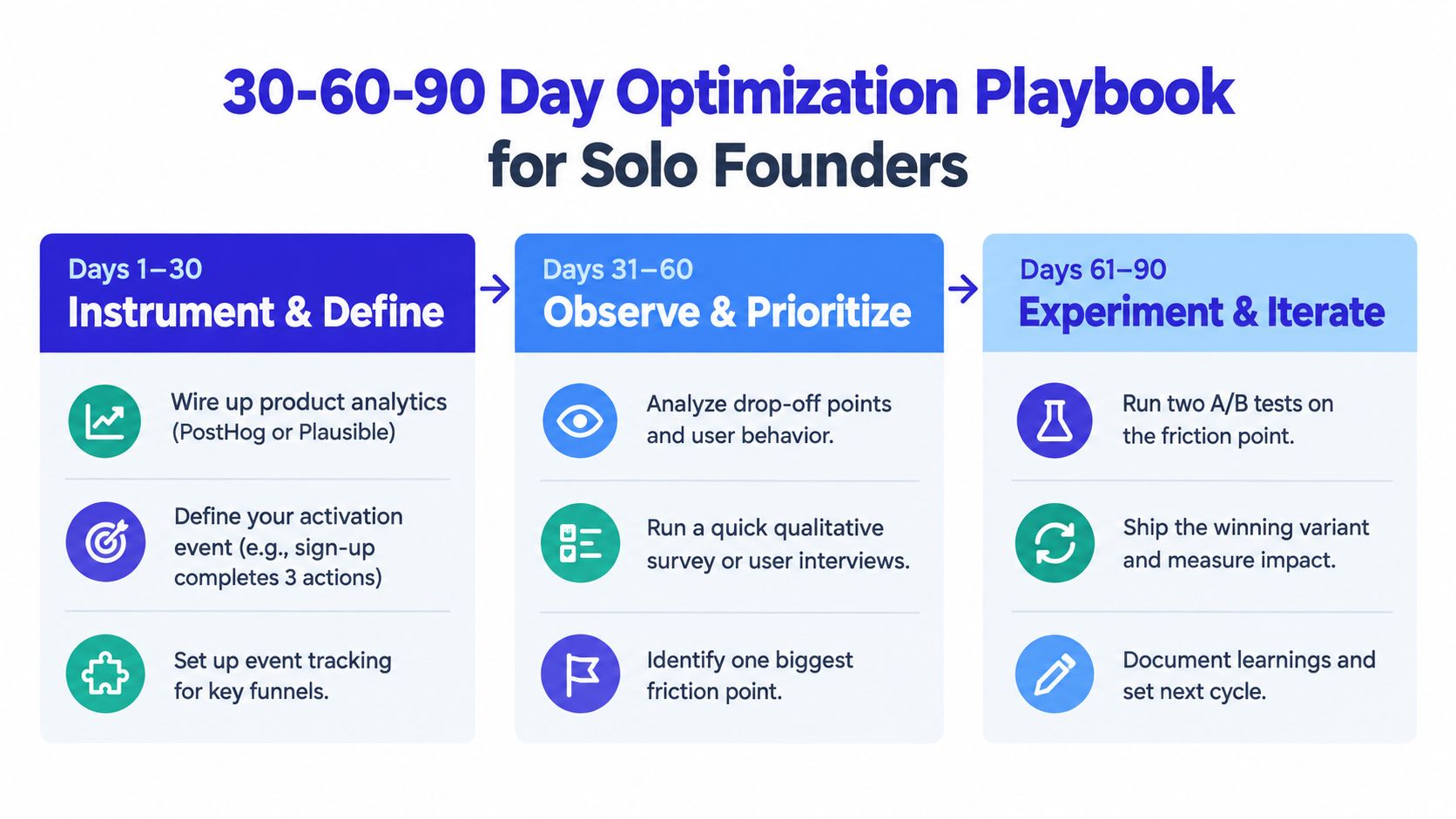
A 30-60-90 Day Optimization Playbook for Solo Founders
Founders usually fail at optimization for one of two reasons. They overcomplicate it and buy too many tools, or they under-instrument and end up making decisions from vibes.
A simple 90-day cadence is enough to build the habit.
Days 1 to 30
The first month is about seeing clearly.
- Set up product analytics with a lightweight tool such as PostHog or Plausible
- Define one activation event that represents real value, not just signup completion
- Track the basic funnel from landing page to signup to activation
- Install session replay on the key pages and flows
- Write down your baseline so later changes have context
If you can't answer “What does a user do before they become likely to stay?” your optimization work will stay shallow.
A short implementation guide can help here. This walkthrough on how to do optimization is a useful companion when you're deciding what to instrument first and what to ignore for now.
Days 31 to 60
Now you start shipping changes, but only a few.
Pick one issue from each of these zones:
| Zone | Example of a first experiment |
|---|---|
| UX | Rewrite the hero CTA or remove one onboarding step |
| Pricing | Change plan descriptions or simplify the comparison table |
| Performance | Compress images, reduce scripts, or improve caching on a high-intent page |
Don't run ten tests at once. A solo founder needs learning, not noise.
Days 61 to 90
By month three, the main shift is operational. You're not just fixing pages. You're building a rhythm.
- Review retention cohorts weekly
- Maintain a test backlog with hypothesis, change, owner, and result
- Decide in advance when you'll keep, iterate, or kill a test
- Document learnings so you don't repeat the same ideas every month
This is also when you should stay lean with tooling. You probably don't need enterprise analytics, paid experimentation suites, or a giant customer-data platform. A modest stack can carry a solo founder surprisingly far if the fundamentals are in place.
If your optimization work includes distribution and visibility for launch pages, directories, or product profiles, one option in the mix is IndieTool, which provides permanent do-follow listings, broad page distribution, and lightweight analytics for indie product submissions. That's useful when discoverability is one of the constraints you're actively testing, not as a substitute for product learning.
Common Misconceptions and Your Optimization Checklist
Three myths derail founders more than bad copy or slow pages do.
Myth one says optimization means redesign
It doesn't.
A redesign can hide the problem by changing too many variables at once. If signups rise, you won't know why. If they fall, you may have erased what was already working. Most indie products get more value from targeted friction removal than from a full visual reset.
Myth two says more features create more value
Sometimes they create more confusion.
More features can fragment the funnel, bury the activation moment, and make onboarding feel heavier. Founders often add what users request without checking whether the request comes from their best-fit users or from edge cases who were never likely to stay.
The product usually gets stronger when the path to value gets shorter, not when the feature list gets longer.
Myth three says you need big data before you can optimize
You don't.
If fifty people use your product each week, that's enough to notice repeated confusion on the same page, compare simple copy variants, or test whether one less onboarding step changes completion behavior. Small samples require humility, but they don't justify guessing.
That same principle applies in commercial product data too. When teams optimize catalogs and listings, the improvement often comes from cleaning the basics first. Guidance in product data optimization consistently treats completeness, consistency, currentness, and channel compliance as the important factors because missing mandatory attributes, inconsistent units or spellings, and stale price or stock data lead to poor filterability, listing rejections, bad reviews, and ranking loss (ChannelPilot on product data optimization).
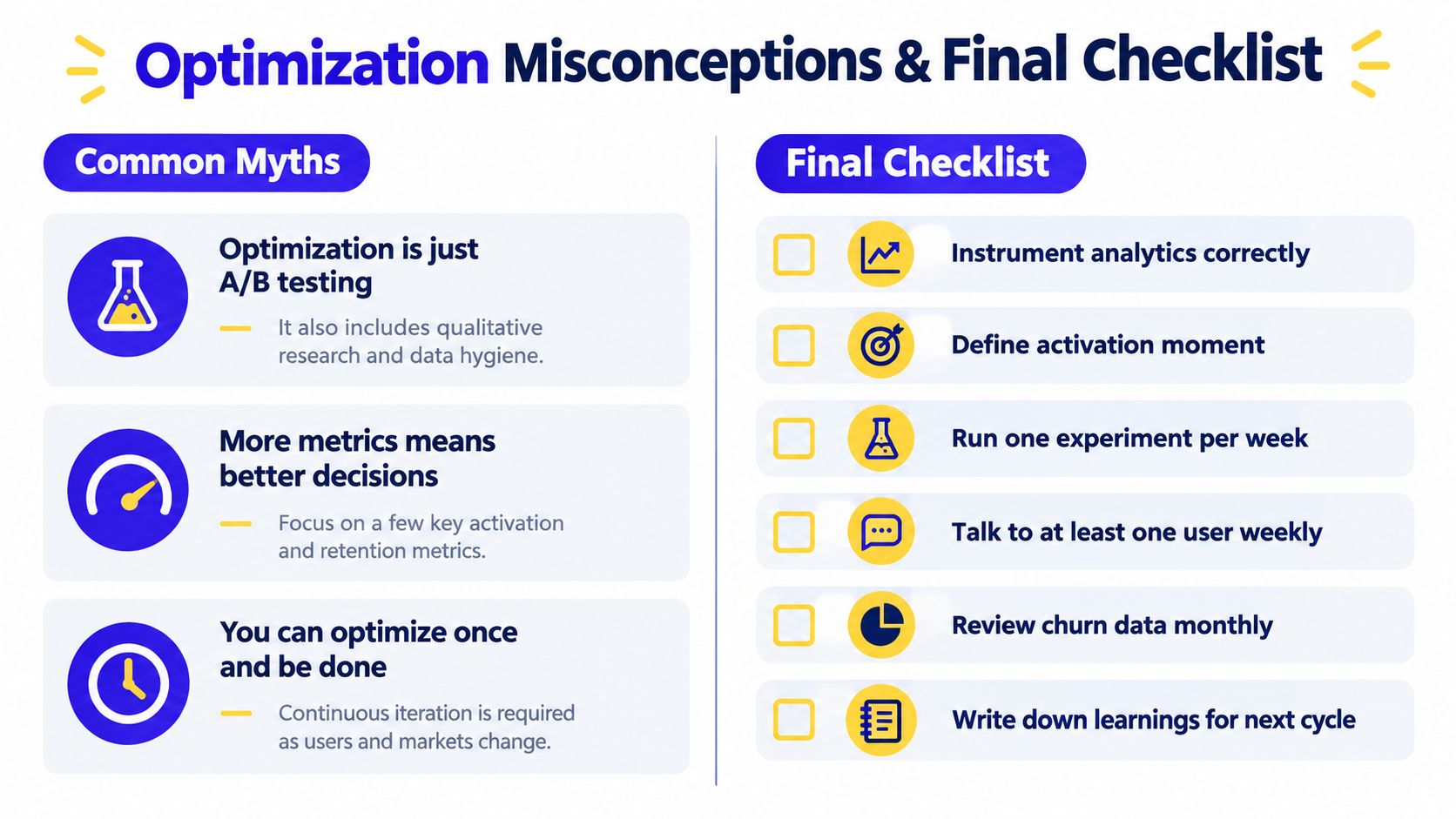
A practical checklist you can copy into your notes
- Define activation clearly so you know what successful early use looks like
- Instrument the core funnel from visit to signup to first value moment
- Review a handful of session replays each week instead of relying only on dashboards
- Run one focused experiment at a time so you can attribute movement
- Check retention after every meaningful change to catch hollow wins
- Keep a decision log with hypothesis, result, and next action
The founders who get the most from optimization aren't the ones with the most elaborate systems. They're the ones who keep the loop alive. They observe, decide, ship, and learn without turning every issue into a months-long project.
What is product optimization, then? It's the habit of improving the product you already have, across UX, performance, SEO, pricing, and retention, in a way that compounds instead of resets.
If you're working on product visibility as part of that optimization loop, IndieTool helps indie founders distribute launches, secure permanent do-follow listings, and track lightweight exposure data without building a bigger marketing stack. It fits best when you already know what you're optimizing for and want more surface area for discovery while you keep improving the product itself.