Indietool
What Is a Pricing Analysis and How Founders Use It
Pricing analysis is a data-driven review of historical pricing, demand, and competitor signals to see how price changes affected profit and what to do next. Companies with well-defined and successfully implemented pricing strategies achieved, on average, 3.5 times higher gross margin than companies without an implemented strategy.
You may be facing the problem right now. Your product is ready, launch day is close, and you need to choose a price. One competitor charges $19, another charges $29, and your instinct says to split the difference. You publish the page, wait for sales, and then wonder whether weak conversion means the product needs work, the audience is wrong, or the price is too high.
A pricing analysis gives you a way to answer that question without relying entirely on instinct. It turns scattered information, such as sales, customer behavior, costs, and competitor prices, into a decision about what to test or change next.
Table of Contents
- Introduction Why Pricing Guesses Cost Indie Founders More Than They Think
- What a Pricing Analysis Really Means Beyond the Price Tag
- Three Common Pricing Analysis Methods Explained Simply
- Key Metrics and Data You Need for a Reliable Analysis
- When to Run a Pricing Analysis and How to Turn Insights Into Action
- Real World Pricing Analysis Examples for Indie Products
- Your Next Pricing Move A Simple Takeaway Plan for Founders
Introduction Why Pricing Guesses Cost Indie Founders More Than They Think
An indie founder often chooses a first price under pressure. There may not be enough customer history, a large research budget, or a finance team to build a detailed model. Copying a competitor feels sensible because it's fast and gives the product a visible place in the market.
The problem is that a competitor's price reflects their audience, positioning, costs, features, and business model. Their $29 plan might include a support team, an established brand, or a different customer segment. Matching it doesn't tell you whether your buyers see the same value in your product.
Practical rule: A competitor's price is evidence about the market, not proof of your own best price.
Pricing analysis is the safety net between a guess and a learning process. You record what price was offered, who saw it, what customers did, how much revenue arrived, and what remained after costs. Over time, that record helps you distinguish a weak offer from a weak price.
Why margin matters more than revenue alone
A lower price can create more purchases while leaving you with less money per customer. A higher price can improve margin while reducing demand. Neither outcome is automatically good or bad. The right choice depends on your costs, delivery model, customer value, and growth priorities.
That's why pricing belongs alongside a basic understanding of profitability and cost. Founders who want a broader explanation of the variables behind profit can use this guide to factors affecting cost from ambitionCFO as a useful reference.
The commercial stakes are meaningful. The cited pricing benchmark found that companies with clearly defined and successfully implemented pricing strategies achieved 3.5 times higher gross margin on average than companies without an implemented pricing strategy, as documented in the pricing strategy and profitability analysis.
You don't need enterprise software to begin. A spreadsheet with price, date, customer type, sales volume, revenue, refunds, delivery cost, and relevant customer comments can reveal patterns. The goal isn't to predict every purchase. It's to make your next pricing decision more informed than the last one.
What a Pricing Analysis Really Means Beyond the Price Tag
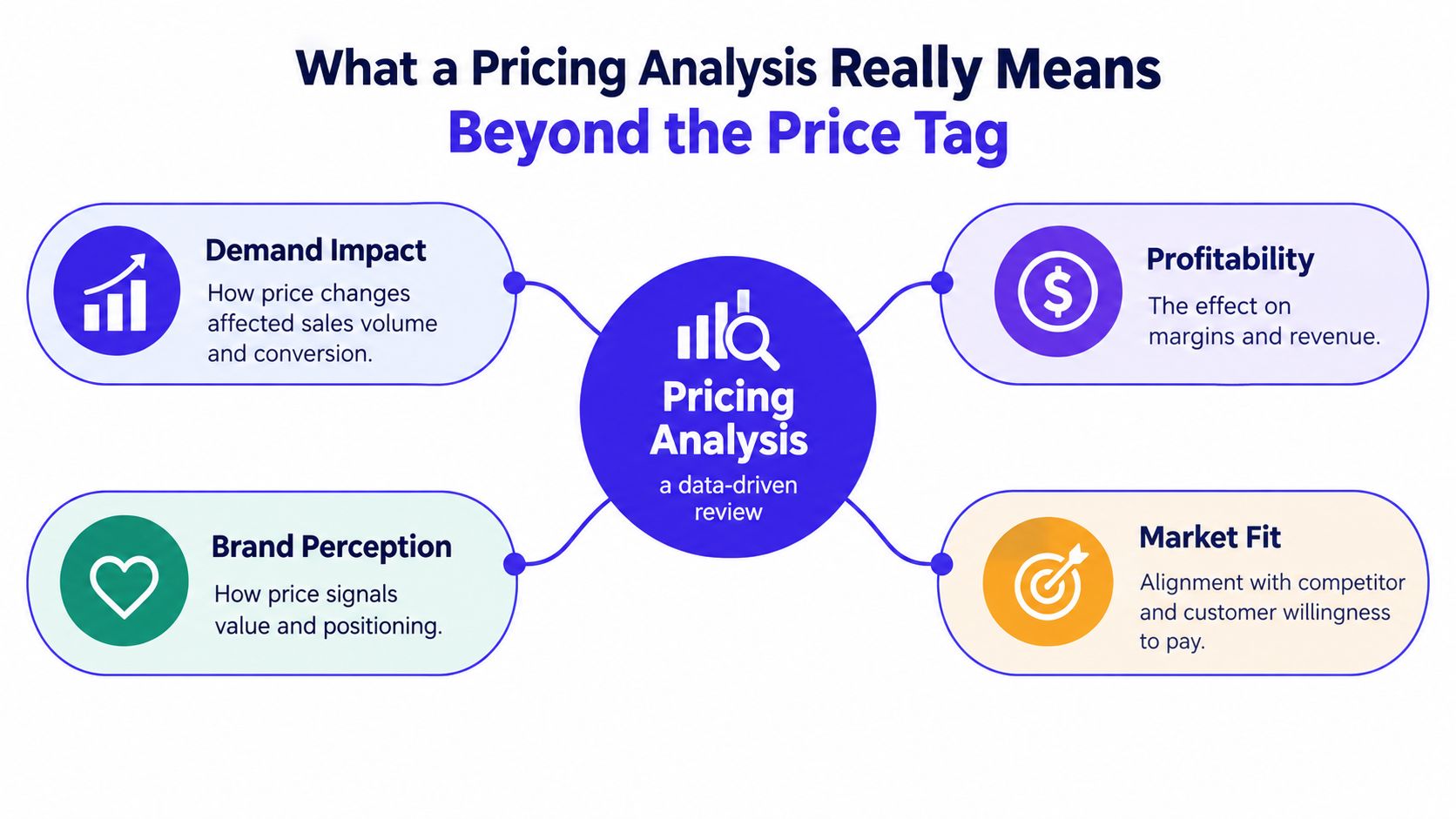
A pricing analysis examines how a price interacts with demand, profitability, customer perception, and market position. It doesn't stop at asking whether customers bought. It asks what changed when the price changed, which customers responded, and whether the result supported the business you're trying to build.
The simplest foundation is descriptive pricing analytics. That means looking backward at what already happened, such as historical prices, sales, revenue, volume, and customer responses. You're using the past as a record, not as a guarantee that the future will behave identically.
Think of it as a product checkup
A useful analogy is a health checkup. One measurement tells you something, but a series of measurements tells you whether the situation is improving, worsening, or staying stable. Pricing works the same way. A single launch result is a data point. Repeated observations create context.
Suppose you raised the price after adding a workflow that saves customers time. Sales volume fell, but revenue remained steady and customers who did buy used the product more fully. That result may support the increase, especially if the higher price gives you enough margin to maintain the feature.
A pricing analysis also considers brand perception. Price can signal whether a product is basic, specialist, premium, experimental, or difficult to trust. A very low price may reduce purchase hesitation for some buyers while making others question quality. A higher price may communicate confidence, but only if the product experience supports that signal.
The analysis becomes useful when it leads to a decision
A report that says “conversion declined” is incomplete. You need to know whether the decline is acceptable, why it happened, and what action follows. You might change the plan structure, improve the value explanation, narrow discounts, or test a different customer segment.
The same principle applies when you compare wine pricing plans. The visible price is only one part of the evaluation. Buyers also compare what each plan includes, how clearly the value is explained, and whether the package fits their intended use.
The difference between static pricing and pricing analysis is the feedback loop. You set a price, observe behavior, examine the financial result, form a hypothesis, and test a controlled change. That loop helps an indie founder make pricing a practical operating habit instead of a launch-day guess.
Three Common Pricing Analysis Methods Explained Simply
Founders usually start with three practical methods. Cost-plus protects the economics of delivery, value-based pricing focuses on customer outcomes, and competitor benchmarking shows how the market presents alternatives. Strong decisions often use all three as inputs, but they shouldn't be treated as interchangeable.
Compare the methods by the question they answer
| Method | What It Uses | Best For | Watch Out For |
|---|---|---|---|
| Cost-plus | Delivery cost, overhead, and target margin | Products with clear and repeatable costs | It can ignore willingness to pay and perceived value |
| Value-based | Customer outcomes, urgency, alternatives, and willingness to pay | Products that save time, reduce risk, or create meaningful gains | Value can be difficult to measure before you have customer conversations |
| Competitor benchmarking | Competitor prices, plans, features, and positioning | Crowded categories where buyers compare options | Competitors may serve a different segment or have a different cost structure |
Cost-plus pricing begins with your economics. If serving one customer requires paid infrastructure, support time, transaction fees, or fulfillment work, the price must cover those costs and leave room for profit. This approach is easy to understand and useful for preventing underpricing, but customers don't pay according to your internal costs. They pay according to the value they believe they'll receive.
Value-based pricing reverses the starting point. You investigate the customer's problem, the cost of leaving it unsolved, and the result your product delivers. A tool that prevents a costly mistake may justify a different price from a tool that offers a minor convenience, even if both products are technically similar to build.
Competitor benchmarking helps you understand the language and structure customers already see. Record the plans, limits, included features, onboarding, guarantees, and target audience, not just the headline number. A cheaper competitor may be using a self-serve model, while a more expensive one may include services you don't provide.
Pricing insight: Cost tells you what you can afford, value suggests what customers may accept, and competitors reveal how buyers compare choices.
The financial impact can be substantial. A 1% improvement in pricing has been associated with an average 11.1% increase in profit, while dynamic pricing strategies have been reported to raise e-commerce profits by 5% to 8% on average, according to pricing effectiveness statistics from OpenSend. Those figures don't prescribe a price for your product. They show why even a small, carefully tested improvement deserves attention.
Key Metrics and Data You Need for a Reliable Analysis
Reliable pricing analysis starts with a clean record of what happened before and after a price was offered. You don't need every possible metric. You need enough information to connect the price to customer behavior and business economics.
Start with revenue and margin
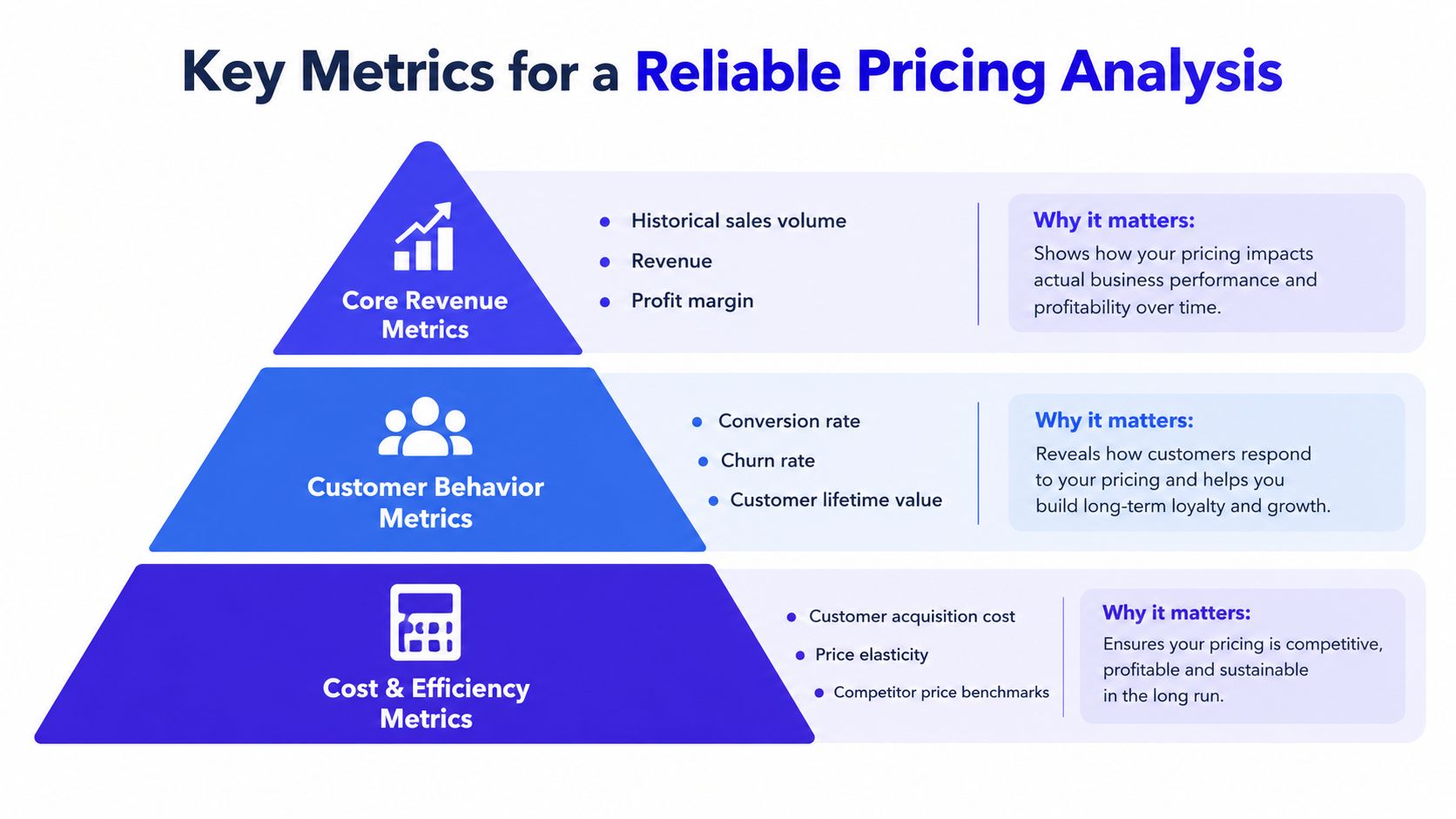
Track the price shown, units sold, revenue collected, refunds, discounts, and direct delivery costs. Revenue tells you how much money came in. Profit margin tells you whether the price leaves enough money after the costs tied to serving customers.
Keep the date and product version beside each record. If you change a feature, onboarding flow, acquisition channel, or pricing page at the same time, you won't know which change caused the result.
Add behavior and efficiency signals
Customer behavior explains why revenue moved. Useful inputs include:
- Conversion rate: Compare the share of relevant visitors who buy at each price or package.
- Churn rate: Check whether customers cancel soon after joining, particularly after a price or packaging change.
- Customer lifetime value: Estimate the economic value of retaining a customer over their relationship with you.
- Customer acquisition cost: Include the cost of acquiring a buyer when deciding whether a price supports sustainable growth.
- Competitor benchmarks: Record comparable plans, limits, positioning, and changes over time.
- Customer feedback: Save the exact objections, questions, and reasons buyers give for delaying or purchasing.
A dashboard can help you combine these inputs without building a complicated data stack. For a practical approach to organizing product and business information, see this IndieTool guide to dashboard data analytics.
Avoid vanity metrics. Page views may rise while qualified buyers remain unconvinced. A larger email list may look encouraging while paid conversion and retention stay weak. Every metric should connect to a decision, such as whether to change the price, revise a plan, reduce a discount, or target a different customer.
A small spreadsheet is enough for a first pass. Create one row per pricing version, segment the data by customer type or acquisition source, and write down the hypothesis before changing anything. That note prevents you from rewriting the story after seeing the result.
When to Run a Pricing Analysis and How to Turn Insights Into Action
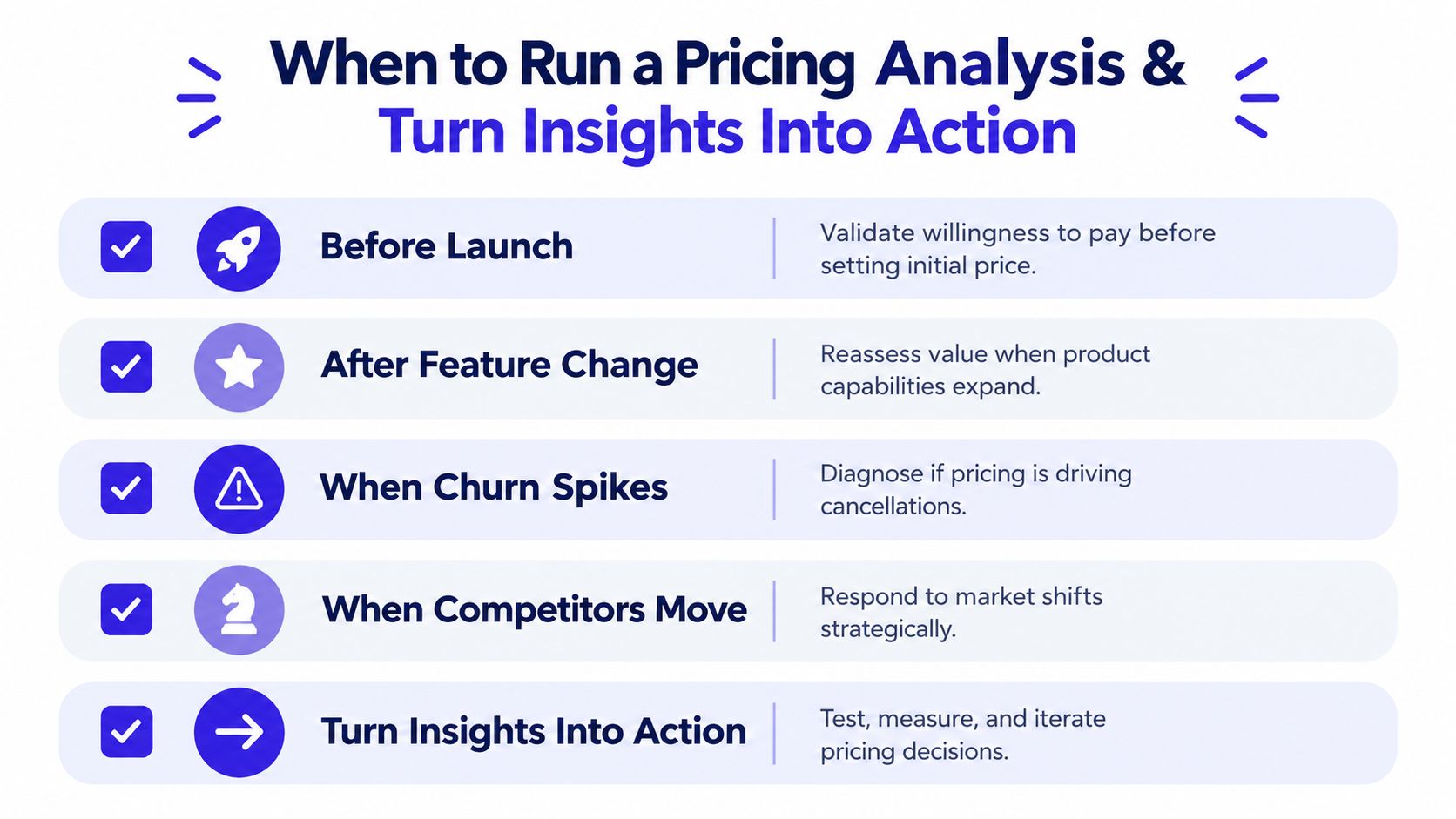
Pricing analysis is most useful when something important has changed. Run it before a launch, after a major feature update, when cancellations rise, or when a competitor changes its offer. You can also review pricing when your costs, customer segment, or delivery model shifts.
Use triggers instead of arbitrary reviews
Before launch, test whether the offer makes sense to the intended buyer. After a feature change, revisit packaging because the product may now solve a more valuable problem. When churn rises, check whether customers are reacting to price, weak activation, missing capabilities, or a mismatch between promise and experience.
Competitor movement deserves context rather than panic. If a rival lowers its price, you might respond with a clearer package, a different segment, or a stronger explanation of value. Browsing best-selling designs to watch can also help a product founder notice how changing customer preferences may affect positioning, though trend observation shouldn't replace your own sales data.
Turn observations into rules
A useful analysis must answer three questions:
- Is the price move good or bad? Define the outcome that matters, such as contribution margin, qualified conversion, retention, or revenue per customer.
- Why is it happening? Separate price effects from traffic quality, product changes, seasonality, sales messaging, and customer mix.
- What should happen next? Choose a response, set a review point, and identify the evidence that would support keeping or reversing the change.
This decision standard is also emphasized in pricing analysis guidance on decision rules and governance. The analysis becomes operational when it includes thresholds, discount corridors, approval rules, and a pilot-and-measure workflow.
For a launch with many moving parts, a startup launch checklist can help you record pricing as part of the broader release process. For example, decide in advance what would count as an acceptable result, what discount you won't exceed, and which customer segment you'll review separately.
AI and usage-based products make architecture part of the pricing decision. You may need to decide who owns billing logic, how usage is measured, when customers receive warnings, and how model or infrastructure costs affect packaging. Industry material reports that companies adopting AI while evolving their pricing models are nearly twice as likely to achieve high growth as firms adopting AI without changing pricing, while a 2025 global pricing study says AI adoption in pricing is rising but its impact remains low, as described in the monetization report covered by Business Wire.
Real World Pricing Analysis Examples for Indie Products
Examples make the decision process easier to copy. The following scenarios are practical illustrations, not reported case studies. The numbers describe test setups, not measured outcomes, so the focus is on what the founder examines and how the decision follows from the evidence.

A SaaS founder tests two plans
A bootstrapped SaaS founder is deciding between a $19 and $29 monthly plan. Instead of choosing the lower price because it feels easier to sell, she records qualified page visits, trial starts, paid conversions, refunds, support time, and early cancellations for each offer.
The lower price may attract more signups but create customers who need extensive support or don't stay. The higher price may produce fewer customers while leaving more contribution margin per account. The decision isn't based on conversion alone. It depends on which version produces a healthier customer relationship and supports the product's delivery costs.
A productivity tool benchmarks the category
The founder of a productivity tool compares competitor plans. He records feature limits, export options, collaboration controls, onboarding, free access, and the audience each product appears to target. He discovers that his direct competitors emphasize storage, while his product's strongest benefit is reducing setup time for a particular workflow.
Rather than copying a competitor's plan, he creates a package organized around that workflow. Customer conversations then test whether buyers understand the distinction and whether the package feels more relevant than a feature-by-feature comparison.
You can find additional patterns for thinking about launches in these product launch examples from IndieTool, then adapt the lessons to your own market instead of treating them as templates.
An AI tool changes its packaging
An AI tool begins with a simple subscription but finds that customer usage varies widely. The founder reviews usage per account, model costs, support requests, failed jobs, and the point at which customers experience value. The possible response might include a base plan with usage allowances, transparent overage rules, or a higher tier for intensive users.
This model requires product, finance, and go-to-market decisions to stay aligned. The founder must explain the billing unit clearly, help customers predict spend, and revisit the structure when model capabilities or costs change. Industry reporting connects AI adoption with evolving pricing models to stronger growth potential, while also noting that AI's impact in pricing remains limited in current practice, as cited earlier.
Your Next Pricing Move A Simple Takeaway Plan for Founders
A pricing analysis is a learning loop, not a document you create once and archive. You start with a price and a hypothesis, collect behavior and financial evidence, decide whether the result supports the business, and run the next focused test.
Begin with a narrow question. “What price should I charge?” is too broad for useful analysis. “Does the higher tier attract customers who need the feature set and remain profitable to serve?” gives you something measurable.
Run a first analysis this week
- Record the current offer: Write down prices, limits, included services, discounts, billing terms, and the customer segment you're targeting.
- Gather the essentials: Pull sales volume, revenue, refunds, direct costs, conversion, cancellations, acquisition source, and customer objections into one sheet.
- Separate customer groups: Compare self-serve buyers, referrals, paid traffic, and any other meaningful segment instead of blending them into one average.
- Choose the decision metric: Pick the outcome that matters most for this test, such as contribution margin, qualified conversion, retention, or revenue per customer.
- Write the hypothesis: State what you expect the price or packaging change to do and why.
- Set a response rule: Decide what result would lead you to keep, revise, or reverse the change.
- Review the evidence: Look for alternative explanations, including a changed feature, weaker traffic, poor onboarding, or a different customer mix.
Don't wait for perfect data. A small but consistently maintained record is more useful than an advanced dashboard you never update. You can use a spreadsheet, payment platform exports, customer interviews, or a lightweight pricing analysis tool. IndieTool offers a pricing analysis utility that accepts product details, current prices, and sales data to generate pricing insights and recommendations for possible conversion and revenue improvements.
The best founders don't treat price as a label attached to the product. They treat it as a business hypothesis. Each test should make the offer clearer, the economics more durable, or the customer fit more precise.
If you're preparing a launch or reviewing an existing offer, visit IndieTool to explore its pricing analysis utility alongside other founder-focused tools. Use your current price, sales information, and product details to turn your next pricing question into a practical decision.