Indietool
10 Toolkit Examples Founders Can Learn From
Most advice about toolkit examples treats a toolkit as a resource list: a few templates, some useful links, and perhaps a checklist to download before launch. That definition is too weak for founders. A useful toolkit coordinates decisions, assigns a workflow to a specific job, and creates evidence that the job is moving forward.
The examples below are evaluated as operating systems for founder work. Each one connects its components to a practical use case, identifies the problem it addresses, and makes its limits visible. Some help prepare a launch, others create demand, earn search discovery, measure traction, or support repeated releases. IndieTool naturally fits the launch and distribution category, but it also illustrates a broader principle: a listing becomes more valuable when distribution, search exposure, and measurement work together.
The sequence moves from preparation and positioning through promotion, analytics, search authority, and multi-launch operations. The point isn't to copy every component. It's to identify the smallest system that matches your current bottleneck.
Table of Contents
- 1. Product Launch SEO and Backlink Toolkit
- 2. Indie Founder Discovery and Distribution Toolkit
- 3. Product Naming and Branding Toolkit
- 4. Content and Copy Generation Toolkit
- 5. Analytics and Founder Dashboard Toolkit
- 6. One-Time Payment and Flexible Credit Toolkit
- 7. Product Category and Discoverability Toolkit
- 8. Multi-Launch Founder Toolkit
- 9. SEO and Search Authority Building Toolkit
- 10. Launch Readiness and Pre-Launch Preparation Toolkit
- Top 10 Toolkits: Features & Focus
- Build Your Founder Toolkit in the Right Order
1. Product Launch SEO and Backlink Toolkit
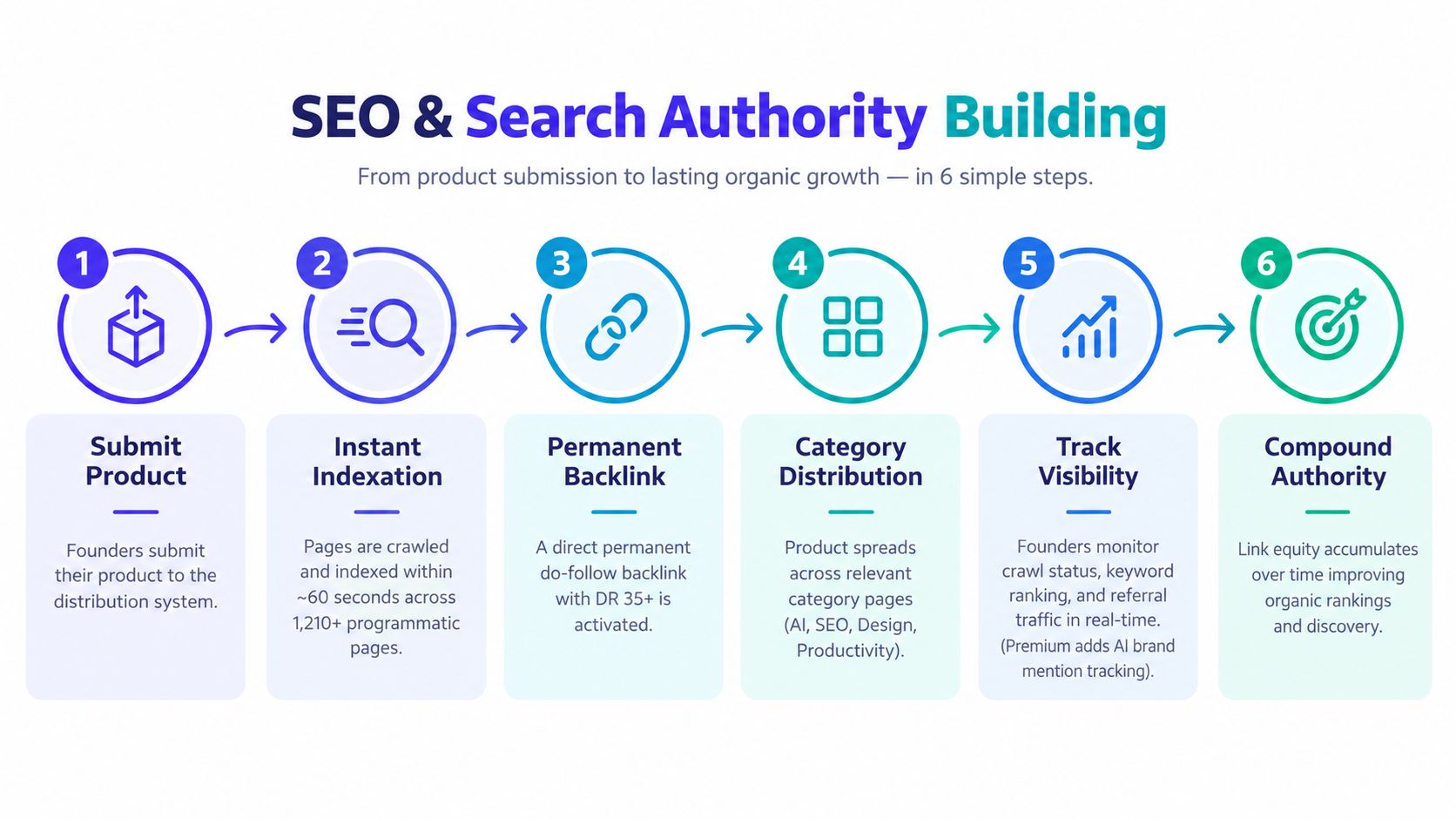
A new product can be well designed and still remain invisible to searchers. A launch SEO and backlink toolkit addresses that early discovery problem by combining a product listing, a permanent do-follow backlink, distribution across indexable pages, and monitoring after submission.
IndieTool presents this model through product listings, category placement, alternatives pages, automated indexing, and founder analytics. Its publisher materials state that each submitted product receives a DR 35+ do-follow backlink, distribution across 1,210+ index, category, and alternatives pages, and listing activation in about 60 seconds after submission. These are product capabilities, not a guarantee that every launch will rank.
A founder might use this workflow for an AI product targeting searches around productivity tools, a SaaS product appearing on category alternatives pages, or a developer tool pursuing narrow technical queries. The practical advantage is coordination. Instead of submitting a product and forgetting it, the founder prepares the title and description, selects relevant categories, checks whether the listing is live, and compares referral activity with on-page SEO work.
Practical rule: Treat a directory listing as one search foundation, not as a replacement for useful pages, internal links, and relevant editorial mentions.
The limit is authority and relevance. A backlink can support discovery, but it can't compensate for weak positioning or a page that doesn't answer the searcher's question. Research summarized by BuzzStream's analysis of link building found positive relationships between backlinks, referring domains, and top-20 Google rankings. For a broader launch plan, founders can also review guidance on how to avoid product launch failure.
2. Indie Founder Discovery and Distribution Toolkit
Search isn't the only discovery channel available to a new product. A founder distribution toolkit puts the product in front of people who already explore new software, including indie hackers, makers, and early adopters.
The strongest version combines a browsable directory with social promotion and newsletter distribution. That combination creates several paths to the same product. A visitor might find it through a category page, see a launch post on X, or encounter it in an email and then return through the listing. Each path serves a different purpose, so founders shouldn't judge the whole toolkit by one channel alone.
A productivity tool could use the directory to collect early feedback, an AI startup could turn a concise launch message into a conversation among builders, and a design tool could use a curated spotlight page to reach people actively searching for alternatives. These are illustrative workflows. They describe how the components can be used, not guaranteed audience or conversion outcomes.
The workflow founders should own
- Write the one-liner first: Explain the product's user, problem, and outcome before asking a channel to promote it.
- Add evidence to the listing: A concrete use case or testimonial gives visitors a reason to investigate.
- Record referral sources: Separate directory, social, email, and direct visits so later decisions aren't based on total traffic alone.
- Respond while interest is fresh: Early comments and objections can improve the product page and future promotion.
The trade-off is that distribution creates attention, not necessarily demand. A launch can receive exposure and still fail to convert if the product description is vague, the onboarding is difficult, or the audience isn't a strong fit. Founders should therefore treat promotion as a feedback mechanism. Questions from early adopters often reveal unclear positioning faster than private drafting does.
3. Product Naming and Branding Toolkit
A product name shapes discovery before promotion begins. If it is confusing, hard to remember, or disconnected from the product's promise, the landing page must spend more time explaining what the product does.
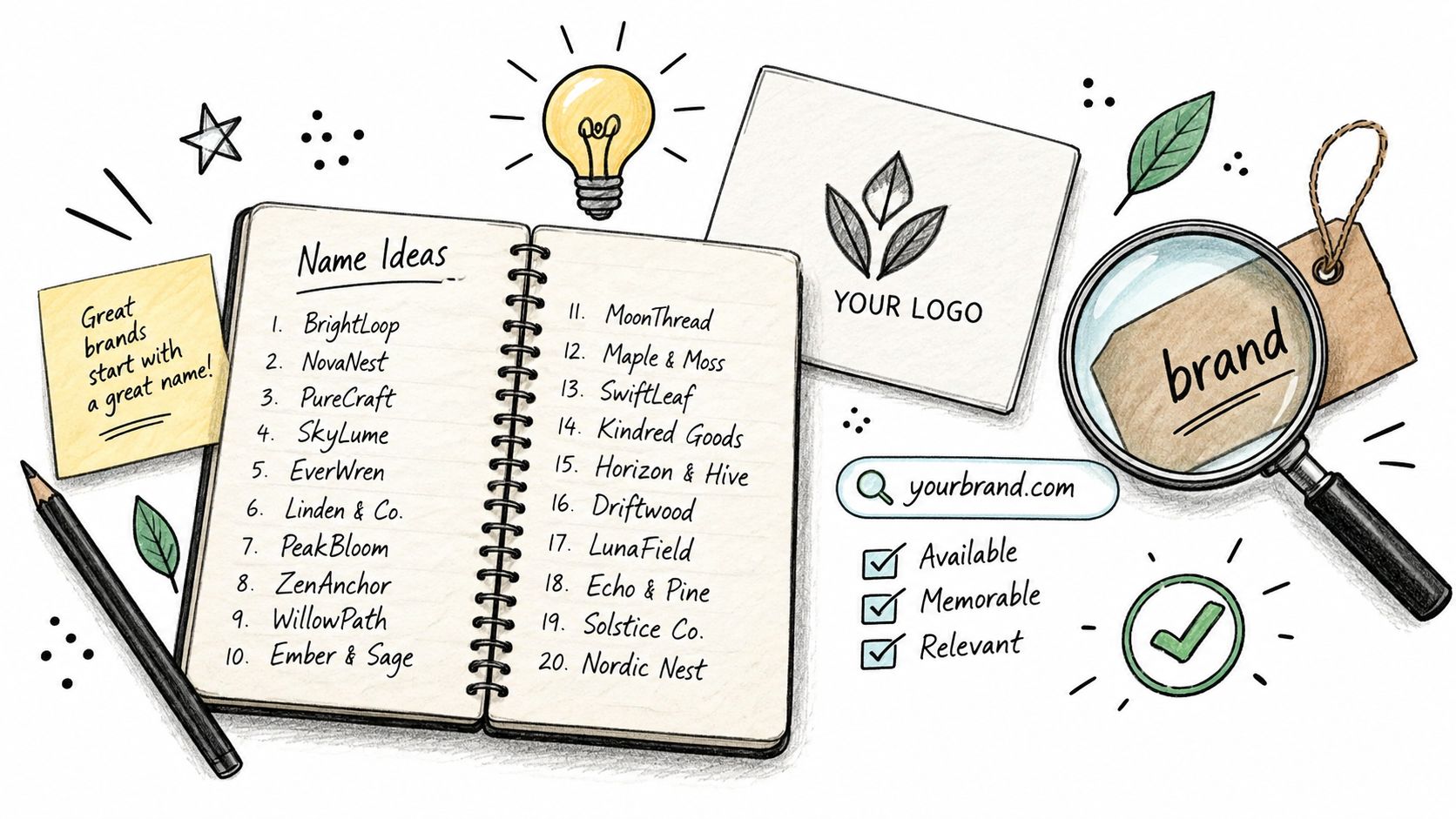
This toolkit brings together name generation, logo creation, mission clarification, and basic naming analysis. Its practical role is to help a solo founder develop a coherent public identity without commissioning a full branding project. Comparing several directions also gives the founder a basis for choosing a product-page title, domain, and launch message.
The strongest workflow separates idea generation from validation:
- Generate a broad set of names.
- Remove options that are difficult to pronounce, spell, or explain.
- Check domain availability and possible conflicts.
- Ask likely users what they expect the product to do from the name alone.
- Select the option whose meaning supports the product's category and promise.
Where the toolkit helps
- Blank-page anxiety: Generators provide starting points when every initial idea feels unusable.
- Disconnected messaging: A mission generator can clarify the value proposition that the name should support.
- Inconsistent presentation: A logo maker supplies an initial visual direction for a landing page and directory listing.
- Premature commitment: Comparing alternatives makes it easier to reject a clever name that gives users little information.
Use automation to expand and narrow the decision set. Keep the final judgment with the founder.
The main limit is false confidence. Automated suggestions do not establish trademark availability, domain ownership, or audience preference. The toolkit should narrow the decision, not replace legal checks or user feedback. The reasoning behind the choice becomes the durable asset, guiding the product description, visual style, and future category positioning.
4. Content and Copy Generation Toolkit
A content toolkit helps founders turn product knowledge into language other people can understand. Useful components include email generation, testimonial extraction, tweet composition, competitor page scanning, and value proposition support.
The practical job isn't to publish whatever an AI tool produces. It's to create a first draft quickly, then make the message specific to the product and audience. A founder can generate several launch email directions, use a tweet-to-testimonial workflow to identify public user feedback, and scan competitor positioning before rewriting the landing page.
A controlled copy workflow
Start with the product's clearest user problem. Generate variations for the email, social post, and listing description, then remove claims that the product can't prove. The founder should edit every draft for voice, accuracy, and context. Generic copy often sounds polished while saying very little.
A SaaS founder might use a productivity calculator to express a time-saving proposition, while a maker could convert a real user comment into landing-page social proof. Those outputs are useful only when the underlying input is real. Testimonial extraction can organize public feedback, but it shouldn't turn an ambiguous comment into an endorsement.

Good launch copy doesn't describe every feature. It makes the right visitor recognize the problem and understand the next action.
The limitation is dependency on editorial judgment. AI can accelerate drafting, but it can't validate whether a positioning claim is defensible or whether a testimonial represents the target customer. Founders should also check practical email details, including email subject line capitalization, before sending. Copy generation works best as a production layer inside a larger messaging system.
5. Analytics and Founder Dashboard Toolkit
A dashboard is not a launch report. It is an operating system for deciding which discovery surfaces deserve another release cycle. Its supported inputs are practical: views, visitors, outbound clicks, and referral sources. Privacy-friendly, cookieless analytics can provide directional evidence without requiring an invasive tracking setup.
The workflow starts with source separation. A founder can compare traffic from a directory, newsletter, X, category pages, and direct visits, then connect each source to the next action. A large traffic total matters less than whether visitors reach the product site, sign up, activate, or return. Those downstream events require product analytics, so the dashboard should distinguish what it measures from what it only suggests.
A useful founder dashboard answers one operational question: which channel should receive the next unit of promotion, testing, or product attention?
Read the signals in sequence:
- Listing views: Did discovery produce page openings?
- Unique visitors: Did exposure reach distinct users rather than repeated visits?
- Outbound clicks: Did visitors move from the listing to the product site?
- Referral sources: Which channel merits another promotion or a clearer message?
- Trend changes: Did interest rise after a post, email, category placement, or product update?
A small team can use this shared view to align decisions. Marketing may track referral volume, a founder may prioritize product-page clicks, and a potential partner may look for sustained interest. One dataset makes those discussions less dependent on anecdotes.
The limit is diagnosis. Analytics records behavior, while user conversations, support messages, and product analytics help explain it. High clicks with weak activation can indicate an onboarding or product problem. Low clicks may reflect unclear copy, poor audience fit, or a weak call to action. Treat each pattern as a hypothesis to test, not proof of a single cause.
6. One-Time Payment and Flexible Credit Toolkit
Recurring software costs create a planning problem for founders who launch irregularly. A one-time credit model changes the decision from “Which subscription should I keep active?” to “How many product submissions do I expect to make, and when?”
IndieTool's publisher information describes lifetime listing credits that don't expire, with packages intended for a single launch, several launches, or a larger portfolio. That structure can suit a solo founder with multiple products, an agency submitting client products, or a startup studio coordinating releases across several teams.
The operating workflow is financial as much as promotional. Estimate the number of products likely to launch, record credits as an asset in the launch plan, and assign each submission to a product and target date. A simple spreadsheet can track the product name, category, listing status, backlinks, referral sources, and remaining credits.
Where flexibility helps
A founder with one product can avoid paying for a service during quiet periods. A portfolio operator can distribute submissions over time instead of rebuilding a launch process from scratch. An agency can also separate listing expenses by client when invoicing and documentation matter.
The limitation is that a credit model doesn't guarantee that every product deserves distribution. A weak or unfinished product can consume a submission without producing useful learning. Founders should use the credit only after the listing copy, destination page, and tracking plan are ready.
Flexible purchasing also doesn't remove strategic prioritization. If several products serve the same audience, releasing them without a clear order can divide attention and create confusing signals. Credits are most useful when they support a deliberate release calendar rather than impulsive submissions.
7. Product Category and Discoverability Toolkit
Categories are more than labels. They determine the context in which a visitor encounters a product, the competitors they compare it with, and the searches that may lead them to a listing.
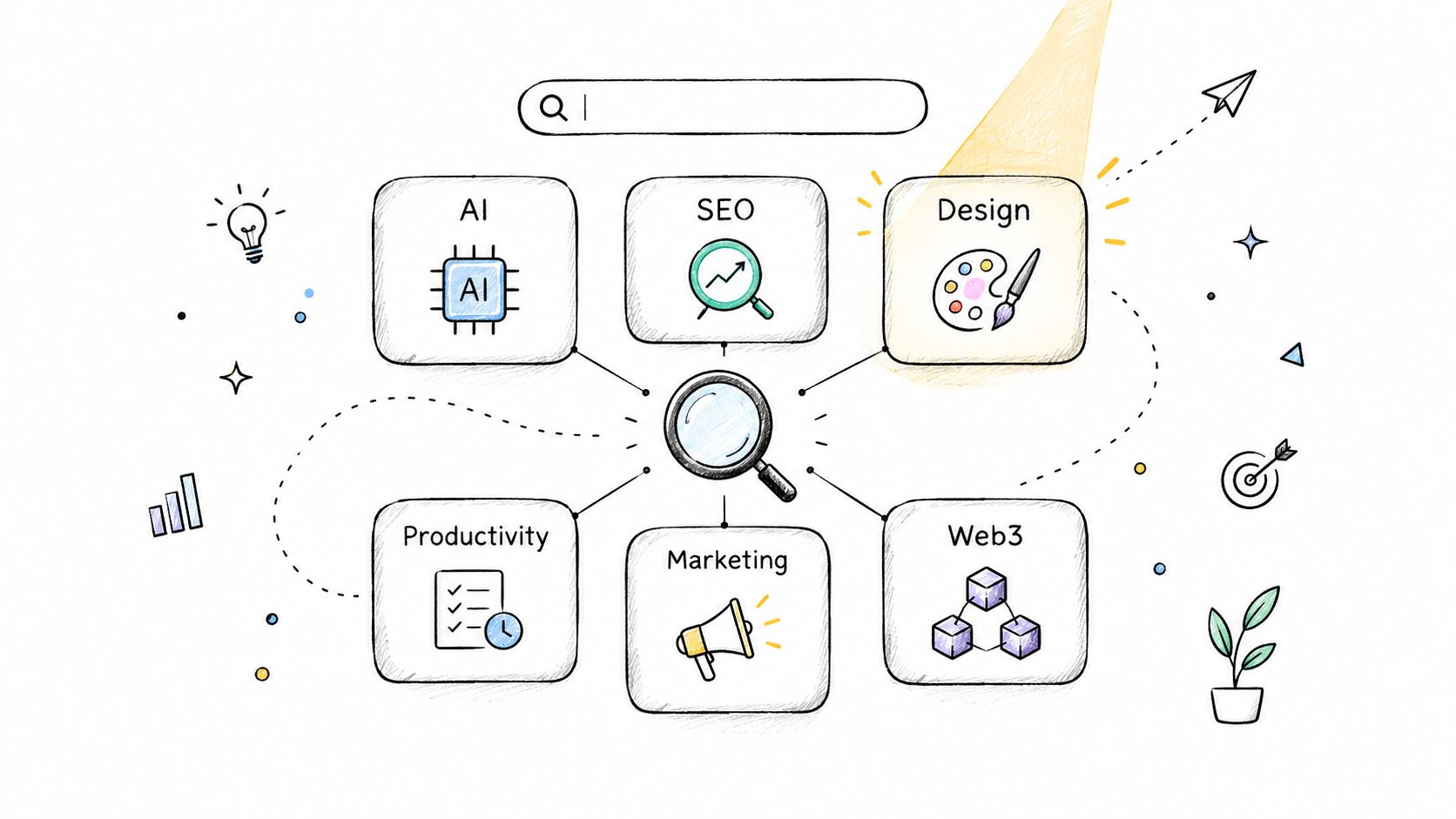
A structured discovery toolkit organizes products across areas such as AI, SEO, Design, Productivity, Marketing, Web3, Fintech, E-commerce, Agency, Business, Academic, and Lifestyle. Curated spotlight pages add another layer by grouping products around a broader discovery need. A founder can use these surfaces to make a product findable both through browsing and through search-oriented pages.
Choose the category that explains the product
An AI productivity tool may belong in both a broad AI context and a more specific productivity context. A fintech product may need positioning that distinguishes it from adjacent Web3 or business tools. The best primary category is the one that matches the user's reason for searching, not necessarily the category with the largest apparent audience.
- Use the title carefully: Include a clear product descriptor rather than relying on a brand name alone.
- Match the description: The first lines should support the chosen category and explain the product's difference.
- Review placement after a pivot: A changed product may need a new category or a revised alternatives context.
- Study adjacent products: Competitor placement can expose a positioning gap, but copying their language won't create differentiation.
The limit is taxonomy dependence. Categories can improve discovery while also placing a product beside stronger or more established alternatives. A founder should therefore treat placement as a positioning test. If visitors repeatedly misunderstand the product, the issue may be the category, the title, or the product itself.
8. Multi-Launch Founder Toolkit
The workflow that works for one launch can become a bottleneck when a founder manages a portfolio. A multi-launch toolkit combines reusable naming, branding, copy, analytics, category selection, and distribution processes so each release doesn't begin with a blank document.
This model serves startup studios, agencies, and solo founders building related products. A studio can standardize listing information across its portfolio. An agency can give each client a repeatable submission process. A solo founder can preserve lessons from one product and apply them to the next without treating every launch as a separate marketing project.
Standardize the system, not the message
Use shared templates for required information, tracking conventions, image sizes, and review steps. Keep the customer problem, positioning, proof, and category logic specific to each product. Reusing the structure saves time. Reusing vague claims weakens every listing.
A multi-launch operator should also stagger releases when products target overlapping audiences. That creates room to review referral data, answer feedback, and adjust the next listing. Comparing products can reveal which categories, descriptions, and channels attract the most relevant visitors.
The limit is operational complexity. More products create more opportunities for inconsistent branding, outdated descriptions, duplicate positioning, and neglected analytics. A portfolio toolkit needs ownership rules. Someone must maintain product details, check whether links still lead to the right destination, and decide when a listing needs an update.
The important shift is from launch as an event to launch as a repeatable capability. The operator isn't merely collecting submissions. They're building a release system that can learn from each product without flattening the products into identical marketing assets.
9. SEO and Search Authority Building Toolkit
Search authority works as an operating system for earning discovery, not a publishing checklist. It gives a founder a repeatable workflow: clarify the product page, earn relevant links, confirm indexation, and measure whether search demand produces qualified visits. Its job is to support discovery after launch and provide evidence for the next content or outreach decision.
Start with the destination page. Align the title, headings, internal links, structured explanation, and target queries with the problem the product solves. Then use relevant directories or editorial mentions as distribution channels, while Search Console and analytics expose crawling, impressions, clicks, and emerging queries. These are supported capabilities of the workflow. A directory link or rising query remains an illustrative outcome, not a guaranteed ranking result.
Research supports the authority component. BuzzStream's summary of Ahrefs and Backlinko research reports that an Ahrefs review of 1,000,000 keywords found positive correlations between backlinks, referring domains, and top-20 Google rankings. It also describes a Backlinko study of 11.8 million search results, in which the first result had about 3.8 times more backlinks than positions two through ten. These findings show relationships, not a ranking promise for one product.
Optimize for relevance, not volume
Link quality depends on context and placement. SearchAtlas reported findings from 350,159 backlink placements across 13,002 landing pages, including increases in keyword rankings and impressions in its before-and-after field study, as described in its analysis of backlink placement impact. Apply those findings as a testable direction, not a universal forecast.
The operating limit is compounding work. A backlink cannot replace useful content, technical accessibility, or a product that satisfies visitors. Founders must build supporting pages, earn relevant mentions, monitor performance, and update listings when the product or target market changes.
10. Launch Readiness and Pre-Launch Preparation Toolkit
A launch checklist can create false confidence. Readiness depends on whether the founder has resolved the decisions that promotion will expose: the customer problem, product position, name, price explanation, and message.
A preparation toolkit may combine business idea validation, mission generation, naming, pricing analysis, and email creation. Its main contribution is sequencing these jobs into an operating system for launch preparation. The tools can support drafting and comparison, while the conclusions remain illustrative until prospective users react to them.
Strategic lesson: Use preparation tools to reduce avoidable ambiguity, not to certify product-market fit.
The workflow begins with Clarify the customer problem by describing the situation that would prompt someone to seek the product. Test the position against alternatives and state why the proposed choice is reasonable. Validate the name with likely users, checking whether it signals the intended category and benefit. Then Prepare the message across the product description, launch email, social post, and call to action.
Before promotion, Check the destination. The landing page should load, explain the offer, and record meaningful actions. Plan review by defining what evidence will change the next release's audience, copy, channel, or product. This connects readiness to the later jobs of creating demand, measuring traction, and scaling repeated launches.
The toolkit addresses premature promotion by forcing unresolved choices into view. It cannot establish product-market fit or make weak evidence persuasive. Completing a checklist may show process completion while leaving the underlying assumptions untested. User feedback still determines whether people interpret the message as intended, whether the price explanation is credible, and which preparation decisions require revision.
Top 10 Toolkits: Features & Focus
| Toolkit | 🔄 Implementation Complexity | ⚡ Resource Requirements & Speed | ⭐ Expected Effectiveness | 📊 Expected Outcomes | 💡 Ideal Use Cases |
|---|---|---|---|---|---|
| Product Launch SEO & Backlink Toolkit | Low, one‑click activation, no technical setup | Moderate one‑time cost; instant indexation (~60s) ⚡ | High ⭐, builds permanent link equity | Faster organic visibility; domain authority growth over weeks | Indie founders seeking immediate SEO authority |
| Indie Founder Discovery & Distribution Toolkit | Low, submit + curated social/newsletter promotion | Low cost; relies on X post and ~1,000 newsletter subscribers; immediate spikes ⚡ | Moderate ⭐, targeted, high‑quality reach | Short‑term traffic spikes and qualified early adopters | Launches aimed at indie hackers and early adopters |
| Product Naming & Branding Toolkit | Very low, self‑serve AI tools and logo maker | Free; rapid iterations (minutes) ⚡ | Moderate ⭐, speeds branding but may lack uniqueness | Dozens of name/logo options quickly; faster branding prep | Early‑stage founders needing quick brand identity |
| Content & Copy Generation Toolkit | Low, template‑driven AI generation | Free; produces multiple drafts quickly ⚡ | Moderate ⭐, saves time; needs human editing | Multiple launch‑ready emails, tweets, testimonials | Founders needing launch copy and social content |
| Analytics & Founder Dashboard Toolkit | Low–Moderate, dashboard setup, GDPR compliant | Low overhead; real‑time, cookieless tracking ⚡ | High ⭐, reliable, privacy‑first insights | Immediate traction metrics, referral attribution | Privacy‑conscious founders monitoring launch performance |
| One‑Time Payment & Flexible Credit Toolkit | Low, purchase credits via checkout | Upfront payment (1/5/30 credits); no recurring fees | Moderate ⭐, predictable budgeting benefits | Predictable costs; flexible multi‑launch usage | Bootstrapped founders, agencies, startup studios |
| Product Category & Discoverability Toolkit | Low, select category and maintain listing | Minimal cost; programmatic distribution across 1,210+ pages | Moderate–High ⭐, consistent baseline discovery | Improved category visibility; spotlight opportunities | Products needing category‑based discovery and comparisons |
| Multi‑Launch Founder Toolkit | Moderate, coordinates tools, templates and credits 🔄 | Requires bulk credits and organizational process; scalable ⚡ | High ⭐, reduces per‑launch overhead | Faster repeat launches; consistent distribution and analytics | Agencies, studio teams, serial founders managing many launches |
| SEO & Search Authority Building Toolkit | Low, activation similar to backlink toolkit | One‑time cost; instant indexation; premium features extra | High ⭐, strong search ranking potential | Improved rankings and sustainable organic growth (2–4 weeks) | Founders prioritizing long‑term organic search growth |
| Launch Readiness & Pre‑Launch Preparation Toolkit | Low, guided generators and checklist | Free tools; time investment for validation and testing | Moderate ⭐, reduces launch risk through preparation | Clear positioning, pricing, and launch assets ready | First‑time founders and teams preparing a launch |
Build Your Founder Toolkit in the Right Order
The best toolkit isn't the one with the largest feature list. It's the one that removes the next important source of uncertainty without creating a new operational burden.
Start with the product and its audience. Write down the problem, the user, the alternative, and the reason the product deserves attention. A business idea generator or mission tool can help you move from an unstructured concept to a clearer proposition, but the output still needs testing with real people. Pricing analysis can expose missing context, yet a competitor comparison isn't a substitute for understanding what your users value.
Then name and brand the product. Check whether the name is easy to explain, compatible with the intended category, and available for the channels you need. A logo and visual identity should support recognition, not delay a launch that already has a clear offer.
Prepare the copy before promotion. Create the product description, email, social post, testimonial selection, and landing-page message as connected pieces. Each should make the same promise in a format suited to its channel. Editing matters because generated copy can sound confident while overstating the product or hiding its practical limits.
Choose distribution based on the founder job. A directory can create browse-based discovery and support search foundations. Social promotion can generate conversation. Email can reach an existing audience. A launch SEO workflow can add a durable backlink and indexable distribution surfaces. These channels work better when the founder tracks them separately rather than treating all visits as one undifferentiated result.
Establish search foundations before expecting search results. Improve the destination page, connect related pages with internal links, choose relevant category language, and pursue backlinks that make sense for the product. Evidence reviewed by Ahrefs and SearchAtlas summaries and SearchAtlas's backlink placement research supports treating links and placement quality as meaningful parts of discovery, while still leaving performance dependent on relevance and execution.
Measure what happens next. Founder analytics should show views, visitors, outbound clicks, and referral sources. Those signals won't explain every conversion problem, but they can tell you which channel deserves investigation and whether a launch generated enough qualified interest to justify repeating the workflow. For teams building technical or data-heavy products, even web scraping projects can become a useful source of ideas for structured research, provided the work respects applicable rules and site conditions.
IndieTool connects several of these jobs through free launch-preparation utilities, directory distribution, permanent listing credits, and founder analytics. Its publisher materials describe a one-time model rather than recurring renewals, audience exposure through directory and promotional channels, and the ability to update product details through a founder dashboard. Those capabilities can reduce setup friction, but founders should still validate the audience fit, inspect the listing, and measure the resulting traffic.
Use this selection test before adopting any toolkit:
- Match the current stage: Choose preparation tools before advanced distribution if the offer is still unclear.
- Name the owner: Assign one person to maintain copy, categories, links, and analytics.
- Separate capability from outcome: A backlink, listing, or dashboard is a mechanism, not a ranking or revenue promise.
- Set a review point: Decide what traffic, feedback, clicks, or user behavior will change the next action.
- Repeat selectively: Keep the components that produced useful learning and remove those that only increased activity.
A founder toolkit becomes an operating system when every component leads to a decision. Build the smallest version that supports the next release, measure what it changes, and expand only when the workflow proves that another capability is worth maintaining.
IndieTool gives founders a practical combination of launch utilities, directory distribution, permanent listing credits, and privacy-friendly analytics for early discovery. Visit IndieTool to prepare a product listing, connect promotion with search foundations, and track the signals that should shape your next launch.