Indietool
Outsourced SDRs: The Bootstrapped Founder's Playbook

Outsourced SDRs can work for indie founders when success is measured by accepted opportunities and downstream pipeline, not by meetings booked. The realistic annual cost is about $42,000 to $96,000 per rep, depending on channel mix and governance depth.
Most advice gets this backward. It asks whether outsourced SDRs work, then celebrates a filled calendar as proof. That's lazy thinking, and it's how founders end up paying for activity that never becomes revenue.
Table of Contents
- The Outsourced SDR Paradox: Adoption Versus Satisfaction
- Outsourced SDR Cost And ROI Math For Bootstrapped Teams
- How The SDR Funnel Converts Activity Into Revenue
- How LatHire Can Help
- AI-Assisted Versus Human Oversight In Outsourced SDR Programs
- Vendor Evaluation Checklist For Indie Founders
- Onboarding Management And Contract Templates That Protect Startups
- Realistic Outcomes And When Outsourced Sdrs Make Sense
The Outsourced SDR Paradox: Adoption Versus Satisfaction
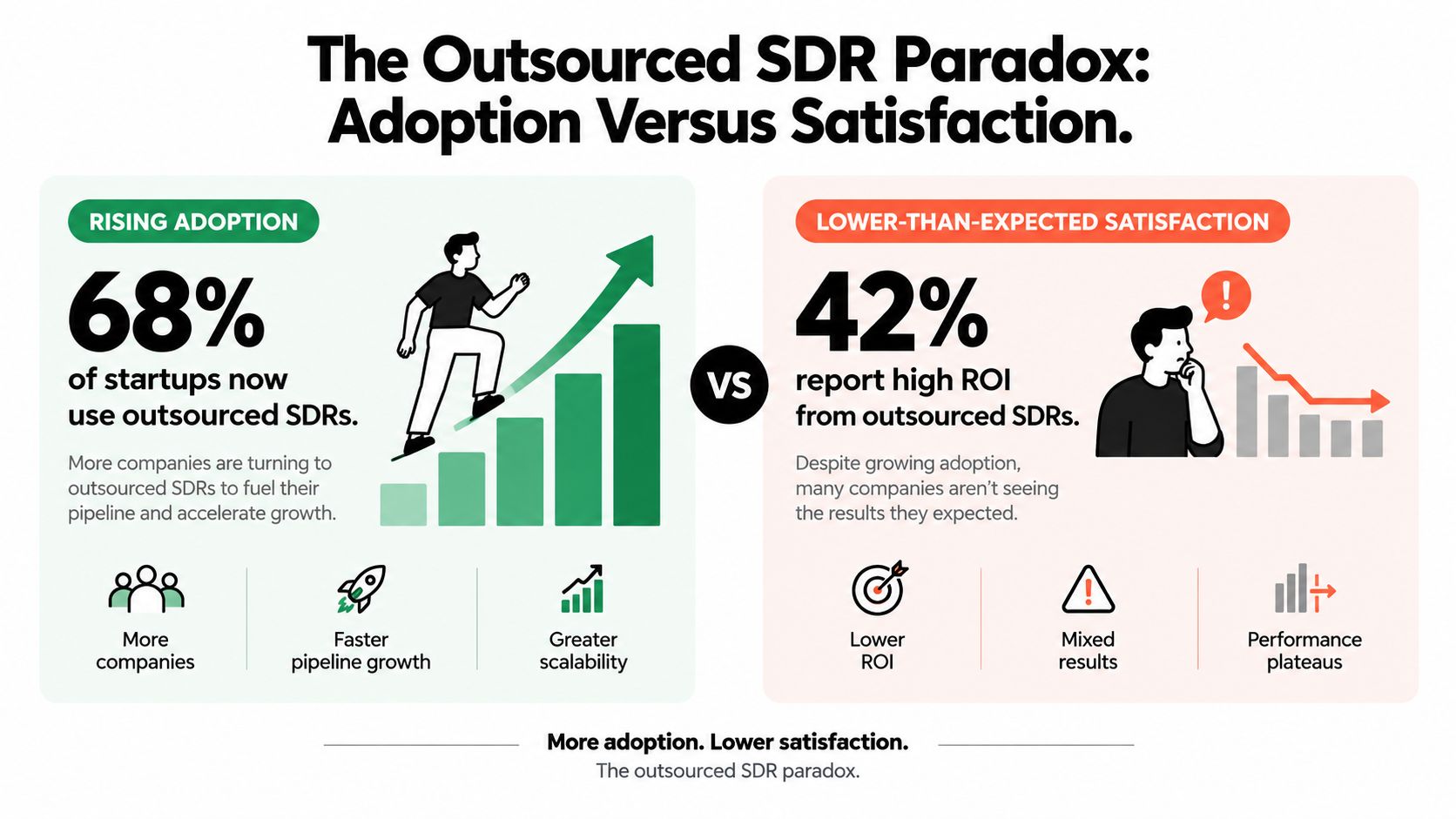
Outsourced SDRs are now part of real revenue motions, but adoption is not the same thing as performance. A 2024 Deloitte outsourcing survey, reported by industry coverage, found broad use of outsourced services across front-office work, including sales and marketing, and a rise in managed or operated services over the prior two years. That does not prove those programs are producing clean pipeline.
A separate survey attributed to SaaStr reported that only a small share of respondents said outsourced SDRs had “really” worked, while a larger share said they had “sort of” worked. That gap points to the core problem. Buyers are measuring activity, while revenue teams need accepted opportunities.
Practical rule: treat outsourced SDRs as an operating model, not a labor swap. If the vendor cannot show how meetings turn into accepted opportunities, you are paying for noise.
The sharper question is how to set controls so outsourced prospecting creates incremental revenue instead of calendar clutter. That matters most for solo founders, because a founder-led sales motion cannot absorb a flood of weak meetings and still stay focused on closing.
Outsourcing did not start with prospecting. It began with admin work, then moved into list building, multichannel outreach, qualification, and meeting setting. That expansion creates upside, but it also creates more room for bad targeting, weak messaging, and sloppy handoffs.
Use the same discipline you would use on any other channel. Define the ICP tightly, keep message control in-house, and demand reporting that connects activity to downstream outcomes. The buyer's job is to govern the model, not admire volume.
Outsourced SDR Cost And ROI Math For Bootstrapped Teams
Outsourced SDR pricing looks attractive because it replaces fixed payroll with a managed service fee. The provider absorbs recruiting, enablement, data, dialer access, sequencing, and supervision, then spreads that infrastructure across multiple clients. Procurement should start with total cost of ownership, not a salary comparison stripped of context.
Published industry benchmarks place outsourced SDR engagements at roughly $42,000 to $96,000 per rep annually. A fully loaded in-house SDR comes in at about $113,000 to $162,000 once you include salary, benefits, sales technology, management overhead, ramp-time productivity loss, and turnover. Monthly outsourced programs commonly range from $3,000 to $12,000, depending on whether delivery is email-only or includes calling, social outreach, data, strategy, and reporting.
| Model | Typical Annual Cost | Included Overhead | Best Comparison Metric |
|---|---|---|---|
| Outsourced SDR | $42,000 to $96,000 | Shared recruiting, enablement, tools, supervision | Cost per held, qualified meeting and cost per accepted opportunity |
| In-house SDR | $113,000 to $162,000 | Salary, benefits, tools, management, ramp, turnover | Cost per held, qualified meeting and cost per accepted opportunity |
The mistake is comparing cost per booked meeting. A cheap meeting that never shows, never qualifies, or never converts is expensive in disguise. A better buyer asks what one accepted opportunity costs, then traces that number to pipeline and revenue.
Founder's filter: if the vendor will not normalize scope, do not trust the price. Geography, channel mix, account-data quality, manager coverage, and whether the provider supplies technology all change the denominator.
Bootstrapped teams should therefore judge pilots on controlled economics. A small external program can make sense if it reduces upfront hiring risk and gives you a testable motion without locking you into fixed headcount. Scope matters more than the sticker price. Calling and email are not interchangeable, and neither is a vendor that brings its own stack versus one that needs you to supply everything.
The financial question is simple. Does the outsourced team create a cheaper path to accepted opportunities than hiring your own SDR, training them, and hoping the playbook survives turnover? If yes, the model earns its keep. If not, the program is just a cleaner way to buy activity.
How The SDR Funnel Converts Activity Into Revenue
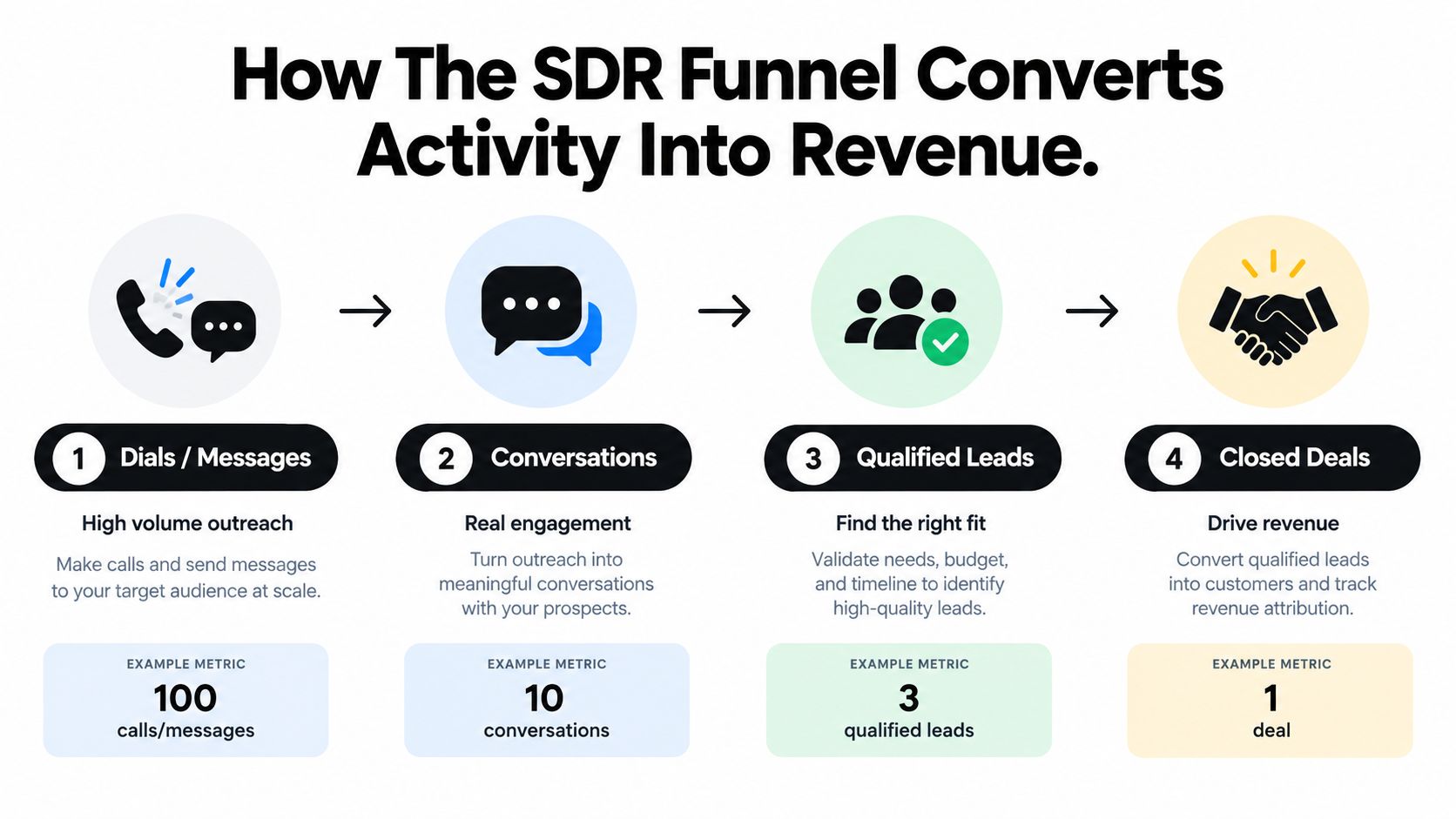
The funnel only works if every stage has a definition you can audit. Dials or messages create conversations. Conversations create meetings. Meetings must show. Held meetings must become sales-accepted opportunities. That is the point where outsourced SDR programs either create revenue or generate vanity output.
Treat these as planning assumptions, not published benchmarks: cold-call dial-to-connect rates of roughly 5% to 12%, connect-to-meeting rates of 15% to 30%, meeting show rates of 60% to 80%, and meeting-to-opportunity conversion rates of 25% to 50%. Those ratios are not targets by themselves. They are diagnostic clues.
If connect rates are weak, the likely problem is territory, contact data, calling windows, or deliverability. If connect-to-meeting is weak, the value proposition or talk track is off. If show rate is weak, the qualification and confirmation workflow is sloppy. If held-to-opportunity is weak, the provider is chasing calendar volume instead of ICP fit.
Reporting discipline fixes this. Require weekly funnel reporting by segment, source, rep, and message variant. Define what counts as a qualified meeting before launch, and define what counts as an accepted opportunity before the first dial goes out.
Useful rule: raw activity is a leading indicator, not a success metric. If a vendor optimizes for activity, you get busyness. If they optimize for accepted opportunities, you get a motion you can actually measure.
A strong SLA should prioritize accepted opportunities and downstream pipeline. Meetings booked can still be tracked, but only as a leading indicator. That distinction matters because a calendar full of poor-fit prospects distracts the founder, pollutes the CRM, and weakens trust with the account executives who have to work the handoff.
Use one dashboard, one set of qualification rules, and one owner for escalation. If a segment underperforms, do not argue about effort. Find the stage that broke first, then fix that stage.
For teams that want a concrete operating example, this lead-generation playbook shows how to structure the funnel and the handoff.
The five-minute walkthrough below shows what stage-by-stage funnel reporting looks like in practice.
You do not manage outsourced SDRs by mood or activity. You manage them by stage conversion, segment performance, and downstream acceptance.
How LatHire Can Help
LatHire is useful when your problem is hiring speed and cross-border execution, not just SDR outsourcing. It connects US and Canadian companies with pre-vetted Latin American professionals across technology, marketing, sales, and operations, and it uses AI assessments, skills evaluations, and human-led background checks to narrow the candidate pool.
That matters if you're deciding whether to build an internal SDR function instead of outsourcing it. If you need a mix of sales support, operations help, and broader go-to-market hiring, the best place to hire SDRs can be a practical starting point because you can evaluate a specialized SDR hire alongside other support roles in the same system.
LatHire is a better fit than outsourced SDRs when you want direct control over messaging, coaching, and data hygiene, but don't want to build a full recruiting stack yourself. It's also relevant if you're replacing an underperforming vendor and want an internal rep who can sit closer to the founder and AE team.
The platform's value is operational, not magical. It helps you move faster through sourcing and hiring, then handles HR, international payroll, benefits, and legal compliance so you're not piecing together five vendors just to make one hire. For a bootstrapped team, that simplicity can matter more than a flashy promise.
AI-Assisted Versus Human Oversight In Outsourced SDR Programs
AI can make outsourced SDR programs faster, but speed is not quality. IndieTool's AI cold outreach resource is a useful reference for separating research support from outbound automation, and that distinction matters. If a vendor claims AI improved meeting volume while reply quality slipped, that is a warning, not a win.
AI clearly belongs in the workflow; the open question is which steps keep a human in the loop. Research prioritization, list enrichment, and signal detection can run through automation. Prospect-facing copy should not. Once a message includes company-specific references, role changes, funding news, hiring moves, or product updates, a human needs to verify the facts before anything goes out.
That boundary should be written into the operating model.
Any personalized claim tied to a prospect should be checked before launch. Sensitive accounts need escalation rules. Opt-outs need suppression-list controls that are easy to audit. Regional compliance ownership should be assigned in writing, not left to vendor goodwill.
For a founder, the standard is simple.
- Research use is acceptable: AI can sort accounts, summarize firmographic patterns, and prioritize follow-up.
- Client-facing copy needs review: a human should approve outbound language when the message includes personalization or regulated claims.
- Sensitive accounts need escalation: if the prospect is strategic, legal, or compliance-heavy, a human should review the message before send.
- CRM hygiene must be auditable: bad fields and duplicated contacts are a vendor failure, not a small annoyance.
The test is judgment. Ask whether the vendor is using AI to improve accuracy or to create the appearance of scale. Request CRM audit rights. Review the suppression workflow. Name one owner for compliance issues. If the provider uses voice or chat automation, require the same clarity on handoff rules and exception handling.
The best outsourced programs use AI where it speeds research and routing, then keep humans on anything that affects accuracy, relevance, or brand trust. Anything less turns automation into a liability.
Vendor Evaluation Checklist For Indie Founders
Most vendor decks are built to sound low-risk. Your job is to find out whether the team can actually sell into your ICP. Start with scope normalization, because without it you are comparing offers that look similar and perform very differently.
Before you sign, ask how the provider handles geography, channel mix, account-data quality, manager coverage, and meeting qualification. A vendor running US calling with clean list data is not the same as one using mixed-channel outreach with weak enrichment. Price only matters if the scope is the same.
Feedback control comes next. You want a provider that can absorb weekly corrections without getting defensive. That means a real loop between your internal team and the SDR manager, not a monthly report with nice charts and no operational change.
Use this checklist to pressure-test the fit.
- ICP definition: Can they restate your ideal buyer in their own words, without sliding into broad audience language?
- Qualification standard: Do they define what counts as a qualified meeting and what disqualifies it?
- CRM access: Can you audit the data fields, activity logs, and meeting outcomes?
- Message control: Who approves copy, and how are changes versioned?
- Disqualification rules: What happens when a prospect is out of scope, hostile, or not ready?
- Manager coverage: Who coaches the rep, and how often do they review calls or emails?
- Escalation path: Who handles compliance, sensitive accounts, or brand-risk issues?
Set reporting expectations before launch. Weekly reporting should be broken out by segment, source, rep, and message variant, with the same definitions used every week. If a vendor can't agree to that, they are not ready for a bootstrapped buyer who needs certainty more than theater.
Tooling matters too. Some founders want a provider that brings its own stack, while others want tighter integration with their current systems. A practical resource like IndieTool's startup marketing tools directory can help you compare related tooling without adding another subscription to your stack.
The cheapest option is usually expensive in disguise. You pay for meetings that do not become opportunities, then spend your own time figuring out why. Ask the vendor to walk through one real disqualification from last month. If they cannot produce one, the reporting standard you just negotiated does not exist yet.
Onboarding Management And Contract Templates That Protect Startups
The first month decides whether an outsourced SDR program becomes a growth asset or a distraction. I've seen founders hand over a product deck, wait two weeks, and then complain that the calendar filled with bad meetings. That outcome usually starts with sloppy onboarding, not with bad intent.
The contract should force alignment before the first outbound sequence. Define qualified meeting and accepted opportunity in plain language. Spell out who owns acceptance decisions, how quickly feedback must be returned, and what happens when the provider books a meeting that doesn't fit the ICP.
Your SLA should reward downstream quality, not raw volume. A basic formula can track accepted opportunities as the primary outcome, with booked meetings and show rate as leading indicators. If the vendor misses the quality threshold, the remedy should be service credits, rep replacement, or a reset of the campaign, not a vague promise to “work harder.”
A sane onboarding cadence looks like this:
- Week 1, align the message. Review ICP, pain points, proof points, exclusions, and deal-breakers.
- Week 2, inspect the data. Check list quality, routing, CRM fields, and suppression logic.
- Week 3, listen to calls or review email threads. Fix objections and tighten qualification.
- Week 4, review the funnel. Compare conversations, meetings, shows, and accepted opportunities by segment.
The fastest way to lose control is to let the vendor define success after launch. Write the rules first, then let the activity begin.
The attribution clause matters too. If your internal AE closes the deal, the handoff must still be traceable to the SDR motion. Without that, you won't know whether the program produced revenue or just handed your closers more admin work.
A practical bootstrapped outcome looks modest, not dramatic. The best result is often a stable flow of commercially useful opportunities, tighter targeting, and a founder who can stop spending half the week on random outbound. You should expect fewer hero stories and more clean handoffs. That's what good looks like.
Realistic Outcomes And When Outsourced Sdrs Make Sense
Outsourced SDRs make sense when you need pipeline faster than you can build an internal machine, and when you're willing to govern the work like a revenue system. They're a strong fit for bootstrapped SaaS teams that have a clear ICP, a believable message, and no appetite for hiring a manager before the motion is proven.
They're a weak fit when you don't know who buys, why they buy, or how long it takes to become sales-accepted. If the only metric you can describe is meetings booked, the vendor will probably look busy while revenue stays flat. That's not a provider problem. That's a measurement problem.
The strongest signal that the program is working is simple. Held meetings start turning into accepted opportunities, sales has fewer complaints about fit, and the CRM contains usable notes instead of vague activity logs. If activity rises but those downstream signals don't, tighten targeting, rewrite messaging, and revisit qualification before you add more volume.
The low reported success rate alongside the high lead-generation improvement claim should calibrate your expectations. Outsourcing can improve top-of-funnel output without improving commercial results. Governance quality decides which side of that line you land on.
For solo founders, the decision is rarely permanent. You can start with outsourced SDRs to learn the motion, keep them if the accepted-opportunity math works, or exit if the program can't beat your other channels. The point is to keep control of the scoreboard.
If you're ready to evaluate a provider, build your scorecard around accepted opportunities, not booked meetings. Demand the reporting structure, set the contract terms, and reject any team that can't explain its qualification standard in plain English. Then run the pilot with discipline and hold the vendor to the same numbers you'd hold an internal hire to.
If you're evaluating outsourced SDRs this quarter, write your qualification standard, SLAs, and acceptance rules before you take the first vendor call. That one document will save you from buying a calendar full of noise.