Indietool
Mission Name Generator: How to Craft Impactful Names
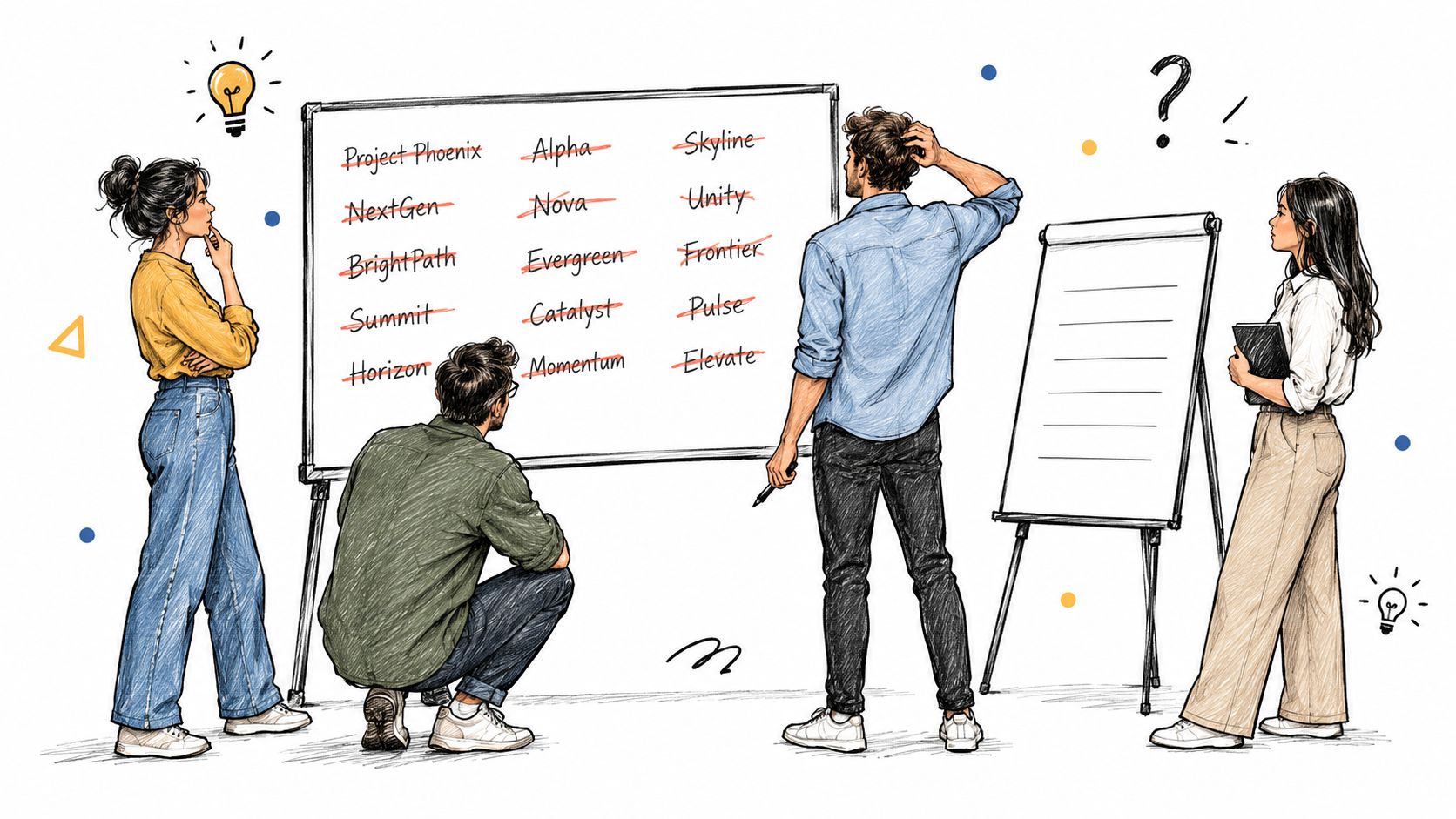
You're sitting in a room with a whiteboard full of mission names. Some sound inspiring, others sound clever, and a few are impossible to remember ten minutes later. The team keeps generating options, but nobody can answer the questions that matter: Will the name survive a trademark search? Can people find it online? Does it work in every market where the mission will operate?
That's the hidden problem with most naming sessions. Teams don't lack ideas. They lack a process for turning ideas into viable names. A mission name generator can accelerate exploration, but only when it's guided by a clear brief and followed by disciplined knockout checks.
Table of Contents
- The Staring-at-Blank-Page Problem Most Teams Face
- Building Your Naming Brief Before You Click Generate
- From Keywords to Candidates and How to Use a Generator Effectively
- Knockout Checks That Save You From Costly Mistakes
- Choosing the Right Generator for Your Use Case
- Next Steps From Name to Launch
The Staring-at-Blank-Page Problem Most Teams Face
A typical naming session starts with good intentions. Someone enters a few broad keywords into a generator, the team scans the results, and a promising phrase appears. It sounds purposeful, so everyone starts discussing colours, logos, and launch copy before anyone checks whether the name is already in use.
That sequence creates avoidable rework. A name can feel distinctive in a meeting and still collide with an existing trademark, an unavailable domain, a confusing social handle, or an unintended meaning in another language. By the time those problems surface, the team has often built emotional attachment to the candidate.
The better first step isn't generating names. It's agreeing on what the name must accomplish.
Why random brainstorming produces weak options
Random brainstorming tends to reward immediate appeal. The loudest person in the room favours a bold name, another person prefers something warm, and a third chooses a phrase that sounds good in a presentation. Without shared criteria, the group evaluates every option differently.
A generator can make this problem worse when users treat it as an oracle. Modern web tools position mission name generators as software that can produce hundreds of ideas in seconds, often alongside domain suggestions, as described by Atom's mission name generator. That speed is useful for widening the search, but it doesn't determine whether an idea is strategically suitable.
A raw list also creates false confidence. More candidates don't automatically mean better candidates. If the inputs are vague, the output will usually be broad, repetitive, or disconnected from the mission's actual audience.
Start with a decision system
Before generating anything, define the boundaries that every candidate must meet. You need to know:
- Who the mission serves, including the audience's language, expectations, and level of familiarity with the subject.
- What the mission promises, expressed as an outcome rather than a list of activities.
- How the name should feel, such as direct, optimistic, serious, rebellious, or calm.
- What the name must avoid, including clichés, sensitive terms, confusing spellings, and unwanted associations.
- Which practical checks are mandatory, from trademark research to domains and handles.
A useful mission name generator from IndieTool can help expand the candidate pool, but it can't replace those decisions. The tool should handle breadth. Your team should handle meaning, fit, and risk.
Practical rule: Never fall in love with a name before it has passed the checks that could disqualify it.
The naming session then becomes a filtering exercise rather than a popularity contest. Generate freely within defined boundaries, capture the strongest patterns, and remove weak options before anyone starts designing around them.
Building Your Naming Brief Before You Click Generate
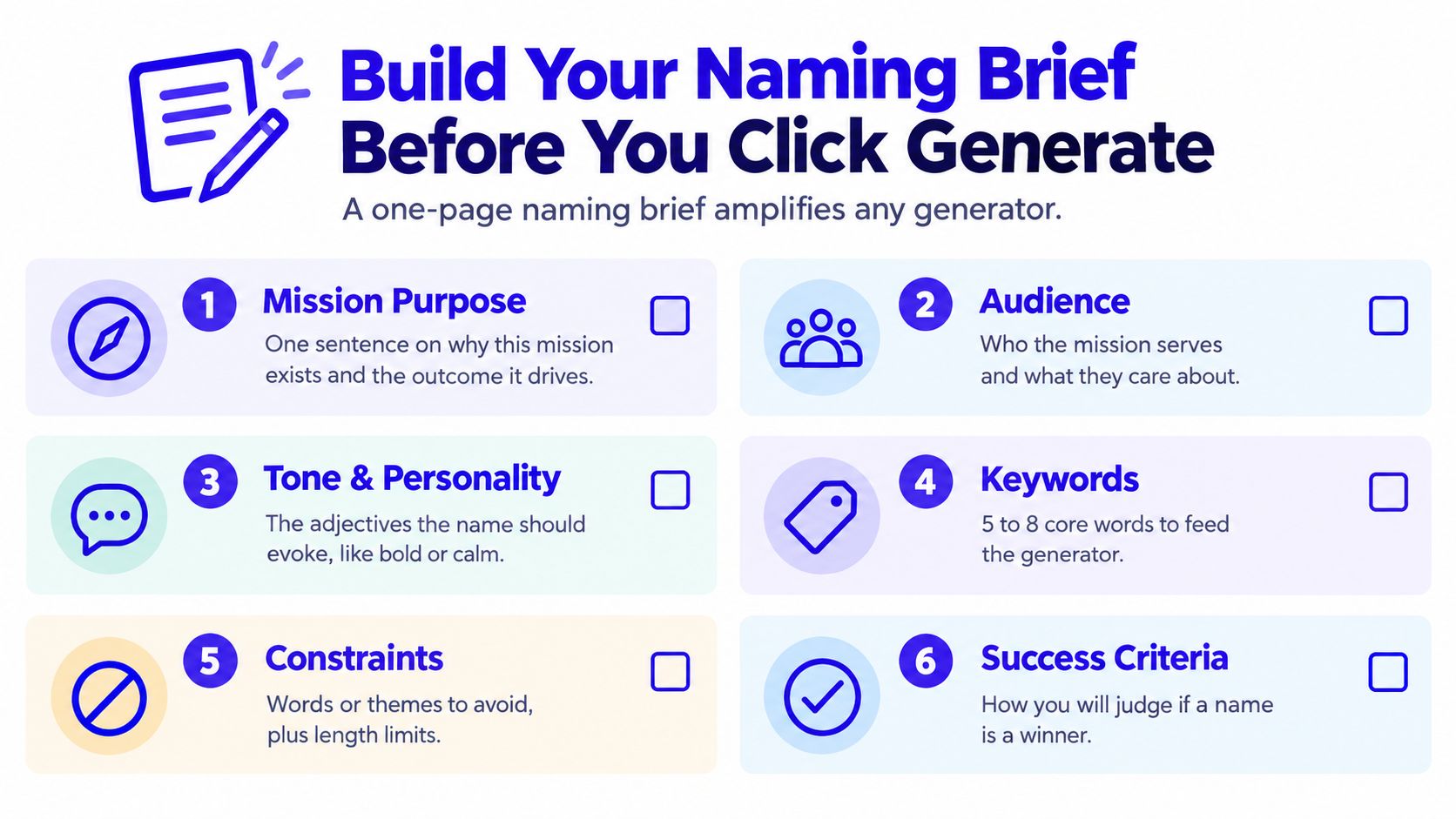
The most effective naming workflows begin with a one-page naming brief. It gives the generator useful direction and gives your team a consistent way to judge the output. Without it, every prompt becomes a fresh guess.
Keep the brief short enough that everyone will use it. A practical version contains six elements.
Define the mission in operational language
Start with one sentence answering, Why does this mission exist, and what change should it create? Avoid internal language. “We build tools for collaborative resilience” may be accurate, but it isn't as useful as a plain statement describing the people served and the result they seek.
Then define the audience. A community initiative for local volunteers needs a different naming style from a technical programme for enterprise buyers. Identify the audience's priorities, vocabulary, cultural context, and likely first impression.
Next, choose the desired personality. Pick a small set of adjectives and distinguish between essential traits and optional ones. A name can't be simultaneously formal, playful, understated, disruptive, traditional, and universally accessible without trade-offs.
Turn meaning into usable inputs
Extract a focused group of keywords from the brief. Include words that describe the mission, the audience's desired outcome, and the emotional territory of the name. Also write down words and themes to avoid, because negative constraints are often as valuable as positive prompts.
The name should be evaluated against the brief, not against a vague feeling of cleverness. The table below makes that evaluation concrete.
| Element | Purpose | Example |
|---|---|---|
| Mission purpose | States the change the mission supports | Help independent creators launch useful digital products |
| Audience | Identifies who must understand or trust the name | Solo founders and small product teams |
| Tone and personality | Establishes the emotional direction | Practical, confident, accessible |
| Keywords | Supplies concepts for generation | Build, launch, craft, signal, maker |
| Constraints | Removes predictable sources of risk | Avoid jargon, forced spelling, and narrow geographic references |
| Success criteria | Defines what makes a candidate viable | Easy to say, relevant, distinctive, and checkable |
A naming brief also separates memorability from strategic fit. A name may be catchy yet fail to communicate the mission. Another may be meaningful but too difficult to pronounce or search. Your criteria should expose those differences before the shortlist becomes emotionally expensive.
For a broader perspective on positioning and naming decisions, review guidance on creating great startup names. The useful takeaway is simple: naming works better when the name expresses a deliberate position instead of trying to appeal to everyone.
The workflow can be supported by a short video prompt or workshop discussion, but the brief should remain the source of truth.
Once the brief is approved, write the naming architecture. Decide whether candidates should be descriptive, suggestive, metaphorical, compound, or invented. A generator performs better when it explores a defined family of names rather than mixing unrelated styles.
From Keywords to Candidates and How to Use a Generator Effectively
A generator works best as a creative partner, not a selection engine. Its job is to expose combinations your team might miss, create variation around a theme, and help you discover language patterns. Your job is to interpret those patterns against the brief.
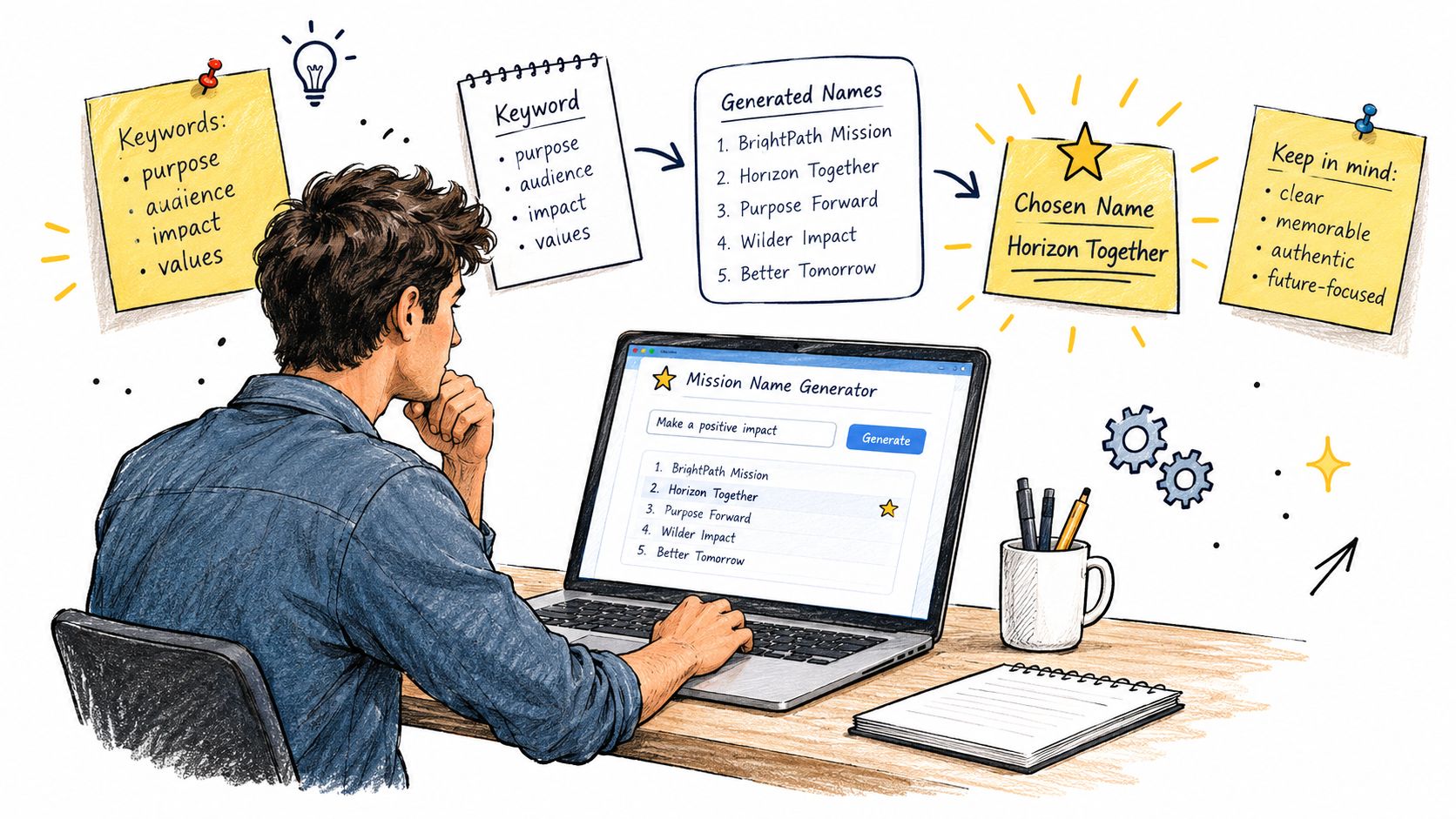
Begin with the clearest keyword set from the brief. Generate a batch, then don't immediately choose a winner. Read the output for recurring structures. You may notice that the tool repeatedly combines movement words with community terms, produces overly technical compounds, or leans too heavily on familiar metaphors.
Those patterns tell you how to refine the next input.
Use controlled variation
Change one variable at a time. If the first batch feels too corporate, retain the mission keywords and adjust the tone. If the names are too abstract, add audience language or a concrete outcome. If the names are too long, introduce a length constraint and remove secondary concepts.
Create separate candidate groups for different naming architectures:
- Descriptive names explain the mission directly, which improves immediate comprehension but may limit distinctiveness.
- Suggestive names point toward an outcome or feeling, offering more flexibility while requiring stronger messaging.
- Metaphorical names create an image or association, but they need explanation if the connection isn't obvious.
- Compound names combine familiar words and can be easy to understand, though they may resemble existing names.
- Invented names can be distinctive, but pronunciation, spelling, and cross-market meaning require extra attention.
Don't blend all categories into one scorecard. A descriptive option shouldn't be judged by the same expectations as an invented one. Compare candidates within their architecture first, then compare the strongest options across architectures.
Narrow with evidence, not enthusiasm
A practical evaluation sheet can include five questions:
- Does the candidate express the mission's intended territory?
- Can the intended audience say, spell, and remember it?
- Does it match the desired tone without sounding generic?
- Can the team explain its meaning in one clear sentence?
- Is there an obvious risk that warrants immediate removal?
Score or discuss each candidate consistently. The aim isn't mathematical precision. The aim is to prevent one person's personal preference from overriding the agreed brief.
A useful shortlist is small enough to inspect carefully and broad enough to preserve real alternatives. Keep notes on why each candidate survived. Those notes become valuable when stakeholders revisit a name later and ask why a seemingly attractive option was rejected.
A generator creates possibilities. A naming system creates confidence.
The process also benefits from prompt refinement. Use mission-specific phrases, audience language, and tone descriptors rather than relying on a single keyword. Specialized tools show how far this format has evolved. For example, Scabard's fantasy mission name generator supports multilingual output, generates multiple names per click, and allows prompt refinement. The lesson applies beyond gaming: useful generators increasingly let users control language and parameters instead of returning purely random combinations.
Knockout Checks That Save You From Costly Mistakes
A candidate isn't viable because the team likes it. It becomes viable when it survives the checks that could stop the launch.
Run those checks in a strict order. First investigate trademark conflicts in the markets and categories that matter. Similarity isn't limited to exact spelling. Sound, meaning, industry, and visual presentation can all affect confusion risk. A preliminary search doesn't replace professional legal advice, but it can remove obvious problems before the shortlist consumes more time.
Check practical discoverability
Review domain availability and social handles before approving a name internally. You don't need every possible variation, but you do need a realistic path to a coherent online identity. A name that requires a confusing suffix or inconsistent spelling may create friction each time someone hears it and tries to find it.
Check search results for unrelated meanings and established organisations. A candidate may be legally available and still create poor discoverability because another subject dominates the phrase. Record what you found, rather than relying on a quick memory of the results page.
Test language with people who understand the market
Machine translation and dictionary checks can identify obvious problems, but they won't reliably capture slang, pronunciation, cultural associations, or offensive interpretations. Ask native speakers who understand the intended audience to review the shortlist in context. Give them the mission description and ask what the name suggests, how they would pronounce it, and whether it creates an unwanted association.
This is especially important for invented names and names built from fragments. A spelling that looks elegant in one language may be difficult to read elsewhere. A clever English pun may lose its meaning entirely or become confusing when used by an international audience.
The recommended sequence is clear: prepare a one-page brief, generate candidates within a defined naming architecture, and run trademark, domain, handle, and native-speaker linguistic checks before testing a candidate. SurveyMonkey's product-naming guidance presents this sequencing discipline as a way to reduce downstream legal and cross-market rejection risk.
Remove candidates quickly
Use knockout questions rather than trying to rescue every promising option:
- Is there a clear trademark conflict?
- Is the required digital identity unavailable or misleading?
- Does the name produce a serious linguistic concern?
- Is the spelling difficult to communicate?
- Does it imply a promise the mission can't support?
- Does it depend on an explanation nobody will remember?
If the answer is yes to a serious risk, remove the candidate. Don't keep it alive because the team has already spent time discussing it. Early rejection is cheaper than late redesign.
Choosing the Right Generator for Your Use Case
The right tool depends on the job. A founder exploring a new venture needs strategic range and practical availability checks. A writer creating a fictional campaign may value atmosphere, genre, and language controls more than domains or trademarks. A community organiser may need clarity and cultural fit above all else.
Start by identifying the generator's role in your workflow.
| Feature | Why It Matters | Look For |
|---|---|---|
| Prompt controls | Keeps output connected to the mission | Keywords, tone, audience, and exclusions |
| Domain suggestions | Surfaces practical availability concerns early | Relevant domain checks rather than unrelated alternatives |
| Multilingual support | Helps identify cross-market possibilities | Language selection and refinement controls |
| Naming architecture | Prevents a mixed, incoherent candidate pool | Descriptive, suggestive, compound, or invented modes |
| Export or saving | Preserves reasoning and shortlist history | Easy copying, tagging, or candidate notes |
| Transparency | Helps users judge output quality | Clear distinction between ideas and validation |
Free tools can be enough for early exploration, especially when the team already has a strong brief and will perform checks separately. Paid or broader platforms may help when you need richer controls, saved workflows, or integrated availability research. Don't pay for volume if your process can't evaluate the results.
For content-led missions, a related resource such as this AI content idea generator for X can help translate a chosen mission into adjacent themes and campaign ideas. It shouldn't be used as a substitute for naming validation, but it can be useful once the naming direction is clear.
IndieTool is one option that combines a free mission statement generator with other naming and launch-preparation utilities. Its mission statement tool produces variations from a company's details and brand tone, which can help teams clarify the language that feeds a mission name generator.
A basic randomizer suits fictional prompts and playful exploration. A parameterized tool is more useful for real missions because it lets you control the territory. Whichever option you choose, judge it by the quality of the workflow around the output, not by the number of suggestions it displays.
For another perspective on creative naming decisions, see IndieTool's guide to business name generation. The same principle applies here: a name should support a clear position rather than merely sound polished.
Next Steps From Name to Launch
Once a candidate passes the knockout checks, secure the practical assets immediately. Register the appropriate domain, claim consistent handles where possible, and document the approved spelling, pronunciation, meaning, and usage rules. Keep the naming brief with the final decision so future contributors understand why the name exists.
Prepare a compact launch test with people who match the intended audience. Ask them what they think the mission does, how they would say the name aloud, and what they expect to find after clicking through. Treat confusion as evidence, not as a failure of the audience.
Then build the name into the mission statement, landing page, profile descriptions, presentation materials, and internal language. Consistency helps the audience connect the name with the promise it represents. If the name works only when someone explains it, strengthen the surrounding message before launch.
The winning process is simple to describe: brief first, generate within a naming architecture, eliminate risks early, then test the survivors in context. A mission name generator can make the creative stage faster, but the quality of the final decision comes from the work around it.
IndieTool offers a free mission statement generator and other naming and launch-preparation tools for turning a clarified mission into usable ideas. Visit IndieTool, create your brief first, and use the generator to build a shortlist you can validate with confidence.