Indietool
Best Company Name Generator: 7 Ranked Picks for 2026
You've built the product, the landing page copy is nearly there, and you spend an evening with a Best Company Name Generator collecting two hundred ideas. One name finally feels right. Then you check it and the .com is taken, a similar app is already live, and a soundalike trademark sits in your category. The list was never the hard part. Getting to a name you can launch with is.
That's why I didn't rank these tools by volume. AI naming platforms reportedly processed more than 90 million name-generation requests worldwide in 2025, according to Dataintelo's AI brand naming report, so volume is cheap. I scored each option on output quality, availability checks, cost to reach a usable shortlist, workflow fit, and how well it separates ideas from legal clearance. A generator is a brainstorming aid, not a clearance tool. If you're also weighing broader branding help, this Aibranding tool overview is useful context before you start.
Table of Contents
- 1. Tools - Name Generator
- 2. Namelix
- 3. NameSnack
- 4. Shopify Business Name Generator
- 5. Namecheap Business Name Generator
- 6. Wix Business Name Generator
- 7. Looka Business Name Generator
- How the leading company name generators compare on free access, domain checks, logo tools and best use
- Turning a Long List Into a Name You Can Launch
1. Tools - Name Generator
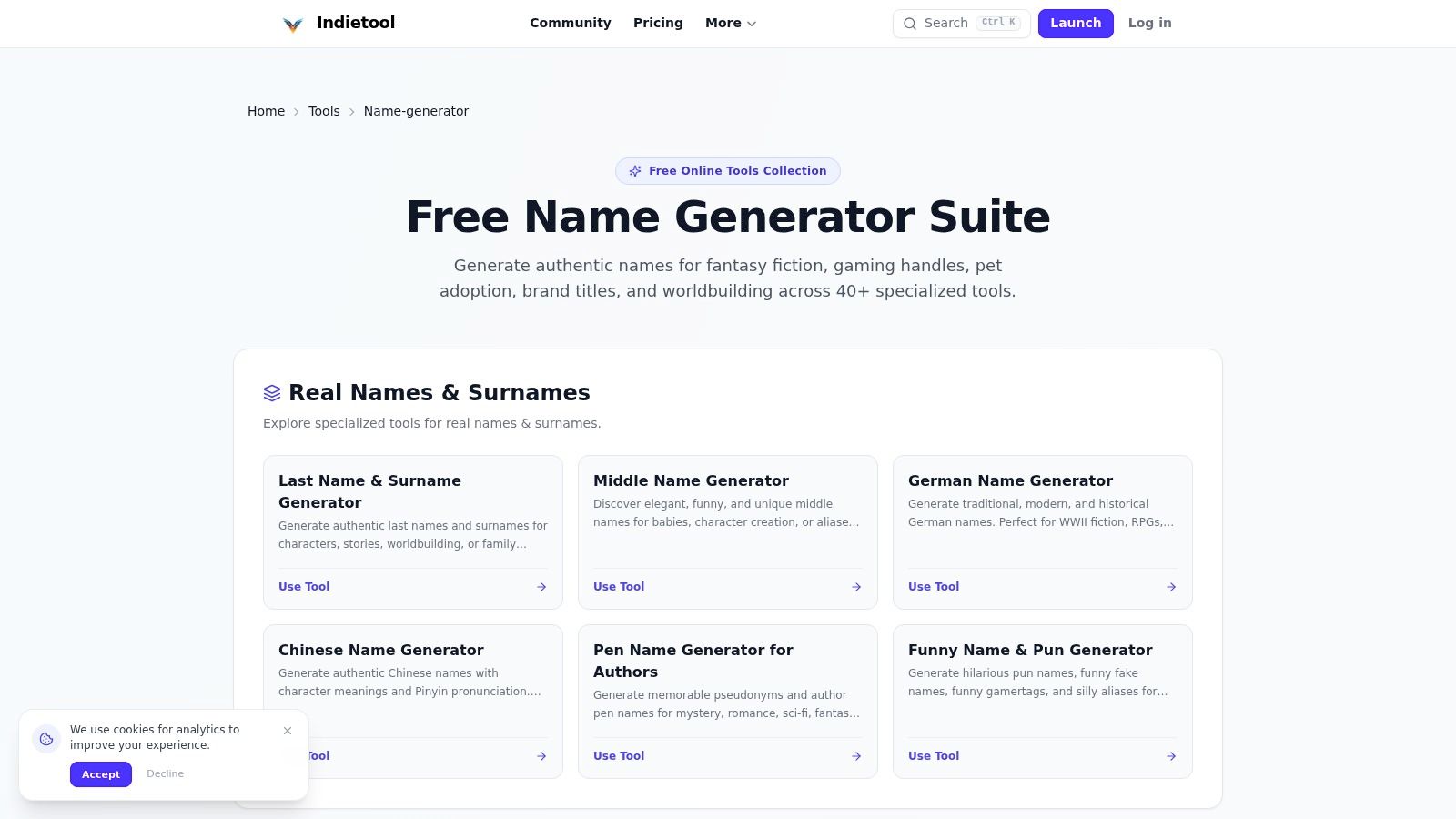
Start here if you want a free, low-friction first pass inside a founder launch workflow, not another subscription. IndieTool's Name Generator sits alongside other launch preparation utilities in a directory built for indie products, so you're brainstorming in the same place you'd later list and promote what you build. That placement matters more than it sounds. Naming in isolation produces clever words. Naming next to discovery and distribution forces a better question, which is whether the name will still work on a listing, in search results, and spoken in a pitch.
Where It Fits Best
Treat this as your divergent phase. Generate widely, copy candidates into a shortlist document, and don't judge spelling or domain fit until you have a batch worth cutting. Our free tools also include a Headline Generator, Logo Maker, Email Generator, and Business Ideas generator, so you can test a candidate against a headline and a rough visual without switching platforms.
The honest limit is transparency. The page doesn't explain how names are generated, what inputs you can control, or whether any availability screening happens. You shouldn't assume domain or trademark checks are built in. That gap is common, but it's also risky, because global domain registrations reached 371.7 million across all top-level domains in Q2 2025, according to the DNIB Domain Name Report for Q2 2025. In a namespace that crowded, an unchecked name is just a placeholder.
- Pros: Free to use, useful during early product planning, and conveniently located with startup discovery and distribution tools.
- Cons: No published detail on generation method, customization, or domain and trademark screening, so you must run those checks yourself.
Practical rule: Use it when you need fresh directions fast and you're willing to do your own validation. Don't use it as your only step before buying a domain.
Stress-test any result this way. Say the name once on a phone call, ask someone to spell it back, then search the exact name plus your category. If they mishear it or a competitor dominates page one, cut it, however much you liked it in the list.
2. Namelix
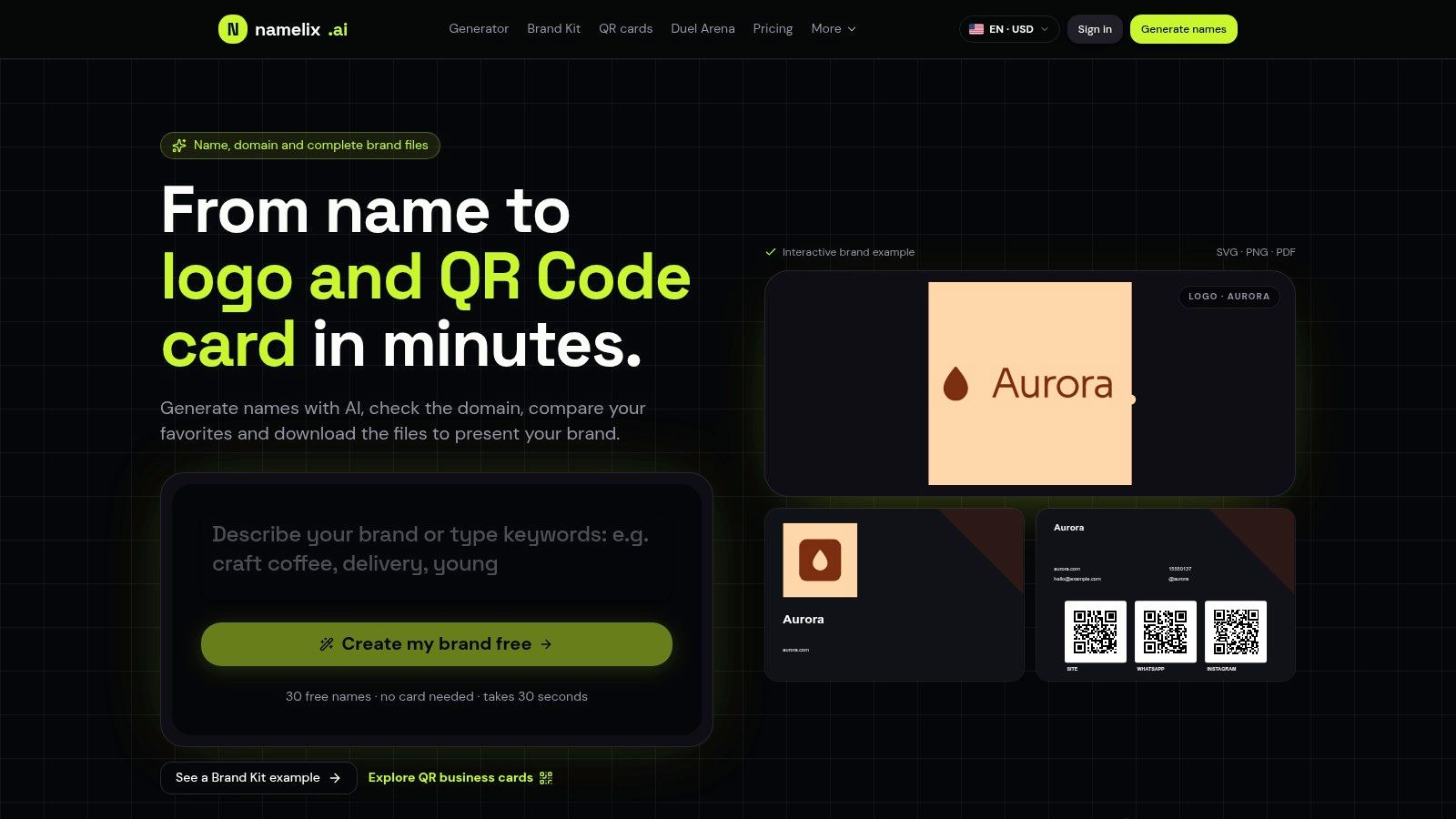
Namelix is the pick when you want short, invented, brandable names instead of literal descriptions. You give it a brief business description and it returns compact wordmarks, with domain checks across extensions, saved favorites, logo previews, and a head-to-head comparison view for finalists. That comparison feature is more valuable than another hundred suggestions, because forced choice reveals which name you remember five minutes later.
The trade-off is spelling. Invented names look clean in a logo preview and then fall apart when someone hears them in a podcast mention. That tension shows up in buyer preferences too, since 31% of American consumers said simplicity was the most important aspect of a technology startup's name in a 2024 survey reported by AtomRadar's tech industry insights. If you want the deeper mechanics behind tools like this, this breakdown of company name generator technology explains why generation style shapes output quality.
- Pros: 30 free names without a payment card, strong brandable output for apps and SaaS, and domain checks built into shortlisting.
- Cons: Harder-to-spell inventions, paid packs for more generations, and no trademark clearance behind the domain check.
Use it when distinctiveness matters more than instant description, such as a consumer app or developer tool you'll explain with a tagline anyway. Stress-test: record yourself saying the name in a sentence at normal speed, send the audio to two people, and see what they type. Two different spellings means the name will leak search traffic forever.
3. NameSnack
Say you're naming something less fashion-forward, a niche store, a local service, a small SaaS utility. NameSnack suits that job better than pure brandable generators because it starts from keywords and business category and offers short, creative, and industry-oriented styles. You're less likely to get a slick nonsense word and more likely to get something a customer can parse on first contact.
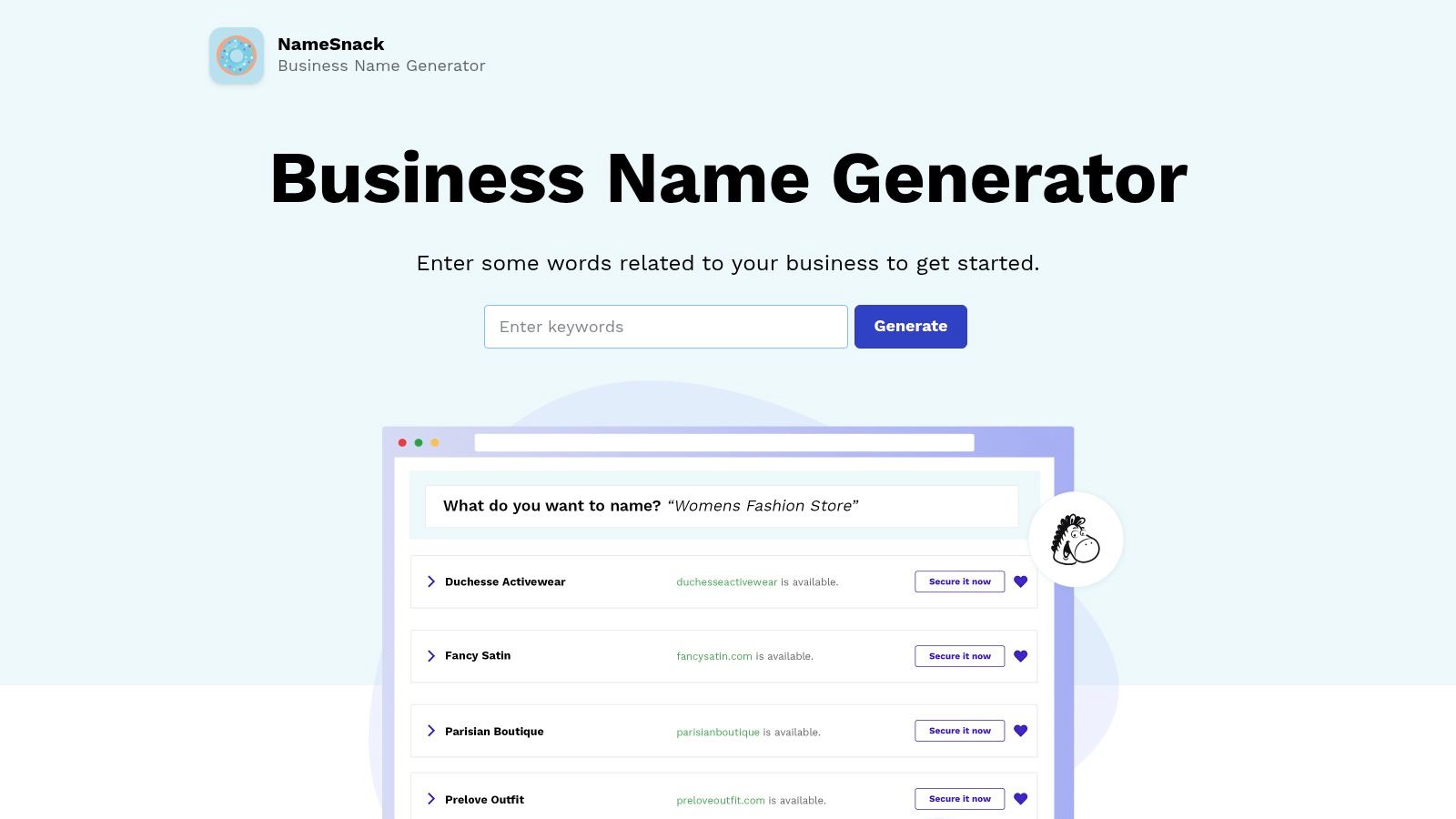
It pairs suggestions with domain availability information and a logo creation option, so one session can take you from keyword to a rough visual direction. That speed has a cost. Keyword-led output can feel generic, and generic is a real problem when 74% of consumers said it was important for a brand name to be unique in AtomRadar's business naming survey. A name built from your two most obvious keywords is probably close to what competitors already tried.
How to Get More From It
Run it three times with different inputs, once with your category word, once with the customer benefit, and once with an unrelated metaphor. Keep only names that survive across runs in spirit, then verify any suggested domain directly at a registrar before you trust it.
- Pros: Free generator, broad coverage across startups, apps, stores, and products, with domain info and logo exploration together.
- Cons: Keyword-heavy results can blur together, and logo concepts are a starting direction, not a finished identity.
Use it when you need descriptive clarity for an early product that depends on search and word of mouth. Stress-test: remove your main keyword from the name mentally. If nothing distinctive remains, you've got a description, not a brand.
4. Shopify Business Name Generator
If you're launching a store, Shopify's Business Name Generator removes friction you don't need. Enter a keyword or describe the business, get store-ready ideas, and move straight into domain search and Shopify's store-building tools. There's no usage charge for searches, and the whole flow assumes you're trying to sell something this month, not build a naming thesis.
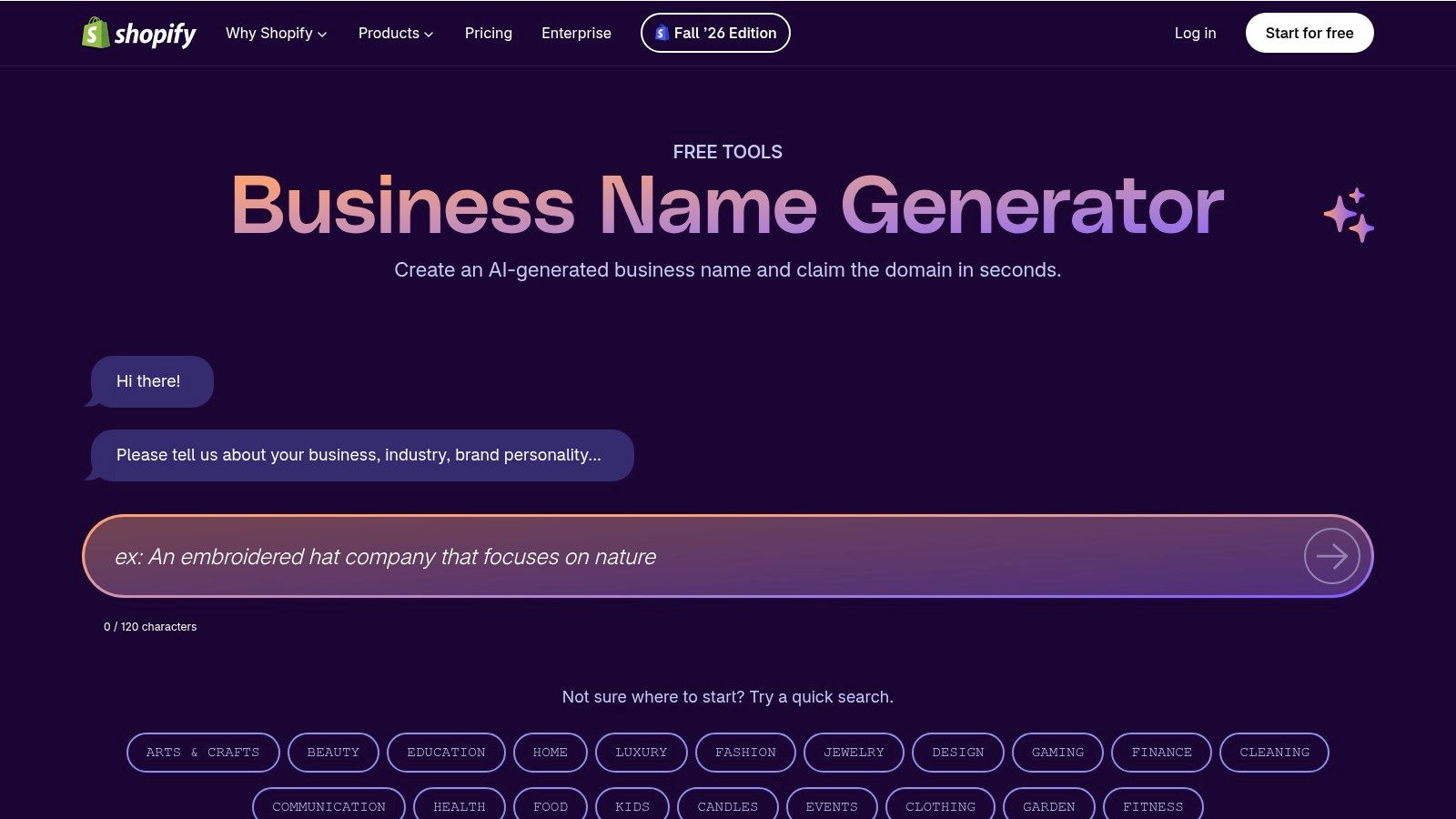
That ecommerce focus is both the strength and the ceiling. Results lean descriptive, which helps a shopper understand your store instantly but can box you in if your product line shifts. History argues for leaving room to grow, because among 115 firms incorporated before 1860, only 4% had names that did not mention their product, process, or function, while by 1960 that share had risen to 43% among Fortune 500 companies, according to a historical study summarized in Wix's domain name statistics. Companies outgrow literal names and then pay to change them.
A name that describes your first product perfectly can become the reason your second product looks like a mistake.
- Pros: Free and fast, straightforward brainstorming, and highly convenient if your store will live on Shopify.
- Cons: Descriptive rather than distinctive output, shallow naming process, and no legal clearance behind any domain match.
Use it when you're validating a store concept and speed beats long-term brand architecture. Stress-test: add a plausible future product line to the name in a sentence. If it sounds wrong, the name is too narrow for anything beyond a test store.
5. Namecheap Business Name Generator
Namecheap's Business Name Generator is built around a simple, useful idea, which is that a name and its domain should be judged together. You enter keywords, get business name suggestions paired with domain and logo ideas, and can edit the logos or register a domain separately. Name generation and logo creation are free, and you don't have to buy a domain to explore.
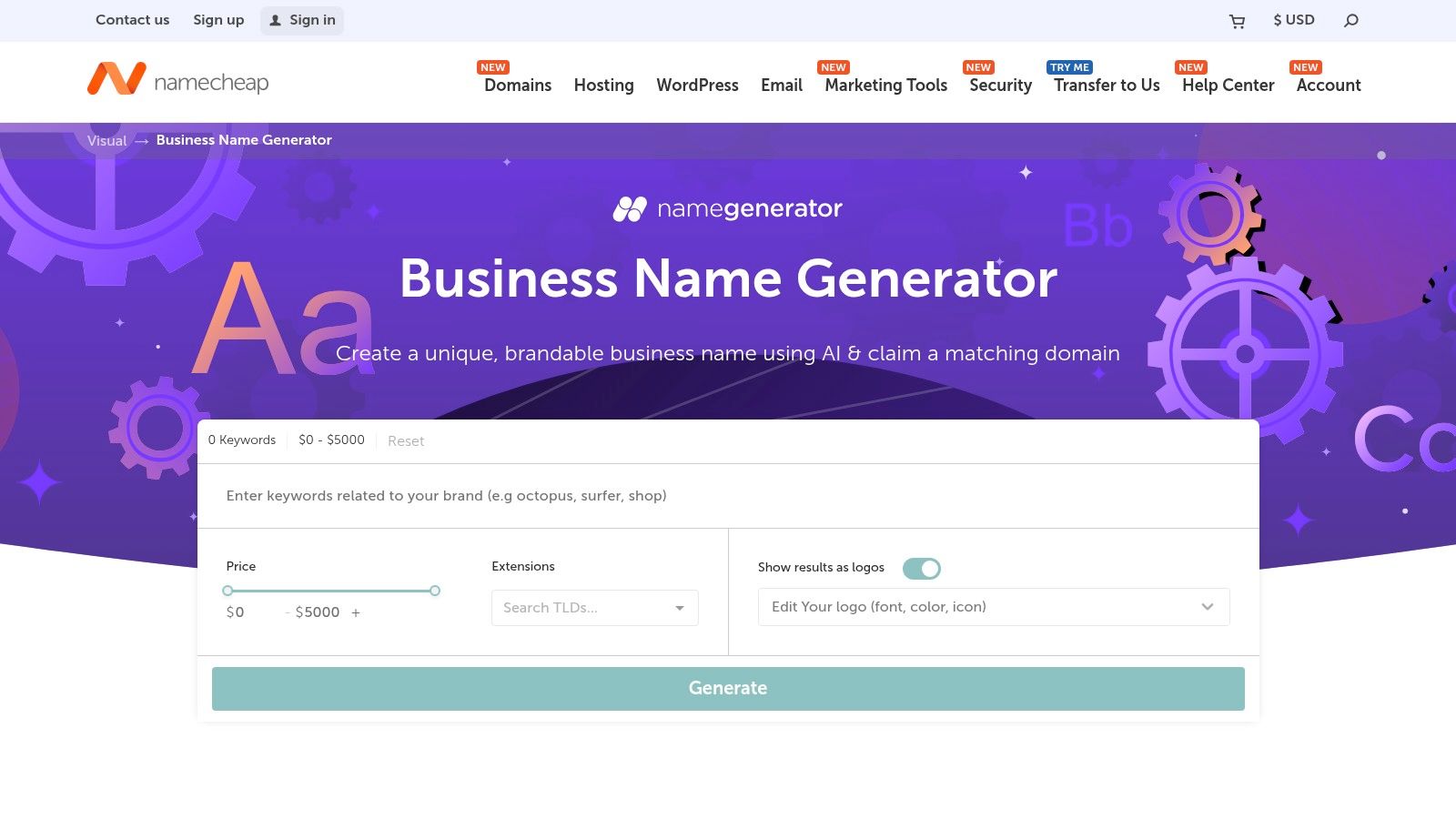
Don't mistake that convenience for safety. An available domain tells you nobody registered that exact string. It tells you nothing about an earlier trademark that sounds similar, looks similar, or is already used in your market without a matching domain. Independent legal guidance from Westaway's startup trademark FAQ recommends searching exact, soundalike, and visually similar marks, then checking web, app store, social, and company records before getting professional clearance. Can you safely use a name because the domain is available? No. That's the single most expensive assumption in this whole category.
Availability also isn't guaranteed until registration completes, and premium domains can change your budget fast. Check price, renewal price, and extension alternatives before you fall in love.
- Pros: Free names and logos, name and domain exploration in one workflow, and no purchase required to browse.
- Cons: No trademark screening, possible premium pricing, and availability that can change before checkout.
Use it when domain reality is your first filter and you'd rather cut names early than mourn them later. Stress-test: search your finalist spoken aloud, with an S added, and with the most likely misspelling. If any variant lands on a competitor, walk away.
6. Wix Business Name Generator
Wix's Business Name Generator gives you two speeds. There's a quick keyword and industry generator, and an AI-assisted Business Launcher flow that builds a business profile, suggests names with explanations, and produces a personalized report. Those explanations are the differentiator. A name with a stated rationale is easier to judge, brief to a cofounder, and defend or discard.
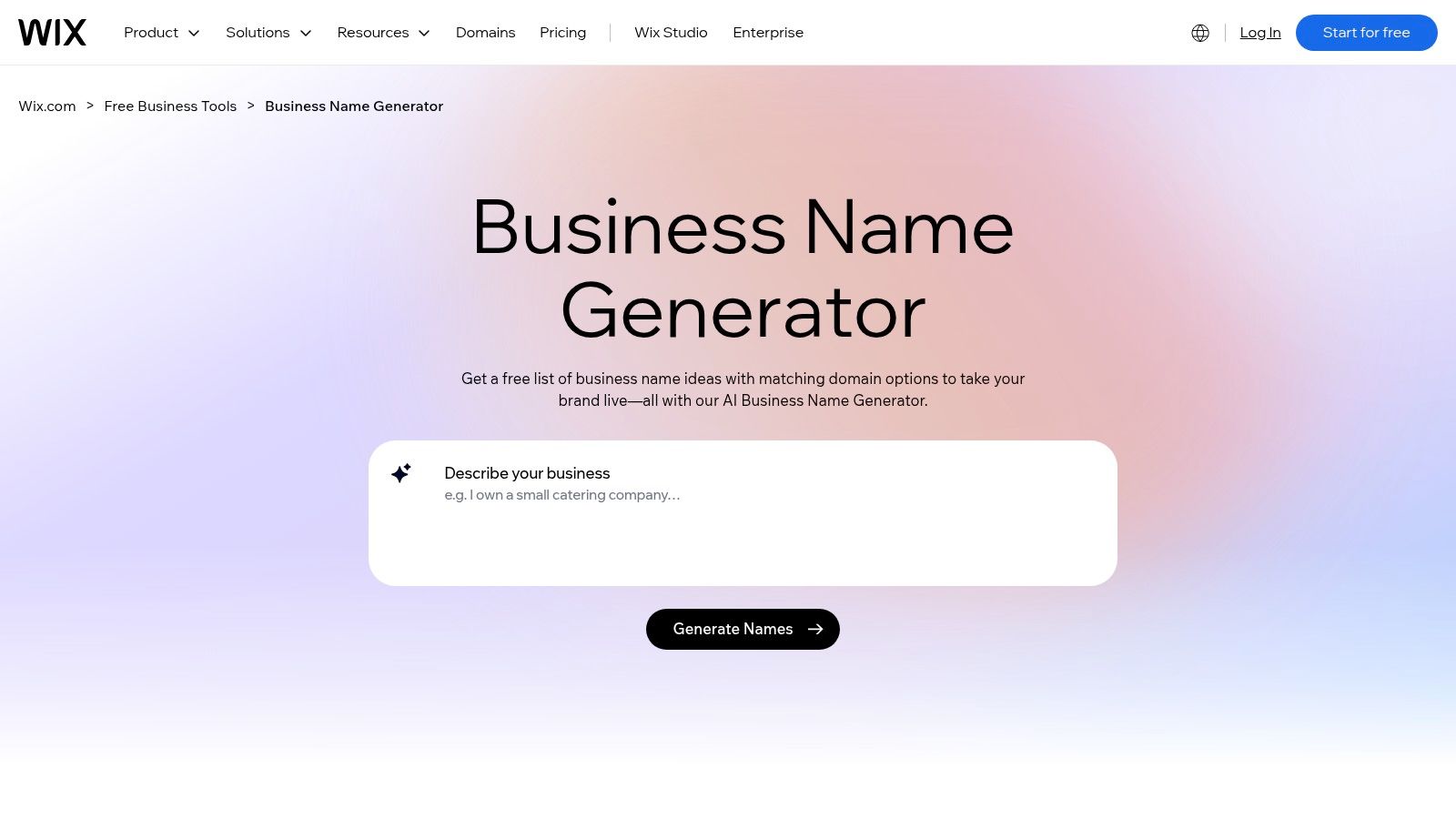
Explainability also helps less experienced founders close the gap with designers. A 2026 comparative study of an integrated generative AI branding platform with 50 participants reported mean usability of 5.61 out of 7, with designers finishing in 19.9 minutes versus 26.5 minutes for non-designers, according to the KCI article record. Guided flows don't erase that gap, but they narrow it. If you want examples of what strong output looks like before you generate, these notes on great startup names are a useful calibration set.
The caveats are platform lock-in and accuracy. The AI flow requires a Wix account, generated analysis can be wrong, and connecting a custom domain requires an upgraded Wix site. Names then connect into Wix site, logo, and domain tools, which is convenient only if Wix is your actual destination.
- Pros: Quick or guided modes, rationale for suggestions, and an easy path into site and logo tools.
- Cons: Account required for the AI flow, possible inaccuracies, and upgrade needed for a custom domain.
Use it when you're already building on Wix and want naming tied to launch setup. Stress-test: ignore the written rationale and say the name cold to someone. Explanations can make a weak name sound clever on screen.
7. Looka Business Name Generator
Some founders can't judge a name as plain text. If that's you, Looka's Business Name Generator is built for visual comparison. Start from keywords, industries, or abstract concepts, filter by length, check domain and social availability, then push finalists into Looka's logo maker to see how they behave as actual brand marks. A name that looks balanced in a wordmark and survives at favicon size has passed a test a text list can't run.
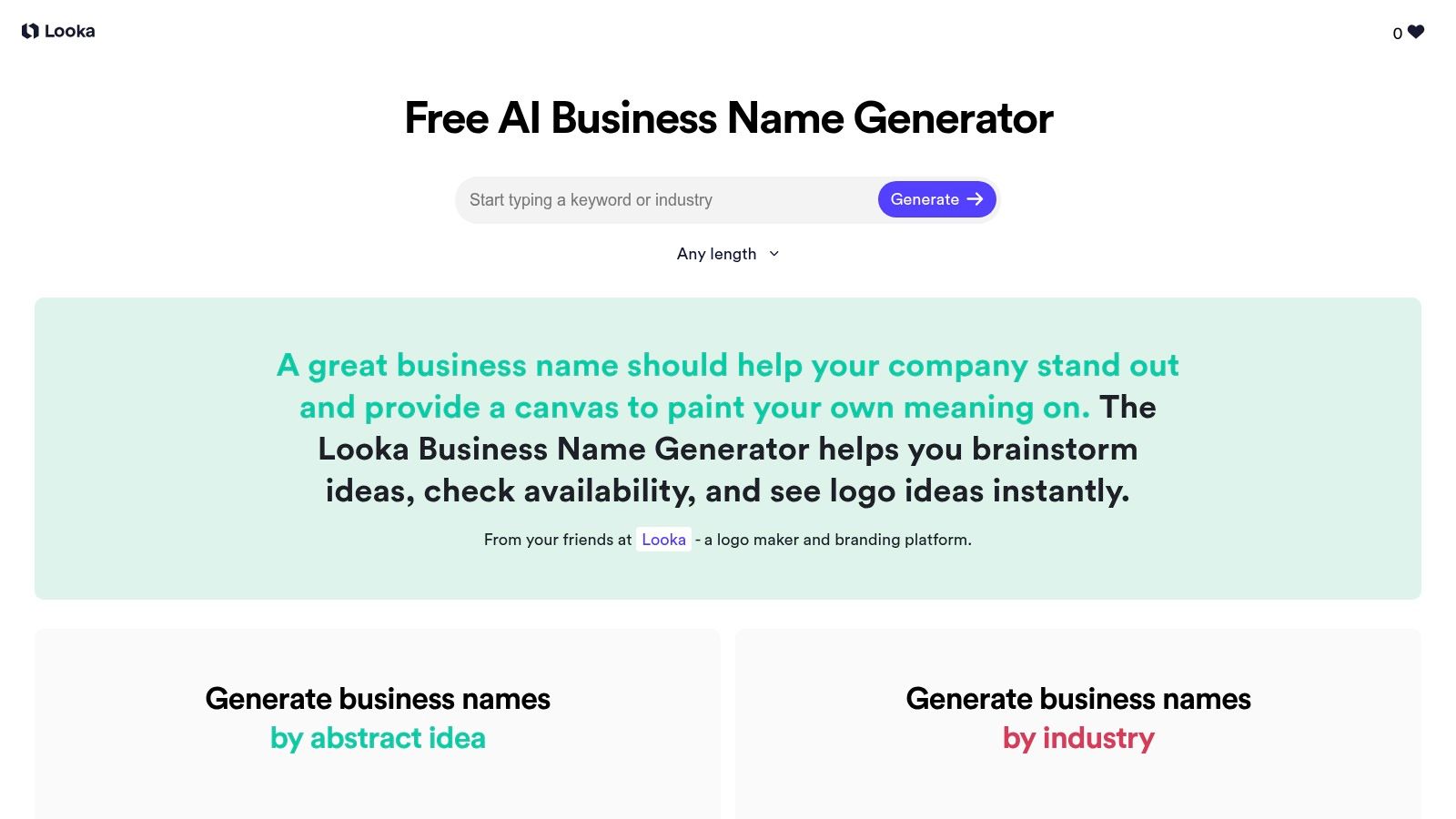
Social checks deserve special weight now. One 2026 comparison reports that combined US monthly search volume for several AI name generator variants exceeds 12,000, according to Fast.io's AI name generator comparison, which means plenty of founders are fishing in the same pool of plausible names. Securing a matching handle isn't vanity. It's how customers find you after hearing the name once.
What to Verify Yourself
Looka's checks are a starting signal, not proof. Recheck the domain at a registrar, search each social platform directly, and remember that logo and branding products cost extra beyond the free generator. A polished mockup can also create false confidence, making a legally risky name feel finished.
- Pros: Free brainstorming, helpful logo concepts for comparison, and domain plus social context while shortlisting.
- Cons: Independent verification still required, paid branding extras, and no resolution of trademark risk.
Use it when visual fit will decide between two or three finalists. Stress-test: shrink the logo to app icon size and print the name in plain text with no styling. If it only works with the design propping it up, it's not strong enough.
How the leading company name generators compare on free access, domain checks, logo tools and best use
| Item | Free to Use | Domain Checks | Logo Tools | Best For |
|---|---|---|---|---|
| Tools - Name Generator | Free | Not specified | Not specified | Early naming brainstorms |
| Namelix | 30 free names | Checks availability across extensions | Logo previews | Brandable startup names |
| NameSnack | Free | Provides availability information | Logo creation for selected names | Business naming with basic visual exploration |
| Shopify Business Name Generator | Free | Includes domain search | Not specified | Ecommerce businesses launching on Shopify |
| Namecheap Business Name Generator | Free name and logo tools | Suggests domain pairings | Editable logo tools | Exploring names, domains, and logos together |
| Wix Business Name Generator | Free status not specified | Connects to domain tools | Connects to logo tools | Founders planning to use Wix |
| Looka Business Name Generator | Free for brainstorming | Checks domain and social availability | Connects to Looka's logo maker | Comparing names with visual brand concepts |
Turning a Long List Into a Name You Can Launch
Don't pick seven tools. Pick two or three that match your stage, one for brandable output, one for descriptive output, and one tied to where you'll launch, whether that's a store, a site builder, or a registrar. Generate in batches and cut ruthlessly between batches. Professional naming work follows the same funnel, since in a study of 74 naming assignments, an average of 46 candidate names were created for each assignment while the mean number submitted for registration was five, according to the Worcester Polytechnic Institute study record. Your job isn't collecting names. It's shrinking forty-something ideas to five credible ones.
Run the cuts in a fixed order so emotion doesn't outrank evidence.
- Cut on availability first: Remove any name without a workable domain and consistent social handles in your main markets.
- Cut on sound second: Say it aloud, dictate it to your phone, and have someone spell it from audio only.
- Cut on scope third: Drop names that trap you in one product, city, or feature you'll outgrow.
- Verify last, before spending: Search trademark registries for exact and similar marks in every country you'll sell in, then get professional clearance for the winner.
That last step is where founders get lazy, and it's the step with real downside. Trademark databases differ by country, so a clean US search doesn't clear you in the UK, EU, Canada, or Australia. Check company registers, app stores, and common-law use through ordinary web search too, because an unregistered competitor with real customers can still create a fight you don't want. Even specialized fields follow this logic, and the discipline behind choosing a wealth management firm name shows how much trust and compliance thinking sits behind names in regulated categories.
Decision rule: If a name needs a paragraph of explanation, a spelling guide, and a domain workaround, it has already failed. Simpler names survive contact with real customers.
My practical recommendation is boring on purpose. Start free, generate in two different styles, and spend money only after a name passes domain, social, pronunciation, and preliminary trademark screens. Buy the domain once you've cleared those checks, not before, because owning a domain creates attachment to a name you may need to abandon.
A generator gets you candidates. Clearance, consistency, and a name people can say, spell, and find again decide what you launch with.
You've got your shortlist process, so put it to work and generate your first batch with our free naming tools, then list the finished product where indie founders and early adopters will see it. Visit IndieTool to brainstorm your name, use the wider launch toolkit, and get your startup in front of builders who are looking for what you're making.