Indietool
App Name Generator AI: 10 Tools Compared for 2026
You're staring at a working prototype, a half-decent launch page, and a name that suddenly looks fragile because the App Store listing is taken, the .com is parked, and the obvious alternatives feel generic. That's where an app name generator ai tool helps, but only if you treat it as one step in a larger workflow, not as a magic answer. The better tools split into different jobs, ideation, domain-first checks, logo handoff, or human-contest upgrade, and the fastest path is usually to combine two or three of them before you commit.
Table of Contents
- 1. Namelix by Brandmark
- 2. Atom formerly Squadhelp
- 3. Shopify Business Name Generator
- 4. Looka Business Name Generator
- 5. DomainWheel Business and App Name Generator
- 6. NameSnack
- 7. Namify
- 8. GoDaddy Business Name Generator
- 9. Namecheap Beast Mode
- 10. Copy.ai Company and App Name Generators
- Top 10 AI App Name Generators, Comparison
- From Shortlist to Launch-Ready Name
1. Namelix by Brandmark
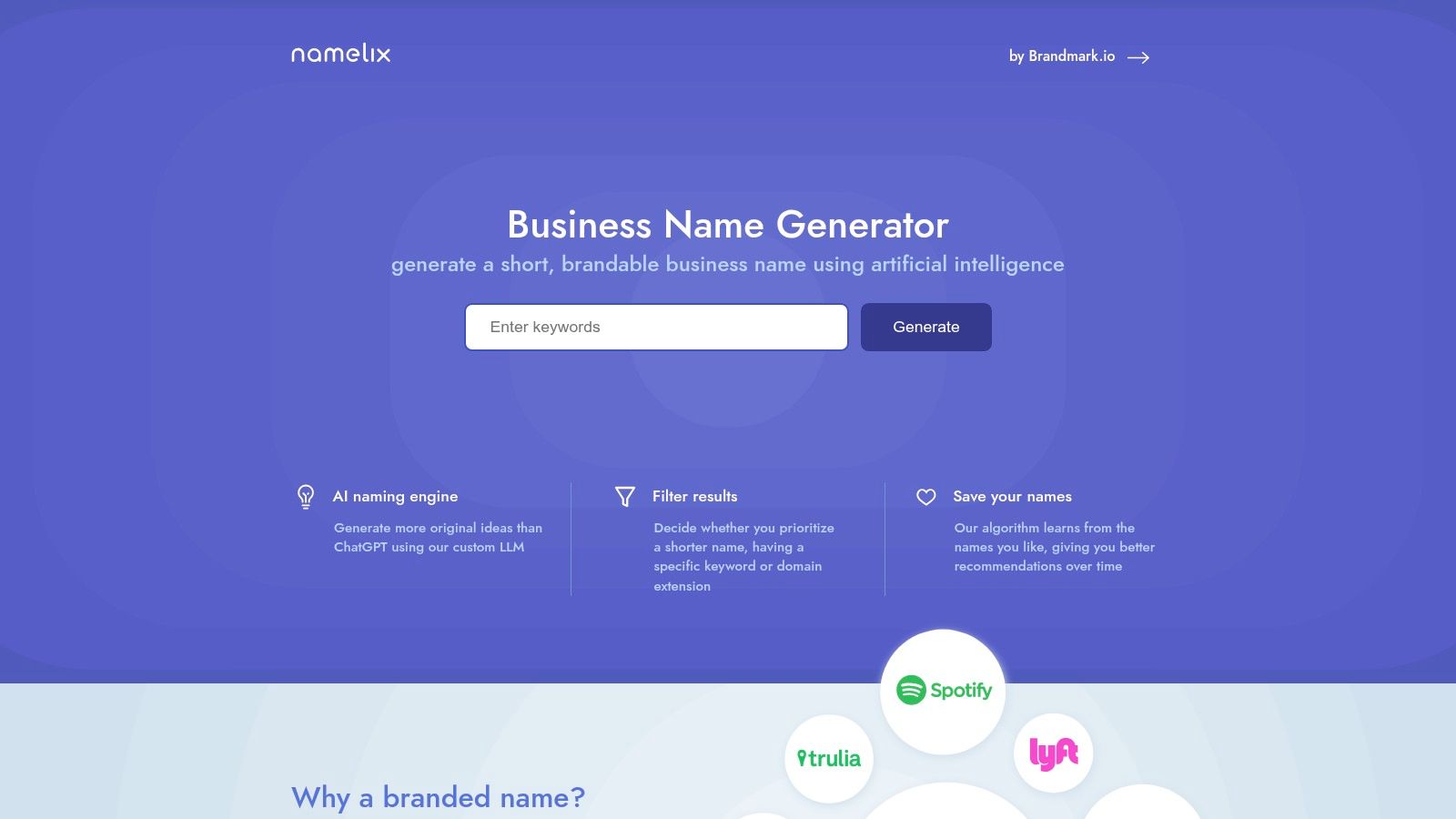
Namelix is a strong first stop when you want short, brandable app names fast. It's good at producing names that feel like product brands instead of keyword soup, and the filters for style, length, and domain preferences help you push the output away from clunky options. The Namelix app name generator is also useful because it doesn't stop at names. The instant logo previews through Brandmark make the shortlist feel more real, which matters when you're trying to sell a name internally or to a cofounder.
Where it fits in the workflow
Use Namelix when you need raw ideation and a quick visual check. It's especially handy if your launch direction is still loose and you want the model to explore more invented, startup-style names rather than literal descriptions. The limitation is obvious, though. It doesn't give you full legal clearance, and it can drift toward names that look sleek but don't say much about the product.
Practical rule: if a name only works after you explain it twice, it's usually not ready yet.
For a broader starting point, Indie founders often pair tools like this with a more general free app name generator overview so they can compare outputs before narrowing down. Namelix is best when you want volume and style first, then a second pass somewhere else for screening.
2. Atom formerly Squadhelp
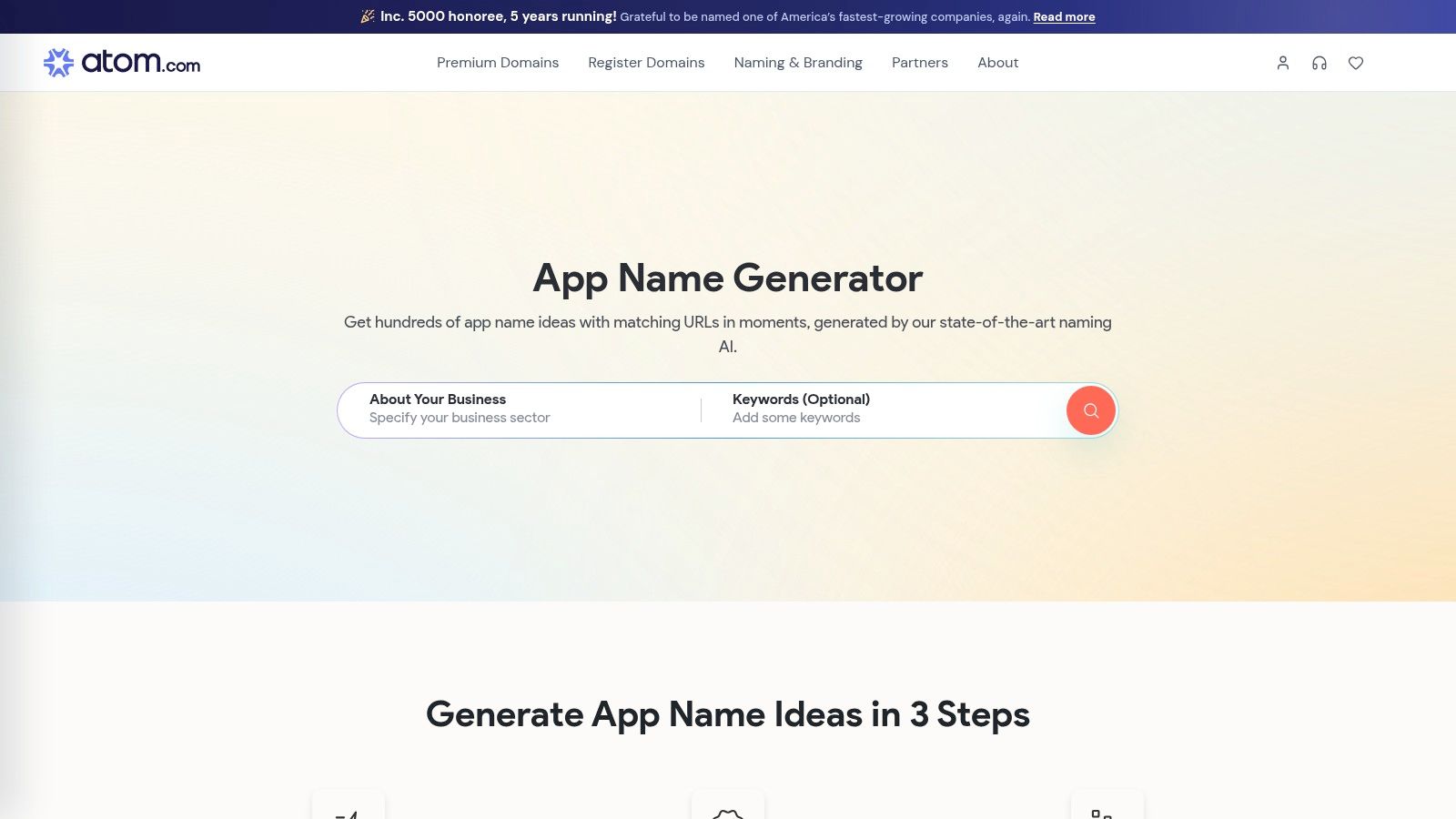
Atom makes more sense when you want AI ideas plus human judgment in the same naming path. The free generator gives you quick options, but the true value is the upgrade route into crowdsourced naming contests and a wider marketplace of ready-to-use names. The Atom app name generator is useful when you're no longer asking, “Can I get ideas?” but “Can I get better ideas, and can other people pressure-test them?”
Why founders use it late, not early
Atom fits the stage where you've already rejected the easy stuff and need names with sharper positioning. The contest model helps when internal brainstorming has gone stale, because human contributors often bring angles an AI tool misses. The trade-off is cost and complexity. If you only need a working shortlist by end of day, the platform can feel like more machinery than necessary.
- Best for validation: Use it when you want outside creativity before committing to a launch name.
- Best for breadth: The marketplace gives you more than generated suggestions.
- Weakest point: It's overkill if you haven't even settled the product category.
If you're building something public-facing and want a naming process that can survive debate, Atom is one of the few tools that naturally supports that handoff from machine output to human selection.
3. Shopify Business Name Generator
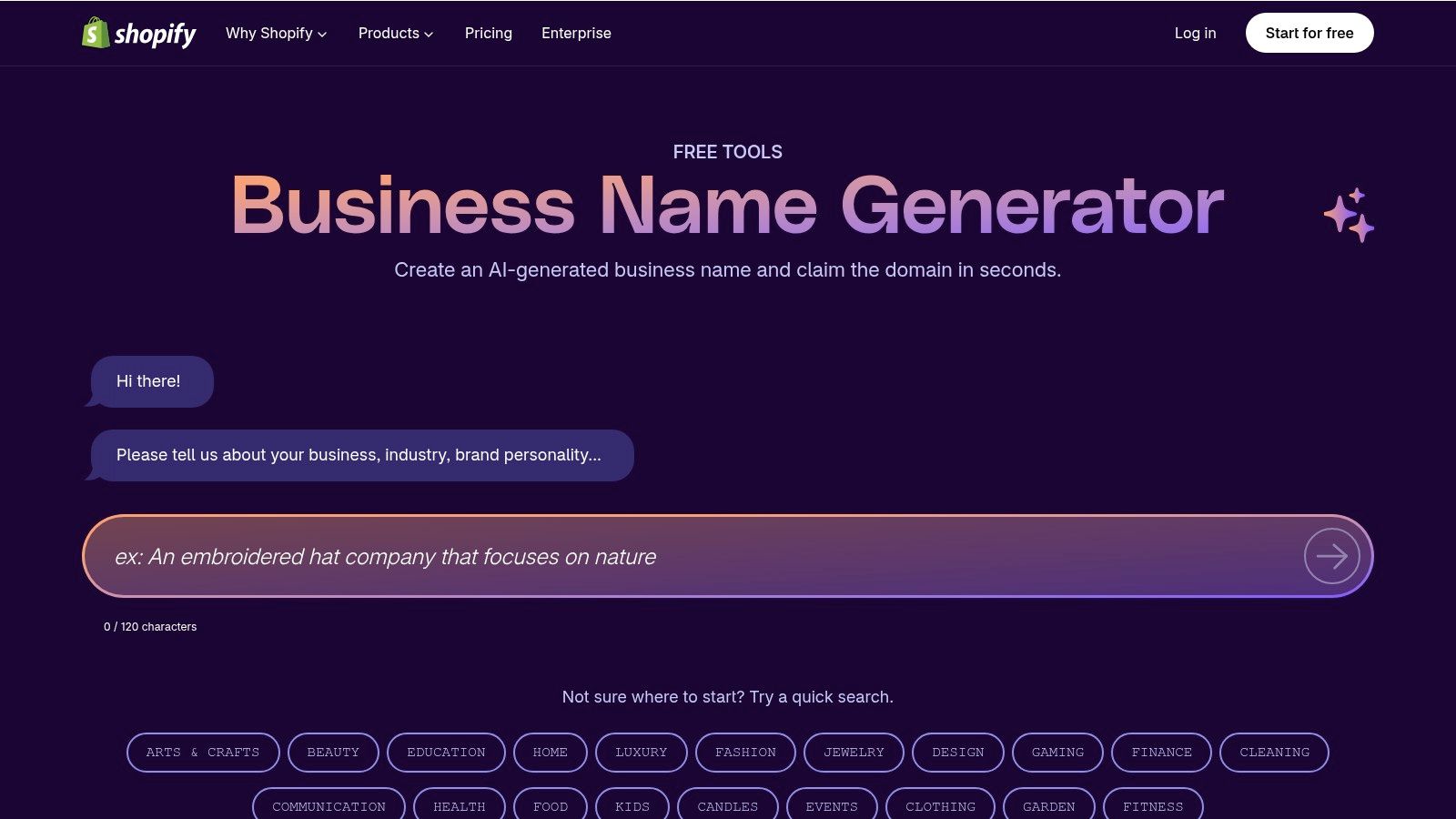
Shopify's generator is the easiest tool in this list to explain to a new founder. You enter an idea, it returns names quickly, and it nudges you toward domain and social handle checks before you get emotionally attached to a bad option. The Shopify Business Name Generator is especially useful for app makers who are already thinking about launch pages, payments, or storefronts inside Shopify's ecosystem.
Simple is the point
This tool works because it doesn't try to be clever. That's also its limit. You get speed and low friction, but not much control over the shape of the output. If you want very specific tone, phonetics, or naming architecture, you'll outgrow it fast.
A good pairing here is the business name generator guide for founders, especially if you need to compare naming styles before you lock the direction. Shopify is strongest as a quick validation pass, not a deep creative studio.
Don't mistake a fast suggestion for a safe name. Domain availability is a filter, not clearance.
For ecommerce-adjacent apps, though, Shopify remains a practical choice because it pushes you straight from brainstorming into the kinds of checks founders need.
4. Looka Business Name Generator
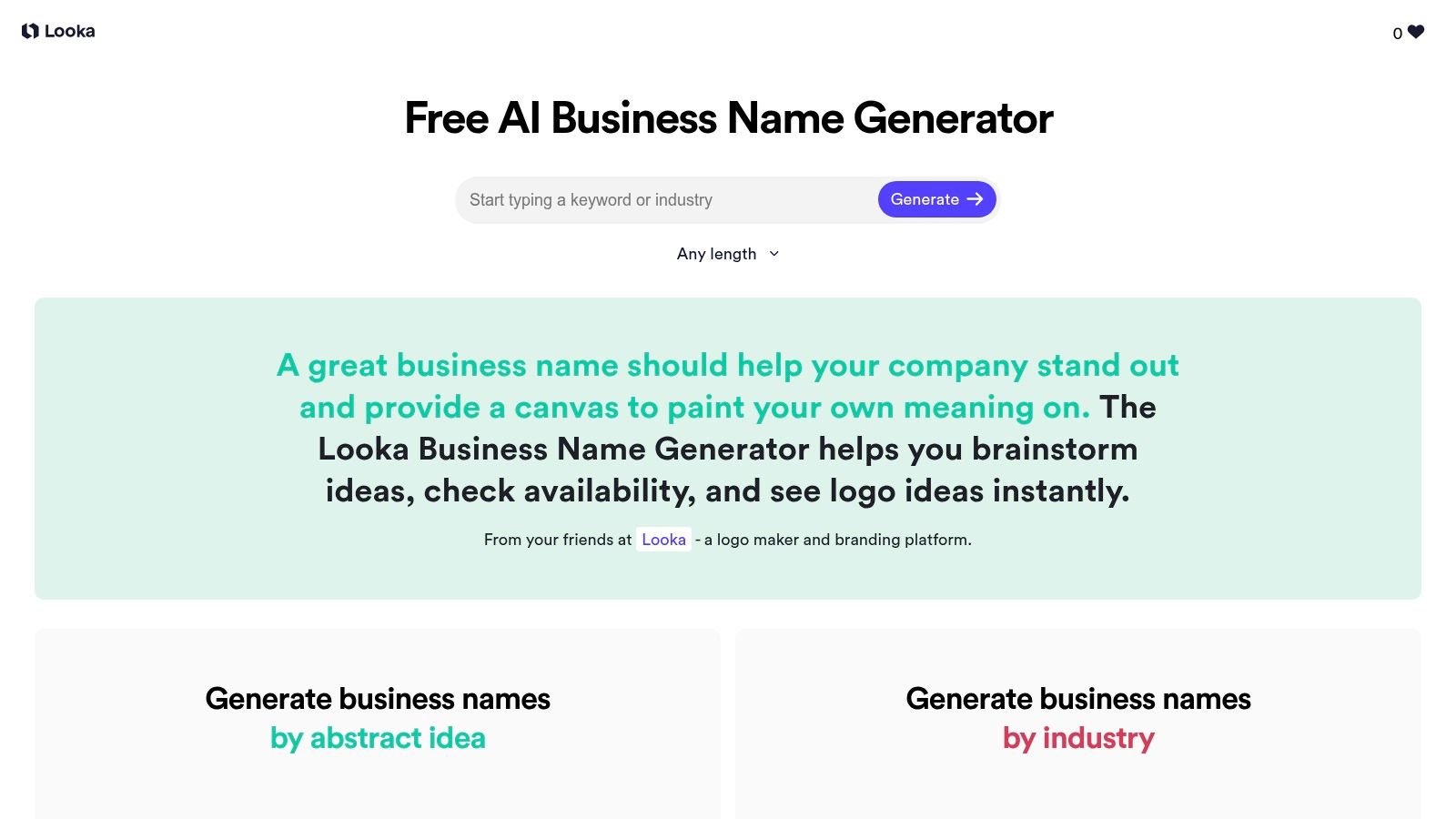
Looka sits in the middle of naming and branding, which makes it a natural pick when you already know the name should look good on a landing page and in a logo. The Looka Business Name Generator gives you real-time domain and social handle checks, plus a one-click path to logo previews and the rest of a Brand Kit. That matters if your app needs a clean visual identity immediately after naming.
Better for launch assets than pure naming
Looka is useful when a name can't be judged in isolation. Some names look fine as text but fall apart when you see them as a logo or app icon. Looka helps expose that quickly. The downside is that the polished output can make template-based branding feel more complete than it really is.
If your priority is to get a name, a logo, and a launchable identity in one sitting, this is a solid option. If your priority is deep naming originality, it's less compelling than tools that focus on exploration rather than visual packaging.
- Use it when: You need a name that can move directly into brand assets.
- Avoid it when: You want a long creative search with unusual naming styles.
- Remember: Paid assets are part of the path, so budget matters.
Looka is strongest for founders who are already thinking like operators, not just brainstormers. The brand kit workflow makes the name feel actionable, which is often what early-stage teams need.
5. DomainWheel Business and App Name Generator
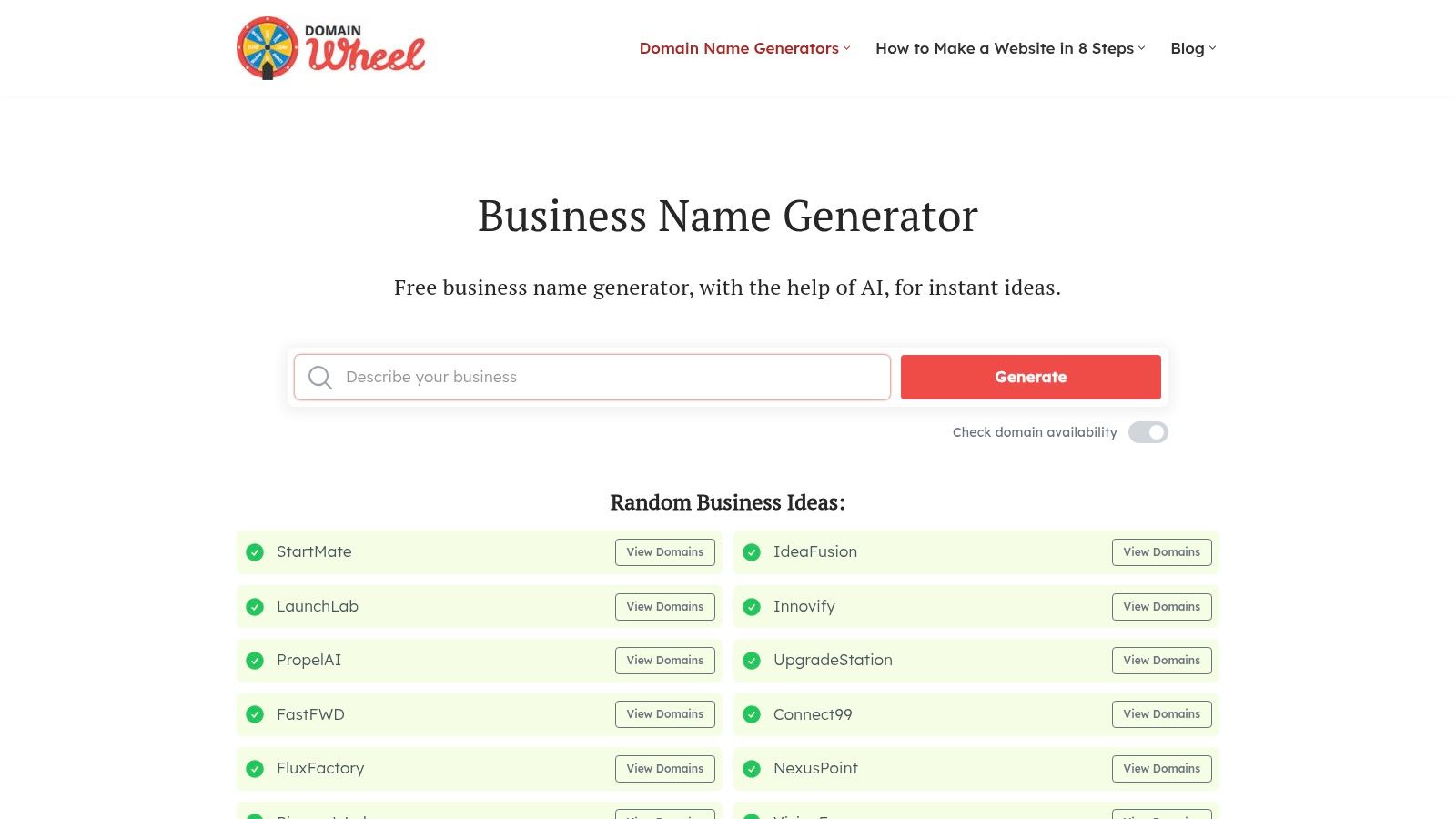
DomainWheel is the clearest domain-first tool in the group. It's built for founders who don't want to fall in love with names that fail the domain test later. The DomainWheel business name generator offers category-specific generators, including app naming, and checks .com, .io, and .ai availability as part of the workflow.
Good at filtering dead ends early
That's DomainWheel's main value. It keeps you from spending an hour brainstorming a name that's already dead on arrival because the obvious domain is gone. It also produces rhyme and sound-alike variants, which is useful when you're trying to preserve a core idea without copying the exact word.
The trade-off is creative range. Domain-first tools tend to push you toward keyword-plus-modifier structures, which can be useful, but not always memorable. They also won't help much with visual branding.
Best use case: shortlist names only after the domain layer has already done some of the elimination work.
For founders optimizing for speed and feasibility, DomainWheel is often the most practical middle step between raw AI output and the first serious shortlist.
6. NameSnack
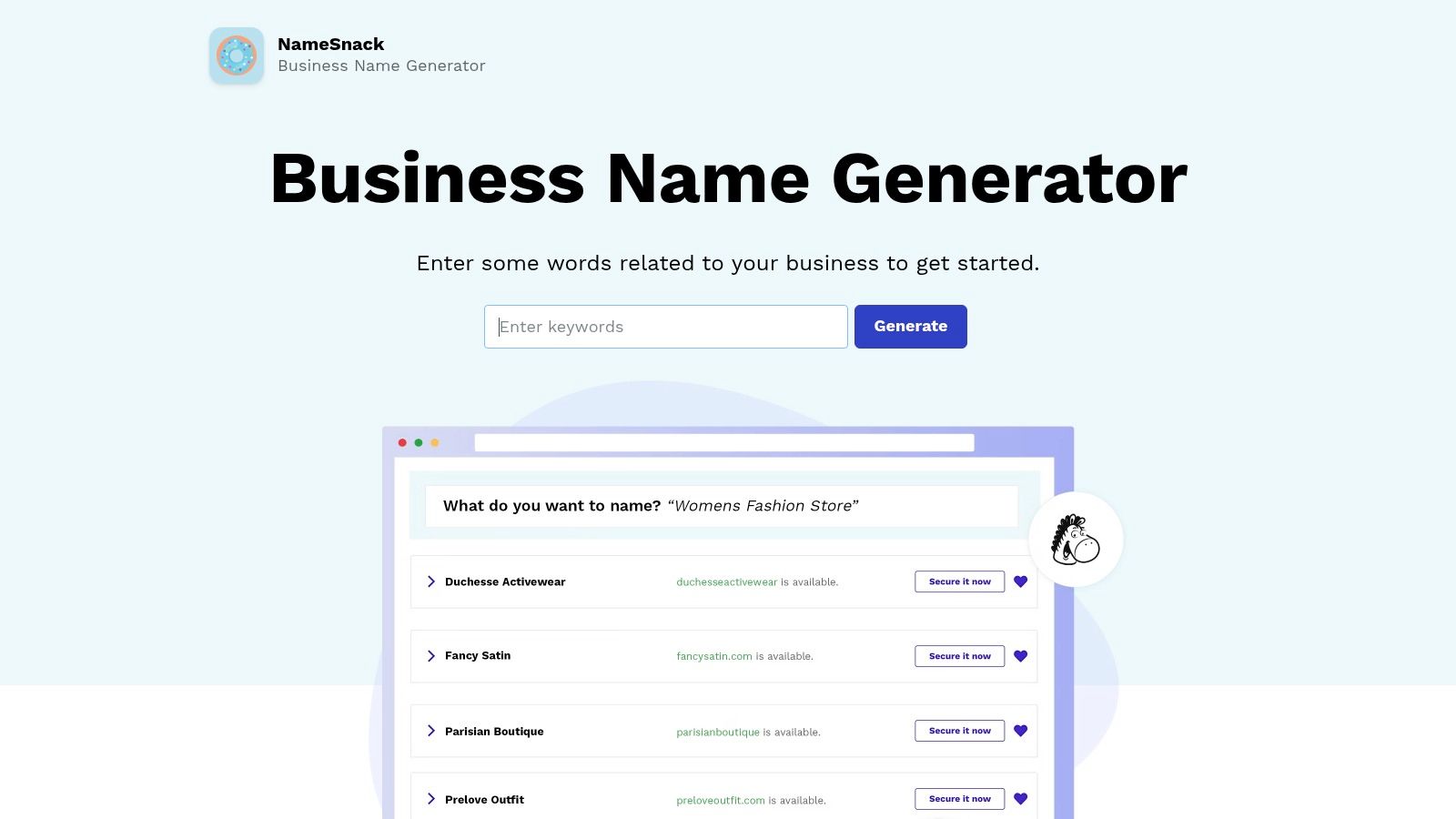
NameSnack is still one of the easiest places to start if you want a free, low-friction generator that doesn't make you think too hard about the interface. The NameSnack generator covers apps, websites, and products, and the domain checks help you quickly sort through what's usable. It's simple in a good way, which is why it still works for early-stage ideation.
Straightforward, but not deeply controlled
NameSnack is useful when you don't yet know what style of name you want. It gives you enough variation to spark ideas across different industries without forcing a long setup process. That said, it doesn't offer the same level of filtering or naming precision as more specialized tools, and it doesn't give you a built-in brand kit.
If you want a second opinion on a shortlist, Indie founders often pair it with the IndieTool name generator to compare a broader set of ideas before moving into domain checks. That combination works because NameSnack is good at breadth, while a second tool helps you test whether the same ideas keep resurfacing.
NameSnack is best as a quick first pass. It's not the tool you'd use to make the final decision, but it's often enough to uncover a direction worth pursuing.
7. Namify
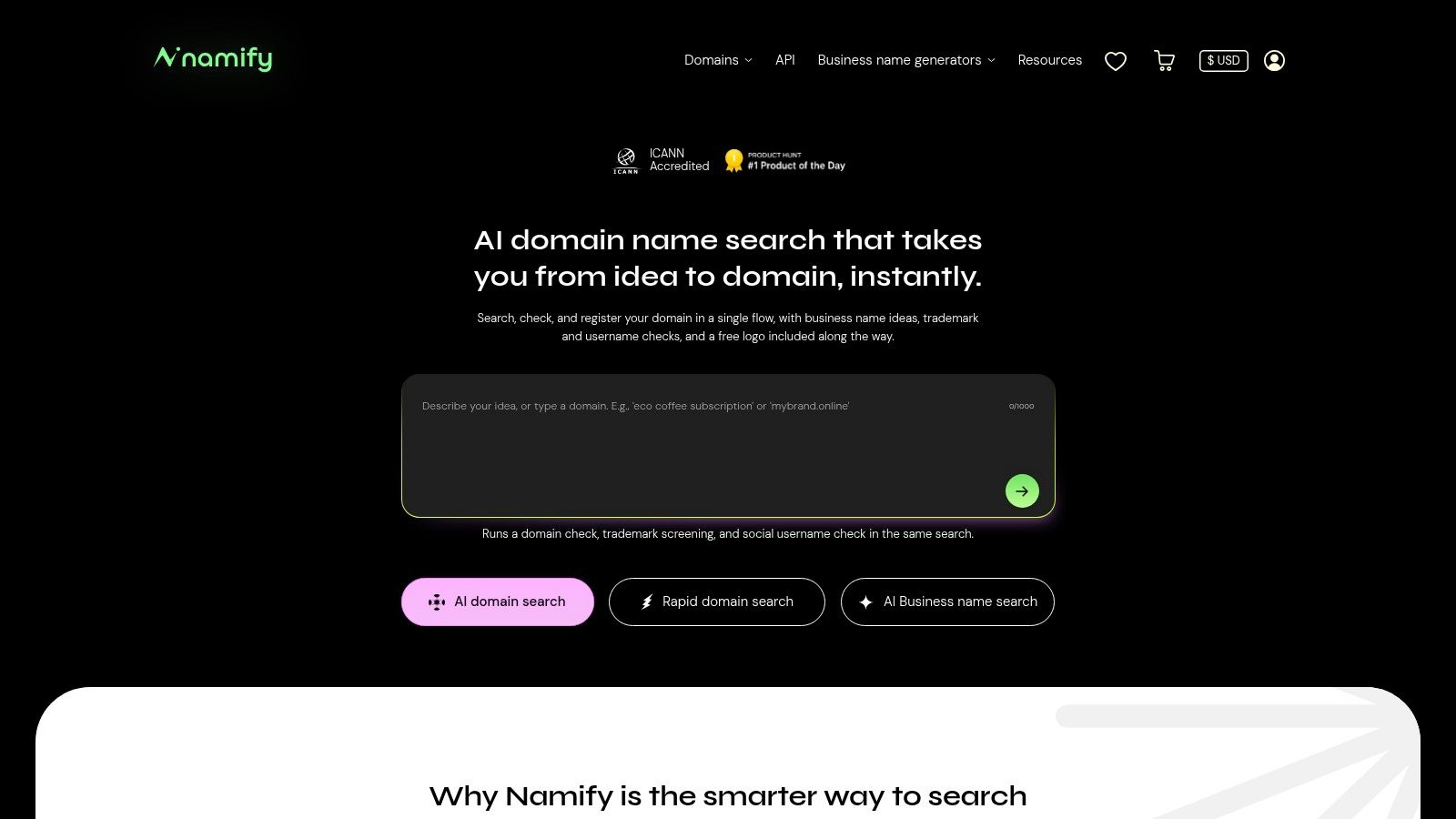
Namify is one of the more workflow-oriented tools here because it tries to connect naming with domain screening, username checks, and even a logo offer on select purchases. The Namify app name generator is useful if you want name ideas that already live inside a broader validation path instead of a purely creative sandbox.
Useful guardrails, not legal clearance
Namify's tone and category filters make it easier to steer output toward a specific brief. The built-in trademark and username screening is helpful as a rough signal, but it still isn't formal clearance. That distinction matters. A screening result can save time, but it shouldn't be treated like a legal opinion.
The platform is attractive for founders who want to move from naming to brand setup without stitching together five separate tools. The limitation is that some of the value is tied to specific domain purchases, so the fine print matters more than it does in a pure generator.
Treat the screening as an early warning system, not a final answer.
Namify works best when the name needs to be evaluated in a practical, launch-oriented way, especially if you want to reduce obvious collisions before you invest more time in design.
8. GoDaddy Business Name Generator
GoDaddy's generator is built for speed and follows the same pattern as the rest of GoDaddy's ecosystem, one click toward domains, then onward to logo and site setup. The GoDaddy Business Name Generator is a strong fit for founders who care less about creative exploration and more about getting a domain and a placeholder presence live fast.
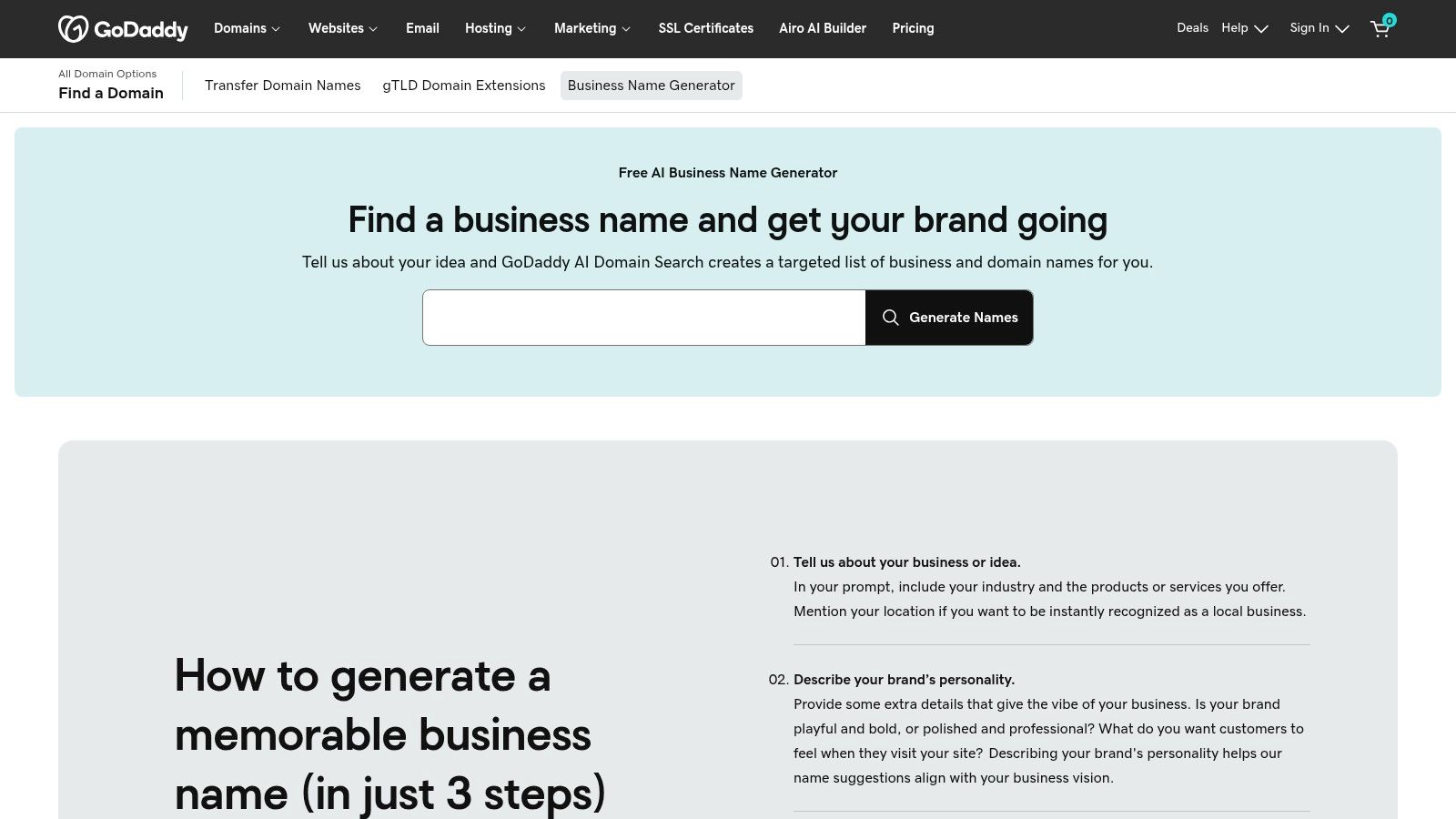
Best for same-day execution
This tool is good when momentum matters. If you already know the rough naming direction, GoDaddy helps you move from suggestion to purchase without much resistance. The downside is the same thing that makes it fast. It doesn't offer the richest creative control, and the surrounding upsells can make a simple naming task feel more expensive than expected.
For solo founders, that trade-off can still be worth it if the goal is to secure a domain and start shipping. For teams in a longer brand process, it's less compelling than a generator that supports more nuanced brainstorming.
- Fastest path: idea, domain, checkout.
- Weakest area: creative depth.
- Most useful when: the domain decision is already the bottleneck.
GoDaddy is less of a naming workshop and more of an execution lane. That's fine, as long as you know you're buying speed, not a well-developed naming strategy.
9. Namecheap Beast Mode
Namecheap's Beast Mode is built for people who want to hammer the availability problem until it gives up. The Namecheap Beast Mode domain and name generator supports filters for length, prefixes, suffixes, and excluded terms, which makes it especially helpful if you already have a naming pattern in mind and want to test it at scale.
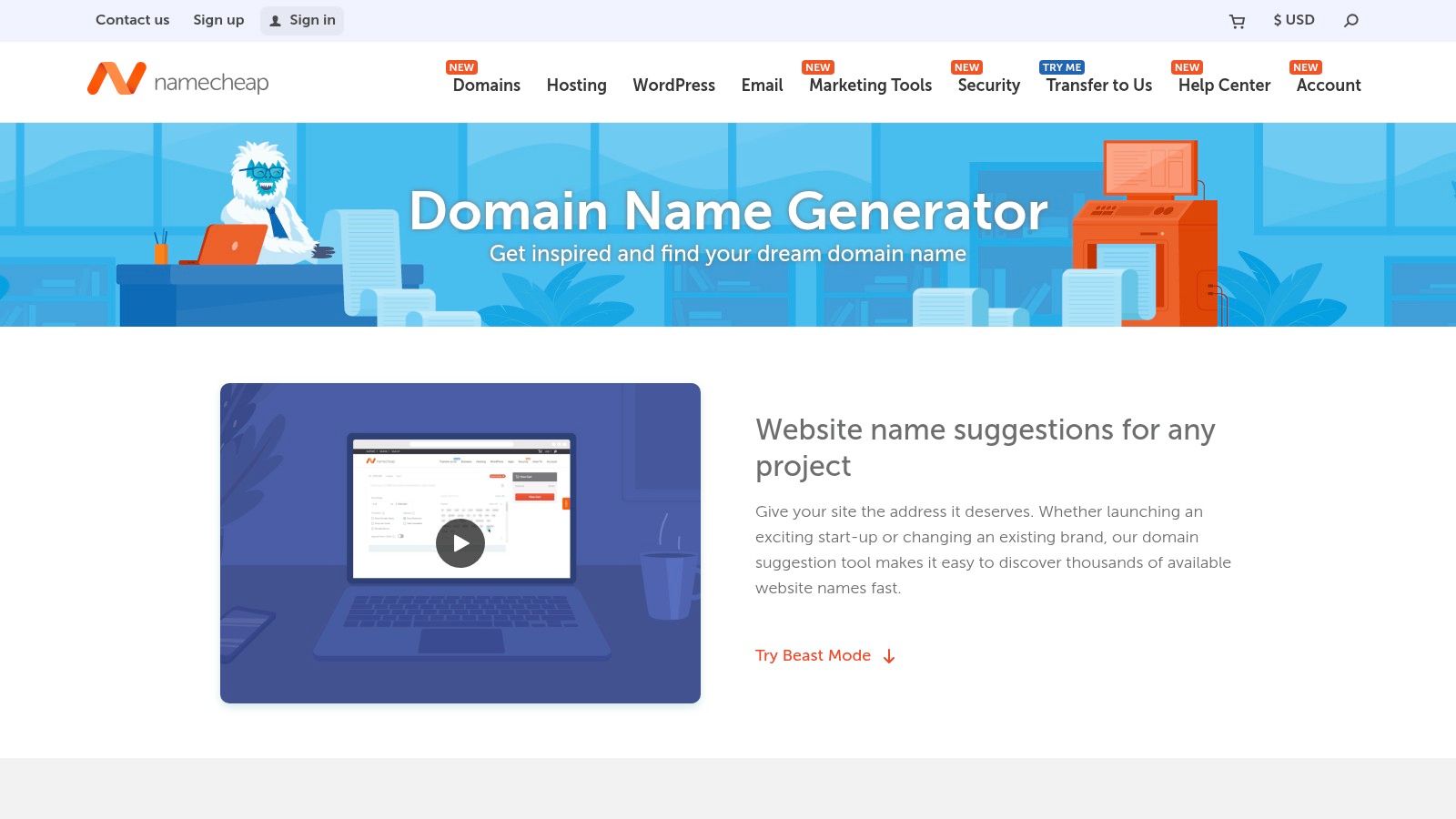
Availability-first is the whole point
Beast Mode is not trying to be poetic. It's trying to help you find something you can register. That makes it excellent for stress-testing permutations, but less useful if you're still in broad creative exploration. The interface also feels more utilitarian than the visually polished generators on this list.
The win here is efficiency. When you already have a few root words, Namecheap can quickly show you which directions still have life left in them. That's valuable because a pretty name that can't be registered is mostly wasted effort.
If you already know the semantic territory, Namecheap is one of the fastest ways to test the domain layer hard.
Use it after brainstorming, not before. It's a filter tool disguised as a generator, and that's exactly why it earns a spot in a serious naming workflow.
10. Copy.ai Company and App Name Generators
Copy.ai is strongest when naming sits next to positioning, taglines, and launch copy. The Copy.ai tools library includes dedicated name generators, so you can iterate on names while also shaping the message around them. That makes it useful for product marketers and founders who already use the platform for launch materials.
Better for messaging cohesion than domain work
The advantage is consistency. If you're trying to align a name with a slogan, feature description, or product narrative, Copy.ai keeps the work in one place. The downside is that it's less domain-centric than registrar tools, so you'll still need to check availability separately. The best filters and broader workspace features also sit behind paid plans, which changes the calculus for bootstrapped founders.
Copy.ai is a good fit when the question isn't just “What should we call it?” but “How should the name sound alongside the rest of the launch story?” That's a real distinction. A lot of naming tools stop at output, while this one helps you keep the naming decision inside a bigger content system.
For teams already writing product pages and ads, that integration can save time. For everyone else, it may be more tool than you need.
Top 10 AI App Name Generators, Comparison
| Tool | Core features ✨ | UX & Quality ★ | Pricing 💰 | Best for / Target 👥🏆 |
|---|---|---|---|---|
| Namelix (Brandmark) | ✨ Style/length filters, adaptive AI, instant logo previews | ★★★★ | 💰 Free (paid logos) | 👥 Indie founders wanting many brandable ideas quickly 🏆 |
| Atom (formerly Squadhelp) | ✨ AI generator + crowdsourced contests + screening workflows | ★★★★ | 💰 Freemium → paid contests & premium names | 👥 Teams needing human‑vetted names & marketplace access 🏆 |
| Shopify Business Name Generator | ✨ Fast AI names, domain/social guidance, e‑commerce tips | ★★★ | 💰 Free (Shopify tie‑ins) | 👥 Shopify sellers / ecommerce founders needing quick validation 🏆 |
| Looka – Business Name Generator | ✨ Name → instant logo → Brand Kit, domain/social checks | ★★★★ | 💰 Freemium; Brand Kit & downloads paid | 👥 Founders who want cohesive brand assets fast 🏆 |
| DomainWheel | ✨ Domain‑first workflow, rhyme/sound variants, 70+ generators | ★★★★ | 💰 Free (domains paid) | 👥 Domain‑focused founders prioritizing availability 🏆 |
| NameSnack | ✨ Quick multi‑category name suggestions + domain checks | ★★★ | 💰 Free (some premium features) | 👥 Beginners seeking fast, simple ideation 🏆 |
| Namify | ✨ Tone/category filters, trademark/username screening, 300+ TLDs | ★★★★ | 💰 Freemium; perks tied to domain purchases | 👥 Users wanting name → domain → basic branding workflow 🏆 |
| GoDaddy Business Name Generator | ✨ AI names + instant domain checkout + Airo integration | ★★★ | 💰 Free generator; upsells for domains & services | 👥 Founders needing same‑day domain + placeholder site 🏆 |
| Namecheap "Beast Mode" | ✨ Bulk name/domain permutations, advanced filters, TLD coverage | ★★★★ | 💰 Free tool (domains paid) | 👥 Power users stress‑testing availability at scale 🏆 |
| Copy.ai – Name Generators | ✨ Name + taglines/positioning in the same copy workspace | ★★★★ | 💰 Freemium; best features on paid plan | 👥 Founders who iterate names alongside launch copy & messaging 🏆 |
From Shortlist to Launch-Ready Name
The cleanest process is simple. Generate candidates in two or three tools, shortlist five to eight names, check domain and social handle availability, run a basic trademark search in the relevant national or regional database, and test the top options with a few target users before you commit. That sequence works better than trying to find one perfect generator, because no single tool handles ideation, availability, and risk screening equally well.
A useful prompt approach is to describe the core user action, the audience, and the tone, then ask for short, pronounceable names without hyphens. That tends to produce cleaner results than vague brand language. It also helps you compare tools on output quality rather than getting distracted by interface polish.
Use one generator for brainstorming and one domain-first tool for filtering. That's the practical split. AI output is useful, but it's still just the first filter, and it shouldn't be confused with clearance. The core job is to find a name that can survive search, speech, and a basic legal screen without forcing you into a rebrand two weeks later.
If you're ready to turn the naming process into something you can publish, test, and index, explore IndieTool for free naming utilities and a directory that helps indie products get discovered faster. It's a practical next step for founders who want more than brainstorming, they want launch traction, visibility, and a place to point people once the name is final.